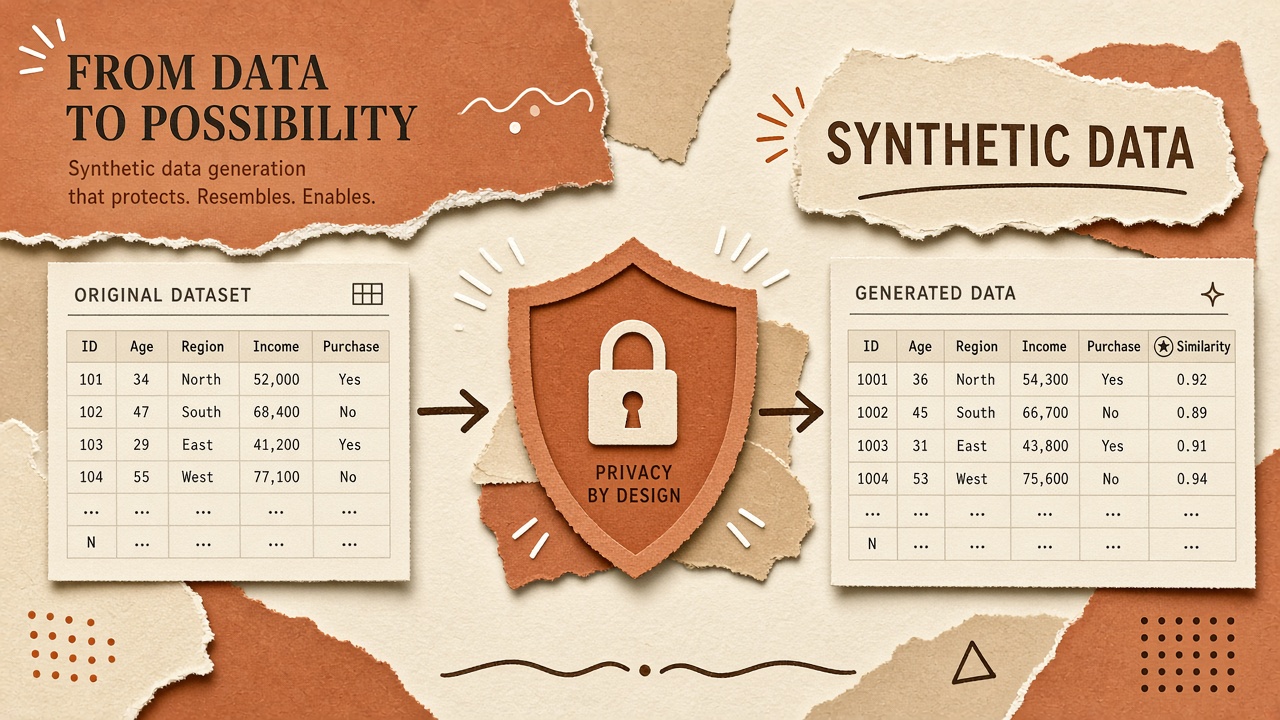
A hospital wants to train a triage classifier but cannot export real patient notes to a vendor GPU cluster. A fintech startup has twelve fraud examples and needs thousands of labeled transactions to test a model before launch. Synthetic data generation AI produces artificial examples that mimic real distributions without copying identifiable records. Synthetic data generation AI spans simulation engines, generative adversarial networks, and large language models that write labeled dialogue, code, or tabular rows on demand. Teams building AI code eval harnesses and AI transcription quality benchmarks increasingly rely on synthetic audio and text to supplement sparse production logs.
Why Teams Generate Synthetic Data
Synthetic data addresses scarcity, privacy constraints, class imbalance, and the need for edge-case coverage that real logs rarely capture. Regulated industries face GDPR, HIPAA, and PCI barriers to sharing raw training sets. Rare events (fraud, equipment failure) appear too infrequently in historical data for supervised learning. QA teams need reproducible test fixtures with known ground truth labels. Synthetic sets augment, not always replace, real data: models trained only on synthetic rows often fail on production drift unless validation proves fidelity.
Privacy marketing claims require scrutiny. Differential privacy noise, aggregation, and generation from statistical models reduce re-identification risk but do not guarantee zero leakage if generators overfit small real samples. Legal review should accompany any plan to publish synthetic derivatives of customer data.
Simulation, LLM, and GAN Methods
Method choice depends on modality: tabular business data often uses GAN or VAE generators; text and code use LLM prompt pipelines with schema constraints; audio and video use domain simulators or diffusion models. Physics-based simulation produces lidar scenes for autonomous driving. LLM generators write synthetic support tickets with labels for intent classification. GAN-based tabular synthesizers (CTGAN and successors) learn column correlations while aiming to hide individual real rows.
| Method family | Typical output | Main risk |
|---|---|---|
| Rule-based simulation | Structured logs, sensor traces | Unrealistic edge cases omitted |
| GAN / VAE tabular | CSV-like business records | Memorization on tiny seeds |
| LLM generation | Text, JSON, code pairs | Template repetition, bias echo |
| Audio synthesis | Speech with transcripts | Speaker diversity gaps |
Hybrid pipelines seed LLMs with statistical profiles from real data (column means, n-gram frequencies) without passing raw rows. For transcription testing, TTS plus background noise simulation creates audio suites covering accents and codecs. For code models, mutate real functions with semantic-preserving transforms to expand test coverage.
Validating Synthetic Dataset Quality
Validation compares synthetic sets to real holdouts on marginal distributions, correlation structure, downstream model performance, and privacy attack resistance. Statistical tests check whether synthetic columns preserve means, variances, and cross-column dependencies. Train-synthetic-test-real (TSTR) and train-real-test-synthetic (TRTS) protocols reveal whether models generalize across the boundary. Utility without privacy fails compliance; privacy without utility wastes engineering time.
Manual spot checks catch absurd LLM rows (negative ages, impossible dates). Deduplication against real training sets detects memorization. For text, embedding distance histograms between synthetic and real samples should overlap without synthetic points clustering exactly on known records. Document every validation metric in release notes when synthetic data ships to partners.
Golden set integration
Blend synthetic edge cases into golden evaluation sets with clear tags so regressions trace to artificial versus production-sourced examples. Synthetic cases excel at adversarial prompts and rare intent labels; real cases anchor realism. Version synthetic generators alongside model checkpoints.
Bias Risks and Representational Harm
Generators encode biases present in seed data, prompt wording, and vendor defaults, which can amplify skew when synthetic rows outnumber underrepresented groups in the final training mix. If seed fraud examples mostly mention one merchant category, LLM expansions may hallucinate that pattern as universal. Demographic attributes in synthetic patient narratives need ethicist review before clinical NLP training.
Mitigations include stratified generation quotas, bias benchmarks on synthetic outputs, diverse persona prompts, and human review slices for sensitive attributes. Never claim balanced representation because a generator produced ten thousand rows; measure label and attribute distributions explicitly. Public synthetic releases should document known limitations and prohibited use cases.
Auditor Documentation and Compliance
Auditors expect data lineage: which real samples (if any) informed generation, which model and version produced rows, validation metrics, and access controls on synthetic exports. Maintain a data card per synthetic release listing purpose, generation date, known failure modes, and retention policy. SOC2 and ISO reviews increasingly ask whether synthetic data still contains secrets; include penetration tests that attempt to reconstruct training records from released files.
| Document | Contents | Audience |
|---|---|---|
| Data card | Method, size, limitations | ML engineers, partners |
| Validation report | TSTR, privacy tests | Compliance, auditors |
| Lineage log | Seed policy, model version | Legal, security |
| Usage policy | Allowed environments | All recipients |
Synthetic Data in MLOps Workflows
Integrate synthetic generation into CI: regenerate test fixtures on schema changes, fail builds when validation metrics drop below thresholds, and store artifacts in versioned object storage. Pipelines should parameterize row counts, random seeds, and scenario tags (`fraud_ring`, `accent_au`) for reproducible debugging. Production monitoring compares live traffic drift to synthetic scenario catalogs; gaps trigger new generation sprints.
Vendor platforms (Gretel, Mostly AI, Tonic, cloud synthetic data services) offer GUIs and APIs; in-house LLM pipelines offer flexibility for niche text tasks. Cost includes generator compute, curator review, and storage, often cheaper than months of legal negotiation for raw data sharing, but not free.
Privacy-Enhancing Technologies
Differential privacy adds calibrated noise during aggregation or generation so individual records cannot be reconstructed with high confidence. Federated learning trains on device without centralizing raw data, sometimes paired with synthetic export of learned statistics only. Homomorphic encryption remains expensive for large-scale generation but appears in niche financial collaborations. Match the PET to threat model: internal dev sandboxes face different rules than sharing synthetic files with external researchers.
Membership inference attacks test whether a specific real record was in the training set for the generator. Run these before external distribution. Document negative results with methodology, not just "we tried and it seemed fine."
Industry Examples
Automotive teams synthesize rare pedestrian scenarios; banks generate fraudulent transaction patterns for AML model tests; healthcare researchers create synthetic cohorts for algorithm papers when IRB approval for raw charts is slow. Each domain applies domain-specific validators: physics plausibility for lidar, regulatory transaction limits for wire transfers, clinical code validity for diagnosis labels. Copying another industry's synthetic playbook without domain validators invites silent failures.
When Not to Use Synthetic Data
Avoid synthetic-only training for safety-critical perception systems, high-stakes medical diagnosis, or any task where rare real tail events dominate risk unless experts validate exhaustive simulation coverage. Regulatory submissions may reject synthetic-heavy evidence. Prefer real anonymized cohorts when available and synthetic augmentation for balance and privacy-safe dev environments.
Cost-Benefit of Synthetic Pipelines
Compare synthetic pipeline cost (generation, validation, curation, storage) against legal review cycles for real data sharing and opportunity cost of delayed model launch. Small teams with public benchmark tasks may download existing synthetic sets; regulated enterprises often build custom pipelines despite six-figure year-one investment because breach liability dominates. Reuse generators across projects once validation frameworks exist; amortize ontology and persona libraries across multiple models.
Frequently Asked Questions
Can synthetic data replace real data entirely?
Rarely for production models; synthetic data best augments real samples and powers testing when real data cannot leave secure environments. Always validate on held-out real data before launch.
Is synthetic data automatically GDPR safe?
No automatic safe harbor; regulators assess re-identification risk case by case. Document generation method, perform membership inference tests, and consult legal counsel.
Are LLM-generated datasets high quality?
Quality varies with prompts, diversity controls, and validation; LLM outputs can be repetitive or factually wrong for domain facts. Human review and automated filters improve reliability.
How is synthetic data used for speech models?
TTS-generated utterances with varied speakers and noise conditions supplement real recordings for robustness testing and partial fine-tuning. Accent and dialect coverage still needs deliberate scenario design.
Should we buy or build synthetic data tools?
Buy when you need tabular privacy guarantees and compliance documentation out of the box; build when you need bespoke text or code scenarios tightly coupled to internal schemas. Hybrid approaches use vendor tabular synthesis plus in-house LLM prompt libraries for unstructured modalities.
Releasing Synthetic Datasets Externally
Public synthetic releases need licenses, prohibited-use clauses, and contact for vulnerability reports if reconstruction attacks succeed. Version datasets semantically (`v1.2.0`) and publish changelogs when validation methodology improves. Partners should sign data use agreements even when no real rows ship, because synthetic distributions may still encode business strategy signals.
Synthetic Data Maturity Model
Level 1 ad hoc LLM prompts for test fixtures; Level 2 scripted generators with version control; Level 3 automated validation gates in CI; Level 4 enterprise catalog with auditor-ready data cards and privacy attack suites. Regulated teams should not share synthetic exports externally before Level 3 validation exists. Document who may request new synthetic scenarios and expected turnaround from data engineering.
Synthetic Data for Red Team Testing
Security teams generate adversarial prompts, phishing templates, and malformed API payloads synthetically to stress-test classifiers and guardrails without sourcing dangerous content from the dark web. Label expected block or allow outcomes explicitly. Rotate scenarios monthly so models do not overfit a static red-team list. Pair synthetic attacks with real incident postmortems when available.
Combining Synthetic and Real in Training
Curriculum mixing strategies start models on abundant synthetic easy cases, then fine-tune on smaller real sets to anchor realism. Track per-source loss to detect when synthetic batches dominate and hurt real-world F1. Some teams oversample rare synthetic fraud rows; monitor precision on live traffic so false positives do not overwhelm investigators. Rebalance when production metrics diverge from lab metrics.
Conclusion
Synthetic data generation AI explained: create labeled artificial examples via simulation, GANs, or LLMs when real data is scarce, imbalanced, or locked behind privacy walls. Validate utility and privacy, document lineage for auditors, and monitor bias before blending synthetic rows into training or evaluation. Used with discipline, synthetic data accelerates code and speech ML workflows without exposing production secrets; used carelessly, it breeds confident models that fail on live inputs.
Treat synthetic releases like software versions: changelog, rollback plan, and owners on call when a partner reports reconstruction risk. The teams that benefit most pair generation tooling with skeptical validation culture, not with slide decks that call synthetic data a magic privacy shield. Schedule annual re-validation when source populations shift; synthetic sets trained on 2024 demographics may misrepresent 2026 customers even if no real rows ever leaked. Keep a running registry of which production models consumed which synthetic snapshot so rollback and forensic analysis stay possible after a bad deploy. Without that registry, synthetic data becomes a liability instead of an accelerator. Procurement teams should demand validation reports before approving vendor synthetic bundles.