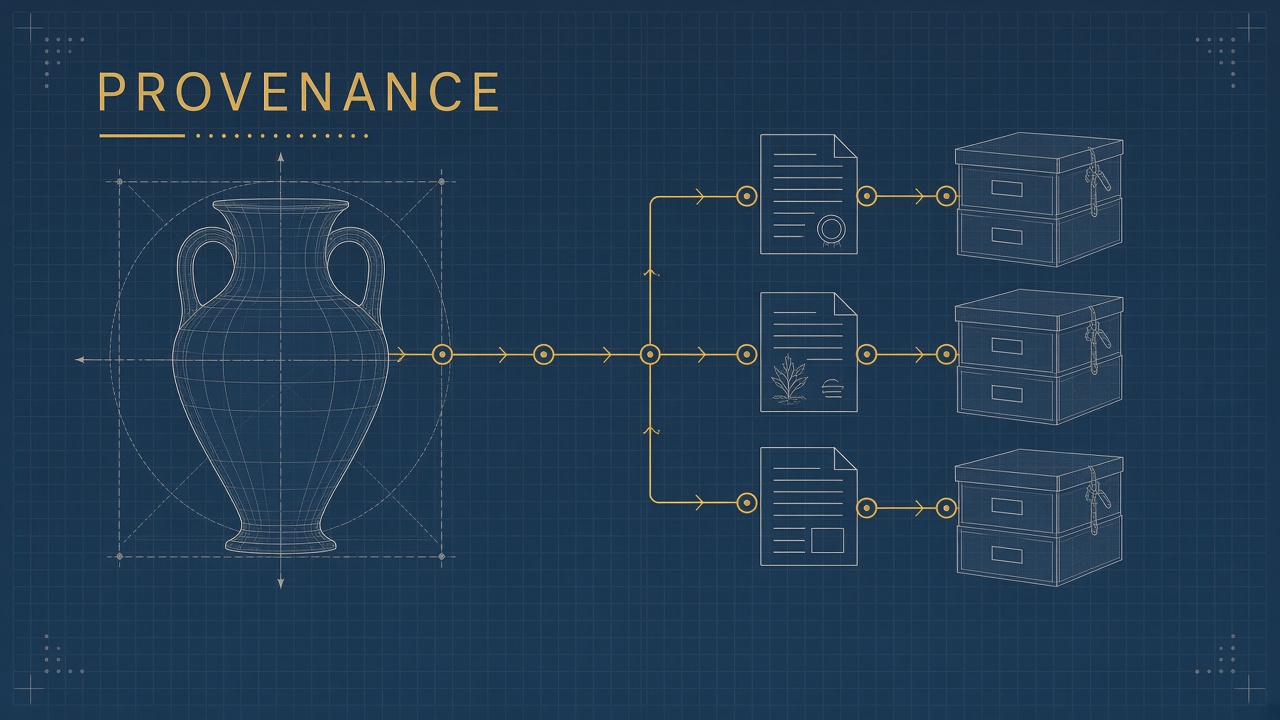
Museums hold millions of objects whose paths from source communities to display cases remain incomplete. A mask may list only "collected in the early twentieth century." A bronze may omit the punitive expedition that seized it. Provenance research, the disciplined tracing of ownership and custody, is slow because evidence scatters across auction catalogs, colonial administration files, dealer ledgers, and field diaries written in multiple languages.
AI cultural heritage provenance tools apply natural language processing, entity extraction, and knowledge graphs to surface leads at scale. Projects such as the European RITHMS initiative fine-tune named entity recognition on museum-standard provenance text. The Dutch Colonial Collections Data Hub publishes linked open data with acquisition and transfer-of-custody events. These systems assist human experts and claimant communities; they do not replace legal judgment or restorative negotiations. This article maps provenance gaps, NLP on sales catalogs, expedition linkage, repatriation ethics, and museum transparency for teams evaluating AI research tools. Compare vendors via popular AI tools only after defining audit requirements for colonial collections.
Why Provenance Gaps Block Repatriation
Repatriation claims need documented chains of custody showing how an object left a community and entered a museum; absent records, institutions default to retention. Colonial acquisitions often mixed gift, purchase, salvage, and coercive taking without consistent paperwork. Index cards converted into museum databases lost nuance. Generations of curatorial shorthand ("said to be from Benin") cannot satisfy modern ethical and legal scrutiny from source nations and descendant groups.
The 2022 Smithsonian policy on ethical returns and growing bilateral agreements with African nations illustrate institutional shift toward transparency. Yet each case still demands archival labor: matching object descriptions to expedition dates, correlating dealer stock numbers with shipping manifests, identifying intermediaries who profited from conflict looting. Manual review across siloed catalogs does not scale to collection size.
Provenance linked open data initiatives treat each acquisition as an event with actors, places, and legal instruments rather than a single prose paragraph. That shift enables graph queries impossible in legacy relational schemas designed for inventory control. AI extraction accelerates conversion of legacy text into event graphs, but curators must validate uncertain edges before they influence repatriation negotiations watched by press and parliaments.
NLP on Auction and Sales Catalogs
Named entity recognition and relation extraction can pull collectors, dealers, sale dates, and lot descriptions from digitized auction catalogs into structured graphs. Provenance paragraphs follow recurring conventions (owner name, sale house, date, lot number), which makes them more tractable for machine learning than free-form object descriptions. RITHMS evaluations show transformer models fine-tuned on North American museum provenance outperform zero-shot baselines on entity boundaries.
| Source type | NLP task | Repatriation value |
|---|---|---|
| Auction catalogs (Christie's, Sotheby's archives) | Lot parsing, price, buyer inference | Links museum accession to market event |
| Colonial administration reports | Place and officer entity linking | Connects seizures to specific campaigns |
| Dealer correspondence | Coreference across letters | Reveals knowingly incomplete provenance |
| Museum TMS exports | CIDOC-CRM event normalization | Surfaces missing acquisition events |
| Field photography albums | Caption OCR plus vision alignment | Places object at documented site |
Retrieval-augmented generation (RAG) lets researchers ask natural-language questions ("Which Benin bronzes passed through dealer X before 1910?") with citations to source pages. Hallucination risk means every machine summary requires archivist verification before legal filings.
Digitization quality matters: nineteenth-century auction catalogs scanned at low resolution defeat OCR and cascade into entity extraction errors. Investment in imaging standards and manual transcription of high-value volumes often returns more repatriation leads than premature model deployment on garbage text. Pair NLP with traditional provenance research methods taught in museum studies programs: archival correspondence, shipping insurance records, and oral history from descendant communities who remember family heirlooms lost during occupation.
Linking Objects to Expeditions
Knowledge graphs that join collector biographies, military campaigns, and object metadata expose patterns invisible in single-institution databases. Colonial Collections research links Wereldmuseum records with biography graphs to mine acquisition modes. Pattern mining can flag clusters of objects acquired after punitive raids rather than documented purchases.
Computer vision can match sculptural features or inscription styles across photographs taken before removal and catalog photos today. Multimodal pipelines remain experimental but promising for cases where textual provenance was never recorded. Expedition maps georeferenced with GIS layers help claimant communities connect objects to ancestral sites.
Legal and Ethical Repatriation Frames
AI-generated leads inform claims under national restitution laws, UNESCO frameworks, and institutional policies; they do not substitute for community authority over sacred and patrimonial objects. Nigeria's negotiations for Benin bronzes, Greece's long-standing Parthenon sculptures dialogue, and Native American Graves Protection and Repatriation Act (NAGPRA) processes in the United States each combine legal hooks with moral arguments. Document discovery accelerates cases but must be shared with claimant representatives, not hoarded as institutional advantage.
Ethical use requires acknowledging biased colonial records that mislabel looting as collecting. Models trained only on Western museum text may reproduce those framings. Involve source-community researchers in labeling training data and interpreting outputs. Open publication of provenance linked open data (PLOD) supports independent verification.
RAG and Auction Archive Search
Retrieval systems tuned on auction house archives let curators query decades of sales in natural language while retaining page citations for evidentiary chains. Combine RAG with entity normalization so "J. P. Morgan" variants link to one authority record. Test retrieval on held-out catalogs where human experts already know ground-truth provenance to measure precision before deploying in live restitution research.
Museum Transparency and Public Databases
Public SPARQL endpoints and downloadable datasets let journalists, scholars, and diaspora communities audit holdings without FOIA delays. The Colonial Collections Hub exposes tens of millions of RDF statements combining object metadata with external thesauri. Provenance enrichment pipelines should log machine confidence and human curator overrides so later researchers see which fields were AI-suggested.
Transparency also means publishing negative results: objects investigated with no definitive colonial seizure proof. That honesty builds trust faster than defensive retention narratives. Dashboards for AI research teams should track restitution-ready cases separately from research-only enrichments.
Human-in-the-Loop Review Standards
Machine-extracted provenance chains require curator sign-off before they enter restitution briefs or public collection databases. RITHMS researchers note that descriptive object paragraphs full of non-essential adjectives degrade NER performance compared with standardized provenance blocks. Train separate models or prompts for each text genre rather than one pipeline for all catalog fields.
Establish confidence thresholds: auto-accept only high-precision entity types (dates, auction house names), route ambiguous collector aliases to human disambiguation queues, and never auto-merge objects across institutions without expert review of visual and material evidence. Document every AI suggestion in audit logs for accountability when claimants challenge conclusions.
Claimant and Community Partnership
Provenance AI delivers ethical value when source communities co-own questions, not only answers. Colonial record biases may label punitive seizures as "gifts." Community historians can flag training labels, correct place names in indigenous languages, and prioritize object classes with spiritual sensitivity. Data sharing agreements should allow claimant nations API access to linked data about their patrimony without forcing them to re-digitize records Western museums already hold.
Repatriation is not only return of objects. It includes shared digital heritage, capacity building for local archive systems, and acknowledgment in exhibition text. AI accelerates document discovery; relationship repair still happens in rooms, not servers.
Implementation Checklist for Institutions
- Export TMS or collection management data to CIDOC-CRM aligned linked data.
- Digitize priority auction and colonial archives with OCR quality control.
- Fine-tune NER on institution-specific provenance paragraphs.
- Build knowledge graph with acquisition and custody events as first-class nodes.
- Run pattern detection for anomalous acquisition spikes after military dates.
- Review all high-confidence chains with provenance staff and external partners.
- Publish citable URIs for objects and events used in repatriation dialogues.
Parthenon, Africa, and High-Profile Cases
High-profile repatriation disputes illustrate how document discovery changes negotiating positions even when legal title remains contested. Greek advocates for Parthenon sculptures continue to cite historical export records and parliamentary debates from the early nineteenth century. Nigerian and Beninese delegations reference British punitive expeditions documented in colonial office files now digitized for NLP search. AI does not resolve sovereignty questions; it surfaces primary sources both sides must address. African Union frameworks on cultural restitution increasingly expect museums to demonstrate proactive provenance research rather than waiting for formal claims. Documentary filmmakers now cross-reference auction OCR output with survivor testimony, creating public pressure that complements formal government-to-government negotiations.
Cross-Institutional Collaboration
Looted objects often moved through networks spanning multiple museums, dealers, and private collectors; provenance AI succeeds when institutions share entity identifiers rather than hoarding extraction results. International Research on Holocaust-era assets demonstrated decades ago that linked catalogs accelerate claims. Colonial collections require the same solidarity without repeating extractive dynamics: data reciprocity, shared APIs, and joint publications crediting source-nation researchers. Federated learning on sensitive records may allow model improvement without centralizing culturally restricted metadata. Journalists and documentary filmmakers increasingly query public SPARQL endpoints; curators should prepare plain-language summaries alongside technical graphs so repatriation evidence reaches audiences beyond specialist researchers. Training workshops for museum registrars should include hands-on review of false-positive entity matches so staff trust but verify machine suggestions during daily cataloging work, not only during headline restitution cases.
Frequently Asked Questions
Does AI change the Parthenon sculptures debate?
AI does not alter legal title arguments between Greece and the British Museum. It can accelerate discovery of nineteenth-century export documentation and dealer correspondence that inform public and diplomatic discourse.
How is AI used in African restitution cases?
Researchers cross-reference museum accession dates with colonial military records and auction sales of Benin, Asante, and other regalia. Machine extraction helps prioritize objects with strongest documentary links to coercive taking.
Which public databases should researchers know?
Colonial Collections Data Hub (Netherlands), Smithsonian open data initiatives, and museum-specific linked open data releases. Always note dataset version because colonial heritage graphs update during active projects.
Can AI decide ownership?
No. Courts, treaties, communities, and museums decide outcomes. AI supplies searchable evidence and hypothesis generation subject to expert validation.
How do teams manage LLM hallucination?
Require page-level citations, ban unsourced prose in claim documents, and keep human provenance specialists as final editors for any text entering official filings.
Does this apply to Nazi-era looted art?
Yes. Similar NLP pipelines target WWII-era gaps and stolen art databases in Romania and Poland within RITHMS case studies. Ethical framing differs but technical methods overlap.
What staffing does provenance AI require?
Expect a mixed team: digital archivist, data engineer, provenance specialist, and community liaison. NLP reduces search time but increases need for validation workflows. Budget for sustained curation, not one-time software purchase.
Should museums use open or closed AI models?
Open models allow inspection and on-premise hosting for sensitive colonial records. Closed APIs may offer accuracy advantages but complicate long-term reproducibility. Many institutions run hybrid stacks with open NER and commercial OCR.
Does better provenance change exhibitions?
Transparent provenance supports honest labeling, rotation of sensitive objects, and co-curated narratives with source communities. AI does not dictate display decisions but supplies evidence for them.