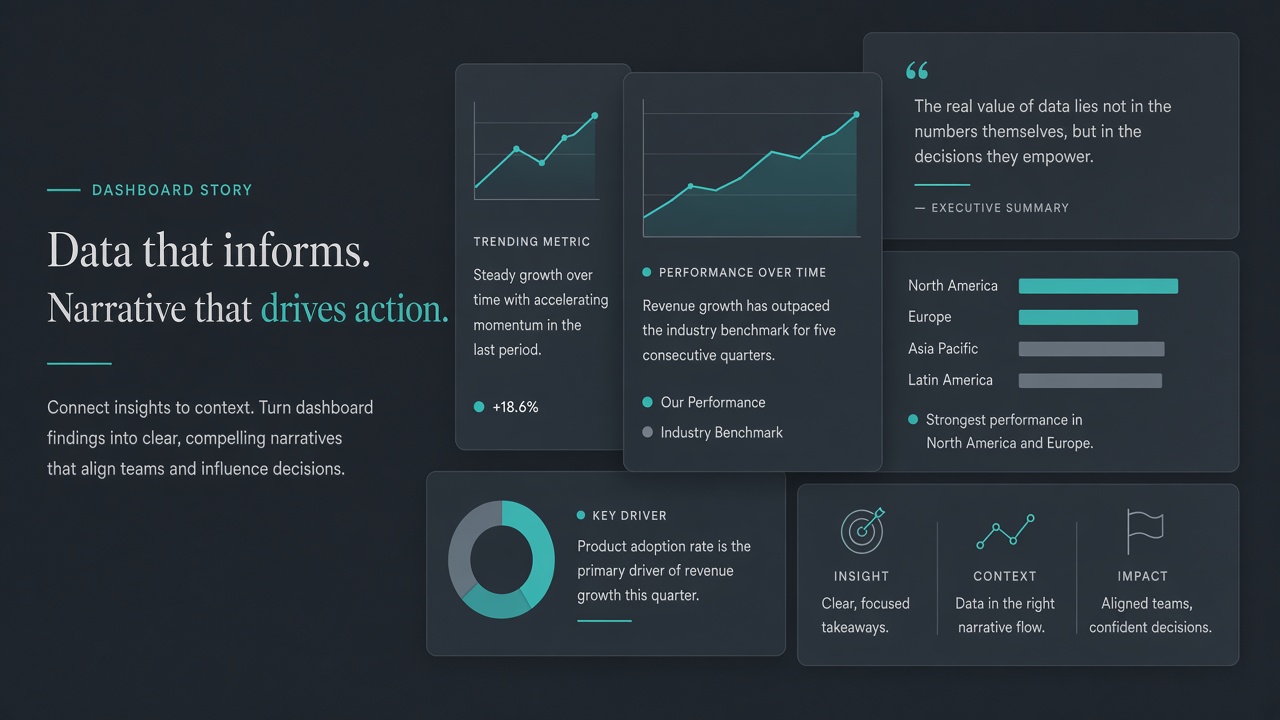
Dashboards show green and red arrows while executives ask what changed and why. BI analysts spend Monday mornings rewriting the same week-over-week commentary in Slack threads and email digests.
An AI workflow for BI analyst narratives snapshots KPI exports, drafts week-over-week commentary, validates every claim against fixed metric definitions, and publishes through approved Slack or email channels. Metric definitions are source of truth; AI narrates, it does not redefine measures. Connect SQL prep to AI code assistants and distribution automation to AI coding tools for digest templates, not for changing warehouse logic without review.
Snapshot KPI Exports
Export a frozen KPI snapshot with period labels, segment filters, and metric version IDs before any narrative draft begins. AI commentary without frozen data invents trends. Analysts store exports in a dated folder or object store path referenced in the published narrative.
- Include week ending date, timezone, and comparison period (WoW, MoM, YoY).
- Attach segment definitions: region, product line, customer tier.
- Export metric values and deltas, not only dashboard screenshots.
- Note data freshness: ETL completion time and known pipeline delays.
- Flag incomplete days from holidays or outages in the export header.
| Export field | Why it matters | Owner |
|---|---|---|
| Metric definition ID | Links narrative to canonical logic | Analytics engineering |
| Filter set JSON | Reproduces dashboard slice | BI analyst |
| Prior period values | Validates delta math | BI analyst |
| Data quality flag | Prevents false anomaly stories | Data platform on-call |
Export Automation
Schedule snapshot jobs after ETL success signals, not fixed clock time that races pipelines. Code assistants help draft SQL or Python export scripts; analytics engineering reviews before production cron registration.
Draft Week-Over-Week Narratives
Prompt AI with the frozen export and a narrative template: headline, three key movements, plausible drivers, and recommended follow-up questions. BI analysts edit for business context models lack, such as promotions, pricing changes, or sales cycle effects.
- Headline: one sentence with direction and magnitude for the primary KPI.
- Movements: bullet top three metrics with signed deltas from export only.
- Drivers: hypothesis language unless validated by downstream analysis.
- Caveats: data delays, definition changes, or sample size warnings.
- Links: dashboard URL with encoded filters matching the export.
Narrative Tone Standards
Use neutral precision: "revenue increased 4.2 percent WoW" not "revenue soared." AI defaults to hype. Analysts strip causal claims unless supported by attributed analysis. Separate facts from hypotheses with explicit labels.
Validate Against Metric Definitions
Every number in the narrative must match the export and the published metric definition catalog; analysts reject drafts that recompute percentages or rename metrics. Definition changes require a version bump and narrative footnote, not silent AI paraphrase.
| Validation check | Pass criteria | Fail action |
|---|---|---|
| Arithmetic | Deltas match export cells | Rewrite; log prompt issue |
| Definition | Metric names match catalog | Replace term; notify data steward |
| Segment | Filters match dashboard link | Fix URL encoding |
| Anomaly | Flagged spikes cross threshold | Escalate to deep dive ticket |
Maintain a single metric dictionary BI and AI prompts reference. Coding tools can lint narrative drafts against CSV exports programmatically; human sign-off remains required before publish.
Definition Change Process
When analytics engineering ships a definition change, pause AI narratives until exports use the new version ID and a one-time explainer paragraph is approved. Mixed-version weeks confuse executives more than no narrative.
Publish to Slack or Email Digest
Publish validated narratives to approved Slack channels or email digests with dashboard links, export hash, and analyst attribution. Do not paste narratives into channels with external guests unless classification allows.
- Slack: pin weekly post; thread deep dives; use block kit for metric tables when helpful.
- Email: plain text plus link for accessibility; attach PDF only when policy requires.
- Schedule: consistent send time after validation window closes.
- Archive: store narrative text with export path for audit questions.
- Feedback: emoji or reply taxonomy for "needs driver analysis" requests.
Digest Template Governance
Version digest templates in Git; AI prompts reference template ID so format stays consistent quarter to quarter. Marketing-style redesigns of digests require executive comms approval, not analyst preference alone.
Anomaly Escalation Path
When exports cross anomaly thresholds, narratives switch to alert mode: fact, impact, known causes, open investigation owner. AI must not speculate on root cause for revenue or safety metrics. Open a tracking ticket linked from the Slack post.
Self-Serve Boundaries
Narratives point executives to self-serve dashboards for drill-down but restate filter instructions so mis-filtered exploration does not spread. Train recipients on metric dictionary links embedded in every digest.
Segment Owner Feedback Loop
When narratives cite regional or product segment movements, segment owners confirm or reject driver hypotheses before the digest sends. AI drafts driver bullets as hypotheses; owners reply with structured comments in the review doc. Published narratives label confirmed drivers separately from open questions.
Holiday and Seasonality Adjustments
Apply seasonality notes to narrative templates during retail peaks, fiscal close, or known slow weeks. AI otherwise interprets expected dips as crises. Maintain a calendar of annotated periods referenced in export headers and prompt context.
Narrative Archive and Audit
Store each published narrative with export hash, approver name, and dashboard link in a searchable archive for finance or board follow-up questions. Auditors ask what executives knew and when; archives answer without reconstructing Slack history.
Prompt Library Governance
Centralize narrative prompts in a versioned repository; when KPI sets change, update prompts and revalidate sample weeks before production use. Analysts fork prompts per executive audience when detail level differs, not per analyst preference alone.
Executive Dashboard Pairing
Each recurring narrative maps to one primary dashboard URL with saved filters; analysts reject digests that reference metrics spread across unrelated views. When executives request new cuts, open a backlog item to add exports rather than improvising numbers in Slack replies outside the validated workflow.
Cross-Functional Metric Ownership
Data stewards own metric definitions; BI analysts own narrative accuracy; business owners own driver confirmation. RACI clarity prevents AI drafts from assigning blame or credit without owner input. Quarterly steward reviews update the dictionary before narrative templates reference deprecated fields.
Digest Accessibility
Email digests use semantic headings and tables with header rows so screen readers parse weekly movements. Slack posts include alt text when images of charts are attached. AI-generated chart descriptions need analyst verification against the underlying export values.
On-Call Handoff for Data Incidents
When pipelines fail mid-week, on-call engineers post status to the narrative review channel before analysts draft commentary. Narratives during incidents state known data gaps explicitly rather than omitting metrics silently. Resume standard narrative tone only after exports return to green status in the monitoring dashboard.
Frequently Asked Questions
How do narratives coexist with self-serve BI?
Narratives highlight what changed and what deserves attention; self-serve BI answers follow-up questions with the same metric definitions. Without narratives, executives misread vanity movements. Without self-serve, analysts become bottlenecks. Link both in every publish.
What should analysts do when AI flags a false anomaly?
Correct the narrative, document the data quality issue, and notify platform owners if pipelines caused the spike. Retract Slack posts when errors reached executives. Tune anomaly thresholds after repeated false positives. AI sensitivity settings belong in runbooks, not ad hoc prompt tweaks alone.
Can AI add forecasts to weekly narratives?
Forecasts belong in separate models with named owners; weekly operational narratives should stick to realized data unless leadership requests forecast sections. Mixing forecast and actuals without labels violates trust. If included, cite model version and confidence intervals from official forecasting tools.
Who approves narratives before send?
BI analyst signs standard digests; analytics manager signs alert-mode posts affecting external communications or executive all-hands. AI never sends autonomously in this workflow. Approval timestamps live in the archive folder.
Trusted Numbers, Clear Stories
BI analysts save time when AI drafts week-over-week narratives from frozen exports while metric definitions stay fixed and validation gates every publish. Good narratives reduce dashboard misreadings without replacing analytical rigor.