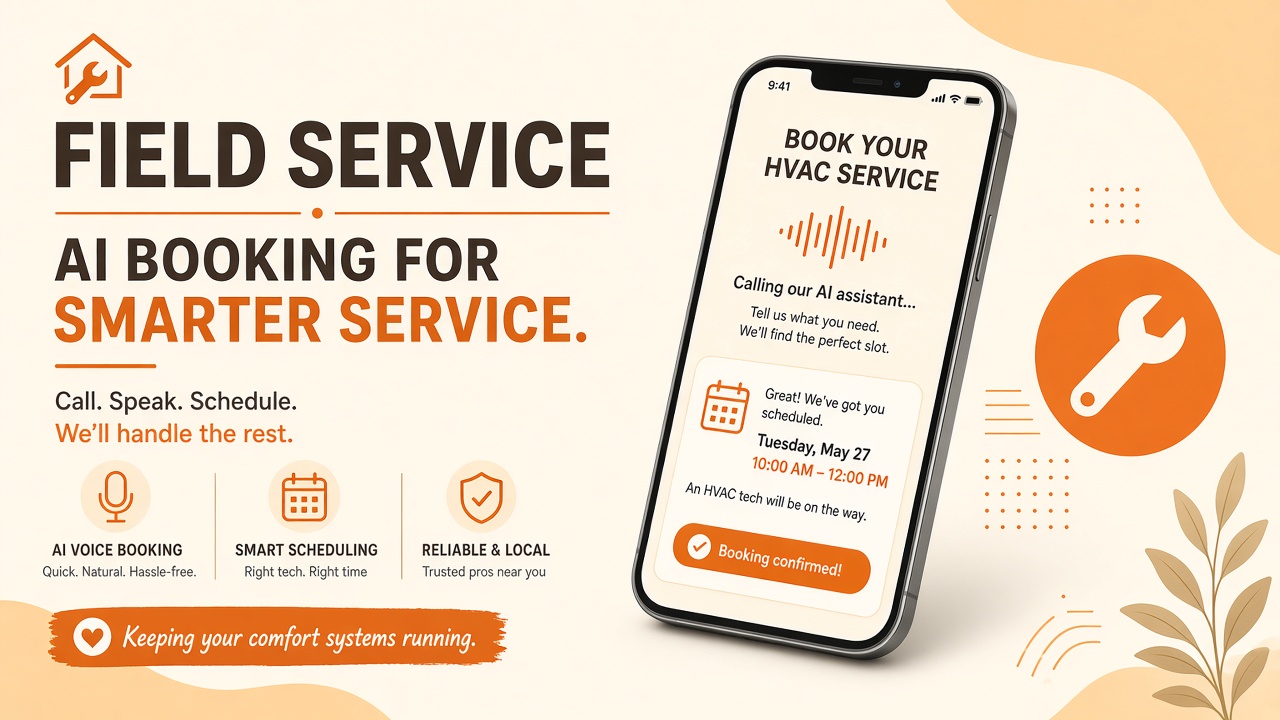
Plumbers, HVAC technicians, and roofing crews lose revenue every time a call goes to voicemail during a job site visit. Voice AI agents promise 24/7 answering, basic qualification, and calendar booking without hiring a full-time dispatcher. The failure mode is familiar: an agent quotes a flat rate that does not match field reality, double-books a technician, or sounds nothing like the brand customers trust. This AI field service booking workflow guide covers call flow design, quoting boundaries, calendar integration, brand voice, and when humans must take over, with links to AI voice platforms and AI automation patterns for trade businesses.
Why Field Service Needs Structured Booking
Field service businesses convert inbound calls into scheduled truck rolls; unstructured voice bots that skip qualification steps create no-shows, margin-killing misquotes, and angry reviews. Unlike SaaS support, a booked plumbing visit consumes drive time, parts inventory, and licensed labor. Every appointment slot has a real cost. AI booking works when the workflow mirrors how a good dispatcher thinks: identify urgency, confirm service area, gather symptoms, set price expectations, and only then commit calendar time.
Call Flow: From Ring to Confirmation
A production field service call flow answers immediately, authenticates the caller's location, classifies the job type, collects safety-critical details, offers booking windows, and sends confirmation by SMS or email before hanging up. Each step has exit ramps to a human or callback queue.
- Greeting and brand ID: State business name, hours, and that the caller may request a human at any time. Required in many states for recorded lines.
- Service area check: Zip code or address validation against dispatch polygons. Out-of-area callers get referral or polite decline, not a booked slot.
- Urgency triage: Gas leak, active flooding, or no heat in freezing weather escalate to on-call technician or emergency script. Non-urgent jobs enter standard booking.
- Job qualification: Structured questions per trade (HVAC: system type, age, symptoms; roofing: leak location, stories, recent storms; plumbing: fixture, clog vs leak).
- Price expectation: Dispatch fee, diagnostic range, or "estimate on site" language per quoting policy (see next section).
- Calendar offer: Present two to three windows synced to technician skills and drive-time buffers.
- Confirmation: Read back address, window, and dispatch fee; send SMS with cancel policy.
| Trade | Must-ask questions | Auto-escalate if |
|---|---|---|
| HVAC | Heat or cool, system age, error codes | Gas odor, carbon monoxide symptoms |
| Plumbing | Active leak, floor level, shutoff status | Sewage backup, main line break |
| Roofing | Interior stain, storm date, stories | Structural sag, active interior pour |
Quoting Boundaries and Liability
Voice AI should state dispatch fees and diagnostic ranges confidently but avoid binding repair quotes without site inspection, because field conditions routinely invalidate phone estimates. The safest pattern: quote the trip charge, explain that repair price depends on parts and labor on site, and document that the customer agreed to the dispatch fee before booking.
Build a quote matrix the agent reads verbatim: approved phrases for "starts at" language, banned phrases (flat total repair price), and mandatory disclaimers recorded on the call. When a caller pushes for a number the script does not cover, transfer to a human estimator or schedule an in-person quote visit instead of improvising. Roofing and HVAC replacements especially need human involvement; AI handles tune-ups and service calls better than full system replacements.
Price Objection Handling
Train objection responses that emphasize licensed work, warranty, and same-day availability without discounting on the first objection unless owner-approved promotions exist in the knowledge base. Unauthorized discounts destroy margin and confuse technicians who arrive expecting standard pricing.
Calendar Integration and Dispatch Logic
Calendar integration must respect technician skills, drive-time between jobs, parts lead times, and buffer windows, not merely show open slots from a generic Google Calendar. Field service management systems (ServiceTitan, Housecall Pro, Jobber) expose APIs that AI automation layers should call in real time during the call.
- Map job types to skill tags (e.g., flat roof vs shingle, heat pump vs furnace)
- Apply drive-time radius from previous job or shop location
- Block double-booking when jobs routinely run long
- Hold tentative slots with TTL until SMS confirmation link is clicked
- Write booked jobs back to FSM with call recording URL and AI transcript
Test integration weekly: book a job via voice, verify it appears on the technician mobile app with correct notes. Silent sync failures strand customers and technicians.
Brand Voice and Trust
Customers hire local trades for reliability; the voice agent should sound like the company's best dispatcher, using approved vocabulary, regional phrasing, and empathy scripts for stressful situations (burst pipe, AC out in summer). Generic robotic voices erode trust faster than voicemail.
AI voice platforms now support custom voices and fine-tuned prosody, but clarity beats novelty. Disclose AI assistance where state law requires. Offer immediate human transfer on request without penalty. Record calls for quality review and dispute resolution. Review transcripts weekly for drift: agents that start improvising prices or promising timelines not in the script need prompt tightening.
After Hours and Seasonality
After-hours scripts differ: emergency surcharges, on-call technician rotation, and honest next-morning callbacks for non-urgent work. Seasonal peaks (first heat wave, post-storm roofing) need dynamic slot throttling so the agent does not book more jobs than crews can clear in 48 hours.
When Humans Take Over
Humans must take over when callers request it, when safety triggers fire, when quotes exceed scripted bounds, when sentiment turns hostile, or when the AI fails two consecutive comprehension attempts. Warm transfer beats cold transfer: pass job notes so the customer does not repeat everything.
| Trigger | Action | SLA |
|---|---|---|
| Caller says "real person" | Warm transfer or callback | Under 60 seconds hold |
| Emergency keywords | On-call dispatch | Immediate |
| Quote outside matrix | Estimator queue | Same business day |
| Angry sentiment score | Owner or senior CSR | Under 2 minutes |
| Integration failure | Manual booking promise + ticket | Callback within 15 minutes |
Spam, Wrong Numbers, and Vendor Calls
Trade businesses receive marketing robocalls, supplier pitches, and wrong-number dials that waste agent minutes if not filtered early. Configure allow/deny patterns: short-circuit known spam, politely end vendor sales calls, and offer callback scheduling for legitimate supplier issues without booking truck rolls. Wrong-address emergencies (caller thought they reached a different company) need a compassionate handoff script, not a forced booking attempt.
Repeat Customer Recognition
When caller ID or account lookup matches an existing customer, skip re-collecting address and pull service history so the agent references prior jobs ("I see we serviced your furnace last winter"). Personalization increases trust but requires CRM integration and privacy controls. Never read full payment card numbers aloud; confirm identity with address or email on file before discussing account details.
Technician Mobile Handoff
Booked jobs must arrive on the technician mobile app with structured notes, photos requested during the call, and priority flags so field staff trust AI bookings. If technicians routinely call customers to re-qualify because AI notes are thin, dispatcher labor savings evaporate. Require minimum data fields before calendar commit: symptom summary, access instructions, pets on site, and photo upload links for visible damage. Technicians who see complete packets defend the system; those who see garbage lobby to disable it.
Parts and Truck Stock Awareness
Advanced integrations check common parts availability before promising same-day repair completion; otherwise book diagnostic visits honestly. Nothing erodes brand faster than a tech arriving without a capacitor that the agent implied was a quick fix. Link to inventory when possible or default to diagnostic language.
Measuring Booking Agent Quality
Track booking conversion rate, no-show rate, average ticket vs human-booked baseline, transfer rate, and post-job customer rating segmented by booking channel. A high conversion rate with rising no-shows signals over-aggressive booking without qualification. Compare AI-booked job margin quarterly; if lower, tighten scripts or escalation rules. Segment metrics by job type and zip code to catch geographic script gaps after storms or heat waves when call patterns shift overnight.
Frequently Asked Questions
Will voice AI replace my dispatcher?
AI handles overflow, after-hours, and routine service calls; dispatchers still manage exceptions, complex quotes, technician coaching, and storm surge. Most shops redeploy dispatcher time to outbound follow-up and quality control.
Which trades fit voice booking best?
HVAC service, drain cleaning, water heater diagnostics, and leak triage fit well; full roof replacements and commercial bids usually need human estimators. Start with your highest-volume repeatable job type.
Which field service software integrates with voice AI?
Major FSM platforms expose APIs; verify real-time availability read and job write before signing a voice vendor. Ask for reference customers in your trade and climate region.
What about missed calls the AI never saw?
Pair voice AI with SMS auto-reply on missed calls and website chat booking so omnichannel demand still converts. Report total capture rate, not just answered AI calls.
Do I need consent to record AI calls?
Two-party consent states require disclosure at call start; scripts should include recording notice and match your attorney's guidance. Store recordings with job records for warranty disputes.
Can voice AI handle bilingual callers?
Many platforms support Spanish and English switching mid-call; script both languages for safety keywords and quote disclaimers. Test accent diversity in pilot calls. If quality is insufficient, route Spanish calls to bilingual staff rather than risking misbooked emergencies.
How do membership and warranty plans affect booking?
Encode membership tiers in the knowledge base so the agent applies correct dispatch fees and priority scheduling without improvising discounts. Warranty jobs may require manufacturer authorization codes the agent collects before booking.
How do we add new services to the agent?
Update qualification trees, quote matrix, skill tags, and calendar rules together; adding a service to the script without calendar mapping causes double-booking. Run ten test calls before going live.
Pilot Rollout Plan
Roll out voice booking in phases: after-hours only for two weeks, then overflow during business hours, then primary answer for routine service lines. Compare metrics at each phase before expanding. Keep a human dispatcher on parallel answer for the first month to catch script gaps live. Document every transfer reason code; top five reasons become weekly script updates. Owners who skip phased rollout blame the technology when the real issue was deploying full primary answer before calendar integration was stable.
Conclusion
AI field service call booking earns trust when trade businesses treat voice agents like trainable dispatchers, not magic receptionists. Design call flows with safety escalations, keep quotes inside inspected boundaries, sync calendars with real dispatch logic, match brand voice, and hand off aggressively when humans add value. Measure conversion alongside no-shows and margin. Pair AI voice with governed AI automation to your FSM. The shops that win are not the ones that answer every call fastest; they are the ones that book the right job, at the right price expectation, with the right technician on the truck.