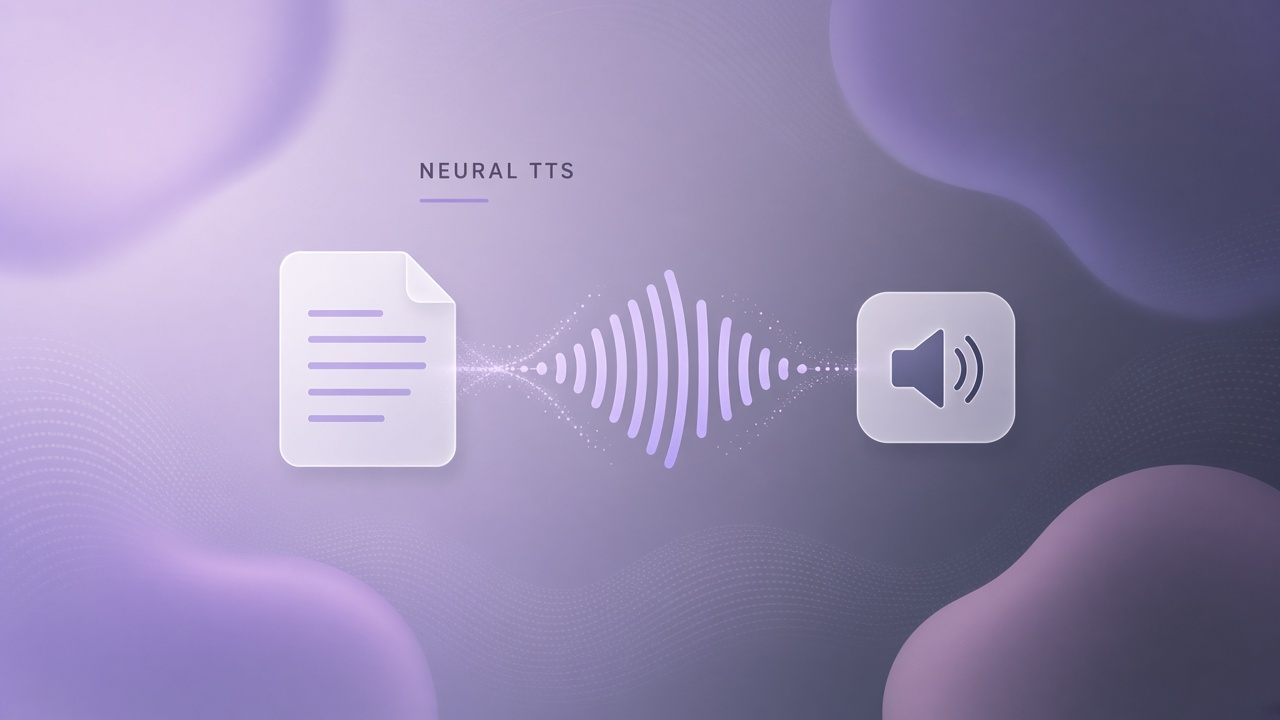
A language-learning app reads vocabulary aloud. A support bot speaks confirmation codes. A documentary editor generates narration without booking a studio. Text to speech AI explained in brief: neural models predict speech waveforms or spectrograms from written text, producing voices that sound far more natural than robotic concatenative systems from the 2000s. TTS powers voice assistants, accessibility features, multilingual AI chatbot responses, and AI video tools that auto-narrate storyboards. Buyers must weigh voice quality, streaming latency, cloning consent, and commercial licensing before shipping audio to end users.
Traditional vs Neural TTS
Concatenative TTS stitched recorded diphones into sentences; parametric TTS used signal processing; neural TTS learns mappings from text to mel spectrograms or raw audio with deep networks and neural vocoders. Traditional systems sounded mechanical on rare words. Neural approaches (Tacotron, FastSpeech, VITS, and transformer variants) improved prosody, coarticulation, and breathiness at the cost of GPU inference and new failure modes like mispronounced acronyms.
| Generation | Mechanism | Tradeoff |
|---|---|---|
| Concatenative | Replay sliced recordings | Natural on scripted words, brittle elsewhere |
| Parametric (HMM) | Statistical acoustic parameters | Robotic, compact |
| Neural two-stage | Text to mel, neural vocoder to wave | High quality, moderate latency |
| End-to-end (VITS-style) | Single model text to wave | Fast inference options, training complexity |
Cloud TTS catalogs (Amazon Polly, Google Cloud Text-to-Speech, Azure Speech, ElevenLabs, PlayHT, OpenAI speech APIs) expose dozens of preset voices. Developers choose standard vs neural tiers, often paying more per character for neural quality and streaming endpoints.
Voice Selection, SSML, and Prosody Control
Speech Synthesis Markup Language (SSML) tags instruct engines to pause, emphasize words, read digits as telephone numbers, or switch languages mid-utterance; prosody controls adjust rate, pitch, and volume. Without SSML, long numbers and URLs sound wrong. Voice selection balances gender presentation, age coloration, and locale (en-US vs en-GB). Neural voices support style variants (newscast, cheerful) on some platforms.
SSML patterns that matter in production
<break time="500ms"/>for natural pauses between sentences.<say-as interpret-as="characters">for spelling codes aloud.<sub alias="World Wide Web">WWW</sub>for abbreviations.<lang xml:lang="fr-FR">for embedded foreign phrases.<phoneme alphabet="ipa" ph="..."/>for stubborn proper nouns.
Not every vendor implements full SSML 1.1. Validate tags in staging; fallback plain text when unsupported. Pronunciation lexicons (custom lexicon files) fix brand names across an entire application without per-string phoneme tags.
Cloning, Consent, and Deepfake Policy
Voice cloning trains a model on minutes of target speech to mimic timbre; ethical and legal use requires explicit consent from the voice owner and policies that block impersonation of non-consenting individuals. Deepfake audio fraud rose with accessible cloning APIs. Reputable vendors require verified consent clips, watermarking, or voice ID checks before enabling custom voices.
| Policy element | Purpose | Implementation hint |
|---|---|---|
| Written consent | Prove right to clone | Talent release forms on file |
| Liveness verification | Block upload of third-party clips | Vendor-led ID checks |
| Usage restrictions | Forbid fraud, political deepfakes | Acceptable use policy in contract |
| Watermarking | Trace synthetic audio | Invisible or disclosed markers |
Internal policy should define who may request a cloned voice, retention of training audio, and offboarding when talent contracts end. Delete custom voice models when licenses expire. Disclose synthetic narration to audiences where regulations or platform rules require transparency.
Streaming Latency for Interactive Apps
Interactive voice agents need time-to-first-audio under roughly 300 to 800 ms after text is finalized; batch narration tolerates seconds of synthesis per paragraph. Streaming TTS sends audio chunks as they are generated, pairing with streaming LLM tokens in conversational stacks. Latency drivers include model size, region distance, text length, and whether synthesis runs on edge devices.
| Tier | Typical latency | Example use |
|---|---|---|
| Ultra-low latency stream | Sub-500 ms first byte | Phone IVR, live copilots |
| Standard cloud neural | 0.5 to 2 s per request | App read-aloud, notifications |
| High-fidelity batch | Seconds per minute of audio | Audiobooks, video voiceover |
Caching and chunking strategies
Cache stable phrases ("Your order has shipped") as pre-rendered audio to skip synthesis cost and latency. Chunk dynamic LLM answers at sentence boundaries before TTS to start playback while later sentences generate. Measure end-to-end perceived latency including network, not just vendor-reported synthesis milliseconds.
Licensing for Commercial Voice Use
Commercial TTS requires licenses covering redistribution, broadcast, monetized content, and seat counts; stock voices and cloned voices carry different terms. Read whether you may store audio files, use voices in ads, or ship voices inside a white-label product. Enterprise agreements add indemnification and SLA credits.
- Standard voices: Usually royalty-free within API metered usage.
- Neural premium voices: Higher per-million-character pricing.
- Custom / cloned voices: Talent fees, exclusivity windows, geographic limits.
- On-prem licenses: Per-core or per-instance for air-gapped deployments.
YouTube and podcast platforms may require disclosure of synthetic narration. Advertising standards bodies increasingly scrutinize AI-generated spokespersons. Legal review should cover trademarked voice similarity even when cloning is not intentional.
Vocoder Basics and Audio Quality
Neural vocoders (WaveNet, HiFi-GAN, and successors) convert predicted mel spectrograms into audible waveforms; vocoder quality determines whether speech sounds breathy, metallic, or natural at the edges of consonants. Two-stage TTS separates linguistic planning from waveform generation so teams can upgrade vocoders without retraining the entire text front end. Artifacts appear on sibilants ("s", "sh") and plosives ("p", "t") when bitrates drop or models run in aggressive speed modes.
Output formats and bitrates
APIs expose MP3, OGG, WAV, and PCM streams. Voice agents often use 24 kHz or 48 kHz PCM for low latency decode on clients. Audiobook pipelines export higher bitrates for distribution platforms. Test playback on cheap phone speakers, not only studio headphones, because harsh vocoder artifacts distract on small drivers.
TTS in Chatbots and Video Pipelines
Chatbots append TTS after the language model finishes a sentence chunk; video tools align TTS audio to scene timelines and may re-time lip-sync avatars to generated speech. Mismatched sentence chunking produces awkward pauses mid-thought. Video editors need duration estimates before rendering; some TTS APIs return predicted audio length metadata to schedule B-roll. When avatars lip-sync, phoneme timing must align with viseme libraries or the face animation drifts.
- Queue TTS jobs after LLM safety filters pass.
- Fall back to text-only UI when synthesis latency exceeds user patience.
- Cache character voice profiles per scene in video templates.
- Caption the same script for accessibility even when audio plays.
Evaluation Checklist for TTS Buyers
Score candidate voices on intelligibility, naturalness, pronunciation of your product lexicon, emotional fit, and cost at projected monthly character volume. Run listening tests with native speakers for each target locale. Automated mean opinion score proxies exist but do not replace human judgment on brand-sensitive content.
- Prepare a script with numbers, URLs, jargon, and mixed-language sentences.
- Synthesize with SSML fixes and without, comparing error rates.
- Test streaming playback on mobile networks with packet loss.
- Confirm data processing terms if text contains PII.
- Document voice ID and fallback when primary voice is unavailable.
On-Device vs Cloud TTS
On-device TTS runs without network round trips, helping offline apps and privacy-sensitive workflows; cloud TTS offers broader voice catalogs and easier updates at the cost of latency and data transfer. Mobile OS voices improve yearly but may not match brand-specific cloned voices available only via vendor APIs. Hybrid apps synthesize locally for confirmations and call the cloud for long-form narration.
| Factor | On-device | Cloud |
|---|---|---|
| Latency | Low after model load | Network dependent |
| Voice variety | Limited bundle size | Large catalogs, cloning |
| Updates | App release cycle | Vendor rolls out silently |
| Privacy | Text stays local | Requires DPA review |
Frequently Asked Questions
How many languages do neural TTS engines support?
Large vendors offer 40 to 100+ locales, but quality is uneven; always audition the specific locale you ship, not the language family average. Some engines support multilingual voices that code-switch within one utterance using SSML language tags.
Can TTS express emotion and emphasis?
Style-capable neural voices accept parameters or SSML for cheerful, sad, or angry delivery within limits; extreme acting still trails human voice actors. Pair modest style controls with scriptwriting that avoids emotions the engine cannot render.
How do we fix mispronounced product names?
Upload custom lexicons, insert IPA phoneme tags, or alias strings in SSML so the engine speaks approved pronunciations consistently. Re-test after vendor model upgrades, which can shift phoneme predictions.
Are open-source TTS models production-ready?
Projects like Coqui, Piper, and various research checkpoints enable self-hosting with GPU ops overhead; quality and licensing vary by checkpoint. Managed APIs reduce burden when latency SLAs and legal indemnity matter.
How does TTS relate to accessibility requirements?
Screen readers use OS-level TTS separate from cloud narration APIs, but in-app read-aloud features should respect user playback speed, focus order, and captions for deaf users. WCAG success criteria still apply; synthetic voice does not replace text alternatives for audio content.
SSML Security and Injection
When user-generated text flows into TTS, sanitize input so attackers cannot inject SSML tags that change voice, rate, or speak unintended phrases from your billed character quota. Treat SSML like HTML: escape or strip markup from untrusted sources. Admin-only SSML editors can remain rich for marketing teams while customer-facing read-aloud uses plain text with a fixed voice profile.
Monitoring TTS in Production
Production TTS needs monitoring for synthesis failures, latency spikes, quota exhaustion, and pronunciation regressions after vendor model updates. Log character counts per voice ID for cost attribution. Alert when error rates exceed baseline or when time-to-first-byte crosses SLO thresholds during peak hours. Run weekly golden-script synthesis diffs; audio fingerprint changes may indicate silent model rollouts that altered prosody without announcement.
User-facing read-aloud buttons should degrade gracefully: show the text, offer retry, and never leave a spinner indefinitely when the TTS endpoint times out. Rate-limit abusive clients who spam synthesis to burn quota. Separate API keys per environment so staging tests do not exhaust production character pools before marketing launches.
Joint TTS and STT Round-Trip Tests
Voice products that both speak and listen should run round-trip tests: synthesize a script, play it through the same acoustic path users experience, then transcribe with your ASR stack to catch pronunciation gaps before launch. Numbers, homographs, and brand names fail most often in this loop. Fix lexicon entries on the TTS side before tuning ASR custom vocabulary.
Brand Voice Guidelines for TTS
Document target pace, warmth, and formality for each customer-facing voice so engineers configure SSML defaults consistently across web, mobile, and IVR channels. A single brand should not sound rushed in the app and sluggish on the phone tree because different teams picked different rate parameters. Centralize voice configuration in a shared service rather than hardcoding per platform.
Conclusion
Text to speech AI explained for product teams is neural audio generation with selectable voices, SSML control, and streaming latency budgets tuned to the use case. Treat voice cloning as a consent-gated capability with anti-fraud guardrails, not a novelty filter. Read commercial licenses before monetizing narrated content. Benchmark pronunciation on your real strings, disclose synthetic speech where required, and pair TTS with chatbots and video tools only after legal and accessibility review clears the voice experience for customers.