A humanoid robot loses balance when a push arrives from the side, when terrain narrows underfoot, or when the center of mass shifts during a single-leg pose. Classical model-based controllers can stabilize walking on flat floors, but extreme balance tasks, fall recovery, and robust sim-to-real transfer increasingly rely on humanoid robot balance reinforcement learning: policies trained in GPU simulators with millions of randomized episodes, then deployed on physical hardware with minimal or no fine-tuning. Research groups at universities and robot vendors now report standing-up from arbitrary postures, single-leg balance under disturbances, and narrow-terrain locomotion on Unitree G1 and H1-2 platforms, while Boston Dynamics and the RAI Institute train electric Atlas with RL pipelines built for dynamic whole-body behavior.
Robotics program managers evaluating automation roadmaps should treat balance RL as a research-to-pilot capability, not a turnkey product feature. Teams exploring adjacent AI workflows can browse AI chatbot resources for documentation and operator tooling, while the EliteAI.tools blog index collects other technical explainers on embodied and industrial AI.
What Humanoid Robot Balance Reinforcement Learning Means in Plain Language
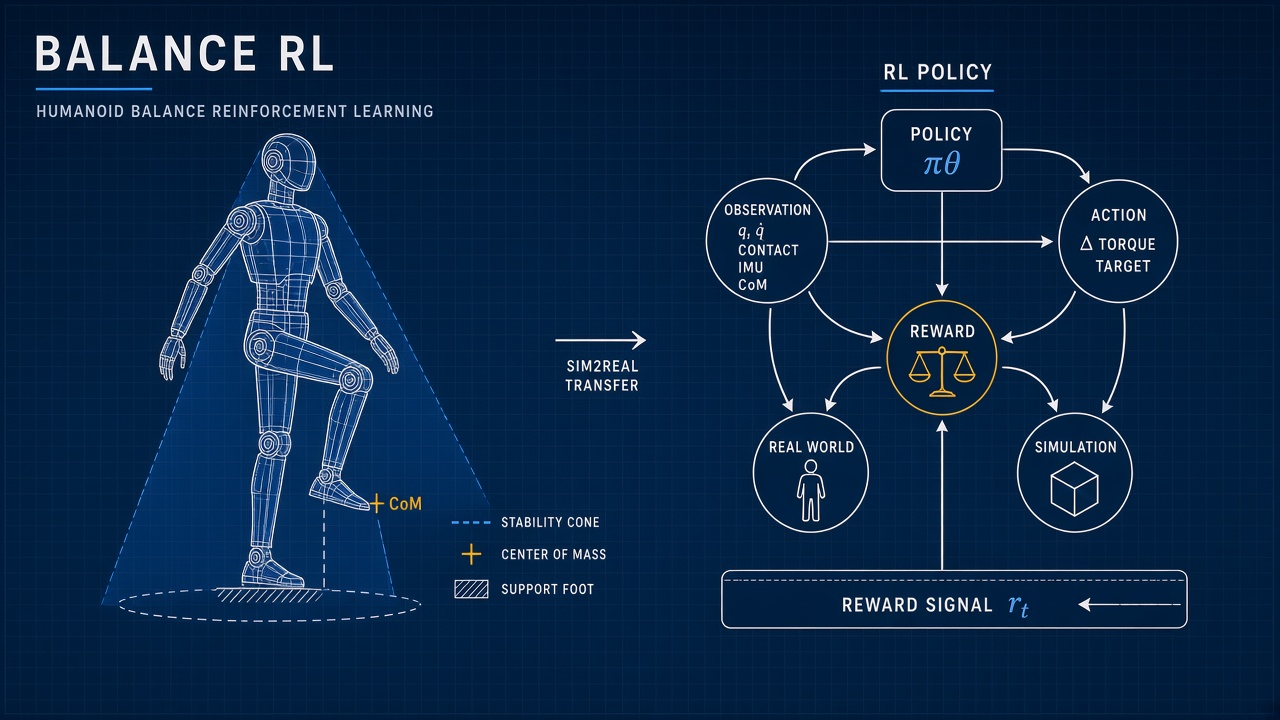
Humanoid robot balance reinforcement learning is the use of trial-and-error policy optimization in simulation to teach a bipedal robot how to keep its center of mass inside a support polygon, recover from pushes, and coordinate arms and legs without hand-coded balance rules for every scenario. The robot receives proprioceptive feedback (joint angles, velocities, IMU orientation) and outputs joint torque or position targets. A reward function scores upright posture, foot placement, energy use, and task progress; penalties discourage falls, joint limits, and violent oscillations.
Balance differs from simple walking. Quasi-static poses such as standing on one leg require minute ankle and hip corrections. Dynamic balance during narrow-terrain traversal adds momentum management: the Zero Moment Point (ZMP) must stay inside the foot support region while the upper body compensates. RL excels when analytic models are incomplete, contacts multiply, and domain randomization can expose the policy to varied masses, friction, and sensor noise before real-world deployment.
| Balance mode | Primary challenge | Typical RL signal |
|---|---|---|
| Static bipedal stance | Small corrective torques, sensor drift | Upright orientation, low joint velocity |
| Single-leg quasi-static | Tiny support polygon, morphological mismatch to human demos | Reference pose tracking plus disturbance rejection |
| Dynamic locomotion | Momentum, foot placement, terrain variation | Velocity tracking, ZMP or capture-point terms |
| Fall recovery (stand-up) | Discontinuous contact sequences, hardware torque limits | Multi-critic rewards, smoothness regularization |
Balance control versus locomotion policies
Many published systems unify standing, walking, and transitions under one recurrent or gait-conditioned policy, while specialized frameworks target extreme balance or stand-up as distinct skills. Unified gait-conditioned RL on Unitree G1 reports standing, walking, and walk-to-stand transitions transferred without fine-tuning. HuB (Humanoid Balance) focuses on quasi-static single-leg tasks on G1. HoST (Humanoid Standing-up Control) learns posture-adaptive stand-up from scratch. Choosing a monolithic or modular architecture depends on whether the deployment needs one general controller or certifiable behavior modules for safety review.
Proprioception and control frequency
Balance RL policies typically run at hundreds of hertz on joint torque or position targets, reading IMU orientation, joint encoders, and foot contact estimates without waiting for camera frames. This proprioceptive loop mirrors human vestibular reflexes. Adding vision or LiDAR helps preview upcoming terrain but increases latency and sim-to-real tuning. DBHL's narrow-terrain results show proprioception-only policies can traverse 25 cm wide tracks with ramps and stairs when ZMP-aware rewards coordinate upper-body sway with foot placement.
Reference motion retargeting challenges
When human motion capture supplies reference trajectories, leg length ratios, hip width, and ankle torque limits differ on humanoid hardware. Naive retargeting destabilizes quasi-static balance: a human Swallow Balance yoga pose may require ankle ranges the robot lacks. HuB's reference motion refinement stage adjusts demonstrations before policy learning so rewards track feasible poses. Boston Dynamics uses animated references for Atlas fridge lifting, exploiting the robot's superhuman joint range while still randomizing object mass and grip in simulation.
How the Underlying AI Pipeline Works
The standard pipeline runs Train in Isaac Gym or Isaac Sim, Play in simulation, optional Sim2Sim in MuJoCo, then Sim2Real on the physical humanoid, with domain randomization and reward shaping bridging the physics gap. Unitree documents this workflow in its open-source unitree_rl_gym repository for Go2, H1, H1_2, and G1 robots. Parallel environments (often thousands) accelerate sample collection. Actor-critic networks map proprioception to actions; critics estimate value functions for policy gradient updates.
Simulation, references, and reward design
Boston Dynamics describes Atlas RL training with three ingredients: a reference trajectory (animation, teleoperation, or abstract goal), a reward that keeps the robot near the reference while tolerating disturbances, and massive parallel simulation on GPUs. HuB adds reference motion refinement for balance-intensive skills where naive motion capture retargeting destabilizes training. DBHL (Dynamic Balance Humanoid Locomotion) combines ZMP-driven rewards with task rewards in a whole-body actor-critic framework for narrow-terrain traversal on H1-2 using proprioception only.
Sim-to-real robustness techniques
Domain randomization varies friction, actuator delay, payload mass, and push disturbances during training. HoST applies smoothness regularization and implicit speed bounds to reduce oscillatory torques on real G1 hardware. HuB targets sensor noise and unmodeled dynamics with dedicated robustness training stages. Multi-critic architectures separate competing objectives (posture versus speed) so curriculum training can ramp difficulty on slopes, bridges, and stairs without collapsing the policy.
| Stage | Purpose | Common tooling |
|---|---|---|
| Policy training | Maximize cumulative reward under randomized physics | Isaac Gym, PPO or similar RL algorithm |
| Sim validation | Replay checkpoints, inspect fall rate | Play scripts, TensorBoard logs |
| Sim2Sim transfer | Detect overfitting to one simulator | MuJoCo deployment scripts |
| Hardware deployment | Run policy on robot with safety harness | Vendor deploy_real.py, low-level SDK |
Typical workflow steps
- Define task scope (stand, walk, stand-up, single-leg balance) and success metrics.
- Build or import URDF model with accurate actuator limits and contact parameters.
- Design reward terms and curriculum (flat ground before narrow beams or pushes).
- Train with thousands of parallel envs until sim success rate plateaus.
- Validate in alternate simulator and log joint torque profiles for limit violations.
- Deploy on hardware with harness, estop, and logging; compare sim versus real state trajectories.
- Iterate randomization or add reference refinement if real falls cluster on specific failure modes.
Real Deployments and Published Evidence
Peer-reviewed and vendor-reported results now include zero-shot or direct sim-to-real transfer on commercial humanoid hardware, not simulation-only benchmarks. HuB validates extreme single-leg balance on Unitree G1, including Swallow Balance and high kicks, withstanding strong physical disturbances where baselines fail. HoST deploys stand-up policies on G1 across laboratory and outdoor scenes. Gait-conditioned RL work reports standing, walking, and transitions on real G1 without fine-tuning. DBHL demonstrates H1-2 traversal of 25 cm wide tracks with ramps, bridges, and stairs using proprioception alone.
Boston Dynamics and the RAI Institute announced a 2025 partnership to build a shared RL training pipeline for electric Atlas, extending Spot RL Researcher Kit experience (including record quadruped speeds near 11.5 mph) to humanoids. Boston Dynamics blog posts describe Atlas learning fridge-lifting with implicit proprioceptive adaptation to mass and grip variation. RAI Institute reports maneuvers trained from roughly 150 million simulator runs transferred zero-shot to Atlas hardware. ZEST demonstrates athletic skills on Atlas and Unitree G1 from heterogeneous motion data with a single-stage training recipe.
Vendor hardware context
Unitree G1 (23 degrees of freedom in HoST experiments) and H1-2 (full-sized humanoid in DBHL) represent commercially available platforms with published RL deployments. Boston Dynamics electric Atlas targets industrial manipulation with higher actuator bandwidth than many research humanoids. Hardware differences matter for balance RL: lighter robots recover faster from pushes but carry less payload; heavier robots have larger angular momentum during dynamic steps. Policy checkpoints trained on one URDF rarely transfer to another without retraining or careful domain randomization of link masses and actuator gains.
Evaluation metrics beyond "does not fall"
Papers report task completion rates, maximum survivable push magnitude, terrain traversal length, and joint torque RMS as proxies for deployability. HoST emphasizes smooth stand-up trajectories visible in outdoor videos. HuB reports disturbance rejection against forceful strikes during single-leg poses. Teams adopting balance RL should define acceptance criteria aligned with their environment: a warehouse pilot might require zero uncontrolled falls per eight-hour shift with harness, while a research lab might accept occasional falls during exploration if actuators remain within safe thermal limits.
Limits, Risks, and Ethical Guardrails
RL balance policies can fail silently outside training distributions: ice, cables, payload changes, or joint wear shift dynamics enough to cause falls even when simulation metrics look strong. Sim-to-real gaps persist for contact-rich skills. Morphological mismatch between human reference motions and robot kinematics destabilizes quasi-static balance unless motions are refined. Violent or oscillatory torques damage hardware; HoST explicitly regularizes smoothness for this reason.
- Safety: Humanoids near people require harnesses, geofencing, and estop during policy evaluation.
- Explainability: Neural policies lack transparent stability proofs compared to ZMP controllers with known assumptions.
- Regulatory context: Industrial mobile robots fall under machinery safety standards; research policies are not certified by default.
- Labor impact: Balance-capable humanoids enable new automation tasks; workforce planning should precede hype-driven procurement.
- Dual use: Robust whole-body control research applies to military and surveillance platforms; transparency in funding and deployment context matters.
Ethical guardrails include publishing failure videos alongside successes, documenting training randomization ranges, and avoiding overstated generalization from curated demo terrains to unstructured construction sites or homes.
Who Should Use This and Who Should Wait
University robotics labs, humanoid vendors, and advanced R&D teams with simulation GPUs and harnessed hardware should pursue humanoid robot balance reinforcement learning now, using open pipelines and published reward structures as baselines. General manufacturers seeking reliable pallet transport should prioritize proven AMRs and box-handling robots until humanoid reliability data matches multi-shift industrial metrics.
| Audience | Recommendation | Caveat |
|---|---|---|
| Humanoid research lab | Start with vendor rl_gym and published reward papers | Budget for hardware repair and safety staffing |
| Logistics operator | Monitor Atlas and G1 pilots; deploy Stretch-class robots today | Balance RL is not yet a warehouse SLA |
| Startup building controllers | Focus on one skill vertical (stand-up or narrow terrain) | Generalist claims require broad real-world validation |
| Individual hobbyist | Sim-only unless owning insured, harness-ready hardware | Falls can destroy actuators and injure bystanders |
Frequently Asked Questions
How reliable is humanoid robot balance reinforcement learning on real hardware?
Published G1 and H1-2 results show repeatable balance on trained tasks, but reliability is task-specific and rarely reported as industrial uptime percentages. Policies that stand on narrow beams in one paper may fail on wet floors or worn feet. Treat demo videos as existence proofs, not fleet-wide guarantees.
Is RL humanoid balance control regulated for commercial use?
Deployed industrial robots must meet regional machinery safety requirements; research RL policies loaded onto development humanoids are not automatically compliant. Vendors pursuing commercial Atlas or G1 applications must integrate safety-rated monitoring, workspace limits, and risk assessments beyond academic sim-to-real success.
How much simulation data does balance RL require?
Recent Atlas work cites on the order of 150 million simulator runs per maneuver; Unitree training uses thousands of parallel environments over many iterations. Data efficiency improves with better reward design and reference refinement, but balance-intensive skills remain sample-hungry compared to narrow supervised tasks.
When should teams prefer model-based balance controllers over RL?
Model-based ZMP or capture-point controllers remain appropriate when stability proofs, predictable failure modes, and certification documentation are mandatory. RL fits exploratory skills, uneven terrain, and whole-body coordination where analytic models are costly to maintain.
Do balance RL policies require vision or LiDAR?
Several 2025 humanoid papers achieve narrow-terrain locomotion with proprioception only; perception adds obstacle avoidance but increases sim-to-real complexity. DBHL explicitly trains without exteroceptive sensing for extreme balance under pushes.
How do Unitree open pipelines compare to Boston Dynamics Atlas RL?
Unitree rl_gym offers reproducible open workflows on purchasable robots; Boston Dynamics and RAI Institute focus on proprietary electric Atlas pipelines with demonstrated dynamic manipulation. Both rely on large-scale simulation and domain randomization; access and hardware cost differ sharply.
ZEST and unified skill transfer
ZEST (Zero-shot Embodied Skill Transfer) trains policies in a single stage from heterogeneous motion sources including motion capture, video, and keyframe animation, deploying zero-shot to electric Atlas and Unitree G1 with one hyperparameter set per robot. The framework avoids multi-stage pipelines with contact labeling and extensive reward shaping, suggesting future balance controllers may share training recipes with dynamic manipulation skills. Teams monitoring humanoid progress should track whether unified policies reduce engineering time or increase debugging difficulty when one network handles both extreme balance and fast locomotion.
Conclusion
Humanoid robot balance reinforcement learning converts simulation experience into joint-level control that handles standing, recovery, and dynamic locomotion under disturbances. HuB, HoST, DBHL, and gait-conditioned frameworks validate real hardware on Unitree platforms; Boston Dynamics and the RAI Institute extend RL to electric Atlas for industrial-grade whole-body skills. Success depends on reward engineering, domain randomization, hardware-safe regularization, and honest reporting of failure modes. Teams should match method ambition to safety requirements: research labs can push sim-to-real frontiers now, while production environments should wait for certified integrations and shift-level reliability evidence.