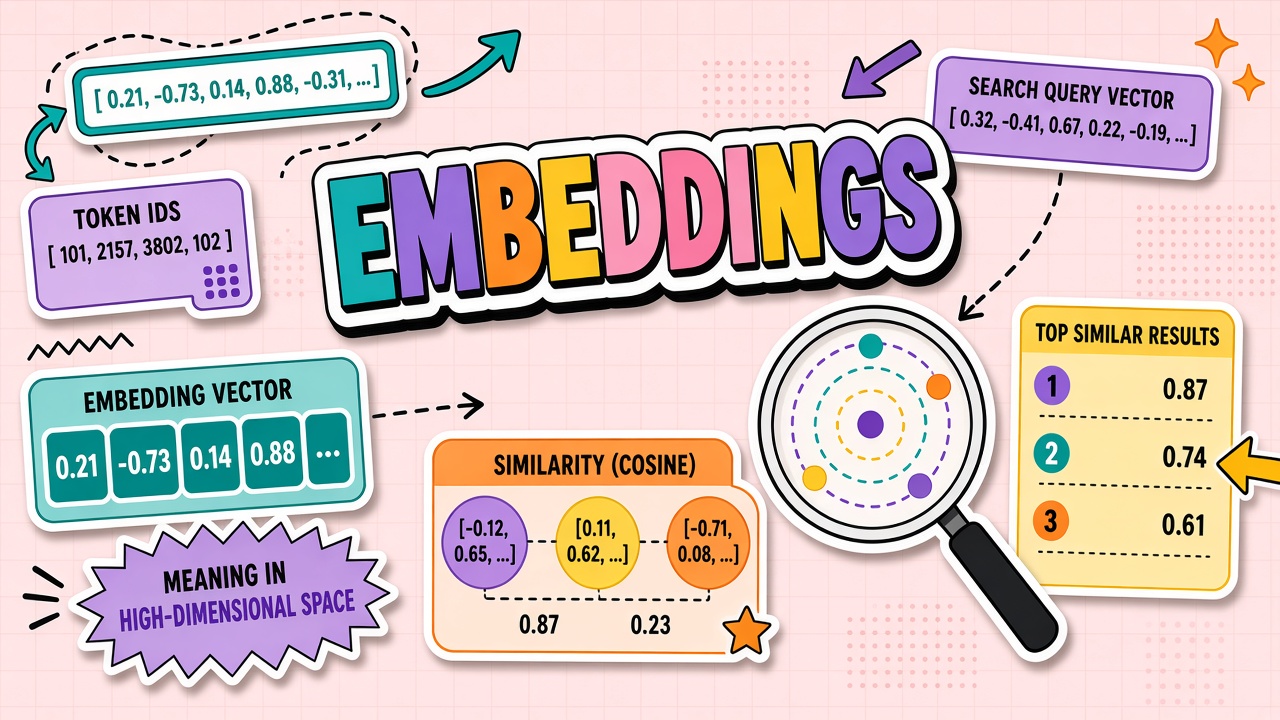
You search a help center for "reset password" and the top result is an article titled "Recover your account access" with no shared keywords. Or an AI assistant pulls the right policy paragraph even though your question used different wording. Behind both experiences is usually an embedding: a numeric representation of text that captures meaning, not just character matches.
Embeddings are fixed-length vectors produced by embedding models. Similar concepts land close together in vector space, which enables semantic search, retrieval-augmented generation, deduplication, clustering, and recommendation features in commercial AI tools. This guide defines embeddings in plain language, explains how similarity search works, shows where you encounter embeddings in products, covers model quality tradeoffs, and notes privacy implications of what gets embedded. Researchers comparing AI research tools should ask whether semantic search is keyword-based, embedding-based, or hybrid.
What Are Embeddings? Meaning as Numbers
An embedding model reads a piece of text (word, sentence, paragraph, or document chunk) and outputs a list of floating-point numbers, often 384, 768, 1536, or more dimensions. Each dimension captures some latent feature of meaning learned during training on large text corpora. You do not read the numbers directly; you compare them with distance metrics.
The key property is neighborhood structure. "King" and "queen" vectors sit closer than "king" and "banana." Paraphrases cluster even when they share few tokens. That is why embeddings power "search by concept" features that keyword indexes cannot replicate alone.
How Similarity Search Works in Practice
Semantic search follows a repeatable pipeline. Documents are split into chunks, each chunk is embedded, vectors are stored in an index optimized for nearest-neighbor lookup. At query time the question is embedded with the same model, and the system returns chunks whose vectors are closest, typically measured by cosine similarity or dot product.
- Chunk: Split documents into passages sized for retrieval (often 200 to 800 tokens).
- Embed: Run each chunk through the embedding model; store vector plus metadata (source, page, date).
- Index: Load vectors into an approximate nearest neighbor structure (HNSW, IVF, etc.).
- Query: Embed the user question; find top-k nearest vectors.
- Return: Map vectors back to text chunks for display or RAG context injection.
| Metric | What it measures | Typical use |
|---|---|---|
| Cosine similarity | Angle between vectors (direction, not magnitude) | Standard for text embeddings |
| Dot product | Combines direction and magnitude | Some hosted vector DBs when vectors are normalized |
| Euclidean distance | Straight-line distance in vector space | Less common for text; used in some clustering workflows |
Where You See Embeddings: RAG, Dedup, and Clustering
Embeddings are invisible in the UI but visible in feature lists. Any product advertising "semantic search," "ask your documents," "find similar tickets," or "auto-tag content" likely embeds text behind the scenes.
- RAG assistants: Retrieve relevant chunks before the LLM generates an answer.
- Support deflection: Match user questions to existing help articles by meaning.
- Deduplication: Flag near-duplicate uploads or tickets by vector distance.
- Clustering: Group feedback, reviews, or survey responses into themes.
- Recommendations: Suggest similar products, papers, or tools based on description embeddings.
Automation platforms in the AI automation category increasingly expose embedding steps as workflow blocks, not just black-box search.
Embedding Model Choices and Quality Tradeoffs
Not all embedding models perform equally on your domain. General models trained on web text may underperform on legal, medical, or internal jargon. Multilingual support varies. Dimension size affects storage cost and search speed.
| Factor | Higher-end choice | Tradeoff |
|---|---|---|
| Model size / dimensions | 1536-dim frontier embedding models | Better recall; more storage and compute per query |
| Domain specificity | Fine-tuned or domain-trained embedders | Requires evaluation data; vendor lock-in risk |
| Multilingual | Models trained on 100+ languages | English-only tasks may pay for unused capacity |
| Hybrid retrieval | Embeddings plus BM25 keyword search | More engineering; better on SKUs, codes, and names |
Privacy Note: What Gets Embedded
Embedding sends text to a model, often on a vendor API. That text may include customer names, health data, financial records, or trade secrets if you index sensitive documents without redaction. Embeddings are not human-readable, but they are not guaranteed to be irreversible; treat stored vectors as sensitive derived data subject to your retention and deletion policies.
- Confirm whether embedding calls leave your VPC or go to a third-party API.
- Apply the same access controls to vector stores as to source documents.
- Delete vectors when source documents are removed (reindexing alone may leave orphans).
- Consider on-prem or self-hosted embedding models for regulated data.
Frequently Asked Questions
Are embeddings better than keyword search?
For paraphrases and conceptual queries, yes. For exact product codes, legal citations, and rare proper nouns, keyword search (BM25) often wins. Production systems frequently combine both with reciprocal rank fusion.
When do you need to reindex embeddings?
When documents change, when you switch embedding models, when chunking strategy changes, or when retrieval quality drifts on your eval set. Reindexing is not optional maintenance; it is part of keeping semantic search accurate.
Must query and index use the same embedding model?
Yes. Mixing models produces incomparable vectors and breaks similarity search. Version your embedding model in metadata and block queries against mismatched indexes.
How much do embeddings cost?
Hosted APIs charge per million tokens embedded. One-time indexing of a large corpus can cost tens to hundreds of dollars; per-query embedding adds smaller ongoing cost. Open-source models shift cost to your compute.
Do end users see embedding vectors?
No. Users see search results, citations, or answers. Embeddings are infrastructure. Understanding them helps you debug bad retrieval, not operate the UI.
The Bottom Line
Embeddings convert text into vectors so AI tools can search and compare by meaning. They underpin RAG, semantic help search, deduplication, and recommendations. Choose embedding models for your domain and language, index with consistent chunking, and treat vectors as sensitive data. Explore AI research and AI automation tools on EliteAI.tools and ask vendors how their semantic features are built.