Your phone runs face unlock without calling OpenAI. That inference rides on a Neural Processing Unit (NPU), Digital Signal Processor (DSP), or Edge TPU depending on vendor silicon. Cloud GPUs train the model once; on-device hardware runs a quantized graph thousands of times per day within a watt budget. This guide compares Edge TPU vs NPU architectures for developers choosing deployment targets without product ranking hype. Topics include workload mapping, TensorFlow Lite and Core ML tooling, INT8 quantization tradeoffs, and when cloud AI API calls still beat local silicon. Privacy-sensitive apps should also review private AI chatbot options that keep prompts off third-party training pipelines while comparing on-device limits.
Definitions: Edge TPU, NPU, and DSP
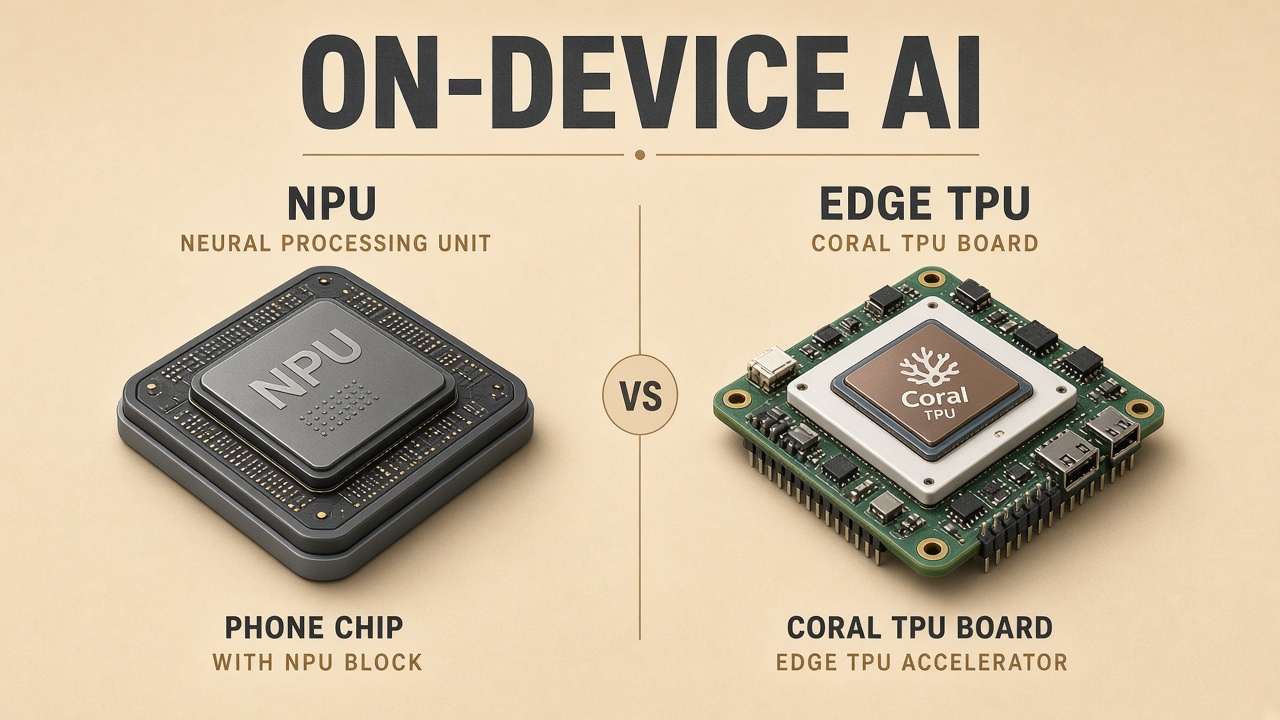
An NPU is a general marketing term for on-chip AI accelerators optimized for neural network operators; Edge TPU is Google's branded accelerator in Coral modules; DSPs often run audio and sensor ML with tight power envelopes. Apple Neural Engine, Qualcomm Hexagon, and Samsung NPU are NPUs in this broad sense. Google Edge TPU appears in Coral USB accelerators and some embedded boards, not in every Android phone.
| Hardware | Typical device | Primary SDK |
|---|---|---|
| Apple Neural Engine | iPhone, iPad, Mac with Apple Silicon | Core ML |
| Qualcomm Hexagon NPU | Android flagships, IoT SoCs | QNN, TFLite delegate |
| Google Edge TPU | Coral Dev Board, USB Accelerator | TFLite + Edge TPU compiler |
| Generic DSP | Earbuds, voice widgets | Vendor-specific, often fixed graphs |
Workload Mapping
Map workloads by operator support, memory footprint, and latency: vision classifiers fit all targets; large language models exceed phone NPUs unless heavily quantized and chunked. Keyword spotting and gesture recognition are sweet spots. Seven-billion-parameter chat models generally need cloud or hybrid private chatbot servers, not Coral USB sticks alone.
Vision and Audio on Device
- Image classification and detection: MobileNet and EfficientDet variants at INT8 run at 30+ FPS on modern NPUs.
- Segmentation: Higher memory; may need input resolution caps on Edge TPU.
- Audio wake word: DSP or tiny NPU graphs under 10 MB.
- Sensor fusion: IMU plus mic pipelines on Hexagon for fitness and industrial wearables.
Language Model Limits
On-device LLMs in 2026 use aggressive quantization (4-bit), sliding windows, and speculated decoding on Apple and Qualcomm flagship chips for short replies, not long document analysis. Developers should measure tokens per second and quality degradation on target hardware before promising offline chat parity with cloud APIs.
Developer Tooling
TensorFlow Lite with delegates targets Android and Coral Edge TPU; Core ML converts PyTorch and ONNX graphs for Apple Neural Engine; Qualcomm QNN SDK exposes Hexagon directly for performance-critical apps. Toolchain fragmentation is the main tax: a model exported for Core ML needs separate conversion for Edge TPU with operator compatibility checks.
- Train in PyTorch or TensorFlow on cloud GPUs.
- Export to ONNX or SavedModel intermediate.
- Quantize to INT8 with representative calibration dataset.
- Compile with Core ML Tools, TFLite converter, or Edge TPU compiler.
- Profile on physical device; simulators lie about NPU timing.
INT8 Quantization Tradeoffs
INT8 cuts memory and raises ops per watt but can collapse accuracy on small objects, rare classes, or sensitive regression heads. Post-training quantization is fast; quantization-aware training recovers accuracy at engineering cost. Edge TPU requires fully integer graphs for many layers; Apple Core ML supports mixed precision. Always compare F1 or MAE on device, not only on desktop float baselines.
Power Budgets
Phone NPUs target hundreds of milliwatts sustained; Coral Edge TPU USB draws a few watts; always-on DSP paths target tens of milliwatts for voice listen modes. Thermal throttling on phones reduces NPU clocks during gaming or charging. IoT designers pick Edge TPU modules when USB or PCIe attached acceleration beats rebuilding around a mobile SoC.
When Cloud Still Wins
Cloud AI APIs win for large models, frequent updates, multimodal reasoning, and centralized logging; on-device wins for privacy, offline, and sub-100 millisecond loops without network round trips. Hybrid designs run wake word and PII-sensitive preprocessing locally then send redacted embeddings upstream.
- Model updates weekly: OTA app size limits favor server-side weights.
- Complex tool use and RAG: Cloud retrieval beats on-phone vector stores beyond modest corpora.
- Regulated audit: Central API logs may simplify compliance versus fragmented device logs.
- Battery-critical always-on: Local DSP beats polling cloud every second.
Decision Framework Without Product Rankings
Pick hardware by deployment surface, not benchmark bragging: iOS apps follow Apple Neural Engine; Android apps target NNAPI or QNN on shipping devices; embedded Linux prototypes often start with Coral Edge TPU dev kits. Maintain a device lab with oldest supported phones. NPUs differ by generation more than spec sheets suggest.
NNAPI and Cross-Vendor Android Deployment
Android Neural Networks API (NNAPI) routes graphs to available accelerators (Hexagon, GPU, CPU) based on device capabilities; performance varies by OEM driver quality more than by your model architecture. Test on Samsung, Pixel, and one budget device minimum before launch. Qualcomm QNN bypasses NNAPI when you need Hexagon features NNAPI hides, at the cost of narrower device coverage. Maintain CPU fallback for devices where NPU delegates crash on specific ops.
Apple Silicon Unified Memory
Apple Neural Engine shares unified memory with CPU and GPU on M-series Macs and A-series phones, simplifying model loading but exposing thermal competition when video and ML run together. Core ML automatically selects compute units; developers can hint preferences but should not hardcode Neural Engine-only paths that fail on older A-chips without ANE support for specific ops. macOS apps shipping both Intel and Apple Silicon builds need separate Core ML compile artifacts.
Security and Model Extraction on Device
On-device weights can be extracted from app bundles or memory; treat embedded models as obfuscated, not secret. Sensitive logic belongs server-side with attestation, or inside Secure Enclave backed pipelines for biometrics. Edge TPU models on embedded Linux require filesystem hardening and signed OTA updates. Pair local inference with private chatbot servers when prompts and responses must never live in APK assets alone.
Ops Monitoring for Edge Models
Ship telemetry on inference latency, thermal throttling events, and quantization fallback rates without uploading raw user media. Compare on-device metrics against cloud API baselines monthly; drift in camera optics or OS updates silently degrades vision models. Version models in app config with staged rollouts identical to server-side canaries, just constrained by app store review timelines.
Frequently Asked Questions
| Question | Short answer |
|---|---|
| Is Edge TPU the same as cloud TPU? | No; Edge TPU is low-power inference hardware; cloud TPUs train and serve large models in data centers. |
| Does every Android phone have NPU? | Most modern flagships include Hexagon or similar; budget devices may lack fast delegates. |
| Can Core ML run on Mac GPU instead? | Yes; Core ML picks Neural Engine, GPU, or CPU based on graph and OS policy. |
| Why does my TFLite model fail on Edge TPU? | Unsupported ops or non-integer tensors; run Edge TPU compiler compatibility report. |
| On-device vs private cloud chatbot? | On-device for small offline tasks; private server for full LLM with data control. |
| Is NNAPI still relevant? | Yes as Android abstraction; vendor delegates determine real performance. |
Is Coral Edge TPU production ready?
Coral suits embedded prototypes and fixed-camera edge boxes; enterprise scale validates supply, thermal, and remote update paths separately. Google product roadmaps change; maintain fallback ARM NPU paths.
Release Checklist for Mobile ML Teams
Before shipping on-device models: run P95 latency on minimum supported OS version, verify INT8 accuracy on diverse skin tones and lighting for vision apps, test offline airplane mode behavior, and confirm model size fits cellular OTA update caps. Document when the app escalates to cloud APIs and what metadata leaves the device. Privacy policies should mention on-chip inference separately from server-side private chatbot routing so users understand which path handles their prompts.
Battery and Duty-Cycle Math
Estimate milliamp-hours consumed per inference multiply by daily inference count plus idle listen power for wake-word paths. Edge TPU USB accelerators on Raspberry Pi class hosts may draw more idle power than integrated Hexagon NPUs on phone SoCs optimized for suspend states. Always-on voice products often keep DSP cores alive while NPUs sleep until keyword detection fires. Spreadsheet duty cycles before choosing Coral over custom mobile apps. Cloud API costs rise linearly with query volume; on-device costs amortize hardware across device lifetime but add engineering headcount for multi-platform conversion pipelines. Document fallback UX when NPU delegates fail and the app routes sensitive prompts to private server chat instead.
Platform Selection Summary
| Target platform | Preferred accelerator path | Cloud fallback |
|---|---|---|
| iOS app | Core ML plus Neural Engine | Private or public API for LLM |
| Android app | TFLite plus NNAPI or QNN | Same |
| Embedded Linux | Edge TPU or SoC NPU | Optional gateway API |
Should apps mix FP16 and INT8 on device?
Mixed precision can recover accuracy on regression heads while keeping backbone INT8, but not all NPUs expose mixed modes through Core ML or TFLite delegates. Validate numerics on device; desktop conversion tools hide rounding differences that break bounding box regression at small object sizes. Regression-heavy IoT apps may need float heads on cloud APIs while keeping classification on-device.
What about wearables and earbuds?
Wearables favor fixed-function DSP graphs for heart rate and voice; general NPUs appear in watch SoCs for richer apps but battery budgets cap model size below phone flagships. Profile on-device inference at cold outdoor temperatures where battery voltage sag throttles clocks.
Are TOPS ratings comparable across vendors?
No; TOPS marketing numbers use inconsistent operator mixes and precisions. Benchmark your graph on target devices and report latency at P95, not peak TOPS.
Can federated learning replace on-device NPUs?
Federated learning trains across devices; inference still runs locally on NPUs or DSPs. Private chatbot servers complement federated setups when models exceed phone memory.
How should OTA model updates work?
Sign model bundles, stage rollout by device cohort, and keep rollback packages sized for cellular download limits. Edge TPU and Core ML bundles differ; maintain separate artifact pipelines from one training job. Log device delegate failures in production telemetry to catch OEM driver regressions early. Re-benchmark after every major OS release on supported devices.
Conclusion
Edge TPU vs NPU is really a question of platform: Google Coral for attachable accelerators, Apple Neural Engine for iOS, Qualcomm Hexagon for Android and IoT. DSPs handle micro workloads. INT8 quantization and toolchain choices matter as much as raw TOPS claims. Cloud APIs still win for large models and rapid iteration; on-device silicon wins for privacy, latency, and offline duty cycles. Evaluate private AI chatbot deployments when data must stay off public training pools but exceeds phone NPU capacity. Maintain conversion pipelines per platform, not one export path dreamed in PyTorch alone. Profile on real hardware, support oldest devices you claim, and treat vendor TOPS as starting points only.