A Bronze Age sherd arrives in the lab with no matching rim. A fragmented inscription survives on three stone pieces. A cranium from a burial context prompts public interest in facial approximation. Archaeological reconstruction has always blended measurement, comparison, and judgment. Machine learning now accelerates pottery assembly, provenance classification, and digital restoration, while generative models tempt teams to fill gaps with plausible but unverified detail. This workflow guide covers input modalities, reconstruction types, uncertainty display, cultural heritage ethics, and publication standards for teams using AI image generator pipelines alongside structured AI research tools. The goal is assistive reconstruction with traceable assumptions, not synthetic history presented as fact.
Which Input Modalities Feed Archaeological AI Reconstruction?
Effective workflows combine 3D scans or point clouds, 2D photographs, compositional assay data, stratigraphic context records, and curated reference corpora matched to period and region. Pottery projects often start with laser-scanned sherds or structured light captures. Inscription work may use multi-view photos or RTI (reflectance transformation imaging) stacks. Facial approximation traditionally relies on skull landmarks from CT scans. Each modality carries noise: erosion rounds breaks, looting strips context, and museum lighting skews color-based classifiers.
| Modality | Common use | Quality risk |
|---|---|---|
| 3D point cloud / mesh | Sherd positioning, vessel fitting | Incomplete scans, post-depositional wear |
| 2D photography | Motif classification, inscription stitching | Perspective distortion, uneven lighting |
| Chemical / isotopic assay | Provenance prediction | Reference set bias, contamination |
| Context metadata | Stratigraphy, burial association | Looted objects lack provenance |
What Reconstruction Types Can AI Assist?
Current archaeological AI applications cluster into vessel reassembly, typology and provenance classification, inscription completion, site-scale digital twins, and facial approximation from osteological remains. A 2024 Journal of Cultural Heritage study proposed a generative framework that simulates fragments and combines deep models to reconstruct Italian Bronze and Early Iron Age vessels from sherds, evaluated by specialists on thousands of records. Separate work applied PotNet-style networks to predict sherd transforms relative to a canonical vessel coordinate system, reducing manual ICP fitting labor. Provenance studies use supervised models on geochemical data, with newer graph neural pipelines purifying reference groups before classification.
Pottery and Object Reassembly
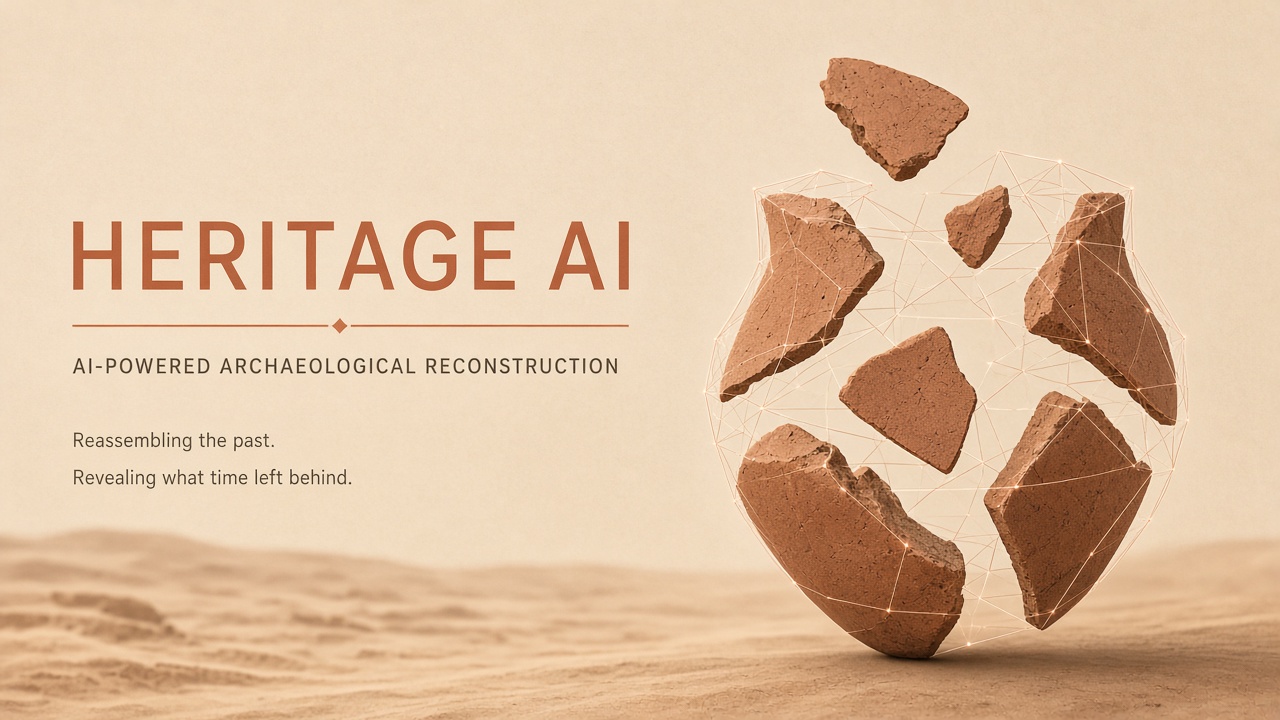
Generative adversarial and diffusion approaches can propose complete vessel shapes from partial evidence. Outputs rank candidate fits for human curators who accept, reject, or request new scans. The assistive step matters: AI proposes; specialists authenticate joins using edge matching, paste analysis, and stratigraphic consistency.
Inscriptions and Text Gaps
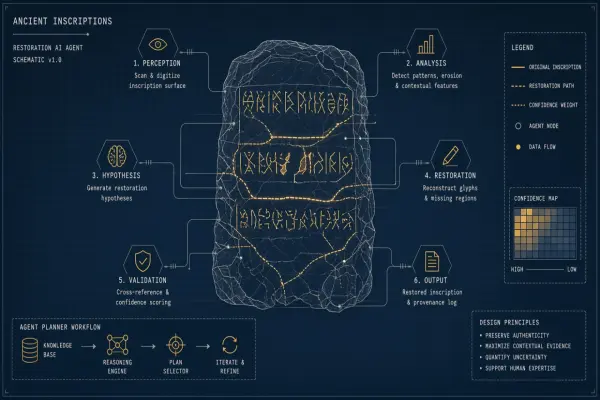
Sequence models trained on epigraphic corpora can suggest missing characters in damaged inscriptions. Risk is high: a confident glyph completion without paleographic review can misdate a site. Workflows should store multiple hypotheses with confidence scores rather than publishing a single filled line as definitive.
Facial Approximation
AI image generator tools can produce photorealistic faces from skull data faster than manual sculpting. SAPIENS and peer commentary warn that photorealism implies certainty the underlying osteology does not support. Skin tone, hair, and expression embed cultural assumptions. Descendant community consultation is essential when remains connect to living peoples.
What Does an End-to-End Workflow Look Like?
A responsible reconstruction workflow moves from digitization through model inference, specialist review, ethics sign-off, and publication with explicit uncertainty layers. Follow these stages:
- Digitize and catalog: Scan artifacts, record find context, attach persistent identifiers.
- Curate training references: Limit models to period-appropriate comparanda; document exclusions.
- Run inference: Generate ranked candidates, not single outputs.
- Specialist review: Archaeologists validate joins, readings, or anatomical landmarks.
- Ethics checkpoint: Consult stakeholders for sensitive human remains or sacred objects.
- Publish with metadata: Release meshes, confidence maps, and model version hashes where policy allows.
Provenance Prediction with Machine Learning
Beyond shape reconstruction, teams apply supervised models to geochemical and isotopic assays to infer where pottery was manufactured. Reference collections from known kiln sites train classifiers; archaeological sherds from excavations receive predicted origins with probability scores. Graph neural network pipelines now purify noisy reference groups using density clustering and autoencoder reconstruction error before classification, reducing false assignments when legacy museum catalogs mix production centers. Provenance AI supports trade route hypotheses but cannot override looting concerns: a statistically likely origin does not legalize an unprovenienced object.
How Should Teams Display Uncertainty?
Never ship a photorealistic reconstruction without visual or textual markers separating measured data from model inference. Effective patterns include wireframe overlays on inferred regions, heatmaps of per-vertex confidence, side-by-side alternative hypotheses, and captions stating which features are osteologically constrained versus artistically chosen. Journals increasingly expect supplementary files listing model architectures and training data sources. Public-facing museum displays should use labels like "scientific approximation" rather than "portrait of individual X" when identity is unknown.
Generative models trained on broad internet datasets may import modern hairstyles, clothing, or architecture into ancient scenes. That contamination produces engaging images and poor scholarship. Filtering training data to excavation-backed corpora reduces but does not eliminate bias. Human reviewers must catch anachronisms models treat as high probability.
Case Study: Generative Pottery Reconstruction
The Italian Bronze and Early Iron Age pottery framework published in Journal of Cultural Heritage simulates breaks, trains three cooperating deep models, and reconstructs vessels from single sherds across six burial contexts. Specialists evaluated thousands of fragment records against complete reference vessels. The pipeline released open code on GitHub (ReconstructionPots), setting a reproducibility standard other regions can adapt. Teams replicating the method should swap comparanda corpora rather than reusing Italian typologies blindly on unrelated ceramic traditions. Transfer learning without local expert review risks imposing foreign vessel shapes onto indigenous pottery sequences.
What Cultural Heritage Ethics Apply?
Ethical reconstruction requires provenance verification, descendant community engagement where applicable, repatriation respect, and refusal to beautify looted objects. UNESCO frameworks and national heritage laws restrict export and publication of illicitly excavated materials. AI cannot launder provenance gaps. If context is unknown, reconstruction may still proceed for conservation science internally, but public release may be inappropriate.
- Confirm legal authority to scan and publish.
- Seek informed consent from indigenous and local communities tied to remains or sacred motifs.
- Avoid sensationalized facial renders used as clickbait without tribal review.
- Credit traditional knowledge holders when motifs or stories inform visualization.
- Store sensitive data with access controls, not open repositories by default.
How Should Archaeologists and ML Engineers Collaborate?
Successful projects assign clear ownership: archaeologists define research questions, approve comparanda, and sign off on public visuals; ML engineers own pipelines, evaluation metrics, and compute reproducibility. Weekly review sessions where specialists flag anatomically impossible facial soft-tissue thickness or ceramically implausible rim diameters prevent demo-ware from reaching press releases. Funders increasingly require data management plans covering 3D scan retention, tribal consultation timelines, and embargo rules for sensitive sites. Treat the collaboration as joint authorship with shared accountability, not a service contract where "the AI team" drops meshes over the wall.
What Publication Standards Should Researchers Follow?
Publish methods, training data scope, evaluation metrics, and failure cases alongside visually compelling reconstructions. The Italian pottery generative paper released code and supplementary materials for replication. Follow that precedent: DOI for datasets, versioned models, and blinded specialist evaluation scores. Peer review should interrogate whether AI shortened labor or introduced new error modes. Negative results (failed joins, rejected inscription readings) belong in appendices to prevent publication bias toward pretty meshes.
Cross-link computational outputs with AI research reproducibility norms: fixed random seeds, held-out site tests, and geographic splits so models do not memorize a single museum collection. Reviewers familiar only with classics may need plain-language explanation of model limits; reviewers familiar only with machine learning may need stratigraphy tutorials. Interdisciplinary papers should serve both.
Which Software Stacks Do Teams Use?
Archaeological reconstruction pipelines mix open-source deep learning frameworks, mesh processing tools, and museum collection management systems. Pottery projects may export meshes from Meshroom or commercial scanners into Python notebooks running PyTorch models. Inscription teams stitch RTI derivatives before character recognition. Facial approximation may chain landmark detection, cranial measurement solvers, and texture mapping from AI image generator backends. Standardize file formats (PLY, OBJ, glTF) early so specialists and ML engineers exchange assets without proprietary lock-in. Version-control model weights alongside publication DOIs so future researchers can reproduce or challenge results.
Frequently Asked Questions
Is generative AI bad for archaeology?
Not inherently. Generative tools can accelerate tedious sherd matching and public education when labeled as hypothetical. Harm arises when photorealistic outputs masquerade as verified fact or when training data includes looted or decontextualized objects. Critical, specialist-supervised use is the standard.
Can machine learning determine pottery provenance?
Supervised models on geochemical assays can classify production origins when reference collections are representative. Accuracy collapses if reference groups include mislabeled sherds or if test samples fall outside training chemistry. Graph-based purification pipelines attempt to clean reference noise before classification. Results require convergent evidence from typology and excavation context.
Should museums show AI reconstructions to visitors?
Yes, with transparent labeling, multiple hypotheses where uncertainty is high, and community input for human remains. Interactive tablets that toggle between fragment reality and proposed completion teach science better than a single uncaptioned portrait.
Can reconstruction datasets be open access?
Often partially. 3D scans of sensitive burial goods may carry access restrictions. Metadata and model weights may be open while high-resolution meshes remain embargoed. Follow funder and tribal data sovereignty requirements.
How does reconstruction differ from restoration?
Physical restoration alters the artifact. Digital reconstruction creates a separate model layer. AI assists both, but digital workflows are reversible. Teams should archive raw scans before any virtual inpainting so future methods can revisit the same evidence.
Can AI build full site digital twins?
Photogrammetry plus generative inpainting can propose missing wall segments or rooflines for virtual tourism. The same uncertainty rules apply: label speculative geometry, separate laser-scan truth from model inference, and restrict public flythroughs when sacred spaces require access control. Digital twins aid conservation planning when storms or conflict threaten monuments; they should not replace condition surveys on site.
How do journals review AI reconstruction papers?
Expect requests for held-out validation sites, blinded specialist scoring, and release of training data manifests. Reviewers may ask whether results improve on classical typology alone or merely produce prettier meshes. Anticipate replication packages as a condition of acceptance in top-tier venues.
AI for archaeological reconstruction moves fragments toward interpretable wholes faster than manual methods alone. Success depends on provenance discipline, visible uncertainty, and ethics review that treats living communities as stakeholders, not audiences. Let models propose; let archaeologists certify what history claims.