Commercial beekeepers lose colonies to queen failure, Varroa, starvation, and winter cold without nightly inspections. Beehive colony collapse AI listens to hive acoustics, tracks weight and humidity, and classifies stress patterns with edge CNNs and fuzzy neural networks. Systems like Bee Smart Detection report up to 99 percent accuracy for swarming or queen loss on labeled audio, while winter survival models reach AUC around 0.73 on multi-modal year-long data from Canadian apiaries.
Pollination contractors and hobbyists should note that AI predicts risk indicators, not a single "CCD score" validated by entomology societies. Readers exploring AI chatbot ag tools should ask for hive-independent validation. More explainers sit on the EliteAI.tools blog index.
Migratory pollination routes spanning almond orchards, blueberry barrens, and clover seed fields expose hives to pesticide cocktails and nutritional stress that vary week to week. Acoustic classifiers trained in stationary research apiaries may miss yard-level vibration from adjacent machinery. Temperature probes placed too far from the winter cluster underestimate brood nest cooling failures that precede spring deadouts. Integrating weight scales with audio helps distinguish nectar dearth from queenlessness when buzzing activity drops for different biological reasons.
What Beehive Colony Collapse AI Means in Plain Language
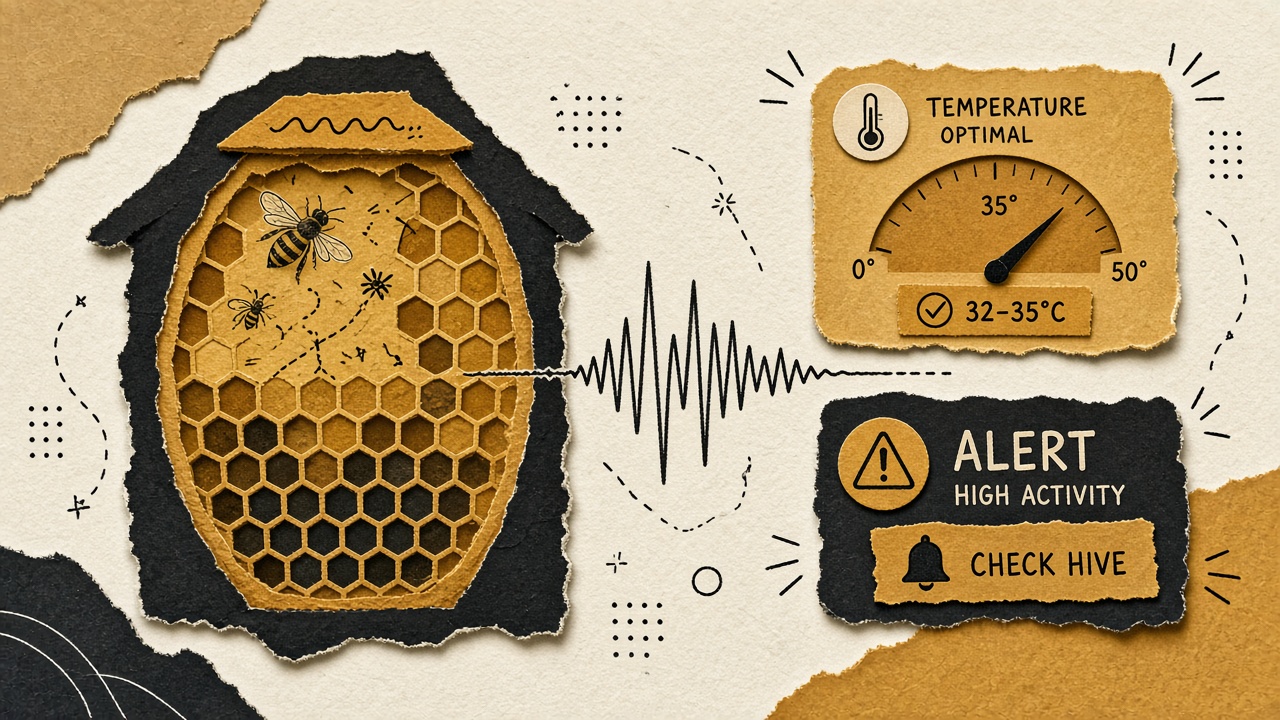
Beehive colony collapse AI applies machine learning to in-hive sensors and audio to detect early warning signs such as queenlessness, swarming preparation, famine stress, or winter mortality risk before deadouts appear. Colony collapse disorder (CCD) as a research term describes complex multi-factor die-offs; commercial AI focuses on actionable sub-events beekeepers can intervene on.
A healthy hive hum carries structured acoustics from wing beats and fanning. Queen loss shifts frequency content within hours; swarming builds characteristic pulses. Temperature and humidity spikes correlate with clustering or moisture stress but are ambiguous alone, motivating multimodal fusion. Colony collapse disorder as a research diagnosis describes complex multi-factor die-offs where foragers fail to return and brood rearing collapses; commercial AI focuses on actionable sub-events beekeepers can intervene on before irreversible depopulation appears at the hive entrance.
ResNet-50 convolutional networks on hive sound mel-spectrograms achieve up to 99% classification accuracy for swarming and queen presence or absence events in controlled published experiments, though open-yard deployments must filter tractor noise, adjacent hive cross-talk, and wind-induced box resonance that depress recall below lab benchmarks.
| Modality | Signals | Typical model |
|---|---|---|
| Audio | Queen status, swarm prep | CNN on mel-spectrograms, ResNet |
| Temperature and humidity | Clustering, moisture stress | Fuzzy neural networks |
| Weight | Nectar flow, starvation | Threshold plus ML residuals |
| Multimodal fusion | Winter survival | Gradient boosting, random forest |
How the Underlying AI Pipeline Works
IoT nodes sample audio and environmental channels, extract MFCC or spectrogram features on edge hardware, run classifiers locally, push alerts to mobile apps, and log time series for apiary-level dashboards. Low-power designs target one season per battery swap; Wi-Fi backhaul uploads ambiguous clips for cloud reanalysis.
Bee Smart Detection edge stack
Bee Smart Detection combines a fuzzy-stranded neural network on temperature and humidity for critical condition flags with ResNet CNNs on audio for swarming and queen loss. Reported accuracies reach about 95 percent for environmental CCD-related conditions and up to 99 percent for audio events on test sets, with ResNet-18 offering faster edge inference at roughly 93 percent accuracy versus heavier ResNet-50.
Bee Sound Detector multimodal alerts
Bee Sound Detector (BeeSD) integrates sound with temperature and humidity to spot famine, extreme weather stress, queen loss, and swarming, pushing mobile notifications through cloud logging. The design emphasizes low cost and easy install for commercial apiaries managing hundreds of remote hives.
Winter survivability forecasting
A Canadian study on 45 hives across two apiaries used year-long audio, humidity, and temperature to predict winter survival with AUC-ROC about 0.730, highlighting audio as especially informative versus humidity alone. Generalization to other climates requires retraining because winter patterns differ by latitude and insulation practice.
Queenless detection at the edge
Mel-spectrogram classifiers with transfer learning across hives deploy on Arduino Zero-class devices for queenright versus queenless states, trading cloud dependency for memory limits. Queenlessness studies report strong accuracy on held-out hives when trained with location-diverse datasets. MFCC features extracted from queenless mel-spectrograms often shift within 24 to 48 hours of queen loss, faster than weekly manual inspection schedules, giving beekeepers a window to introduce replacement queens before brood rearing irreversibly stalls.
BeeSD multimodal acoustic, temperature, and humidity fusion
Bee Sound Detector (BeeSD) integrates sound with temperature and humidity to spot famine, extreme weather stress, queen loss, and swarming, pushing mobile notifications through cloud logging. Multimodal fusion outperforms single-sensor baselines by catching cases where acoustics look normal but brood temperature regulation fails during queen events. Aligning spectrogram windows with thermal ramps improves early swarming detection compared to audio-only classifiers deployed without environmental context.
- Install calibrated microphones, temperature probes, and humidity sensors per hive.
- Stream data to secure storage with hive ID and yard metadata.
- Label events from inspections: swarms, queen replacements, treatments, winter outcomes.
- Train ResNet-50 audio classifiers and BeeSD-style multimodal fusion models.
- Validate winter survival models with held-out seasons (report AUC, not accuracy alone).
- Deliver ranked alerts with intervention playbooks (feed, treat, requeen, combine).
Real Deployments and Published Evidence
Evidence clusters in academic IoT prototypes and commercial bee-tech pilots; long-term randomized trials linking alerts to colony survival rates remain sparse. Varroa-specific acoustic prediction shows promise in review literature but needs broader field validation before treatment automation. Fuzzy-stranded neural networks report approximately 95% classification of defined CCD-related condition labels in published experiments. ResNet-50 on mel-spectrograms reaches up to 99% accuracy for swarming and queen presence or absence on curated test audio from source studies.
Winter survival prediction across 45 hives in Canada achieved AUC-ROC near 0.730 using year-long multimodal archives, illustrating moderate discriminative power useful for triaging supplemental feeding but insufficient as a sole decision rule. Commercial yards deploying one gateway per pallet of four hives buffer audio features locally when connectivity drops during remote pollination contracts. Standardizing microphone placement relative to brood frames remains an under-documented protocol variable that shifts mel-spectrogram baselines between vendors.
Intervention economics and apiary scale
A 99% swarming classifier saves little if the beekeeper cannot reach the yard within hours. Prediction value rises when alerts integrate with route optimization for commercial crews visiting hundreds of hives weekly. Pollination contractors facing almond bloom guarantees use winter AUC scores to prioritize fondant blocks, but false negatives still risk contract penalties when colonies fail mid-season. ROI calculations should compare sensor subscription costs against labor saved on manual inspections, not only headline accuracy percentages from lab datasets.
Varroa loads and treatment timing
Acoustic stress signatures overlap between queen events and subclinical varroa infestation, so beekeepers should log mite counts and treatment dates as metadata features when training yard-specific models. Fuzzy-stranded networks reporting 95% accuracy on defined CCD-related condition sets apply to curated labels that may include varroa-driven stress when entomologists annotate archives carefully. Automated treatment dispensing triggered by AI alerts remains experimental and demands veterinarian oversight for approved acaricide dosing schedules.
Limits, Risks, and Ethical Guardrails
Microphone placement inside hives picks up wind and traffic noise that false-trigger alerts. Over-notification causes alert fatigue; beekeepers ignore real queen failures. Models trained in Mediterranean climates may misread insulated northern hives. Automated interventions (closing entrances, dispensing treatments) demand fail-safe human override.
- Sensor cost: Per-hive hardware limits adoption by hobbyists and developing regions.
- Label scarcity: True CCD events are rare and diagnostically ambiguous.
- False alarms: Excessive swarming alerts cause alert fatigue and ignored warnings.
- Data ownership: Cooperatives must clarify who owns hive telemetry.
- Pesticide politics: Models detecting stress cannot alone prove neonicotinoid causation.
Pollination-dependent agriculture ties hive health to food security; overstated CCD prediction accuracy in investor pitches could misallocate conservation funding away from habitat restoration toward gadget subscriptions. Beekeepers should retain ownership of hive telemetry and demand export formats if they switch vendors, because multi-year acoustic archives train better queenless detectors than single-season snapshots.
Who Should Use This and Who Should Wait
Commercial migratory beekeepers with hundreds of hives, pollination contractors facing bloom guarantees, and research apiaries building labeled BeeSD-style archives should deploy acoustic and thermal AI now. Backyard beekeepers with a few hives should prioritize varroa monitoring and nutrition before buying premium sensor stacks. Sensor AI pays off when labor cost of manual yard visits exceeds hardware amortization across a full pollination season.
| Beekeeper type | Adopt | Wait |
|---|---|---|
| Commercial pollination outfit | Pilot audio alerts on remote yards | Scale without apiary-specific calibration |
| Hobbyist with few hives | Use weight plus manual checks first | Buy CCD prediction claims without peer review |
| Research apiary | Contribute labeled audio across seasons | Treat 0.73 AUC winter model as deterministic fate |
| Cold-climate apiary | Use winter survival models (AUC 0.730) to triage feeding | Combine with varroa and store weight checks |
Frequently Asked Questions
Does AI diagnose CCD officially?
No. Tools detect precursors like queen loss or stress clusters; CCD remains a multi-factor research diagnosis requiring lab analysis. Marketing "CCD AI" oversimplifies entomology.
Is 99 percent audio accuracy realistic in all yards?
Published ResNet results come from labeled experimental datasets; noisy commercial yards likely see lower recall until retrained. Validate on your apiary before trusting alerts.
What does winter AUC 0.730 imply?
Moderate ranking ability to separate surviving versus failing hives months ahead, not perfect prediction. Use scores to prioritize inspections and feeding, not abandon hives automatically.
Can acoustics detect Varroa?
Research explores spectral descriptors for infestation stress, but commercial Varroa treatment still relies on mite counts and approved acaricides. Treat acoustic Varroa alerts as experimental.
Is hive audio data private?
Cloud-uploaded spectrograms may contain ambient farm sounds; read vendor data policies before deploying near residential areas. Prefer edge processing when privacy matters.
What hardware cost should beekeepers expect?
BeeSD-class devices target low-cost IoT stacks, but scaling to hundreds of hives still exceeds manual inspection cost unless labor savings are quantified. Run ROI on one yard first.
What is BeeSD multimodal monitoring?
Bee Sound Detector integrates acoustic recordings with temperature and humidity time series for training colony health classifiers that outperform single-modality baselines on early stress detection. Fusion models on BeeSD-style data catch brood regulation failures invisible to microphones alone.
Can chatbots interpret hive alerts?
Chatbots can explain alert types and suggest standard interventions but should not diagnose disease or prescribe off-label treatments without veterinarian or extension guidance. Link alerts to inspection checklists, not autonomous chemical dosing without human confirmation.
Conclusion
AI beehive colony collapse prediction turns acoustic, temperature, and humidity streams into early warnings through BeeSD multimodal fusion, fuzzy-stranded neural networks reporting roughly 95% CCD condition classification, ResNet-50 mel-spectrogram models reaching 99% on swarming and queen events, and winter survival scoring with AUC 0.730 across 45 Canadian hives. Queenless MFCC features bridge the gap between queen failure and visible depopulation. Deploy sensor AI to prioritize commercial yard visits and winter feeding, validate locally beyond published lab accuracy, and treat collapse prediction as triage alongside varroa management and nutrition, not a substitute for hands-on beekeeping craft.