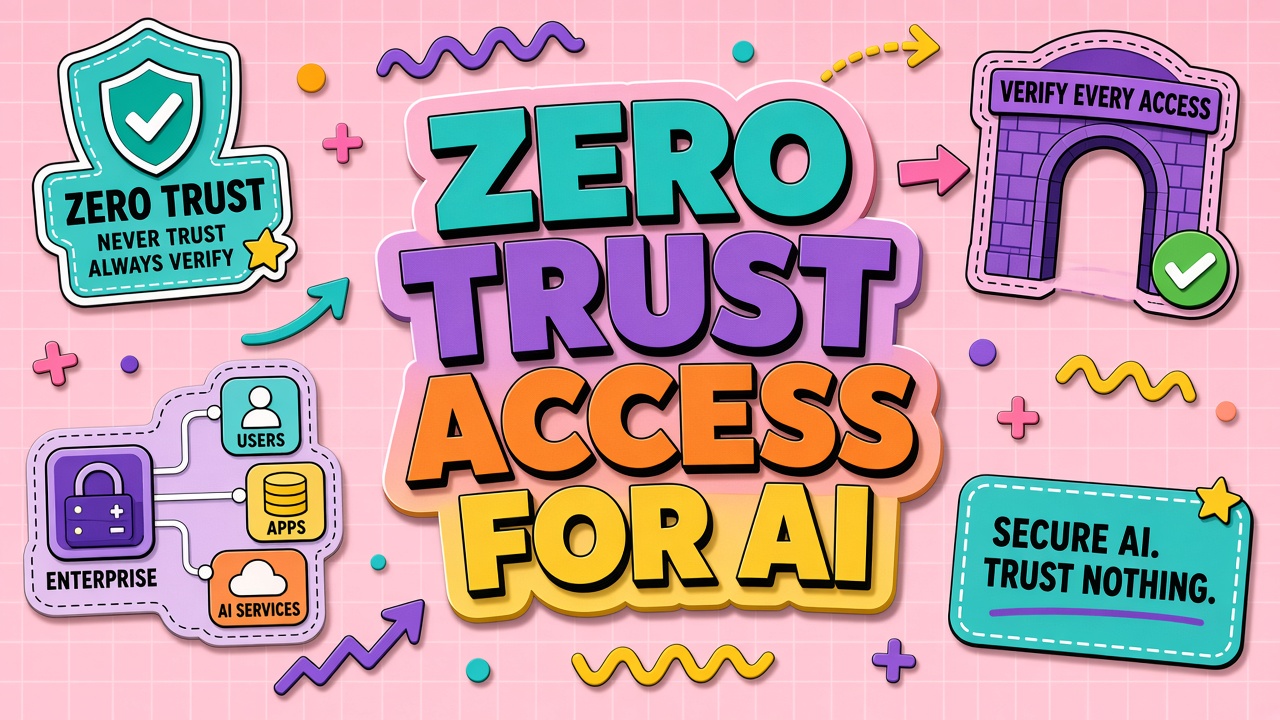
VPN access once meant employees could reach any internal app. AI tools break that model: SaaS assistants, browser extensions, and API keys proliferate outside the corporate network. A zero trust AI access approach verifies identity, device, and context on every session, grants least privilege to models and data, and assumes breach.
Apply zero trust when rolling out AI chatbots and AI APIs that connect to CRM, ticketing, and code repositories. Traditional perimeter security cannot see prompt-level abuse.
Zero Trust Basics Applied to AI
NIST zero trust pillars translate to AI controls:
- Verify explicitly: SSO plus MFA for every AI admin and user login; no shared team accounts
- Least privilege: Role-based tool access, scoped API keys, per-workflow data filters
- Assume breach: Log prompts and tool calls, DLP on egress, rapid key revocation
"Trust but verify" fails when a compromised laptop can paste customer databases into a consumer chat tab. Default deny for unapproved AI domains at the proxy complements approved enterprise SKUs.
Identity, Device, and Context Checks
Before granting AI tool access, evaluate:
- Identity: Corporate IdP group membership, not just email domain on signup
- Device: Managed endpoint, patch level, disk encryption, jailbreak/root detection for mobile
- Context: Geo, time, risk score from IdP, anomalous login patterns
- Session: Short-lived tokens, step-up MFA for sensitive connectors
Customer-facing chatbots need bot-specific controls: rate limits, CAPTCHA, session binding, and fraud signals separate from employee SSO.
Continuous Authorization for API Keys
Static API keys in CI pipelines are a common AI integration pattern. Treat keys like passwords with lifecycle management:
- Issue per environment (dev/staging/prod) with minimal model and data scopes
- Rotate on schedule and after personnel changes
- Store in secrets manager, never in repos
- Monitor usage for anomalous volume or new IP ranges
- Revoke immediately on leak suspicion
Prefer OAuth with short-lived tokens for user-delegated access to AI APIs instead of long-lived master keys where vendors support it.
Micro-Segmentation for AI Data Paths
Segment networks so AI integration workers can reach only approved endpoints: vector DB, model gateway, audit sink. Block lateral movement from a compromised agent container to payroll systems.
Data paths to segment: user browser to SaaS AI, internal app to model gateway, RAG indexer to document store, agent tool executor to third-party APIs. Map each path in architecture reviews and enforce with firewall rules or service mesh policies.
| Control | AI-specific note |
|---|---|
| SSO / SCIM | Deprovision AI seats on offboarding same day |
| CASB / SSE | Block consumer AI uploads of sensitive DLP tags |
| Private link | Keep inference traffic off public internet |
Implementing Zero Trust Rollout for AI
Phase one maps every AI entry point: browser chat, IDE plugins, API keys, automation connectors, and mobile apps. Phase two attaches identity provider groups to each entry point with least privilege. Phase three enables device compliance checks for high-sensitivity tiers. Phase four adds continuous monitoring on anomalous token usage and impossible travel login patterns.
Contractors receive scoped accounts with end dates synced from HR or procurement systems. BYOD access should route through browser isolation or VDI when pasting customer data is expected. Personal consumer accounts on corporate devices should be blocked or heavily DLP-scanned per policy.
Agent workloads need service principals distinct from human SSO. Each agent gets minimum tool permissions, break-glass approval for destructive actions, and immutable audit logs shipped to SIEM. Treat agent credentials like production database passwords with rotation and vault storage.
Micro-segmentation for RAG means separate vector indexes per data class with retrieval filters enforced server-side, not only in prompt instructions. Prompt injection attempts should not escalate retrieval into HR or finance corpora from a public help bot index.
Zero trust is never finished. Quarterly access reviews should include AI-specific entitlements: who can enable plugins, who can export logs, who holds org admin on vendor consoles. Orphaned admin accounts are a common finding after reorganizations.
Conditional Access Policies
IdP conditional access can block AI SaaS from unmanaged devices, require compliant OS patch level, or step-up MFA when accessing connectors to production CRM. Policies should tag AI tools as a group for bulk updates when you add new vendors.
Session lifetime for chatbot admin consoles should be shorter than general SSO because admins can export conversation logs.
ZTNA and AI SaaS
Zero trust network access brokers can wrap legacy AI web apps that lack modern SSO. Traffic flows through broker for DLP inspection before reaching vendor. Latency tradeoff is acceptable for high-risk data classes.
API gateway pattern
Centralize AI API calls through an internal gateway that injects auth, strips PII, logs requests, and enforces per-app rate limits. Applications never hold provider master keys.
Identity-Centric Controls in Practice
Map IdP groups to vendor roles: Viewer, Editor, Admin, API Key Manager. Never grant Admin broadly for convenience. Separate group for break-glass admins with MFA hardware key requirement and session recording. Quarterly review removes users who changed roles or left.
Device trust signals integrate via MDM compliance status passed through SAML claims or CASB policies. Non-compliant devices receive read-only access to public documentation chatbots, not customer data workflows. Document exceptions with CISO approval and expiry.
API key rotation calendar should align with employee offboarding and major releases. Automate rotation where vendor supports multiple active keys during grace period. Keys in git history require revocation even after removal commit; scan repositories continuously.
Zero Trust for Agents and Automation
Autonomous agents violate implicit trust if they inherit broad OAuth tokens. Issue scoped tokens per agent instance with allowlisted endpoints. Human approval step for actions above threshold: send email, delete record, post public content. Log proposed action and approver identity immutably.
Cross-border data paths need explicit policy: EU employee on US trip accessing EU-hosted tenant may be blocked or routed through approved VDI. AI vendors with multi-region tenants should pin data residency per workspace and enforce at network layer, not honor system.
BYOD contractors on agent projects should use dedicated VDI with clipboard restrictions preventing paste into personal consumer AI accounts. Technical control plus policy beats policy alone for high-sensitivity agent rollouts.
Continuous Monitoring and Response
SIEM rules should alert on: new API key created, admin role granted, spike in tokens per hour per key, login from new country, and disabled MFA attempts. Pair alerts with runbooks that include key revocation steps and user communication templates for suspected compromise.
Zero trust maturity assessments score identity, device, network, application, and data pillars annually. AI tools should appear as explicit line items in application pillar, not hidden inside generic SaaS score. Progress tracking justifies budget for CASB, vault, and MDM investments.
Document zero trust decisions in architecture decision records (ADRs) so future teams understand why a chatbot is blocked on BYOD or why only one IdP group may enable code execution plugins. ADRs prevent security regressions during rushed feature launches when new engineers lack incident context from last year's breach drill.
Frequently Asked Questions
Contractors and BYOD?
Issue time-bound access via IdP groups. BYOD may be limited to browser-only approved SaaS with DLP, no local model downloads of sensitive corpora.
Autonomous agents?
Agents need service identities with narrower scopes than the human who launched them. Continuously re-evaluate agent permissions each tool call where platforms support it.
Shadow AI vs zero trust?
Zero trust includes discovering unsanctioned AI use via DNS/proxy logs and offering approved alternatives with equivalent UX.
Does verification hurt UX?
SSO once per session is acceptable. Risk-based step-up only on sensitive actions balances security and friction.
Small teams without enterprise IdP?
Start with MFA, shared secrets ban, approved vendor list, and API key rotation. Grow into full ZTNA as headcount and data sensitivity increase.
The Bottom Line
A zero trust access model for AI tools verifies identity and context continuously, scopes API keys tightly, and segments data paths. Deploy alongside chatbots and APIs before connectors touch production customer data. Perimeter VPN access is insufficient when the model is the new network edge.
Zero Trust Maturity Roadmap for AI
Phase 1: SSO and MFA on all approved AI admin consoles. Phase 2: CASB discovery of shadow AI domains. Phase 3: DLP on paste and upload. Phase 4: private link to model APIs. Phase 5: per-workflow service identities for agents. Most enterprises are phase 1–2; document honest current state in risk register.
Measure progress: percent of AI spend through SSO-provisioned seats vs credit card shadow. Target 95% within 12 months of program launch.