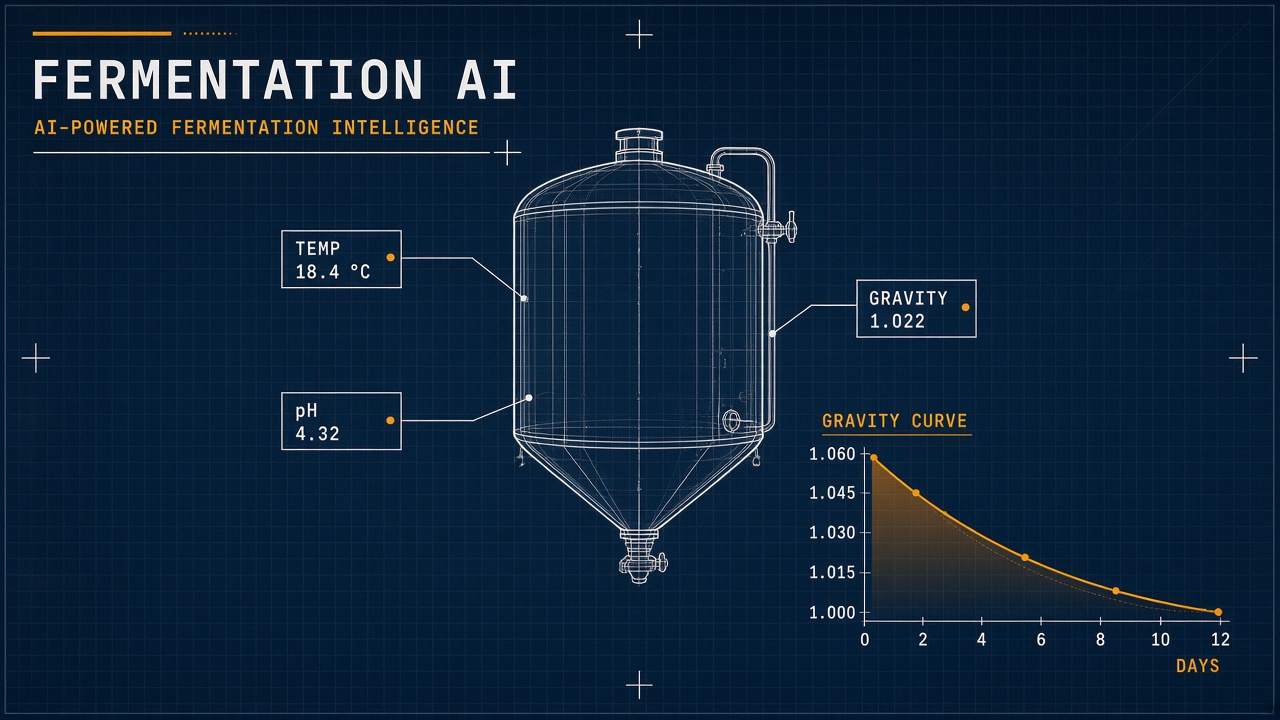
AI fermentation optimization for brewing uses temperature, pH, dissolved oxygen, and specific gravity time series to predict batch outcomes, shorten fermentation cycles, and catch off-flavor precursors before packaging. Long short-term memory networks, autoregressive recurrent models, and reinforcement-learning temperature schedulers trained on thousands of commercial batches outperform recipe-specific kinetic equations when yeast strain, hop schedule, or tank geometry changes. Craft breweries from Kyoto Craft Bank to research pilot plants at Sheffield Hallam University demonstrate 20 to 30 percent fermentation time reductions without sacrificing sensory targets when brewmasters retain final approval. Teams exploring AI research in process industries or comparing popular AI tools for manufacturing analytics should treat fermentation models as decision support, not replacements for sensory evaluation.
Variables That Determine Beer Consistency
Beer consistency depends on wort composition, pitch rate, fermentation temperature profile, pH trajectory, dissolved oxygen at knockout, and yeast health; small deviations compound across multi-day fermentations. Apparent extract derived from specific gravity tracks sugar conversion. Temperature shapes ester and phenol production: ale strains near 18 to 22 degrees Celsius versus lager schedules stepping from 10 to 14 degrees. pH drift affects enzyme activity and hop utilization perception. Dissolved oxygen at pitch supports cell growth but excess later invites oxidation off-flavors.
Mixed-culture and brett-forward beers add microbial interaction complexity that first-principles models struggle to capture. Data-driven approaches using autoregressive RNNs on time-from-pitch, gravity, pH, and fluid temperature handle sporadic offline sampling typical of craft budgets. The Neural Brewmeister LSTM study trained on 1,305 fermentations across ales, IPAs, lagers, and mixed cultures, achieving apparent extract RMSE near 0.34 degrees Plato and pH RMSE near 0.074 on held-out medoid batches.
Diacetyl, acetaldehyde, and sulfur compounds define many quality failures. Predictive models flag gravity plateaus and temperature excursions that correlate with vicinal diketone precursors, giving brewers lead time for diacetyl rests before crash cooling. Sensory panels remain the acceptance gate: AI narrows which tanks need human tasting on a busy production day.
Sensor Placement in Fermenters
Reliable fermentation AI starts with calibrated inline or drop-port sensors for temperature, pressure, gravity, and optionally dissolved oxygen, sampled at intervals tight enough to capture diurnal tank stratification. Temperature probes mid-depth avoid false readings from chilling jacket contact. Sanitary fittings on cone ports support manual gravity samples that anchor hydrometer truth for model calibration. Optical density probes estimate gravity continuously but need periodic hydrometer verification to correct drift from yeast turbidity and hop particulates.
Sampling frequency trades cost against model accuracy. Research AR-RNN models benefit from high-frequency multivariate streams; craft breweries with daily manual gravity reads can still train usable models by interpolating between samples, though uncertainty bands widen. Wireless loggers on smaller conical tanks offer middle-ground five-minute temperature resolution without full SCADA investment.
Data hygiene matters: tank IDs, recipe version, yeast generation, and dry-hop timing must join sensor streams in a single batch record. Missing metadata breaks cross-batch learning when the same IPA recipe ferments differently after hop supplier change. Brewery information systems should store one immutable batch key linking all time series.
| Sensor | Typical range | ML use case |
|---|---|---|
| Temperature | 0.1 degree C resolution | Schedule optimization, ester control |
| Specific gravity | Daily to continuous | Attenuation forecast, stuck fermentation alert |
| pH | 0.01 unit offline lab | Acid stress, wild micro risk flags |
| Dissolved oxygen | ppb at pitch and transfer | Oxidation risk, yeast health |
Predictive Models for Diacetyl and ABV
Predictive models forecast final ABV from gravity curves and estimate diacetyl rest timing from temperature-gravity coupling, letting brewers adjust schedules before sensory failure. LSTM roll-outs over 0 to 300 hours predict one-step-ahead extract and pH trajectories for process monitoring. Model predictive control frameworks use LSTM plant models to propose temperature schedules that minimize time-to-target attenuation while respecting flavor constraints encoded by brewmasters. Yokogawa and Craft Bank's 2025 proof of concept applied reinforcement-learning FKDPP to Bank IPA fermentation, shortening duration from 336 to 240 hours, a 28 percent reduction, while meeting aroma and taste criteria through manual temperature execution reviewed by the brewmaster.
ABV estimation from apparent extract uses standard formulas but ML improves when wort FAN, yeast strain, and pressure fermentation variables interact nonlinearly. Diacetyl prediction benefits from linking alpha-acetolactate precursor kinetics to temperature spikes: models trained on historical gas chromatography or sensory diacetyl scores learn early warnings from gravity slope changes alone when lab data is sparse.
Mixed-culture beers require separate model heads or fine-tuned weights because Brettanomyces and Lactobacillus timelines diverge from Saccharomyces monoculture curves. Transfer learning from large ale datasets to small sour program batches reduces cold-start pain when a brewery adds one foeder line.
Small Brewery ROI Calculations
ROI for fermentation AI on small breweries combines tank-turn acceleration, reduced dump batches, and labor saved on manual sampling, minus sensor capital and software subscriptions. A 28 percent shorter fermentation on a 10-hectoliter fermenter frees roughly one additional turn per month per tank if scheduling allows, translating to incremental revenue without new capital equipment. Avoiding one dumped 20-barrel batch per quarter from early stuck-fermentation detection may exceed annual analytics software cost alone. Manual gravity and sensory labor drops when dashboards prioritize which tanks need attention.
Entry costs range from spreadsheet logging with open-source Python LSTM notebooks to turnkey brewery monitoring platforms with continuous dissolved oxygen and gravity. Pilot one high-volume flagship SKU before rolling models across seasonal releases with sparse history. Payback often lands in 12 to 24 months for 1,000 to 5,000 hectoliter breweries running tight tank capacity.
Staff training should cover model limits: novel hop varieties, water chemistry changes, and yeast repitch beyond fifth generation may fall outside training distribution. Brewmasters override AI temperature suggestions when sensory checks conflict, preserving brand trust over blind automation.
Extension to Wine and Kombucha
The same time-series ML patterns extend to wine malolactic fermentation, kombucha SCOBY acid profiles, and distillation wash ferments when sensor streams and batch metadata are comparable. Wine tanks monitor brix, temperature, and cap management events; models predict stuck fermentations on high-sugar must. Kombucha tracks pH and Brix across shorter 7 to 14 day cycles where temperature drift sours batches quickly. Transfer learning requires retraining: beer yeast metabolism differs from MLF bacteria, but LSTM architectures persist.
Cidery and mead producers with irregular production schedules benefit most from anomaly detection rather than aggressive schedule compression: flagging outliers beats shaving hours off already-short ferments. Regulatory labeling for ABV still demands approved measurement methods; ML forecasts guide operations but legal ABV reporting uses standardized lab or inline alcohol analyzers where required.
Quality, Sensory, and Regulatory Alignment
Machine learning forecasts must align with sensory panels, lab analysis, and labeling regulations so optimized batches still meet brand flavor targets and legal alcohol declarations. Breweries run triangle tests and descriptive analysis panels when AI-shortened fermentations complete; statistical significance on preference or defect detection gates release. Gas chromatography for diacetyl and vicinal diketones validates model alerts when inline sensors are unavailable. TTB and regional regulators require approved methods for alcohol by volume on labels; ML-predicted ABV guides operations but official reporting uses hydrometer, distillation, or NIR analyzers certified for compliance.
Hop creep and refermentation in packaged beer remain risks if AI schedules crash temperature before true terminal gravity, leaving fermentable sugars that activate in the bottle. Models should include packaging hold-time features and pressure logging from bright tanks. Quality teams maintain hold-and-release protocols independent of model confidence when novel yeast strains or adjunct sugars enter the recipe.
Data Pipeline and Implementation Roadmap
A practical implementation roadmap starts with historian export, batch metadata cleanup, baseline LSTM forecasting on one flagship SKU, then expands to MPC or reinforcement-learning temperature suggestions after brewmaster trust builds. Month one: instrument one fermenter with reliable temperature logging and disciplined daily gravity reads keyed to batch ID. Month two: build a dashboard comparing live curves to historical medians for the same recipe. Month three: deploy stuck-fermentation alerts when gravity slope falls below the fifth percentile for day-of-fermentation. Month six: pilot AI temperature schedule suggestions on one tank with side-by-side control fermentations judged blind in sensory panel.
Data pipelines should land in a warehouse (Postgres, InfluxDB, or brewery-specific MES) with immutable raw readings and derived features computed nightly. Feature stores track rolling statistics: 24-hour temperature variance, gravity drop per degree-day, and time since dry hop. Version control for model weights parallels recipe versioning so auditors can reproduce which model scored a batch shipped six months prior.
Cybersecurity for connected fermenters matters as breweries adopt cloud analytics: segment tank VLANs, patch gateway firmware, and restrict remote temperature override to authenticated brewmaster accounts. A malicious schedule change could ruin product or create safety pressure risks if relief valves are undersized for runaway fermentation, though commercial breweries retain mechanical safeguards independent of software.
Staff onboarding should include interpreting model uncertainty bands: a wide confidence interval on predicted terminal gravity means schedule aggressively only when sensory checks confirm flavor targets. Celebrating successful AI-assisted batches in team meetings builds culture acceptance faster than top-down mandates from engineering consultants unfamiliar with cellar workflow.
Seasonal beer releases with irregular production history should default to conservative schedules until ten or more comparable batches populate the training set. Barrel-aged and mixed-fermentation programs benefit more from anomaly detection than aggressive time compression because flavor development depends on factors sensors rarely capture, including wood species and prior fill history.
Frequently Asked Questions
Does AI replace the brewmaster?
No. Commercial deployments keep humans setting quality criteria, approving temperature plans, and conducting sensory evaluation. AI proposes schedules and alerts; brewmasters authorize changes and interpret brand-specific flavor goals models cannot fully encode.
What happens when recipes change?
Models need retraining or fine-tuning when grain bill, hop variety, or yeast strain shifts materially. Version-tag recipes in the data warehouse so the model conditions on recipe ID. Incremental learning from the first few batches under a new spec reduces forecast error within weeks.
Can models account for dry hopping?
Dry-hop timing affects biotransformation and diacetyl masking but is weakly visible in standard gravity and temperature sensors alone. Encode dry-hop events as categorical features in the batch record. Some breweries add hop creep monitoring through late gravity drift after dry hop.
Does optimization scale to large breweries?
Yes. Research used commercial-scale monitoring from craft networks and pilot plants. Enterprise breweries often already have SCADA historians suitable for ML pipelines; craft sites may need logger retrofits first. Model complexity scales with data volume more than tank count alone.
Open-source models vs vendor platforms?
Open-source LSTM and MPC notebooks suit engineering-heavy teams with Python skills. Vendor platforms bundle sensors, dashboards, and support for breweries without data staff. Hybrid approaches export historian CSVs to notebooks for custom diacetyl models while using vendor alerts for temperature drift.
Wine and kombucha: same software?
Generic time-series anomaly tools apply; beer-specific diacetyl models do not. Retrain on wine brix and MLF events or kombucha pH-acid loops. Expect separate model artifacts per beverage category even within one production group.
Where to follow fermentation ML research?
Brewing science journals, MDPI fermentation special issues, and university brewing technology programs publish updated benchmarks. For general industrial AI patterns, browse AI research on time-series forecasting and process control.