Your team wants "AI search" over internal docs. Someone proposes fine-tuning GPT on every PDF. Someone else suggests OpenAI embeddings plus a vector database. A third person asks why you need two models at all. The confusion is common because both technologies involve neural networks and both appear in the same product demos.
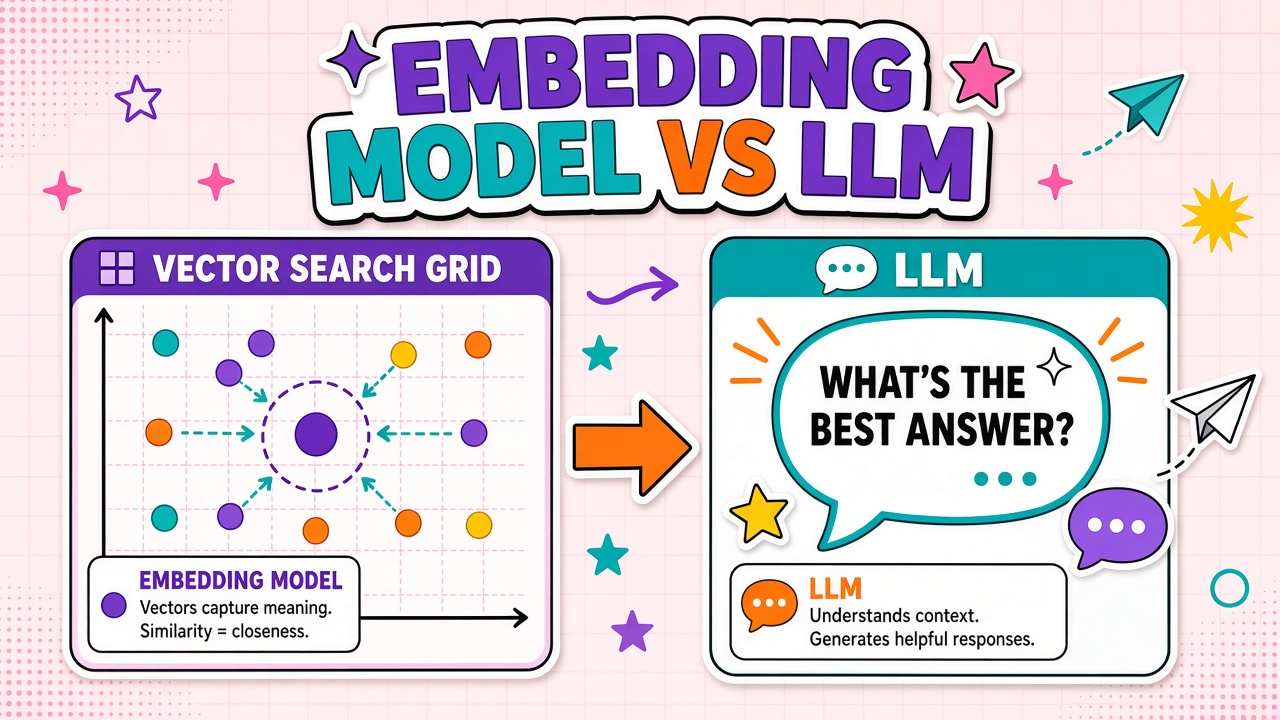
Embedding models and large language models (LLMs) solve different problems. An embedding model converts text into fixed-length numeric vectors that capture semantic similarity. An LLM predicts natural language tokens to answer questions, write copy, or reason over context. In modern AI stacks, embeddings power search and retrieval; LLMs power generation and synthesis. OpenAI, Cohere, Voyage, Google, and open-source families (BGE, E5, Nomic) ship dedicated embedding endpoints separate from chat models. This guide explains embeddings as semantic coordinates, the embed-retrieve-generate pipeline, when an embedding API alone is enough, dimensionality and model family choices, reindexing costs, and multimodal hybrid search. Builders comparing AI API providers and AI image generators should understand which layer each product uses before designing architecture.
Embeddings as Semantic Coordinates
An embedding model maps a piece of text (word, sentence, paragraph, document chunk) to a vector: a list of floating-point numbers in high-dimensional space. Texts with similar meaning land near each other in that space. Texts with different meaning sit farther apart, measured by cosine similarity or dot product.
Embeddings do not generate prose. They produce coordinates you store in a vector database (Pinecone, Weaviate, pgvector, Qdrant, Elasticsearch dense vectors) and query at search time. "Find passages similar to this question" becomes "find vectors closest to the question's vector."
What embeddings capture well and poorly
- Capture well: Paraphrase similarity, topical overlap, conceptual relatedness across wording differences.
- Capture poorly: Exact identifiers (SKU codes, error numbers), rare proper nouns, precise numeric reasoning, very recent events not reflected in training.
- Hybrid search fix: Combine dense embeddings with sparse keyword search (BM25) to recover exact matches embeddings miss.
The Embed, Retrieve, Generate Pipeline
Retrieval-augmented generation (RAG) is the canonical pattern that uses both model types. Offline, documents are chunked and embedded; vectors land in an index. Online, the user question is embedded, similar chunks are retrieved, and an LLM generates an answer grounded in those chunks.
- Embed (indexing): Split documents into chunks. Run each chunk through an embedding model. Store vectors plus metadata.
- Retrieve (query time): Embed the user query. Search the index for top-k nearest neighbors. Optionally rerank with a cross-encoder.
- Generate (query time): Insert retrieved text into an LLM prompt. The LLM synthesizes a natural-language answer, often with citations.
Neither step replaces the other. Bad embeddings send irrelevant chunks to a capable LLM, which then hallucinates confidently. Good embeddings with a weak LLM may retrieve the right passage but fail to synthesize a clear answer. Production quality depends on both layers plus chunking and parsing upstream.
| Capability | Embedding model | LLM |
|---|---|---|
| Primary output | Fixed-size vector | Token sequence (text) |
| Typical use | Search, clustering, deduplication, recommendations | Chat, summarization, code generation, reasoning |
| Cost profile | Low per token; one-time index cost | Higher per token; paid on every generation call |
| Latency | Fast batch encoding | Slower; scales with output length |
| Answers questions directly? | No; returns similar text only | Yes; may hallucinate without retrieval |
When an Embedding API Alone Is Enough
You do not always need an LLM. Many products stop at semantic search, recommendations, or duplicate detection when users prefer browsing results over synthesized answers.
Embedding-only use cases
- Semantic document search: Return ranked passages or files; user reads sources directly.
- Support ticket routing: Match new tickets to similar resolved cases for agent suggestions.
- Content deduplication: Flag near-duplicate articles, ads, or product listings.
- Clustering and analytics: Group feedback, reviews, or survey responses by theme.
- Recommendation: "Related tools" or "similar posts" based on description embeddings.
Add an LLM when users expect a direct natural-language answer, multi-step reasoning across sources, or generated content in a specific format. An AI API stack might expose search-only endpoints for developers and optional RAG endpoints that add generation on top.
Dimensionality, Model Families, and Reindexing
Embedding models differ in vector size (dimensions), training data, language support, and whether they optimize for symmetric similarity (query-to-query) or asymmetric retrieval (query-to-document). Switching embedding models usually requires reindexing the entire corpus because vectors from one model are not comparable to another.
Choosing an embedding model
- Dimensions: Higher dimensions can improve quality but increase storage and search compute. Common sizes range from 384 to 3,072 depending on model.
- Model family: OpenAI text-embedding-3 series, Cohere embed v3, Voyage, BGE, E5, and others dominate 2026 benchmarks. Match model to domain (code, legal, multilingual).
- Matryoshka models: Some models support truncating dimensions at query time for speed with modest quality tradeoffs.
- Hosted vs self-hosted: API embeddings simplify ops; self-hosted suits air-gapped or cost-at-scale deployments.
Reindexing when you change models
Plan reindex jobs as batch pipelines with progress tracking. For ten million chunks, embedding API cost and wall-clock time matter. Blue-green indexes let you build a new vector index alongside the old one, switch traffic after validation, and retire the previous index. Never mix vectors from two models in one search index.
Version embedding model IDs in metadata so you can audit which index generation served a given query. Teams that skip versioning struggle to debug retrieval regressions after silent model upgrades.
Multimodal Embeddings and Hybrid Search
Text-only embeddings do not natively represent images or audio. Multimodal embedding models (CLIP-style, vendor image-text encoders) map images and captions into a shared vector space. That enables "find products similar to this photo" or search across marketing assets and copy in one index.
AI image generators produce pixels; embedding models index those pixels (or their captions) for later retrieval. A creative workflow might generate variants with an image model, embed approved assets for brand consistency search, and use an LLM to draft alt text and captions. Three model types, three roles.
Hybrid search combines dense vectors with keyword indexes in one query. Elasticsearch, OpenSearch, and several vector databases support hybrid fusion. Pure embedding search alone underperforms on SKU lookups, version strings, and legal citations where token overlap matters more than semantic paraphrase.
Frequently Asked Questions
Can one model do both embedding and generation?
Some foundation models can theoretically produce internal representations usable for similarity, but production stacks use dedicated embedding endpoints optimized for search. Chat models are tuned for fluent generation, not efficient large-scale indexing. Use purpose-built embedding APIs for retrieval indexes.
Should we fine-tune embeddings or the LLM?
Fine-tune embeddings when domain vocabulary is highly specialized and off-the-shelf retrieval misses obvious matches. Fine-tune LLMs when you need consistent output format, tone, or tool-use behavior. Many teams fine-tune neither and instead improve chunking, hybrid search, and reranking first because those changes are cheaper to iterate.
How does multimodal RAG work?
Ingest images, slides, or scans with a multimodal embedding model or OCR plus text embedding. Store vectors with source type metadata. At query time, embed the text question (or image query) and retrieve across modalities. The LLM step may use a vision-capable model when retrieved chunks include images, not just extracted text.
Is hybrid search always necessary?
Not always, but recommended for technical corpora with codes, IDs, and rare tokens. Start with pure semantic search on a eval set; add BM25 or splade sparse components when recall on exact-match queries falls below your threshold.
How much does storing embeddings cost?
Storage scales with document count, chunk size, and vector dimensions. A million chunks at 1,536 dimensions is manageable on managed vector DB pricing tiers but not free at billion-chunk scale. Compress metadata, avoid over-chunking, and prune obsolete documents from the index on a schedule.
Embedding API Pricing vs LLM Generation Pricing
Embedding APIs charge per input token at rates far below chat generation. Indexing one million document chunks is a one-time or periodic cost. LLM generation charges apply on every user query and scale with both input and output length. Architecture decisions that reduce retrieved chunk count or generation length often save more than switching embedding providers. Still, embedding model choice sets the ceiling on retrieval quality, so evaluate both layers independently on your labeled question set.
Common Architecture Mistakes When Mixing Embeddings and LLMs
Teams new to RAG often conflate the two model types and make predictable errors. Fine-tuning a chat model on document text does not replace a vector index for search at scale. Embedding an entire corpus once and never reindexing after document updates produces stale retrieval. Using chat model outputs as embeddings (hidden layer activations) without a purpose-built embedding endpoint yields poor search quality compared to dedicated retrieval models.
Another frequent mistake: skipping reranking. Embedding search returns approximate neighbors; a cross-encoder reranker rescores the top candidates with higher precision before the LLM sees them. The embedding model handles recall at scale; the reranker sharpens precision on a small candidate set; the LLM synthesizes the final answer. All three layers matter in production corpora.
How to evaluate embedding quality before blaming the LLM
When RAG answers are wrong, check retrieval first. Build a labeled set of questions with known correct source passages. Measure retrieval recall: did the right chunk appear in top-k results? If recall is low, swap embedding models, tune chunk size, or add hybrid search before upgrading the generation model. LLM upgrades are expensive; embedding and indexing fixes are often cheaper and more durable.
Embedding Models and LLMs Work Together
Embedding models turn text into searchable semantic coordinates. LLMs turn retrieved evidence and user intent into fluent answers and generated content. Confusing the two leads to wrong architecture choices: fine-tuning chat models when you need better search, or building RAG without evaluating embedding quality. Choose embedding families deliberately, plan for full reindex on model changes, and add hybrid search when exact tokens matter. Explore AI API providers and AI image generator tools on EliteAI.tools with a clear picture of which layer each product serves in your stack.