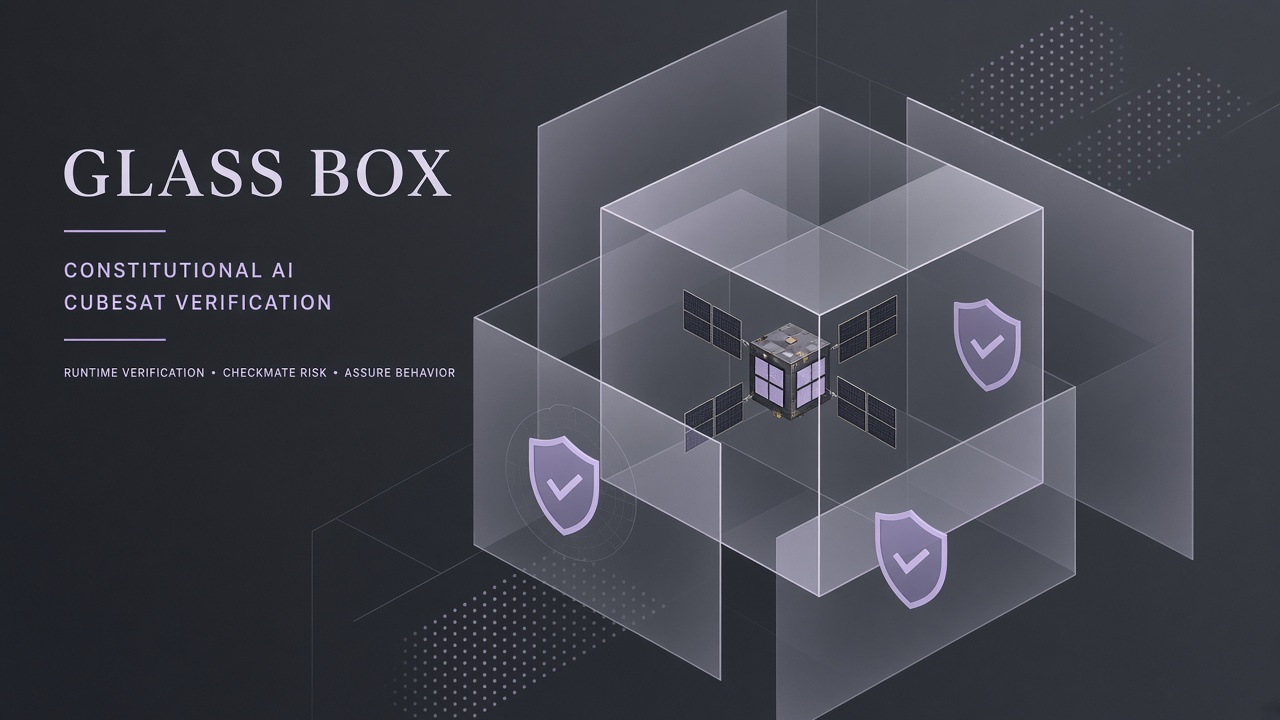
A CubeSat attitude controller receives a neural network command to fire a reaction wheel at maximum torque while the spacecraft already spins near its rate limit. Executing blindly could saturate gyros, tumble the bus, and end the mission. Traditional fault protection uses hand-coded limit checks that lag behind modern learned planners. Constitutional AI CubeSat verification through the Glass Box architecture intercepts every proposed action from an onboard AI stack, evaluates it against explicit physics and safety constraints, and blocks or modifies commands before actuators fire. The approach combines runtime monitoring with formal methods so operators can trust autonomy without treating the neural network as infallible.
Small satellite programs, university labs, and commercial constellation operators exploring onboard AI for collision avoidance or adaptive pointing need verification layers that fit kilogram-class compute budgets. Teams documenting autonomy architecture for regulators or insurers through AI chatbot knowledge bases should distinguish Glass Box-style runtime shields from offline training guardrails. More aerospace AI explainers appear on the EliteAI.tools blog index.
What Glass Box Constitutional AI Means for CubeSats
Glass Box constitutional AI is a runtime verification layer that evaluates each proposed spacecraft command from a learned planner against a written set of constitutional constraints and linear temporal logic invariants before allowing actuators to execute. The name emphasizes transparency: every rejection comes with an explainability score and traceable rule violation, unlike opaque neural network internals. Constitutional constraints encode orbital mechanics limits, power budgets, thermal envelopes, and mission rules as checkable predicates rather than hopes embedded in training loss functions.
CubeSats amplify the stakes. Limited redundancy, tight power, and minimal operator contact mean a single bad command can drain batteries or lose attitude lock for days. Glass Box (arxiv 2606.02967) targets this class of platform with verification overhead scaling linearly in the number of constraints, making onboard deployment feasible on flight processors.
| Layer | Role | Failure mode addressed |
|---|---|---|
| Learned planner | Proposes attitude, propulsion, or mode commands | Distribution shift, adversarial inputs |
| Glass Box shield | Checks constraints and LTL invariants | Physics violations before actuation |
| Actuator interface | Executes approved commands only | Unauthorized torque or power draw |
How Glass Box Verification Works
Glass Box parses each proposed action into parameters (torque vector, slew angle, heater duty cycle), evaluates six constitutional constraints and seven linear temporal logic invariants using SMT solvers (Z3) and model checkers (NuSMV), and assigns an explainability score E(a) in [0, 1] before approve or reject. Constitutional constraints capture instantaneous limits: maximum wheel speed, sun exclusion zone violations, battery state of charge floors. LTL invariants express temporal properties such as "eventually return to safe mode" or "never enter eclipse with heaters at full duty without sufficient charge."
Six constitutional constraints
The Glass Box paper defines six constitutional constraints encoding CubeSat-specific physics and mission rules, each implemented as a decidable predicate evaluated on the proposed action and current state estimate. Examples include angular rate caps, momentum desaturation requirements, and thermal limits on sensitive payloads. Constraints are human-readable so mission operators can audit what the shield enforces without reading neural network weights.
Seven LTL invariants
Seven linear temporal logic invariants specify properties over command sequences and state trajectories, verified with NuSMV model checking and Z3 satisfiability testing depending on constraint type. LTL captures ordering rules that single-step limit checks miss, such as forbidding a sequence that slews toward the sun immediately after a sensor calibration mode. Model checking overhead stays bounded because CubeSat mode spaces are finite when discretized for flight software.
Explainability score E(a)
Each action receives explainability score E(a) in the interval [0, 1], quantifying how clearly the shield can attribute approval or rejection to specific constitutional rules, supporting operator trust and post-anomaly review. High scores mean a small set of violated constraints explains the decision; low scores flag ambiguous cases warranting human review or conservative fallback to safe mode.
Computational overhead O(Nc)
Glass Box reports verification overhead scaling as O(Nc) in the number of constitutional constraints, enabling onboard execution within CubeSat compute budgets when constraint counts remain modest. Linear scaling matters because adding mission rules should not explode latency between planner output and actuator command. Flight software teams profile worst-case verification time alongside traditional GNC cycles.
| Component | Tool / formalism | Purpose |
|---|---|---|
| Constitutional constraints (6) | Z3 SMT | Instantaneous physics and resource limits |
| LTL invariants (7) | NuSMV model checking | Temporal mission safety properties |
| Explainability | Score E(a) in [0, 1] | Operator-facing rejection rationale |
| Complexity | O(Nc) per action | Onboard feasibility |
Typical integration workflow
- Document mission modes, actuator limits, and thermal/power envelopes as constitutional constraints.
- Express temporal safety properties (sun avoidance sequences, safe mode recovery) as LTL invariants.
- Offline verify invariants against simplified spacecraft models with NuSMV and Z3.
- Integrate Glass Box between learned planner output and flight software command bus.
- Log E(a) scores and violated rule IDs for every rejected action.
- Hardware-in-the-loop test adversarial planner outputs against the shield.
- Flight rule: if verification times out, default to safe mode rather than pass unverified commands.
Hardware-in-the-Loop Testing for Glass Box
Before flight, teams inject adversarial planner outputs into hardware-in-the-loop simulators with real flight computer timing to measure worst-case verification latency and false reject rates. Test cases include sensor dropout sequences, maximum slew requests, and simultaneous heater plus wheel commands that trip multiple constitutional constraints. Log E(a) distributions: if most rejects cluster on one rule, constraints may be miscalibrated; if rejects scatter with low E(a), the planner needs retraining or tighter action bounds.
NuSMV offline proofs and onboard Z3 checks must use consistent discretization of spacecraft modes. A common integration bug proves invariants over ten modes in NuSMV while flight software exposes twelve after a software update. Version-control constitutional rule sets alongside flight software images so anomaly review can replay which rules were active when a command was blocked.
Constitutional AI vs Training-Time Guardrails
Training-time constitutional AI (reward shaping, rejection sampling during fine-tuning) reduces but does not eliminate unsafe actions at runtime; Glass Box-style shields assume the planner can still propose violations under distribution shift, sensor faults, or adversarial inputs. Verification at command time is the last line before irreversible physics. Both layers complement each other: training narrows the proposal distribution; Glass Box certifies each instance.
For CubeSats, runtime verification also supports regulatory narratives. Operators can show insurers and launch providers which LTL invariants hold regardless of neural network version, decoupling safety case updates from model retraining cycles.
Limits, Risks, and Assumptions
Glass Box correctness depends on accurate state estimation, complete constraint specification, and model checker abstractions that match flight software discretization; missing constraints or stale telemetry create false approvals. O(Nc) overhead grows with mission complexity; large constellations with dozens of rules need profiling on flight processors.
- Model-reality gap: Simplified dynamics in offline NuSMV models may not capture all flex modes.
- Constraint maintenance: Every new payload mode requires new constitutional rules.
- False rejects: Over-conservative shields can block valid efficiency gains; tune E(a) thresholds.
- Latency: Verification must finish within control loop deadlines (milliseconds to seconds).
Who Should Use This and Who Should Wait
CubeSat teams deploying learned attitude or scheduling planners on missions with limited operator contact should prototype Glass Box-style shields before flight, starting with the six-constraint / seven-invariant pattern from arxiv 2606.02967. Missions with human-in-the-loop approval for every command gain less immediate value but still benefit from logged E(a) audits.
| Audience | Recommendation | Caveat |
|---|---|---|
| University CubeSat lab | Add runtime shield to learned GNC experiments | Profile O(Nc) on flight computer |
| Commercial LEO constellation | Formalize constraints for collision avoidance AI | Coordinate with space traffic rules |
| Traditional GNC only mission | Existing limit monitors may suffice | Revisit when adding ML planners |
| Deep-space flagship | Compare with AMPLE-GNC-style shields | Different fault models and compute |
Frequently Asked Questions
How is Glass Box different from a black-box neural network?
Glass Box is a transparent runtime shield that checks each proposed action against explicit rules and returns explainability score E(a); the neural network proposes actions but does not self-certify safety. Operators audit constraints, not hidden activations.
Why use both Z3 and NuSMV?
Z3 handles instantaneous constitutional constraint satisfiability; NuSMV model checks linear temporal logic invariants over command sequences. Different formalisms match different safety properties.
What do the six constraints and seven invariants cover?
The Glass Box paper (arxiv 2606.02967) encodes CubeSat physics limits as six constitutional constraints and seven LTL invariants; exact rule text is mission-specific but the counts demonstrate compact onboard rule sets. Teams adapt templates to their bus and payload.
Can Glass Box run onboard a CubeSat computer?
Reported O(Nc) overhead scales linearly with constraint count, designed for flight processor budgets when rule sets stay small. Hardware-in-the-loop timing tests are mandatory before launch.
What does explainability score E(a) tell operators?
E(a) in [0, 1] measures how clearly a specific constitutional rule explains approve or reject decisions, aiding anomaly review and regulator briefings. Low scores suggest ambiguous cases.
Is runtime verification enough without constitutional training?
Runtime shields are necessary but not sufficient; training-time constitutional AI reduces how often the shield must reject commands, while Glass Box guarantees no unverified action reaches actuators. Use both.
What should operators see when Glass Box rejects a command?
Ground stations should receive violated constraint IDs, E(a) score, proposed action parameters, and spacecraft state snapshot at rejection time for replay in mission simulation. Transparent logs build operator trust faster than opaque "autonomy hold" flags without rationale.
Conclusion
Glass Box constitutional AI for CubeSat verification places a transparent runtime shield between learned onboard planners and actuators. Six constitutional constraints, seven LTL invariants, Z3 and NuSMV checking, O(Nc) overhead, and explainability score E(a) in [0, 1] make safety arguments inspectable. CubeSat teams should treat verification as flight software, not research optional: specify constraints explicitly, log every rejection, and default to safe mode when checks time out. Learned autonomy gains efficiency; constitutional runtime verification preserves the spacecraft.