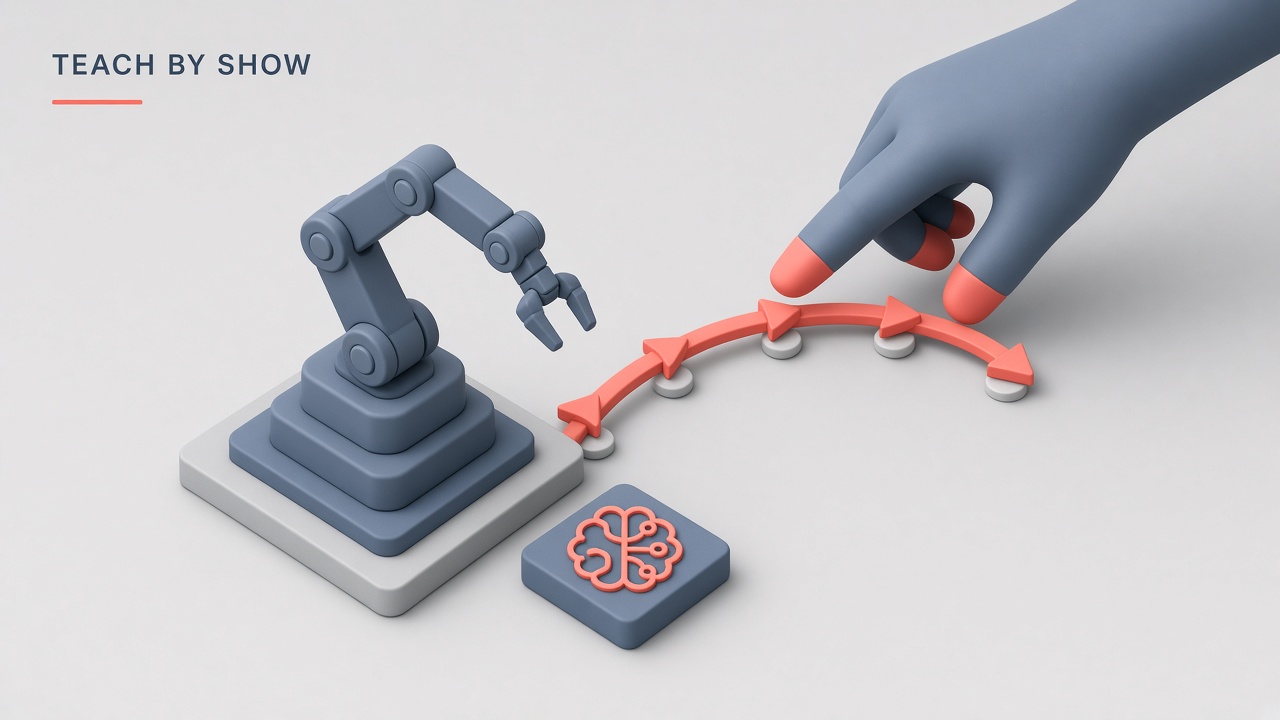
Showing a robot how to fold a cable, thread a bolt, or pour from a cup looks simple to a human operator, yet the learned policy often fails on the next attempt because small execution errors compound into states the demonstrations never covered. That failure mode defines learning from demonstration robotics AI: algorithms that turn human trajectories into control policies while addressing covariate shift through dataset aggregation (DAgger), diffusion-based action models, and interactive correction interfaces.
Factory automation teams, university labs, and startups comparing AI chatbot tools for operator training materials all face the same bottleneck: expert time is expensive, and naive behavioral cloning wastes it. Modern pipelines combine teleoperation (kinesthetic teaching, spacemouse, or handheld grippers like UMI) with policies that chunk actions, estimate uncertainty, and request human corrections only when needed. For broader context on research explainers, see the EliteAI.tools blog index.
What Learning from Demonstration Robotics AI Means in Plain Language
Learning from demonstration robotics AI is the family of machine learning methods that train robot control policies from recorded expert state-action trajectories, optionally refined with on-policy human corrections when the robot visits unfamiliar states. The simplest form is behavioral cloning (BC): supervised learning that maps observations to actions. BC is off-policy because training ignores how errors accumulate at deployment. DAgger, introduced by Ross and colleagues, iteratively rolls out the current policy, queries an expert for corrective labels in visited states, and aggregates new data into the training set.
Recent systems replace small MLP policies with diffusion policies, Action Chunking with Transformers (ACT), or flow-matching models that capture multimodal demonstrations (multiple valid ways to reach the same goal). Teaching interfaces matter as much as algorithms: kinesthetic guidance, virtual reality teleop, and handheld UMI grippers that record end-effector pose and grip width during natural human motion. The AI layer must align observation spaces, action frequencies, and embodiment between demonstration hardware and deployment robots.
| Term | Meaning | Common pitfall |
|---|---|---|
| Behavioral cloning (BC) | Supervised mapping from demo states to actions | Covariate shift when robot drifts off demo path |
| DAgger | Aggregate corrective labels on policy rollouts | Cost of continuous expert monitoring |
| Interactive IL (IIL) | Human or robot gates when to intervene | Poor uncertainty estimates waste expert time |
| Residual policy | Frozen base plus learned correction term | Corrections may leave valid base behaviors |
Why demonstrations alone are not enough
Covariate shift means the robot encounters observation states during execution that were rare or absent in the demonstration dataset, so the policy predicts actions the expert never labeled. A stacking policy trained only on near-success trajectories may never recover after knocking a cup. DAgger addresses this by labeling corrective actions in those visited states. Interactive methods like HG-DAgger (human-gated) and robot-gated variants reduce labeling burden by intervening only when uncertainty or risk thresholds trigger.
How the Underlying AI Pipeline Works
A modern learning-from-demonstration pipeline records synchronized observations and actions, trains a generative or chunked policy offline, deploys it on hardware, collects failure states, and updates weights through aggregation, residual learning, or latent-space correction without destroying pretrained skills. Diffusion Policy (2023 onward) models action sequences as denoising targets, handling multimodal demos better than single Gaussian heads. ACT predicts action chunks with a transformer CVAE, reducing compounding error within each chunk window.
DAgger variants in 2024 to 2026 research
Diffusion Meets DAgger (DMD), published at RSS 2024, synthesizes out-of-distribution eye-in-hand views with a conditional diffusion model instead of collecting new robot data, reporting 80 percent success on pushing with eight demos versus 20 percent for BC, and 92 percent stacking success across cups versus 40 percent for BC. Diff-DAgger uses diffusion policy loss as an uncertainty signal for robot-gated intervention, reporting improved failure prediction and faster training versus ensemble variance baselines on manipulation tasks.
ASkDAgger (TMLR 2025) lets the robot state planned actions plus uncertainty ("I plan to do this, but I am uncertain") so teachers label corrections more efficiently through S-Aware Gating, Foresight Interactive Experience Replay, and Prioritized Interactive Experience Replay. Compliant Residual DAgger (CR-DAgger, 2025) targets contact-rich manipulation with compliant correction interfaces that reduce force discontinuities when humans take over from the policy mid-contact.
FlowDAgger adapts generative diffusion policies in latent noise space rather than full weight updates, aiming to preserve broad skills in large pretrained models while incorporating human corrections. Source-Lifted Flow Matching (SL-FM) exposes intervenable source handles in flow-matching policies so operators can steer among valid multimodal branches without separate mode-conditioned networks.
| Method | Mechanism | Reported benefit |
|---|---|---|
| Diffusion Meets DAgger (DMD) | Synthetic OOD views + corrective labels | Strong few-demo performance on eye-in-hand tasks |
| Diff-DAgger | Diffusion loss as uncertainty for gating | Better intervention timing vs ensemble variance |
| ASkDAgger | Novice plan + uncertainty queries | Fewer expert annotations, language tasks |
| CR-DAgger | Compliant human correction interface | Contact-rich real-world corrections |
| FlowDAgger | Latent-space correction on generative policies | Adapt without eroding base model skills |
Typical workflow steps
- Define task success criteria, workspace limits, and emergency stop behavior before collecting data.
- Choose a teaching interface (kinesthetic, spacemouse, VR, or handheld UMI) matched to deployment robot kinematics.
- Record 20 to 200 successful demonstrations with synchronized cameras, proprioception, and optional tactile streams.
- Train an offline policy (BC, ACT, or diffusion) with validation splits and sanity-check open-loop replay in sim if available.
- Deploy with safety bounds; run robot-gated or human-gated DAgger to label failure states and corrections.
- Aggregate datasets; prefer residual or latent updates when finetuning large pretrained policies.
- Evaluate success rate, intervention rate, and time-to-train across object and lighting variations.
Real Deployments and Published Evidence
Learning from demonstration robotics AI has shipped in research platforms and early commercial teleoperation stacks, with published evidence spanning RSS, CoRL, and TMLR papers that report both simulation and real Franka, UR, and mobile manipulator experiments. The Universal Manipulation Interface (UMI) ecosystem demonstrates handheld data collection transferred to Franka arms for dynamic tasks, extended by Force-Aware Robotic Manipulation with matched actuated grippers. Reactive Diffusion Policy pairs TactAR teleoperation with slow-fast diffusion for contact-rich bimanual tasks, releasing open code and user studies on demonstration quality.
Large-scale fleet learning appears in Sirius and Sirius-Fleet research on shared-autonomy deployment with trust-weighted behavior cloning across multiple robots. HIL-SERL combines human interventions with reinforcement learning rewards for precision insertion tasks, blurring the line between pure imitation and reward-driven fine-tuning. Manufacturing pilots often remain unpublished, but public results consistently show that interactive correction reduces total expert hours versus collecting hundreds of naive demos upfront.
Diffusion Meets DAgger reports 90 percent shirt-hanging success and 80 percent coffee-bean pouring transfer to novel cups with synthetic augmentation, suggesting data-efficient paths for structured eye-in-hand tasks. ASkDAgger validates language-conditioned manipulation in simulation and on real hardware with reduced query counts. These results are task-specific; contact-rich industrial tasks still favor compliant correction hardware and CR-DAgger-style interfaces over pure offline scaling of demonstrations.
Teaching interfaces and data quality
Demonstration quality dominates algorithm choice. Jerky kinesthetic paths, misaligned timestamps, or grippers that do not match deployment geometry inject noise that no DAgger variant fully removes. TactAR and UMI emphasize ergonomic collection and quantitative user studies. Teams should log intervention reasons, object IDs, and failure modes as metadata for later aggregation, not just raw observation tensors.
Limits, Risks, and Ethical Guardrails
Learning from demonstration robotics AI risks unsafe extrapolation, overfitting to demo lighting and layouts, expert bottleneck during aggregation, and silent failure when policies appear confident in out-of-distribution states. Ensemble variance uncertainty fails on multimodal tasks where multiple valid actions look disagreeing to the ensemble though each is correct. Diff-DAgger and diffusion-based uncertainty partially address this but require validation on each task class.
- Distribution shift: New objects, backgrounds, or robot wear change observations without corrective labels.
- Correction quality: Human takeovers that jerk the robot off the policy manifold can hurt more than help unless interfaces are compliant.
- Compute: Retraining large diffusion policies from scratch each DAgger round is expensive; residual and latent methods exist to mitigate cost.
- Skill erosion: Finetuning entire generative models on narrow corrections can forget broad pretrained behaviors; FlowDAgger targets this failure mode.
- Workplace impact: Automating skills learned from operator demos raises job redesign and training obligations, not just ML metrics.
Ethical guardrails include informed consent when recording operator demonstrations, clear human override during all learning rollouts, bias audits when demo collectors are not representative of future operators, and transparency about failure rates near humans. Demonstration data may capture proprietary motions; storage and model sharing need contractual boundaries.
Who Should Use This and Who Should Wait
Teams with repeated manipulation tasks, available expert operators, and hardware amenable to teleoperation should adopt interactive imitation learning now, starting with BC plus a gated DAgger loop rather than scaling demos alone. Organizations needing certifiable open-loop planners for safety-critical paths without human oversight should wait until policies include formal verification or remain confined to guarded workcells.
| Audience | Recommendation | Caveat |
|---|---|---|
| Robotics research lab | BC + Diff-DAgger or ASkDAgger on one Franka task | Budget expert time for aggregation rounds |
| Manufacturing engineer | Pilot UMI or compliant teleop on one station | Validate cycle time and safety interlocks |
| ML engineer with large VLA model | Use FlowDAgger-style latent adaptation | Monitor catastrophic forgetting on broad skills |
| Small business without robotics staff | Wait for integrated vendor solutions | Custom IL stacks need ongoing ML ownership |
Groups with only a handful of demos should explore Diffusion Meets DAgger-style augmentation for eye-in-hand tasks before hiring weeks of expert time. Groups with hundreds of demos but poor success should invest in correction interfaces and uncertainty gating rather than collecting more successful trajectories that never visit failure boundaries.
Demonstration metadata that improves aggregation
Store more than joint angles: log operator ID (hashed if needed), success/failure label, contact phase timestamps, e-stop events, and environment version (lighting, fixture position). DAgger correction rounds become auditable when reviewers can replay why a trajectory entered the aggregate set. Without metadata, teams cannot distinguish a policy regression from a changed fixture or a tired operator on the third shift. Version demonstration interfaces alongside policy weights so rollback restores both control code and the teaching UI operators actually used during collection.
Frequently Asked Questions
How is DAgger different from collecting more demonstrations?
Extra successful demos stay off the robot's actual execution distribution; DAgger labels states the learned policy visits, targeting covariate shift directly. Random demo scaling helps diversity but is less sample-efficient than corrective labels on failure boundaries when expert time is limited.
How many demonstrations does learning from demonstration robotics AI need?
Published manipulation tasks range from under ten demos with DMD augmentation to hundreds for contact-rich bimanual skills; interactive aggregation often reduces total expert hours versus offline-only scaling. Count demonstrations after defining success metrics and intervention protocol, not before.
Should I use diffusion policy or ACT?
Diffusion policies excel at multimodal contact-rich actions; ACT chunks sequences for faster inference and appears widely in sim benchmarks like UniVTAC. Latency, hardware control rate, and demonstration style should drive the choice; many teams prototype both on the same dataset.
Human-gated or robot-gated DAgger?
Human-gated (HG-DAgger) suits early prototyping with one robot; robot-gated methods like Diff-DAgger scale to fleets but depend on calibrated uncertainty estimates. Hybrid schedules that start human-gated and transition to robot-gated are common in lab-to-pilot transitions.
Is learning from demonstration regulated for industrial robots?
Regulators and standards bodies evaluate installed robot systems and risk assessments, not specific IL algorithms. Learned policies must still respect speed limits, guarding, and stop categories required for collaborative or industrial workcells in your jurisdiction.
Can DAgger run entirely in simulation?
Simulation supports algorithm development, but contact physics, latency, and human correction fidelity on real hardware still require physical aggregation rounds for deployment-grade policies. Synthetic OOD augmentation (DMD) reduces but does not eliminate real-world correction needs.
Who owns demonstration recordings?
Employment contracts and pilot agreements should specify ownership of trajectories, model weights, and whether operator identity is stored in metadata. Demonstrations may reveal proprietary motions or sensitive environments; treat datasets like production IP.
Conclusion
Learning from demonstration robotics AI turns operator skill into control policies, but success depends on addressing covariate shift through DAgger and its modern variants rather than naive behavioral cloning alone. Diffusion Meets DAgger, Diff-DAgger, ASkDAgger, Compliant Residual DAgger, and FlowDAgger represent distinct answers to data efficiency, uncertainty estimation, contact-rich correction, and large-model adaptation. Teaching interfaces and demonstration metadata matter as much as architecture choice. Teams should start with clear task definitions, safe rollouts, interactive correction loops, and documented failure modes. Treat expert time as the scarce resource aggregation algorithms were designed to protect.