Your billing service asks the model to classify a support ticket and return `{ "category": "billing", "priority": 2, "summary": "..." }`. Instead, the model replies with a friendly paragraph, a markdown code fence, and a trailing apology. Your parser crashes in production. AI structured output and JSON mode solve this by constraining generation so the API returns machine-readable data your integration can validate and type-check. The capability underpins reliable automations in AI chatbot routers that hand off to specialists and AI writing assistant pipelines that emit outline objects before drafting paragraphs.
Why Free-Form Text Breaks Integrations
Integrations need predictable fields; free-form completions introduce parsing errors, schema drift, and silent type mistakes that only surface under load. Developers historically wrapped prompts with "respond only in JSON" instructions, then scraped responses with regular expressions. Models still prepend commentary, omit required keys, use single quotes, or hallucinate enum values. Each failure becomes retry logic, support tickets, and brittle glue code that breaks when the vendor updates tokenizer or sampling behavior.
Structured pipelines treat the model as a function from prompt to typed object. Downstream services map JSON directly to database rows, workflow engines, or UI components. When validation fails, the system retries with repair prompts or falls back to human review instead of corrupting production data. The shift from "parse prose" to "validate schema" is the difference between demo and production grade AI features.
JSON Mode vs Schema vs Tool Calls
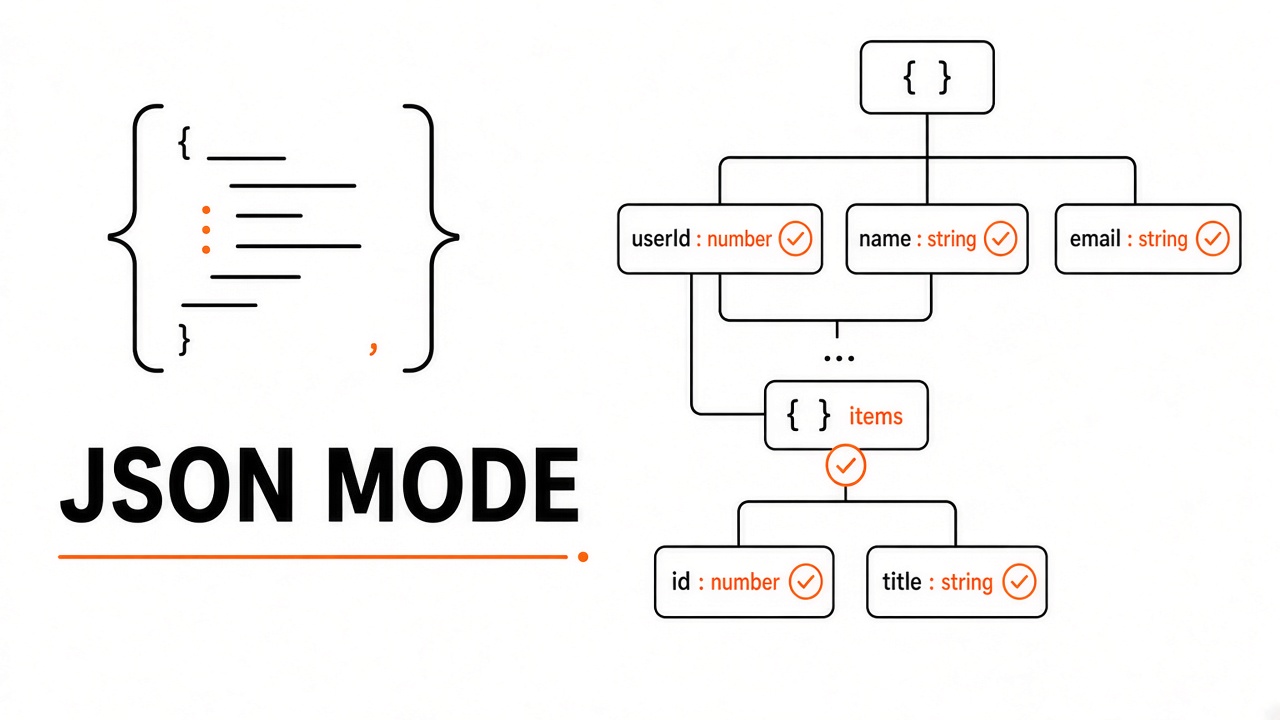
JSON mode guarantees syntactically valid JSON; schema-constrained output enforces shapes and types; tool calls let the model invoke functions with validated parameters as part of a larger agent loop. These features overlap but serve different layers. JSON mode is the baseline: no trailing commas, no markdown wrappers. Schema mode (JSON Schema or vendor equivalents) adds required fields, enums, numeric ranges, and nested object rules. Tool calling extends structure to actions: the model emits `search_orders(order_id=88421)` and your runtime executes it, returning results for the next turn.
| Mechanism | Guarantees | Best for |
|---|---|---|
| JSON mode | Valid JSON syntax | Simple key-value extractions |
| Schema constrained | Types, enums, required fields | API contracts, form filling |
| Tool / function calls | Named functions with parameters | Agents, live data lookups |
| Prompt-only JSON | None (hope and parse) | Prototypes only |
Choose schema mode when the consumer is your own microservice expecting a fixed DTO. Choose tools when the model must fetch fresh data before answering. Some stacks combine both: a tool returns records, then a schema pass formats the user-visible summary. Avoid duplicating the same structure as both a tool definition and a separate response schema unless codegen keeps them in sync.
Schema Design for LLM Outputs
Schemas should be minimal, explicit, and tolerant of optional fields where the model lacks information; over-constraining invites validation failures on edge cases. Prefer string enums over free text when categories are finite. Use `nullable` for legitimately missing data instead of forcing empty strings that confuse analytics. Split large schemas into stages: first extract entities, then enrich with a second call if needed, rather than one forty-field monster object.
Name fields for clarity (`customer_email` not `ce`). Document semantics in the schema description fields vendors pass to the model; "priority: 1 urgent, 5 low" reduces invented scales. Keep nesting shallow; deeply nested arrays of objects are harder for models to fill consistently. For multilingual products, specify whether string fields must match user locale or a canonical English key set.
Versioning structured contracts
Version response schemas (`ticket_classification_v2`) and support dual-read periods when mobile clients lag server deploys. Breaking changes (renaming `summary` to `brief`) should bump version and run migration transforms at the API boundary, not inside prompt text alone. Store the schema version on each logged response for replay debugging.
Validation, Retry, and Repair Patterns
Always validate model JSON with the same library your application uses in production, then retry with a repair prompt or constrained re-generation when validation fails. A typical flow: call API with schema, parse response, run JSON Schema validation, on failure append "your output failed: missing field priority" and retry up to N times with temperature reduced. Log failure payloads for tuning. For critical paths, route persistent failures to a queue humans review rather than looping indefinitely.
| Failure type | Typical cause | Mitigation |
|---|---|---|
| Missing required field | Ambiguous prompt or long schema | Repair prompt citing validator error |
| Invalid enum | Model invents synonym | Tighten enum descriptions; map fuzzy post-process |
| Type mismatch | Number returned as string | Coerce in validator or use stricter schema mode |
| Truncated JSON | max_tokens too low | Raise token cap or split schema |
Idempotency keys matter when retries trigger side effects. Structured classification should not double-charge if the second attempt succeeds after the first partial write. Separate "extract structured data" from "commit transaction" steps when possible.
CI Testing for Structured Outputs
Check JSON schemas into the repository and run contract tests against live or recorded model responses on every deploy. Golden files store anonymized inputs with expected validated objects. CI jobs call the inference API (or a mocked fixture in fast paths) and assert schema compliance, not exact string match, since sampling varies. Track validation pass rate over time; a drop after a model upgrade signals prompt or schema drift.
Property-based tests generate edge inputs: empty strings, unicode, very long ticket bodies, conflicting instructions. Fuzz enums to ensure the validator rejects out-of-domain values before they reach SQL. For writing assistants that emit section arrays, assert minimum and maximum array lengths match product rules. Pair unit tests on pure validators with integration tests on the full prompt plus API path.
Structured Output in Multi-Step Pipelines
Pipelines chain structured stages: classify intent, retrieve context, then generate user-facing prose from a validated intermediate object. Only the final user message needs natural language; internal handoffs should stay typed. Orchestration frameworks benefit when each node declares input and output schemas, enabling static checks on graph wiring before runtime.
Streaming complicates structure: partial JSON is not valid until complete. Some APIs offer streamed schema filling or deliver the structured block only after generation finishes. UI layers should show loading states rather than parsing incomplete buffers. For chat products, consider showing structured metadata (confidence, category) in a sidebar while the assistant streams the human reply.
Error Handling in Production APIs
Production APIs should return typed error envelopes when structured generation fails, distinguishing validator errors from model refusals from infrastructure timeouts. Clients need `error_code`, `retry_after`, and optional `partial_object` fields when safe. Never pass raw model stderr to end users. Circuit breakers stop hammering a degraded inference endpoint when validation pass rates collapse after a deploy.
Fallback tiers help: primary model with strict schema, secondary smaller model with relaxed schema, then human queue. Document SLA impact per tier. Rate-limit clients that generate systematically invalid prompts that waste retry budgets. Structured logging of schema path failures (`$.priority` enum violations) guides prompt tuning faster than aggregate 400 counts.
Mapping JSON to Domain Models
Generate server-side types from the same JSON Schema the model targets so PHP, TypeScript, or Go structs stay aligned with validator rules. OpenAPI and JSON Schema codegen tools reduce drift between prompt contracts and database columns. Nullable fields in schema should match ORM nullability. Enum values in schema should match application constants checked in code review, not invented per request.
Vendor Capabilities in 2026
Major providers expose JSON mode, strict schema adherence, and native SDK helpers that bind responses to typed classes in Python, TypeScript, and other languages. Capabilities differ by model tier: smaller models may support JSON mode but struggle with complex nested schemas. Evaluate on your actual schema, not vendor demos with ten-line examples. Self-hosted open models may need grammar-guided decoding or Outlines-style constraints to match cloud reliability.
Security Considerations for Structured Output
Structured fields can carry injection payloads if downstream systems concatenate JSON values into SQL, shell commands, or HTML without escaping. Treat model output as untrusted input. Validate string lengths and patterns (email format, ISO dates) after schema pass. Redact secrets from repair prompts when logging failed generations. Role-based access should limit who can change production schemas without approval, since a widened enum might enable new automated actions.
Frequently Asked Questions
Does JSON mode guarantee correct data?
JSON mode guarantees parseable syntax, not semantic correctness; the model can still populate fields with plausible but wrong values. Combine schema validation with business rules and human review for high-stakes fields.
Should I use schema mode or tool calling?
Use schema mode for final structured answers; use tool calling when the model must fetch or mutate external state before responding. Many agent architectures use both in sequence.
Can open-source models do structured output?
Yes, with grammar constraints, fine-tuning, or inference servers that enforce JSON during decoding. Reliability may lag frontier cloud APIs on complex schemas; test on your workload.
Can structured output stream to the UI?
Some APIs stream tokens while building JSON; others return the object only when complete. Design UX around partial text streams for chat and batch object delivery for admin dashboards.
How do you handle large nested arrays in schemas?
Split generation into paginated schema calls or cap array length with explicit maxItems in JSON Schema and product validation. Summarize long lists in a first pass, then expand selected items in follow-up calls to stay within token limits.
Logging and Observability for JSON Responses
Log schema version, validation outcome, retry count, and latency per structured call without storing full PII payloads in plaintext telemetry. Sample failed generations for offline review queues. Alert when enum violation rates spike after a prompt change. Dashboards split metrics by consumer service so one broken mobile client schema does not hide a healthy web backend.
Structured Output Maturity Checklist
Production readiness means checked-in schemas, automated validation tests, retry policies with caps, typed domain models, security review on new fields, and dashboards on validation pass rate by schema version. Teams at maturity Level 0 parse prose with regex; Level 2 uses vendor JSON mode; Level 4 runs schema diff gates in CI blocking deploys that break mobile clients. Aim for Level 3 before customer-facing automation touches money or health data.
Anti-Patterns to Avoid
Do not ask users to paste JSON into chat for parsing, do not mix markdown tables with schema mode on the same call, and do not skip server-side validation because the vendor promised strict JSON. Another common mistake is generating fifty optional fields "just in case," which confuses the model and balloons token cost. Design schemas for the integration you ship this quarter, not every hypothetical field product management might want next year.
Conclusion
Structured output and JSON mode turn language models into dependable components inside software systems. Free-form prompts fail at scale; schema validation, retry discipline, and CI contract tests make AI integrations maintainable. Design small versioned schemas, pick the right constraint layer (JSON mode, schema, or tools), and never trust prose parsing in production paths for chatbot automation or content pipelines.