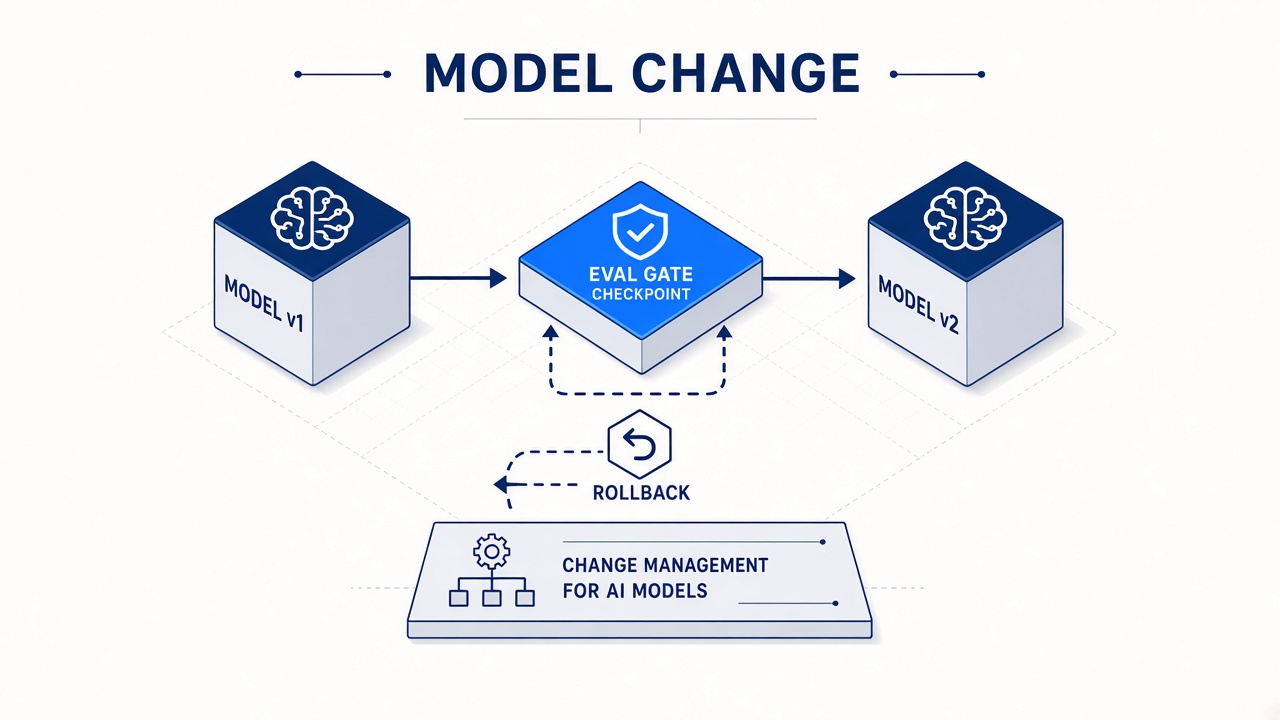
SaaS vendors ship new foundation models on short notice. Default API versions shift. A private AI chatbot that passed security review six months ago may run a different model today with different safety and accuracy profiles. Teams treating model updates as vendor internals rather than production changes discover regressions only after customer complaints or compliance gaps surface.
An AI model change management policy classifies vendor model updates as patch, minor, or major changes, requires evaluation gates before production promotion, defines communication to affected teams, and grants emergency rollback authority. This guide helps platform, SRE, and governance owners integrate AI model changes with existing change advisory processes and AI automation workflows.
Why Model Changes Are Production Changes
A model version change alters system behavior, latency, cost, safety boundaries, and regulatory evidence baselines even when application code is unchanged. Change management exists to control risk, notify stakeholders, and preserve rollback paths. AI model swaps meet every criterion for a controlled change: user-visible impact, data processing implications, and potential compliance reassessment.
Silent Update Risk
Many AI APIs route "latest" model aliases to new weights without customer opt-in; policies must prohibit unversioned production dependencies and require pinned model identifiers in configuration. Infrastructure-as-code and environment variables should store model IDs, not marketing names alone.
Change Categories: Patch, Minor, Major
Classify every vendor model or configuration change into patch (no expected behavior change), minor (incremental capability or performance shift), or major (material behavior, safety, cost, or compliance impact) to determine evaluation depth and approval authority. Document classification criteria in a decision tree reviewers apply consistently.
| Category | Examples | Typical approval |
|---|---|---|
| Patch | Bug fix with identical model ID suffix, infra scaling | Technical owner, automated smoke tests |
| Minor | New snapshot within same family, prompt template tuning | Team lead plus eval summary |
| Major | New model family, default API version bump, fine-tune redeploy | Change advisory board, legal for high-risk systems |
Configuration Changes
Treat temperature, max tokens, tool-calling enablement, RAG index updates, and system prompt changes as model-adjacent changes requiring the same classification workflow when they affect production behavior. A system prompt edit can shift compliance posture as much as a weight update.
Deprecation Notices
Vendor deprecation timelines are major changes by default; start migration projects when notice publishes, not on the shutdown date. Contract clauses should require minimum notice periods and parallel run windows for enterprise tiers.
Required Eval Before Production Promotion
Before promoting a new model version to production, run evaluations appropriate to the change category: regression suites on golden datasets, safety red-team prompts, latency and cost benchmarks, and human review samples on high-risk outputs. Store eval artifacts with change tickets for audit retrieval.
| Eval type | Patch | Minor | Major |
|---|---|---|---|
| Automated regression | Smoke subset | Full golden set | Full plus expanded edge cases |
| Safety prompts | Optional | Standard library | Extended red-team |
| Human review sample | Not required | 10 to 20 outputs | Stratified sample by risk |
| Cost and latency | Monitor post-deploy | Pre-deploy benchmark | Capacity review required |
Eval Gate Criteria
Define pass or fail thresholds before running evals: maximum regression rate on golden tasks, zero tolerance categories for policy violations, and maximum latency or cost increase percentages. Failed gates block promotion unless a documented exception is approved with compensating controls and a remediation plan.
Shadow and Canary Deployments
For major changes, route a percentage of traffic or shadow duplicate requests to the candidate model before full cutover; compare outputs and business metrics. Shadow mode for a private AI chatbot lets you measure quality drift without user exposure.
Communication to Affected Teams
Notify product owners, support, compliance, and finance when model changes affect user experience, SLAs, pricing, or regulatory documentation. Communication templates should include old and new model IDs, change category, eval summary link, rollout schedule, rollback owner, and user-facing impact statement.
- Patch: technical changelog to platform team; optional support heads-up.
- Minor: email to service owners and support with known differences FAQ.
- Major: change advisory record, stakeholder meeting, updated runbooks and training.
- All categories: update AI inventory register model version field on promotion.
Change Advisory Board Integration
Present major AI model changes to the same change advisory board that reviews infrastructure releases, with compliance attending when high-risk systems are affected. CAB minutes become evidence that leadership understood behavioral shifts before go-live.
Customer Communication
When enterprise contracts promise model stability or human oversight baselines, customer success may need proactive notice of major changes even if end users see no UI difference. Align external messaging with contractual notice clauses.
Emergency Rollback Authority
Pre-authorize on-call engineers or platform leads to revert model version pins without full CAB approval when safety incidents, severe quality regression, or cost overruns occur, with retrospective review within 24 hours. Rollback runbooks must list exact configuration keys, previous model IDs, and validation steps after revert.
- Detect trigger: error rate spike, policy violation flood, vendor incident page.
- Execute rollback to last known good model pin in all environments.
- Invalidate caches and RAG indexes tied to incompatible embeddings if needed.
- Notify stakeholders using major-change template marked EMERGENCY ROLLBACK.
- File incident record; schedule root cause and re-eval before retry.
Rollback Testing
Test rollback quarterly in staging: confirm previous model IDs remain available and deploy pipelines accept revert commits. Vendors retire old models; maintain a supported-version matrix and migration paths before you need emergency rollback.
Vendor Contract and Monitoring
Contracts should require advance notice of model changes, access to release notes, opt-out from automatic default migrations, and audit logs showing which model served each request. Monitor vendor status pages and RSS feeds into the same alerting channel as application errors.
Automation Pipeline Gates
CI/CD pipelines that deploy AI automation workflows should reject configuration drift when model IDs change without an associated approved change ticket ID. GitOps repositories become the source of truth for production model pins.
Frequently Asked Questions
What if the vendor silently updates the model behind an alias?
Treat alias-based routing as unacceptable for regulated production workloads; pin explicit dated model versions and monitor response metadata fields that disclose model ID where vendors provide them. If metadata is absent, run daily canary prompts with hashed expected behavior signatures to detect drift. Escalate contractually when silent changes occur.
Should we follow vendor API default version bumps automatically?
No. Default version changes are major changes requiring eval and approval; staging environments may trail production deliberately to absorb vendor experiments. Subscribe to vendor developer newsletters and enable API deprecation emails for every production API key owner.
How does this apply to self-hosted open models?
Same policy applies: weight file updates, quantization changes, and LoRA adapter swaps are model changes with patch, minor, or major classification. You control rollout timing, which removes silent vendor updates but increases your obligation to track CVEs and upstream releases.
We lack a dedicated eval team. What is the minimum viable process?
Maintain a 50 to 100 prompt golden set per critical use case, run diff reviews before promotion, and require human sign-off from the business owner on major changes. Expand automated eval as volume grows; document known limitations rather than skipping change records.
RAG and Embedding Changes
Retrieval index updates, embedding model swaps, and chunking strategy changes alter answers as much as LLM weight updates; classify them under the same patch, minor, major framework. Re-embed entire corpora on embedding model change. Run regression evals on questions whose answers depend on retrieved passages. Document index version in change tickets alongside LLM model ID.
AI automation flows that chain multiple models (embed, retrieve, generate, classify) need composite change records listing every component version. Partial updates without composite testing cause subtle quality drift that single-model evals miss.
Fine-Tuning and Adapters
Custom fine-tunes, LoRA adapters, and prompt caches trained on proprietary data are major changes by default with full eval, legal review for data rights, and updated model cards. Store training dataset version hashes in change evidence. Rollback means reverting adapter weights, not only API model pins.
Environment Promotion Path
Define promotion path dev to staging to production with mandatory soak periods: minor changes soak 48 hours in staging, major changes soak one to two weeks with synthetic and limited real traffic. Production promotion requires ticket linkage proving staging eval pass. Emergency hotfix path shortens soak but never skips eval entirely.
| Environment | Model policy | Purpose |
|---|---|---|
| Development | May use latest aliases with synthetic data only | Experimentation |
| Staging | Pinned candidate versions under eval | Pre-production validation |
| Production | Pinned approved versions only | Customer and regulated workloads |
Private Chatbot Change Controls
Private AI chatbot deployments on internal knowledge bases require change control when corpus ingestion jobs add sensitive documents or when system prompts broaden tool permissions. Treat corpus updates as model-adjacent changes because they shift factual answers without LLM version changes.
Cost and Capacity Gates
Major model upgrades often change token pricing and infrastructure footprint; finance and capacity owners approve promotions when projected monthly spend increases more than agreed thresholds or when latency SLOs risk breach. Document cost eval alongside quality eval. Unexpected bill spikes after silent vendor changes are change management failures, not finance surprises.
Documentation and Evidence
Archive for each production model change: change ticket, classification rationale, eval results, approver names, promotion timestamp, communication copies, and rollback test date. Link bundles to AI inventory entries. Auditors and enterprise customers increasingly request model change history during security reviews.
Maintain a model version timeline diagram per critical service showing overlapping canary windows and rollback events. Visual timelines help executives grasp risk during incidents. Export quarterly to compliance evidence repositories with immutable storage.
Eval Suite Design
Build golden datasets from production-like examples anonymized or synthetically recreated: customer support intents, code generation patterns, compliance-sensitive Q&A, and refusal behavior on policy violations. Version golden sets in git. Each model change runs the same suite for comparability. Expand suites when incidents reveal uncovered scenarios.
For private AI chatbot deployments, include evals on retrieval accuracy from your knowledge base, hallucination rate on company-specific facts, and permission boundary tests ensuring users cannot access documents outside their role. RAG changes without LLM changes still run retrieval-focused evals.
Third-Party Eval Services
External red-team or eval vendors supplement internal suites; archive their reports with change tickets and note scope limitations. Do not outsource accountability: your organization remains responsible for production promotion decisions. Compare vendor eval methodology to your risk tier requirements before relying on pass/fail summaries alone.
Roles and RACI
Define who classifies changes, who runs evals, who approves promotion, who communicates, and who may execute emergency rollback without prior CAB approval. Ambiguous ownership causes production incidents when engineers promote models to fix latency without compliance awareness. RACI tables should name backup approvers for vacations and timezone coverage.
| Activity | Responsible | Accountable |
|---|---|---|
| Change classification | Platform engineer | Engineering manager |
| Eval execution | ML or QA engineer | Product owner |
| Major change approval | Change advisory board | Director of engineering |
| Emergency rollback | On-call engineer | Incident commander |
Integration With AI Inventory
Every production model change updates the AI tool inventory register: model ID, change ticket, eval pass date, and approver. Inventory without current model version fails customer due diligence. Automate inventory updates from deployment pipelines to reduce human error after late-night rollbacks.
AI automation platforms that orchestrate multiple steps should store composite version strings in inventory metadata so auditors see the full stack state at any point in time.
Post-Incident Review
After rollback or quality incidents tied to model changes, conduct blameless review: was change classified correctly, were evals adequate, was communication timely? Feed lessons into eval suite updates and classification criteria. Repeat incidents with same root cause indicate policy failure, not individual error.
Policy Publication and Training
Publish the model change management policy in your internal developer portal with examples of each change category, ticket templates, and links to eval repositories. Onboard every engineer touching AI integrations during their first week. Annual refresh training covers silent update incidents from the industry and internal near-misses. Quiz completion records become audit evidence.
Support teams need a simplified summary: what changes require customer notice, where to find release notes, and who to page when quality regresses after a vendor upgrade. Miscommunication between engineering and support prolongs incidents when model behavior shifts without support runbook updates.
Metrics for Change Program
Track changes per quarter by category, mean time to evaluate, rollback count, eval gate failure rate, and inventory update lag. Rising rollback rates signal eval suite gaps or classification errors treating major changes as minor. Report metrics to the AI governance council alongside risk tier distribution from your inventory register.
Treat Models Like Releases
AI model change management succeeds when organizations classify patch, minor, and major updates consistently, enforce eval gates before promotion, communicate impact to affected teams, preserve emergency rollback authority, and reject silent API default migrations. Vendor velocity is not an excuse to bypass the controls you already apply to code deployments.