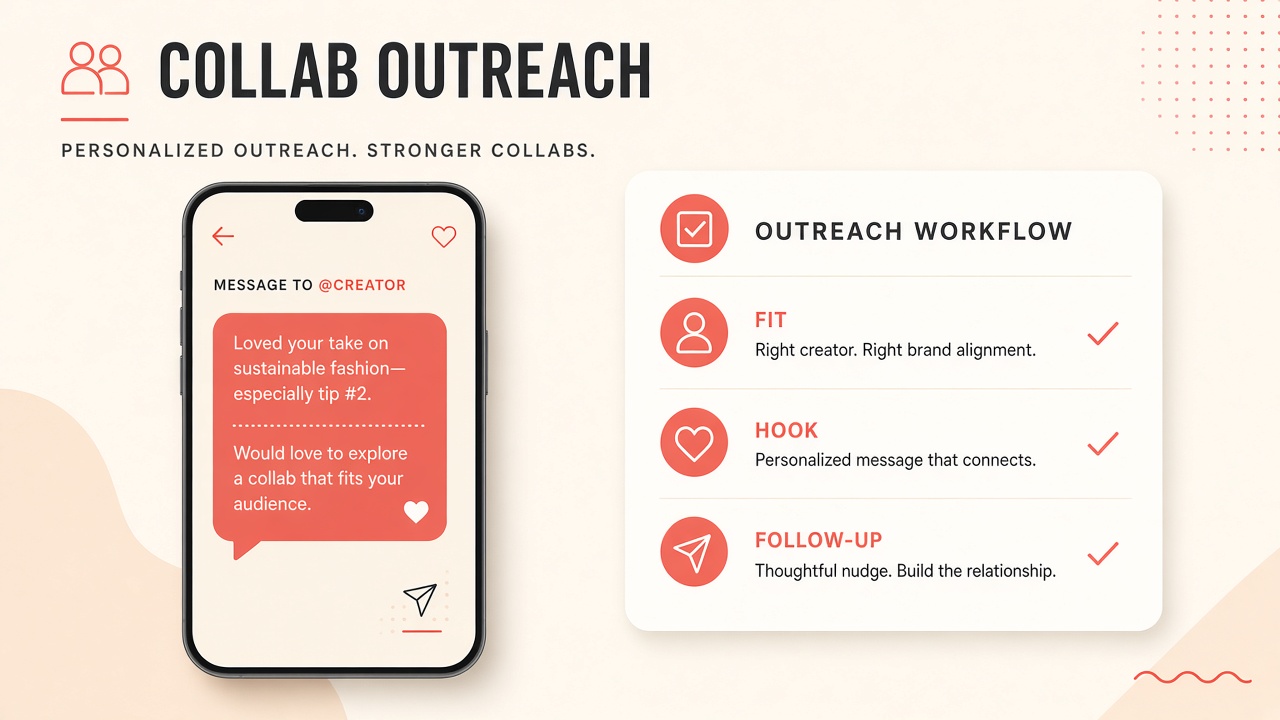
Creators who pitch brands and creators who pitch each other face the same inbox problem: generic DMs get ignored, but fully custom research for every prospect does not scale. The fix is not a longer template. The fix is a repeatable ai workflow creator collaboration outreach pipeline that scores fit first, pulls one verifiable hook from recent work, drafts a message under your platform character comfort limit, sends one follow-up with new value, and logs every touch in a simple CRM. AI handles research and first drafts. You send only messages you would sign your name to.
This guide targets YouTubers, podcasters, newsletter writers, and small brand teams booking creator partnerships without a full agency roster. Pair drafting with AI code helpers when you automate prospect lists from spreadsheets, and AI automation tools only for reminders and CRM updates, never for auto-sending DMs without human approval.
Identify Fit: Audience, Format, and Values
A collaboration prospect is worth a DM only when audience overlap, content format compatibility, and stated values align with your campaign goal, scored before any message is drafted. Skipping fit scoring produces polite rejections or worse, partnerships that underperform because the audience never cared about the topic. AI can summarize public bios and recent posts, but humans set the minimum thresholds.
- Define your campaign objective: awareness, conversion, co-created series, or affiliate test.
- List three audience traits that matter: geography, profession, purchase intent, or hobby depth.
- Match format: long-form video, short clips, newsletter essay, live stream, or static carousel.
- Check values signals: sponsorship transparency, competitor mentions, and tone on sensitive topics.
- Score each prospect 1 to 5 on audience fit, format fit, and values fit; skip totals below 11 of 15.
| Fit dimension | What to verify publicly | Disqualify signal |
|---|---|---|
| Audience | Comment themes, linked products, community questions | No overlap with your buyer profile after three posts reviewed |
| Format | Typical runtime, posting cadence, integration style | Creator only posts formats you cannot support or measure |
| Values | Past brand categories, disclosure habits, crisis responses | Direct competitor integration within your exclusivity window |
Creator-to-Creator Fit Notes
When one creator pitches another, mutual growth matters more than budget size, so fit scoring should weight complementary audiences and shared production burden equally. A podcast host with 8,000 downloads may be a stronger guest swap partner than a generic mega-channel with no topic overlap. AI can cluster topics from show notes; you confirm whether the collaboration actually helps your subscribers.
Research a Hook Specific to Their Recent Work
The opening line of a collab DM must cite one dated, public detail from recent content, not follower count or vague praise. Research shows personalized outreach with specific references can outperform generic messages by a wide margin. AI accelerates note-taking from titles, transcripts, and captions you paste locally. Never invent private metrics or assume audience demographics the creator never published.
- Open one recent post that relates to your campaign angle, published within the last 60 days when possible.
- Capture a visible creative choice: structure, prop, joke, data point, or guest dynamic.
- Write one sentence linking that choice to your collaboration idea without flattery filler.
- Remove any claim you cannot point to on a public URL.
- Store the hook and URL in your CRM row for follow-up context.
| Hook type | Strong example | Weak example |
|---|---|---|
| Format observation | Your three-act breakdown in the Feb 12 desk setup video made the cable routing easy to copy. | Love your content, so inspiring. |
| Topic bridge | The segment on batch meal prep maps to a co-hosted live cook-along we are planning. | We should collab sometime. |
| Audience signal | Commenters on your newsletter deep dive asked for tooling comparisons we also get weekly. | Your audience would love our product. |
AI Research Boundaries
Feed AI public URLs, captions, or transcripts you copy manually, and ban the model from guessing unpublished rates, inbox habits, or management contacts. If a creator lists a business email in their bio, use it for larger accounts. Nano and micro creators often prefer DMs on the platform where they publish. AI summarizes; you verify every fact before send.
Draft the DM Under Your Character Comfort Limit
A first-touch collab DM should stay between 80 and 120 words on Instagram or TikTok, naming collaboration type, one hook, one fit reason, and a single easy question. Instagram DMs allow far more characters, but shorter messages get read. Structure every draft as greeting, evidence, fit, offer type, and next step. Read aloud. If the draft sounds like marketing copy, cut adjectives before cutting the hook.
- Set a hard word cap in your prompt: "Under 110 words, no emojis unless I use them."
- State offer type plainly: paid integration, revenue share, guest swap, or product seeding with terms.
- Include timeline only when real; vague urgency reduces trust.
- End with one question that allows yes, no, or "send details."
- Run a banned-phrase check: amazing, obsessed, game-changer, synergy, pick your brain.
| DM block | Purpose | AI role |
|---|---|---|
| Greeting | Name the creator or team contact correctly | Suggest spelling from public profile only |
| Evidence | Prove you watched recent work | Draft from your hook notes, not from memory |
| Offer | Clarify paid, trade, or affiliate structure | Normalize wording; human sets numbers |
| Next step | One low-friction ask | Propose three CTA options; you pick one |
Channel Choice by Creator Tier
Self-managed creators under roughly 50,000 followers on a platform often respond faster to native DMs than to cold email, while managed talent usually routes deals through listed agency contacts. AI can flag management emails from bios. You choose channel. Never mass-blast identical text across platforms on the same day.
Follow Up Once With New Value
Send exactly one follow-up three to five business days after the first DM, adding a new detail such as a revised deliverable outline, a second content reference, or clarified compensation, then stop if there is no reply. Repeating "just bumping this" trains creators to ignore your future pitches. The follow-up should feel like a continuation, not a guilt trip.
- Reply in-thread on the same platform when possible so context stays visible.
- Lead with the new value: sample brief, calendar window, or relevant case study link with permission.
- Keep the follow-up shorter than the first message.
- Offer an easy out: "Happy to close the loop if timing is off."
- Mark the prospect closed-lost after the follow-up; revisit only when you have a materially new offer.
Some teams run longer sequences for high-ticket brand deals. For creator collab outreach at small scale, one thoughtful follow-up balances persistence with respect. Track reply rate by hook type monthly. Double down on evidence lines that earn responses, not on louder tone.
Follow-Up Examples That Add Value
Strong follow-ups reference a second public post, attach a one-paragraph concept tied to the creator's format, or clarify usage rights upfront when the first DM omitted legal basics. Weak follow-ups repeat the original pitch with different punctuation. AI can draft variants from your CRM notes; you delete anything that was already said.
Track Pipeline in a Simple CRM
A collab outreach CRM needs only prospect name, platform, fit score, hook URL, message status, follow-up date, and outcome, updated within 24 hours of every touch. Fancy software is optional. A spreadsheet or Notion board works when columns stay consistent. Automation should update reminders, not send messages silently.
- Create stages: researched, drafted, sent, followed up, replied, negotiating, booked, closed-lost.
- Log send date and channel for each prospect.
- Tag campaign name so you compare guest swaps vs paid integrations separately.
- Record rejection reasons when shared; patterns improve the next fit rubric.
- Review pipeline weekly: stale drafts mean you are researching without sending.
| CRM field | Why it matters | Automation safe? |
|---|---|---|
| Fit score | Prioritize who gets manual polish | AI can calculate from rubric inputs you supply |
| Hook URL | Audit evidence if a creator asks | Manual paste only |
| Follow-up date | Prevent double pings or forgotten threads | Yes, for calendar reminders |
| Outcome | Measure which hooks convert | Human updates after real replies |
Weekly Review Ritual
Spend twenty minutes each week comparing reply rate to fit score bands, then adjust research depth for mid-tier prospects who stall at the sent stage. If high-fit rows never reply, your offer or channel is wrong, not your opener. If low-fit rows reply often, your rubric is overweighting vanity metrics. AI code scripts can pull platform stats into the sheet; strategy stays human.
Frequently Asked Questions
Should I send a cold DM or ask for a warm intro?
Use a warm intro when a mutual contact can vouch for delivery quality; use a cold DM when no trusted bridge exists but public fit is strong and your hook is specific. Warm intros shorten trust building but add social debt. Cold DMs work when you prove relevance in the first two sentences. Never fake a connection. Mention the introducer only with permission.
When should I pitch paid collabs vs trade or affiliate deals?
Paid deals fit deliverables with defined usage rights and deadlines; trade or affiliate fits lower-budget tests when product value is obvious to the creator's audience. State which type you are proposing in the first message. Switching from "exposure" to paid later damages credibility. AI can draft both templates; you pick the honest offer before research time is spent.
Will creators know AI helped write the DM?
Creators detect lazy templates, not AI assistance, when the hook references real work and the tone matches how you speak on camera. Edit every draft for your slang, punctuation, and honesty about budget. Generic praise flags automation faster than polished grammar.
How many DMs should I send per week?
Quality beats volume: ten well-researched messages with fit scores above your threshold outperform fifty copy-paste blasts that burn channel reputation. Cap weekly sends so each draft gets a read-aloud review. Track positive reply rate, not raw send count.
Specific Beats Polite Every Time
An ai workflow creator collaboration outreach system that earns replies scores audience, format, and values fit before writing, anchors every DM in one verifiable recent detail, keeps messages under your comfort word cap, follows up once with new value, and logs outcomes in a lightweight CRM. AI removes research friction; respect and clarity close the deal.
Start with five prospects who already pass your fit rubric. Draft hooks from their latest posts before opening the DM composer. Send two messages this week with manual approval. Measure replies for thirty days. Outreach improves when hooks and offers evolve together, not when templates get longer.