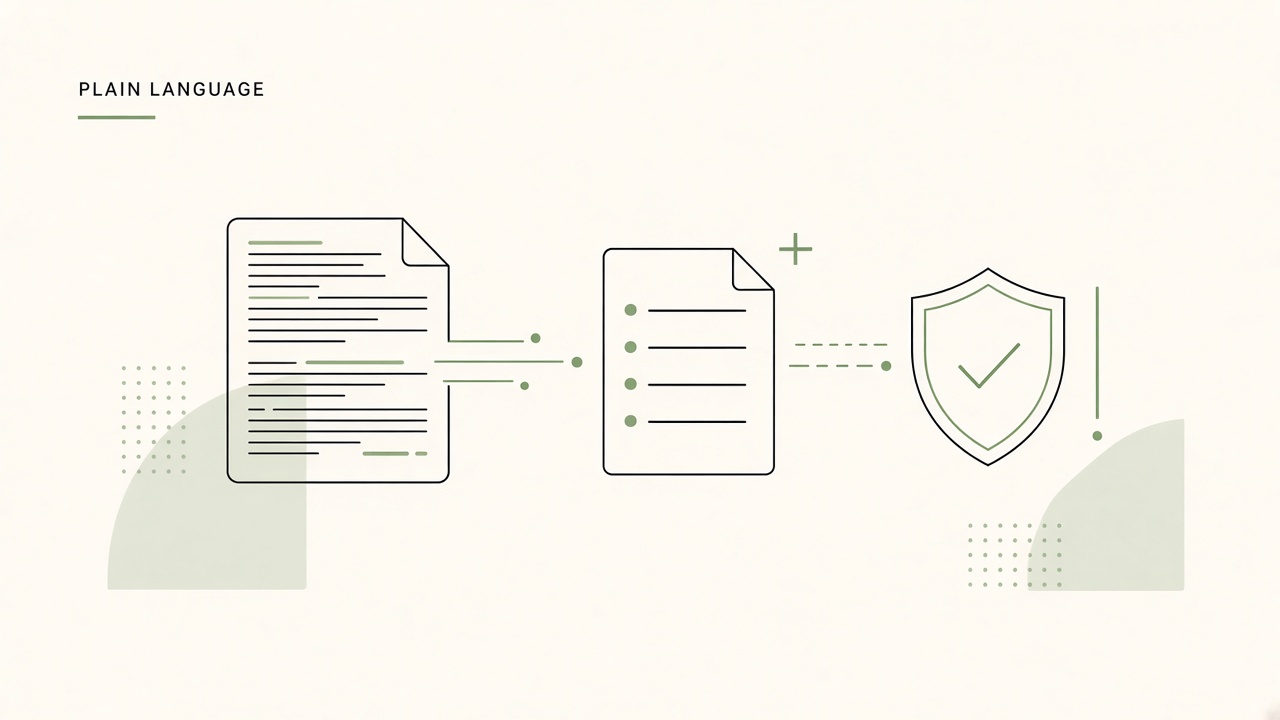
Cognitive accessibility extends beyond screen readers and captions. Millions of readers with dyslexia, aphasia, intellectual disabilities, dementia, or limited literacy need shorter sentences, consistent terminology, and predictable structure. Plain language guidelines from governments and health agencies specify reading levels, active voice, and front-loaded key facts. Large language models can rewrite dense policy prose in seconds, but reckless simplification drops deadlines, flips negations, or invents eligibility rules. Welsh Government Dylun assistant combines LLM drafting with mandatory human review by content designers and domain experts. Open-source Clara adds deterministic fact-checking that verifies numbers, dates, and identifiers survived rewriting without an LLM. Researchers frame human-in-the-loop (HiTL) and human-on-the-loop (HoTL) oversight in arXiv:2603.18879 for public sector AI. Teams exploring creative AI tools or popular AI tools for content workflows should treat readability scores as secondary to meaning preservation and dementia-friendly design patterns.
Cognitive Accessibility Beyond Screen Readers
WCAG success criteria for readability and consistent navigation help, yet many compliant pages remain cognitively exhausting because jargon, nested clauses, and buried actions persist. Cognitive disabilities affect working memory, attention, and language processing in ways magnification cannot fix. Easy Read formats add pictograms and one idea per sentence for intellectual disability communities. Dementia-friendly design favors familiar words, large type, high contrast, and avoiding time-limited interactions that panic users losing temporal context.
Public sector sites serve mandatory information: benefits, taxes, health screening, legal rights. When citizens misunderstand a rewrite, harm is tangible: missed appeals, wrong dosages, or unlawful self-incrimination. AI assistance is attractive at scale, but automation bias tempts authors to publish first drafts without reading them. Disclaimers and two-stage human review, as Dylun implements, are structural guardrails not optional niceties.
Plain Language Principles and Testing
Plain language puts the main message first, uses common words, keeps sentences short, and defines necessary technical terms once. Testing combines quantitative metrics (Flesch-Kincaid, SMOG, Gunning Fog) with qualitative review by representative readers. Automated metrics reward short words but ignore semantic complexity: a short sentence can still confuse if it hides conditional logic. Welsh Government researchers found LLMs can critique reading age yet sometimes increase complexity when restructuring FAQs poorly.
| Check type | What it catches | Limitation |
|---|---|---|
| Readability formulas | Long words, sentence length | Misses flipped negations |
| Clara deterministic check | Numbers, dates, IDs, negations | Regex scope, not full semantics |
| LLM semantic compare | Omissions, contradictions | Costs tokens, may hallucinate |
| Human domain review | Legal and medical accuracy | Slow, needs training |
AI Rewrite Workflows With Human Review
Dylun targets colleagues without content design training, producing a better first draft that still requires author accuracy checks and content designer sign-off before publication. The pipeline uses LLM prompts informed by GOV.WALES style guidance, regex pattern matching for style contradictions, and before-and-after reading grade display. Stage one: author runs rewrite and verifies facts. Stage two: content designer edits for accessibility and tone. Hallucination risk is explicit in Welsh Government algorithmic transparency records: LLMs may invent information, so dual human gates are mandatory.
Clara open-source engine separates rewrite from verification. Deterministic extraction inventories hard facts without an LLM, then compares output for mismatches. Optional semantic checks flag weakened obligations ("must" softened to "should") and distorted conditions. HiTL frameworks assign humans final approval; HoTL frameworks let humans intervene when automated monitors fire alerts. Public health content benefits from HoTL when volume spikes during outbreaks but legal content often demands HiTL on every paragraph.
Automated Readability Metrics Limits
Readability scores optimize proxy features, not comprehension, and can reward oversimplification that deletes legally required qualifiers. A paragraph scoring grade 6 reading level is useless if it removes "unless you opt out by 31 March." Meaning preservation versus readability scores is the core tension cognitive accessibility teams must manage. Dashboards should show both metrics side by side with diff highlighting for dropped entities.
Dylun discovery work noted LLM self-critique sometimes flags buried contact information yet misses subtler logical errors. Combining LLM critique with deterministic checks and human review closes more gaps than any single layer. Teams should log rewrite versions for freedom-of-information audits in government contexts.
Dementia-Friendly Design Patterns
Dementia-friendly content avoids idioms, time pressure, and multi-step memory loads while repeating key information in consistent locations. AI rewriters must not introduce metaphors or sarcasm that confuse readers with progressive cognitive decline. Navigation labels should stay stable across pages: renaming "Apply" to "Start" between sections disorients users relying on muscle memory. Plain language AI should preserve heading hierarchy so care partners can skim documents aloud.
Visual design partners with text: pictograms in Easy Read need human illustration review for cultural appropriateness. AI-generated icons risk stereotyped depictions of disability. Cognitive accessibility is therefore multimodal even when the immediate task is text rewriting.
Frequently Asked Questions
Is AI plain language safe for government sites?
Only with mandated human review. Welsh Government Dylun requires author and content designer approval. Blind publishing violates transparency and accuracy obligations.
Can AI handle health and legal content?
AI can draft candidate simplifications. Clinicians and lawyers must verify outcomes. Deterministic checks like Clara catch dropped numbers but not all clinical nuance.
What is HiTL vs HoTL?
HiTL means humans approve each output. HoTL means automated systems run continuously with human escalation on alerts. High-risk content usually needs HiTL; high-volume routine notices may use HoTL with strong monitors.
Do readability scores equal accessibility?
No. Low grade level does not guarantee comprehension or legal fidelity. Use scores as one signal among many.
How does Clara differ from Dylun?
Dylun is a government assistant with integrated LLM drafting and style prompts. Clara is open-source with emphasis on deterministic faithfulness verification and optional semantic drift checks.
What about dementia-friendly requirements?
Avoid time-limited flows, keep language literal, and test with representative readers. AI should not add cognitive load through unpredictable synonym rotation.
AI for cognitive accessibility succeeds when teams treat models as junior editors, not oracles. Welsh Government two-stage review, Clara deterministic checks, and HiTL or HoTL frameworks from recent accessibility research sketch a reproducible pattern: rewrite, verify facts, measure readability, human sign-off, publish. Meaning preservation beats grade level on every public sector page where a missed deadline costs a citizen real money or healthcare access.
Agencies rolling out plain language assistants should train authors to read diffs aloud, a low-tech habit that catches dropped "not" faster than any automation. Pairing AI rewrite tools with generative design tools for pictogram production still requires human art direction so Easy Read materials respect dignity and cultural context rather than generic clip art.
Future standards may require publishable machine-readable attestations listing rewrite model version, checker results, and reviewer IDs. Until then, cognitive accessibility teams should document their guardrails in algorithmic transparency records similar to GOV.UK entries for Dylun, giving citizens audit trails when simplified guidance fails in the field.
Health literacy initiatives in the United States and European Union increasingly reference plain language statutes for Medicaid notices, clinical trial consent forms, and insurance explanations of benefits. AI plain language cognitive accessibility tools must preserve conditional eligibility logic: "if household income exceeds threshold X unless region Y applies" cannot flatten into a single declarative sentence without footnotes. Clara obligation inventory flags weakened modals; human reviewers confirm whether softening was intentional editorial choice or model error.
Web Content Accessibility Guidelines success criterion 3.1.5 Reading Level and advisory techniques for abbreviations complement plain language programs. Automated checkers in CMS plugins now call LLM APIs for rewrite suggestions; without Dylun-style dual review, agencies risk publishing hallucinated phone numbers on benefit pages. Training procurement officers to reject vendor demos that skip human sign-off prevents expensive rework after citizen complaints.
Easy Read pictogram pipelines pair simplified text with licensed symbol sets from organizations such as Photosymbols or local disability charities. AI image generators produce inconsistent characters across pages; cognitive accessibility teams should not substitute unreviewed generative art for vetted pictogram libraries. Welsh Government scope explicitly excluded images and charts from early Dylun iterations, acknowledging multimodal risk.
arXiv:2603.18879 HiTL and HoTL framing helps managers assign responsibility when volume spikes: routine boilerplate notices may run HoTL with Clara-style deterministic gates, while individualized enforcement letters stay HiTL end to end. Audit logs should capture which mode applied so FOIA reviewers reconstruct decisions. Meaning preservation versus readability scores belongs on the same dashboard: a paragraph that drops from grade 14 to grade 8 while losing a negation fails regardless of green readability icons.
Dementia-friendly banking and utility portals increasingly offer persistent navigation and reduced animation. Plain language rewrites that introduce new metaphors each login undermine familiarity. Style guides should instruct models to reuse exact terms for core actions: "Pay bill" every time, not alternating "Submit payment" and "Complete transaction." Consistency aids readers with progressive cognitive decline more than marginal grade-level improvements from synonym rotation.
Academic researchers evaluating plain language AI should publish failure corpora: sentences where models inverted meaning, dropped exceptions, or invented penalties. Shared benchmarks accelerate Clara-class deterministic checkers and reduce vendor hype. Public sector unions representing editors rightly demand that AI assistive tools augment rather than eliminate skilled content design roles; Dylun positioning as first-draft assistance aligns with that labor reality when funding follows.
Municipal 311 portals and court self-help centers face surges in plain language demand during policy changes. Batch rewriting entire site sections without per-page human review caused visible errors in early adopter cities that rushed generative deployments in 2024. Lessons learned feed into 2026 procurement: require deterministic checkers, mandate bilingual review for Welsh-English sites, and cap automated publish quotas per editor shift so fatigue does not erode vigilance against automation bias.
Corporate intranets serving neurodiverse workforces benefit from plain language HR policies, but executive communications sometimes resist simplification perceived as diluting legal precision. Collaborative workshops where lawyers annotate model outputs in track-changes mode build trust faster than black-box rewrites. AI plain language cognitive accessibility succeeds when organizations reward reviewers for catching errors, not for maximizing pages processed per hour.
Insurance prior authorization letters remain a high-stakes genre where plain language AI must never soften denial grounds or appeal deadlines. Dedicated templates with frozen legal clauses and AI-editable explanatory sections reduce risk compared with whole-document rewrites. Regulators in consumer finance have begun examining similar guardrails for algorithmic simplification of loan disclosures.
User testing with aphasia support groups reveals that bullet lists help when each bullet carries one verb and one object, not nested sub-bullets that recreate tree structures cognitively dense prose already imposed. Dylun-style restructuring into bullets should cap depth at one level unless human designers approve exceptions for genuinely hierarchical tax procedures. Screen reader users with cognitive disabilities still benefit from semantic headings even when body text simplifies; never remove heading hierarchy solely to chase lower grade scores on automated dashboards. Quarterly audits comparing published pages to source statutes catch model drift when regulations update but rewrite templates lag behind.