xAI trained Grok on one of the largest GPU clusters in the industry at Colossus in Memphis, Tennessee. Through 2026 Elon Musk's team expanded phases, signed power agreements, and competed with OpenAI and Meta for NVIDIA H100 and Blackwell allocation. Infrastructure news rarely reaches product teams, but data center capacity shapes model release velocity, API pricing, and Grok availability on third-party clouds.
xAI data center expansion centers on Colossus phase builds, supplemental sites, power and cooling constraints, training throughput implications for Grok 4.x, and competitive dynamics with OpenAI's Stargate program and Meta's MTIA roadmap. This analysis tracks public timeline signals, capacity estimates from filings and press statements, and what enterprise buyers should watch when evaluating AI code platforms and AI infrastructure vendors.
What Colossus Expansion Means for Grok Customers
Colossus expansion increases xAI owned training capacity in Memphis, which influences how quickly Grok frontier weights improve, not necessarily day-to-day API latency in your chosen inference region. Phase energization adds GPU halls, power substations, and cooling systems that let xAI run longer pre-training jobs and parallel experiments. API customers should monitor release notes and contract SLAs separately from infrastructure headlines about GPU counts or Musk statements on social platforms.
Colossus Expansion Phases Through 2026
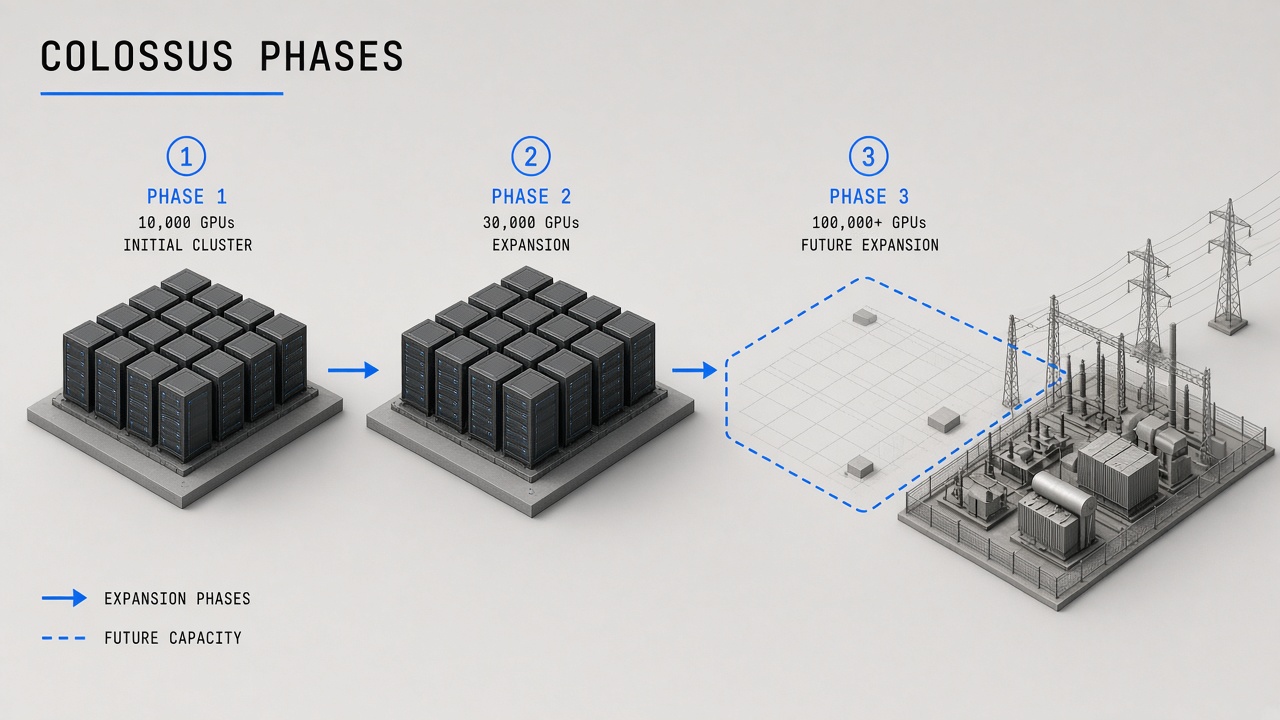
Colossus expansion proceeds in phased GPU halls: Phase 1 established roughly 100,000 H100-class accelerators; Phase 2 and Phase 3 add Blackwell racks, networking fabric upgrades, and dedicated power substations through late 2026. xAI and public utility filings describe incremental energization rather than a single big-bang launch, which spreads construction risk but creates uneven training capacity during buildout.
Musk stated on X that Colossus targets over 200,000 GPUs operational by end of 2026, though public filings confirm committed power and building permits for a lower baseline with optional expansion tranches. Treat social posts as aspiration until matched by interconnect and power delivery milestones. xAI also explored secondary sites in the US Sun Belt for inference and disaster recovery, with Memphis remaining the primary training hub.
| Phase | Timeline | Capacity signal | Training impact |
|---|---|---|---|
| Phase 1 | Operational 2025 | ~100K H100-class GPUs | Grok 4.5 base training |
| Phase 2 | H1 2026 energization | +50K accelerators, fabric upgrade | Grok 4.6 long-run jobs |
| Phase 3 | H2 2026 planned | Blackwell racks, new substation | Next-gen Grok pre-training |
| Secondary sites | 2026 to 2027 scouting | Inference and DR focus | API latency and redundancy |
Power and Cooling Constraints on xAI Sites
Colossus expansion is power-bound before it is chip-bound: xAI negotiated dedicated substations and long-term electricity contracts with Tennessee utilities while facing community scrutiny on grid impact and water use for cooling. Phase delays in 2026 most often trace to interconnect queues and transformer lead times, not GPU shipment alone.
xAI adopted high-density liquid cooling for Blackwell halls, which raises water consumption concerns in Memphis summers. Public filings mention recycled water loops and off-peak training schedules to shave peak load. Competitors face the same constraints; the difference is xAI's concentration in one mega-campus versus OpenAI's distributed Stargate sites. Enterprise buyers should expect occasional training job pauses during grid maintenance windows, though API inference runs on geographically separate capacity with different SLAs.
NVIDIA Supply Competition
xAI competes with OpenAI, Meta, Google, and Amazon for NVIDIA allocation; Musk's X platform integration and Grok consumer growth justify priority negotiations but do not eliminate supply lag for newest SKUs. Blackwell deployment at Colossus Phase 3 depends on rack-scale delivery schedules NVIDIA disclosed to multiple hyperscale customers in 2026. Delayed Blackwell rollouts would push next Grok frontier timelines even if power is ready.
Training Throughput Implications for Grok
Additional Colossus capacity directly increases xAI's ability to run longer pre-training jobs, higher-quality synthetic data passes, and parallel ablation experiments that feed Grok API releases. Grok 4.6 shipped in mid-2026 with improved agent benchmarks partly attributed to Phase 2 capacity coming online. Further gains require Phase 3 Blackwell throughput and networking upgrades that reduce all-to-all communication bottlenecks.
Training throughput also affects inference pricing. Larger owned clusters reduce marginal dependence on cloud rental for burst fine-tuning, giving xAI room to hold API list prices competitive with OpenAI and Anthropic on mid-tier agent workloads. Pricing can still rise if power costs increase or if xAI prioritizes consumer Grok subscriptions over developer API margins. Monitor console.x.ai pricing pages and enterprise quotes quarterly.
Inference vs Training Split
Colossus expansion primarily accelerates training; Grok API latency and availability depend on separate inference clusters that xAI and cloud partners operate in multiple regions. Enterprise buyers should distinguish training capacity headlines from inference SLA commitments in contracts. A delayed Phase 3 may postpone the next frontier Grok tier without immediately affecting Grok 4.6 API uptime if inference pools remain provisioned independently.
Fine-tuning and custom model programs for enterprise customers also consume training hall time. Heavy fine-tune demand from large accounts could compete with frontier pre-training schedules during peak buildout months. Ask xAI account teams how Colossus utilization is prioritized between public frontier runs and private enterprise fine-tunes when negotiating dedicated capacity deals.
Competitive Dynamics with OpenAI and Meta
xAI Colossus competes with OpenAI's Stargate joint venture data centers and Meta's combination of NVIDIA purchases plus MTIA custom accelerators for frontier training share. OpenAI emphasizes multi-site US buildout with Oracle and SoftBank partners; Meta emphasizes efficiency per watt with in-house chips for recommendation and some training workloads. xAI bets on single-campus scale and tight coupling with X data for Grok differentiation.
Supply Chain Ripple Effects
Colossus scale orders contribute to industry-wide lead times for transformers, liquid cooling manifolds, and high-bandwidth networking gear that other labs also require. Enterprise buyers feel supply chain effects indirectly through delayed model releases or regional capacity crunches during simultaneous frontier training runs. Diversify inference regions in contracts so a Memphis-focused buildout does not concentrate your production traffic in one geography.
| Player | 2026 infra strategy | Enterprise implication |
|---|---|---|
| xAI Colossus | Mega-campus GPU scale | Grok release cadence, API pricing |
| OpenAI Stargate | Multi-site US buildout | GPT tier availability, enterprise SLAs |
| Meta MTIA + NVIDIA | Hybrid custom and merchant silicon | Llama open weight, ads-scale efficiency |
| Google TPU v6 | Vertical integration on Vertex | Gemini latency and enterprise bundles |
Enterprise teams should not pick models on infrastructure alone, but capacity constraints explain release timing. If Colossus Phase 3 slips, expect Grok frontier announcements to align with Phase 2 utilization peaks rather than calendar hype. Diversify model vendors when single-lab infrastructure risk threatens roadmap commitments.
Environmental and Community Impact
Colossus expansion drew local scrutiny on grid load, water use, and tax incentive packages in Memphis. xAI public statements emphasize long-term power purchase agreements and infrastructure jobs; community groups request transparent reporting on peak megawatt draw and water recycling rates. Environmental factors increasingly appear in enterprise RFP questions about AI vendor sustainability even when they do not block procurement alone.
Track municipal filings and Tennessee Valley Authority interconnect updates when modeling xAI capacity timelines. Delays tied to community negotiation can shift Grok training schedules as much as chip shortages. Competitors highlight renewable power mixes in their own announcements; xAI may respond with updated sustainability disclosures as Phase 3 energizes.
What Enterprise Buyers Should Monitor
Track xAI public utility filings, NVIDIA supply commentary, Grok API release notes, and Colossus construction permits as leading indicators of training capacity, not Musk social posts alone. Pair infrastructure monitoring with eval scores on your workloads so Grok adoption decisions rest on product fit and contract terms, not hype about GPU counts.
If your organization already standardizes on Microsoft Foundry or Google Cloud Model Garden for multi-vendor routing, Grok availability on those marketplaces reduces single-campus risk because inference can shift regions when Memphis training schedules fluctuate. Negotiate exit clauses if Grok pricing ties to Colossus utilization incentives disclosed in enterprise quotes.
Frequently Asked Questions
Where is Colossus located?
Colossus is xAI's primary training campus in Memphis, Tennessee, with phased GPU halls and dedicated power infrastructure. Inference endpoints are distributed separately for API customers.
How many GPUs does xAI operate?
Public sources confirm roughly 100,000 H100-class GPUs in Phase 1 with expansion toward 200,000 accelerators claimed by Musk for late 2026. Verify against utility filings and NVIDIA delivery reports before treating claims as operational fact.
Does expansion improve Grok enterprise SLAs?
More owned capacity supports redundancy and fine-tuning capacity, but enterprise SLAs depend on contract tier and inference region, not training hall count alone. Negotiate availability and support terms explicitly.
What happens if power delivery delays?
Training schedules slip and frontier releases may pace to available energized halls, while API inference on separate pools typically continues. Monitor xAI status pages during regional grid maintenance.
How does Colossus compare to OpenAI Stargate?
Colossus concentrates scale in one campus; Stargate spreads capacity across partner sites with different power and networking profiles. Both aim to secure frontier training share amid NVIDIA supply constraints.