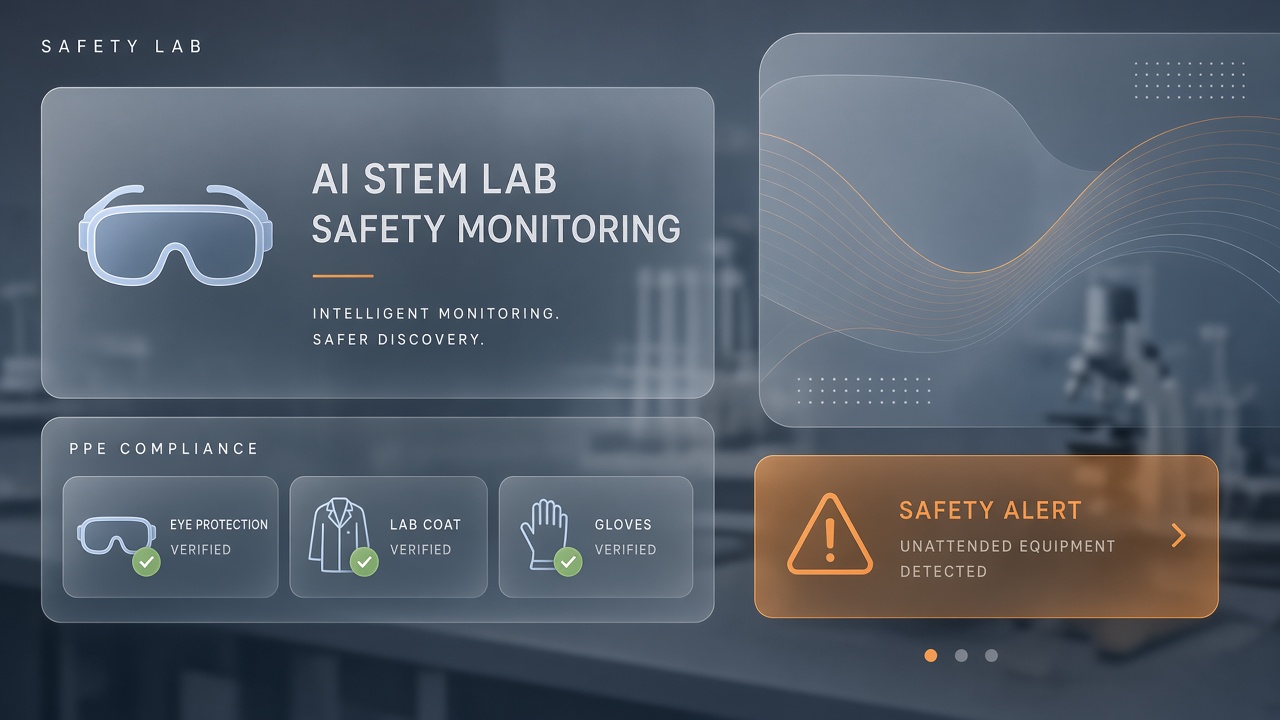
AI STEM lab safety monitoring uses computer vision on fixed or existing CCTV feeds to detect missing personal protective equipment, hazardous behaviors, spills, and fire risks, then alerts teaching staff in near real time. University research groups have published YOLOv5 and YOLOv8 pipelines trained on student lab datasets with glove, goggle, mask, and coat classes, reporting mean average precision in the 70 to 77 percent range on educational imagery. None replace chemical hygiene officers or fume hood engineering controls, but they address a practical gap: one instructor cannot watch thirty bench stations simultaneously. Schools evaluating AI chatbot assistants for science should separate conversational lab help from vision-based compliance monitoring, which carries distinct privacy and liability implications.
Interactive machine learning papers in 2025-2026 also explore ST-GCN hazardous-behavior recognition and wavelet-denoised datasets for imbalanced spill imagery, signaling academic momentum even before mainstream ed-tech vendors ship turnkey K-12 packages. District technology directors should distinguish research demos from warrantied products with SLAs and on-site support.
Common Lab Accidents in Education
Teaching laboratories see cuts from glassware, chemical splashes, burns from hot plates, and inhalation incidents when students skip goggles or work outside fume hoods. U.S. Chemical Safety Board case summaries and school district incident reports repeatedly cite inadequate PPE and overcrowded supervision. High school chemistry demos (methanol flame jets, lithium in water) make headlines when safety protocols fail. Biology labs add sharps and formaldehyde exposure; physics labs add high voltage and laser hazards less visible to generic PPE classifiers.
Accidents often stem from momentary lapses: a student lifts goggles to read a meniscus, removes gloves to text, or leaves a spill unreported. Manual supervision misses brief violations. Automated monitoring aims to log compliance continuously and nudge correction before injury. It cannot detect all chemical risks (invisible vapor, incorrect reagent identity) without additional sensors.
Insurance and liability teams track documented safety training. Timestamped PPE compliance logs from vision systems may support investigations after incidents, though admissibility varies by jurisdiction and consent policies.
Vision Models for Goggles and Coats
Object detectors trained on lab-specific datasets classify PPE items and body regions, outputting bounding boxes and confidence scores per student workstation when camera angles permit. A 2022 Sensors study from United Arab Emirates University introduced the SLS (Students Lab Safety) dataset: 481 images, four classes (gloves, helmets, masks, goggles), resolutions around 835 by 1000 pixels. YOLOv5n reached 77.40 percent mAP on mixed instance sizes. YOLOv7 variants were compared for precision-recall trade-offs on crowded benches.
Vietnam Maritime University researchers trained YOLOv8n on 3,700 labeled images for uniform compliance, unsafe handling, and fire hazards, reporting roughly 70 percent mAP and integrating Flask APIs that push alert images to a web dashboard. Chemical and bioengineering lab work added posture estimation on improved YOLOv5s, claiming 97.68 percent precision on dangerous-behavior classes in controlled test video, though real classroom generalization is typically lower.
Deployment challenges include occlusion (students facing away), similar-colored street clothes mistaken for lab coats, and ethnic diversity in training data affecting fairness. Multi-camera fusion (overhead plus bench-level) improves recall at higher install cost.
| Detection target | Typical model | Reported challenge |
|---|---|---|
| Goggles / faceshields | YOLOv5n, YOLOv8 | Hair occlusion, reflections |
| Gloves and coats | YOLO family | Color confusion with clothing |
| Unsafe posture | YOLO + pose estimation | Needs diverse behavior labels |
| Fire / smoke | YOLOv8, classical CV | False alarms from steam |
Real-Time Alert Workflows for TAs
Production workflows ingest RTSP camera streams, run edge or server GPU inference every few frames, debounce alerts to reduce alarm fatigue, and notify teaching assistants via tablet dashboards, SMS, or PA integration. UAE University's proposed system stores per-student PPE compliance reports for post-lab review. Maritime University software displays live feeds with violation overlays and logs timestamps for administrators. Debouncing matters: flagging a student adjusting goggles should not trigger ten pushes per minute.
Escalation tiers help: Level 1 nudges a bench group chat display ("goggles required"); Level 2 pings the TA tablet with snapshot; Level 3 stops an experiment interlock on supported equipment (rare in schools, more common in industry). Human acknowledgment closes loops so the model learns from false positives when active learning pipelines exist.
Integration with chemical inventory or SDS systems is future-facing; today's deployments focus on vision and simple environmental sensors (smoke, gas) where budgets allow.
Privacy in Secondary School Labs
Continuous video analytics in K-12 settings raises surveillance concerns, minor consent rules, and equity questions when disciplinary records tie to automated flags. FERPA and state student privacy laws may classify compliance logs as education records. Districts should publish clear notices: which cameras run analytics, retention periods, whether vendors process video in cloud GPUs, and if facial recognition (distinct from PPE detection) is disabled. Many academic prototypes detect PPE without identity tracking; production vendors should default to anonymous zone alerts ("Bench 4 missing goggles") rather than naming students in push notifications unless policy allows.
Students of color and neurodivergent learners may be disproportionately flagged if training data underrepresents them. Bias audits and human appeal paths are essential before tying alerts to grades or discipline. Parent councils and union representatives should review pilots.
Universities face similar debates with softer power dynamics. Graduate TAs need training to treat alerts as coaching moments, not automatic misconduct referrals.
University Research Lab Context
Graduate research labs differ from teaching kitchens: fewer students, more hazardous reagents, and longer unsupervised hours increase the value of continuous monitoring when principal investigators cannot be present overnight. UAE University research focused on teaching labs, but the same YOLO architectures transfer to shared instrumentation rooms where laser goggles and cryogenic gloves matter. University IRBs may classify video analytics as human subjects research if identities are tracked; anonymized zone alerts reduce review burden compared to per-student scorecards shared with PIs for grading.
Research safety officers often maintain chemical inventory in ChemTracker or similar systems. Future integrations could correlate PPE alerts with scheduled experiments using particularly hazardous materials, prioritizing TA attention during high-risk weeks.
Integration with Existing CCTV
Schools with legacy security cameras can add edge inference boxes that tap RTSP streams, avoiding full camera replacement when resolution and placement suffice for PPE visibility. Minimum viable specs often require 1080p at bench height, 15 to 30 fps, and stable lighting. Night labs need IR-aware models or supplemental LED. On-prem inference keeps video local for privacy-sensitive districts; cloud SaaS offerings simplify updates but export streams offsite.
IT teams should VLAN-separate lab analytics from public Wi-Fi, patch firmware, and restrict dashboard access to credentialed staff. Cyber incidents on camera networks have hit districts nationwide; safety AI must not become a new attack surface.
Retrofits compete with low-tech mirrors and increased TA staffing. Cost models should include GPU maintenance, model retraining each semester for new lab layouts, and teacher professional development on interpreting alerts.
Hybrid human-AI supervision remains the responsible default: teaching assistants receive alerts, confirm violations visually, and coach students rather than issuing automatic demerits from black-box scores. That workflow preserves educational relationships while using vision to extend attention across crowded benches.
Spill, Fire, and Behavior Detection
Beyond PPE, research systems target visible liquid spills, flame or smoke signatures, and unsafe postures such as reaching over open flames without tongs. Vietnam Maritime University's YOLOv8 deployment labels improper uniform, unsafe handling, and fire hazards with Flask-backed alert dashboards. Chemical engineering labs in China combined improved YOLOv5s with human pose estimation, reporting sub-25 ms inference per frame on GPU for dangerous-behavior classes in controlled video. Steam from hot water baths still triggers false fire positives unless models train on negative examples.
Spill detection without chemical identification cannot assess toxicity: water on the floor differs from corrosive acid. Vision should trigger "liquid on bench" alerts prompting human inspection, not automatic evacuation. Pair cameras with standard spill kits, eyewash stations, and gas sensors where budgets allow.
ST-GCN and spatio-temporal graph models in recent safety education papers recognize hazardous motion patterns (running with glassware, horseplay near balances) from skeleton keypoints, reducing reliance on pixel-level labels alone. These need diverse training actors to avoid bias against body types or mobility aids.
Vendor and Open-Source Landscape
Most published STEM lab safety AI remains academic; commercial K-12 offerings adapt general construction PPE detectors with mixed results on goggles versus safety glasses distinction. Open-source YOLO weights trained on COCO or construction datasets transfer poorly to clear lab goggles on teenage faces. Fine-tuning on institution-specific footage during summer break improves recall before fall enrollment. Some districts prohibit recording minors for training; synthetic data augmentation (paste goggles on lab stock photos) helps but needs validation.
Maintenance includes relabeling when lab layouts change, updating models when new PPE standards arrive (e.g., face shields post-pandemic), and patching edge devices. Annual re-certification with safety officers prevents alert thresholds from drifting into ignored noise.
National Science Teachers Association guidance still centers human supervision and written safety contracts; AI monitoring should appear in those contracts as an assistive layer with defined data retention, not as a waiver of instructor duty of care.
Pilot programs should measure leading indicators (PPE compliance rate, mean time to TA response) before claiming injury reduction, which is statistically rare in any single school year but catastrophic when incidents occur.
Document camera placement in safety plans so students know which areas are monitored, reinforcing training rather than surprise enforcement.
Frequently Asked Questions
Does AI monitoring reduce school liability?
It may demonstrate due diligence in training documentation but does not transfer liability to vendors automatically. Legal counsel should review contracts and consent forms before deployment.
How common are false alarms?
Steam, reflections, and partial occlusion trigger false PPE negatives. Expect tuning periods each term. Systems without debouncing frustrate staff quickly.
Do universities use the same systems as high schools?
Research prototypes dominate university literature; commercial K-12 packages are emerging but less standardized. Universities may pilot open-source YOLO stacks with IT governance review.
What does deployment cost?
Academic papers focus on algorithms, not TCO. Budget edge GPUs per room, installation, and annual software licenses. Small pilots start at one lab bay before campus-wide rollout.
Can vision replace chemical hygiene officers?
No. Ventilation, waste disposal, and protocol design remain human-led. Vision augments eyes-on supervision during active sessions.
Can AI detect chemical spills?
Visible liquid pools are detectable in research settings; clear solvents on dark benches remain hard. Combine with manual spill kits and student reporting culture.
Should ethics committees review lab AI?
Yes when video involves minors or feeds research datasets. Document purpose limitation (safety only) and prohibition on facial recognition for grading.
Are middle school science labs different from high school?
Younger students move more unpredictably and may share goggles, complicating per-student compliance logs. Zone-based alerts ("Table 3") work better than named student flags in grades 6-8.
Does monitoring differ for chemistry versus physics labs?
Chemistry labs prioritize splash goggles, coats, and spill visibility; physics labs may emphasize laser safety eyewear and high-voltage clearance zones. Model class lists and camera angles should match discipline-specific PPE rules rather than one generic detector bundle.