Executives walk into meetings underprepared when context lives across email threads, slide decks, and CRM notes. Assistants spend hours copying links while sensitive materials leak through the wrong forward chain.
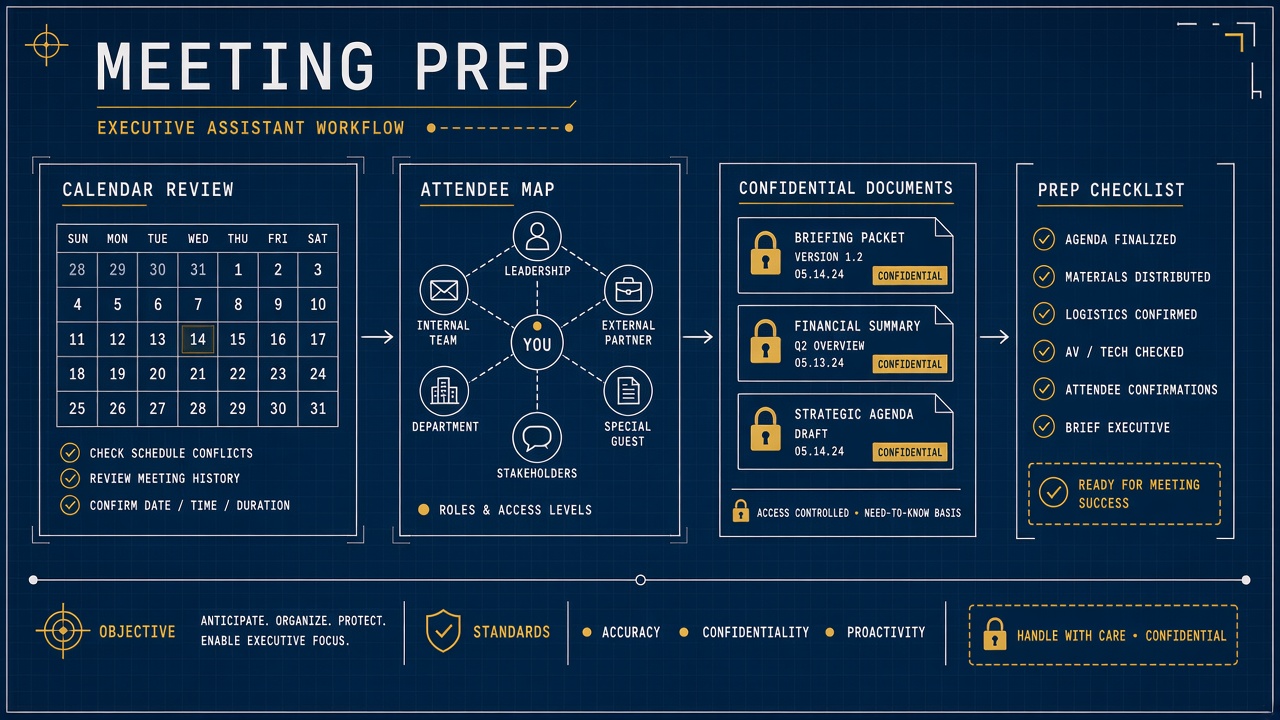
An AI workflow for executive assistant prep researches calendars and attendees, summarizes prior meeting notes, drafts talking points, and distributes packets only through approved secure channels. Confidentiality is non-negotiable at every phase. Use private AI chatbot tiers for packet drafting and AI automation to sync calendar metadata into your prep checklist, never raw attachments to consumer tools.
Calendar and Attendee Research
Build each prep packet from the calendar event, attendee list, and declared meeting objective before opening any document repository. AI summarizes public profiles and internal CRM notes when given structured attendee fields. Assistants verify titles and reporting lines; models confuse similarly named executives.
- Pull meeting title, duration, location, and video link from the calendar API or export.
- Tag internal versus external attendees and note who owns the relationship.
- Attach last interaction date and open action items from CRM when available.
- Flag conflicts of interest or legal hold restrictions before research continues.
- Document which sources AI may read: CRM yes, personal email no unless policy allows.
| Attendee type | Research source | Include in packet |
|---|---|---|
| Internal direct report | HR directory, prior 1:1 notes | Goals, blockers, career topics if relevant |
| External customer | CRM, support history, public news | Account health, renewal dates, open issues |
| Board or investor | Approved investor relations brief only | Metrics pack from finance, no draft slides |
| Vendor | Procurement records, contract status | SOW milestones, escalation contacts |
Calendar Conflict Checks
Scan the executive calendar for back-to-back overload and travel buffers before finalizing packet delivery time. AI can flag impossible travel between physical meetings. Assistants negotiate agenda trims with chiefs of staff when prep time is insufficient.
Prior Meeting Notes Summarization
Summarize prior meeting notes into decisions, open actions, and quotes the executive may need to reference, with links to source documents stored in approved systems. Paste redacted notes into private chatbot workspaces only. Never upload board decks to consumer AI without enterprise privacy terms.
- Collect notes from the last one to three meetings with the same attendees or topic.
- Redact personnel matters, unreleased financials, and acquisition codenames.
- AI outputs: decisions made, owners, due dates, and unresolved debates.
- Assistant verifies dates and names against source files line by line for high-stakes meetings.
- Attach source links with view permissions matching the executive role.
Note Quality Standards
Reject AI summaries that introduce commitments not present in source notes. Hallucinated action items damage trust. When source notes are sparse, the packet states "no recorded decision" rather than inferring outcomes.
Draft Talking Points for Executive
Talking points follow a fixed schema: context, goal for this meeting, three to five points, landmines to avoid, and suggested asks. AI drafts from attendee research and note summaries. The executive or chief of staff approves tone and strategic emphasis before send.
- Context: one paragraph on why this meeting matters now.
- Goal: desired outcome stated as a decision or commitment, not vague alignment.
- Points: bullet arguments with supporting data citations from approved packs.
- Landmines: topics to defer, legal restrictions, or sensitive history.
- Asks: explicit requests with fallback positions when appropriate.
| Meeting tier | Packet depth | Approver |
|---|---|---|
| Routine internal | One-page talking points | EA self-check |
| External customer exec | Attendee brief plus CRM summary | EA plus sales leader |
| Board or committee | Full packet from IR and legal sources | General counsel or CFO |
Executive Preferences
Maintain a living preferences doc: bullet versus narrative style, maximum page count, and topics they want excluded from AI drafts. Some executives read on mobile; packet format should match device, not default PDF when plain email suffices.
Secure Distribution Channels Only
Deliver prep packets through company-approved channels with access logging: secure email, encrypted shared drives, or executive mobile apps, never personal WhatsApp or unmanaged file shares. Distribution rules are as important as draft quality. One wrong forward exposes M&A or HR matters.
- Classify packet tier: internal, confidential, or restricted.
- Apply DLP labels before send; block external forwarding on restricted tiers.
- Send 12 to 24 hours before meeting unless emergency, with update addendum if materials change.
- Revoke access to time-limited links after the meeting ends when platform supports it.
- Log recipient list and version hash in the EA prep tracker.
Automation can schedule packet reminders and collect RSVP status. Automation must not attach restricted files to calendar invites visible to unauthorized guests.
Mobile and Travel Delivery
When executives travel, confirm VPN and offline access policies before relying on cloud links mid-flight. Pre-download approved PDFs to managed devices. AI summaries in email body may suffice when attachments are blocked.
Prep Workflow Cadence
Run a daily prep standup for the next 48 hours of executive meetings: tier, owner, blockers, and approval status. AI reduces drafting time; the standup catches meetings missing SME input or legal review.
Post-Meeting Capture
Assistants capture decisions and new action items within 24 hours while memory is fresh, feeding the next cycle summarization. AI drafts follow-up emails for executive review; assistants never send on behalf without explicit approval rules documented with the executive office.
Duplicate Meeting Merge
When recurring meetings share attendees and topics, reuse validated attendee brief sections rather than regenerating from AI each week. Maintain a master brief library with last-updated dates. AI summarizes only delta notes since the prior session to reduce executive reading load.
Crisis Meeting Mode
Crisis meetings use a shortened packet template: situation summary, decision needed, options with tradeoffs, and comms constraints. Skip attendee LinkedIn research when time-critical. Legal joins the approval chain for any external statement drafts included in the packet.
Vendor Tool Audit
Quarterly, the executive office audits which AI and automation tools EAs use and confirms data processing agreements cover meeting content. Shadow IT chatbots are removed from workflows. Training covers paste discipline and classification labels before new tools roll out.
Executive Feedback Retrospective
Monthly, EAs collect lightweight feedback from the executive on packet usefulness: too long, missing context, or wrong emphasis. Adjust templates and AI prompts from feedback rather than adding more research each week. Executives who never read appendices signal the workflow needs compression, not more AI output.
Assistant Coverage and Handoffs
Backup EAs access the same secure prep tracker and template library so coverage weeks do not revert to inconsistent formats. Handoff notes list pending approvals and restricted packets in progress. AI prompts live in shared workspaces with role-based access, not personal accounts.
Frequently Asked Questions
How should EAs handle board materials?
Board packets come from finance, legal, and investor relations workflows; EAs assemble and distribute, they do not draft metrics with AI. Use only approved slide decks and data rooms. AI may format a cover email template with no substantive content changes. Restricted materials stay in board portals with watermarking when required.
What changes when the executive is traveling across time zones?
Shift packet delivery to local executive morning and compress talking points for jet-lagged reading. Include travel logistics summary separately from strategic content. AI can reorder sections by meeting priority when the calendar compresses. Confirm quiet hours before sending push notifications.
Can EAs use free consumer AI for meeting prep?
No for confidential content; consumer tools may train on inputs and lack enterprise audit controls. Use private deployments with SSO, admin retention policies, and legal review. Sanitize prompts when only public attendee data is involved.
Who owns mistakes in AI-drafted talking points?
The executive office owns accuracy; AI is assistive. Assistants sign off after verification. Executives should treat talking points as drafts until they read them. Chiefs of staff may require dual review for external-facing commitments.
Prepared Executives, Protected Information
Executive assistants deliver value when AI accelerates research and summarization while secure distribution and human approval protect confidential information. Meeting prep workflows fail when speed bypasses classification rules.