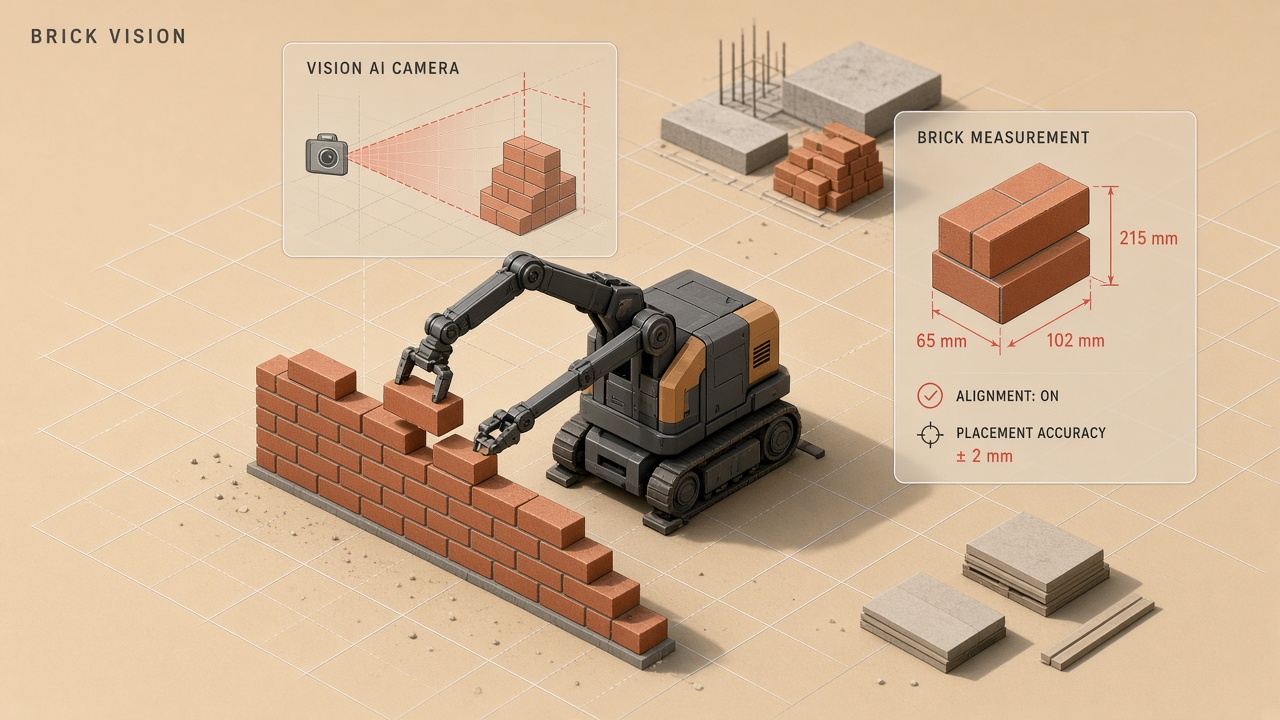
A brick wall looks uniform from the sidewalk. On the scaffold, each unit varies by millimeters, mortar stiffens at different rates, and afternoon sun shifts shadow patterns across the course line. Human masons compensate with touch and sight. Bricklaying robot vision AI attempts the same judgment with cameras, depth sensors, and models that measure every brick before placement, compare reality to BIM coordinates, and adjust pick-and-place trajectories when materials or lighting diverge from training data. Monumental's Pisa, Petra, and Panama fleet in the Netherlands and legacy systems like Construction Robotics' SAM100 illustrate two generations: laser-guided semi-automation versus fully autonomous, vision-first masonry on active job sites.
General contractors evaluating digital twins should treat vision quality as the bottleneck for robotic masonry ROI. Teams browsing AI chatbot assistants for RFI drafting still need ground-truth imagery from the wall face before trusting automated progress reports. More construction robotics explainers live on the EliteAI.tools blog index.
What Bricklaying Robot Vision AI Means in Plain Language
Bricklaying robot vision AI is the use of cameras, depth sensing, and machine learning on construction sites to identify bricks, estimate their pose, check mortar beads, and align each placement with a digital wall model despite dust, vibration, and material variation. Unlike factory pick-and-place, outdoor masonry faces uncontrolled lighting, moving personnel, and stockpiles that shift hourly. Vision replaces fixed fixtures with continual re-localization: the robot must know where the wall plane is, which brick in the tray is next, and whether the last course drifted before laying another row.
Early commercial bricklaying robots relied on external metrology. The SAM100 (Semi-Automated Mason) from Construction Robotics used story poles, CAD/CAM job maps, and a laser rangefinder to guide a robotic arm, reaching roughly 350 bricks per hour in the OS 2.0 revision with masons finishing joints and corners. That architecture predates modern convolutional detectors but established the workflow: digital plan in, sensed pose out, human partner for non-repetitive work. Newer fleets treat vision as the primary loop closure mechanism.
| Vision function | What it measures | Failure if wrong |
|---|---|---|
| Brick detection and pose | Size, chip orientation, color | Gaps, visible chips on facade |
| Wall plane estimation | Course height, bond pattern | Cumulative drift, out-of-plumb walls |
| Mortar inspection | Bead width, slump cues | Weak joints, rework |
| Site localization | Robot pose vs digital twin | Openings misaligned with frames |
Vision AI versus laser metrology
Laser-guided systems excel when story poles and mapped coordinates stay stable; vision AI excels when bricks, lighting, and surrounding clutter change faster than a static map can capture. Monumental CEO Salar al Khafaji emphasizes that "ground truth is physically being there": changing light, weather, surfaces, and materials all affect sensors. The company's robots photograph each brick during pickup and placement with 3D cameras because no two units are identical. When a job specified near-black bricks, models trained on red and light stock failed until retrained on deployment data, a lesson that applies to any construction CV rollout.
Depth cameras also support obstacle detection for autonomous navigation across slabs littered with pallets, rebar cages, and temporary fencing. Lidar mapping supplements vision on some masonry automation roadmaps because it tolerates dust better than passive stereo in dry summer conditions, though sensor fusion increases calibration overhead at every new site mobilization. Contractors should budget calibration time in the mobilization schedule, not only in the robotics rental line item.
How the Underlying AI Pipeline Works
A bricklaying vision stack typically sequences localization, brick instance segmentation, 6-DoF pose estimation, motion planning, and post-place verification, orchestrated by job-site software that maintains a digital twin of the wall under construction. Monumental's Atrium platform connects the physical site to BIM data, schedules its autonomous fleet, and encodes masonry rules (bonds, expansion joints, bat boxes) that experienced masons enforce by eye.
Monumental: Pisa, Petra, Panama, and Atrium
Monumental deploys three cooperating robots: Pisa picks, mortars, and places bricks with dual small crane arms; Petra ferries brick stacks; Panama supplies mortar. All share a hardware platform so perception and navigation modules reuse across roles. Cameras and AI register the immediate environment continuously, detecting when reality diverges from the technical model. The system auto-generates quality documentation with photos of each brick before and after processing, supporting compliance workflows such as the Dutch Quality Assurance Act.
The company reports walls for more than 100 homes plus schools, hotels, and canal infrastructure in the Netherlands, operating robots as subcontractors rather than one-off equipment sales. Funding exceeded $60 million by 2025, reflecting investor belief that parallel small robots scale better than a single gantry in unpredictable sites. Vision underpins navigation: robots drive independently across the slab while avoiding humans, hoses, and partial walls.
SAM100 heritage and Hadrian X contrast
Construction Robotics' SAM100 reached commercial deployment in North America with laser and story-pole metrology, not the convolutional pipelines Monumental publicizes. Registry data suggest the SAM100 line is largely discontinued as the vendor emphasizes the MULE lift-assist product, making SAM a useful historical baseline: collaborative robotics with masons smoothing joints and handling corners. Australia's FBR Hadrian X uses dynamic stabilization technology (DST) on a boom-mounted block layer, adjusting for wind and vibration; industry summaries cite throughput near 500 blocks per hour for multi-story work under a "Wall as a Service" model, with computer vision and lidar increasingly cited for outdoor mapping in newer masonry automation surveys.
| Platform | Vision approach | Human role | Status (2025) |
|---|---|---|---|
| Monumental (Pisa fleet) | 3D cameras, CV per brick, Atrium twin | Masons integrate crews, complex details | Commercial pilots in EU |
| SAM100 | Laser + CAD map, limited CV | Operator, tender, finishing mason | Legacy / largely discontinued |
| FBR Hadrian X | DST stabilization, outdoor mapping | Service model crews | Commercial AU/US |
| Buildroid AI (emerging) | BIM simulation, Omniverse twin | Planners, multi-robot coord | US entry planned 2026 |
Typical workflow steps
- Import BIM or technical model into orchestration software (Atrium or equivalent).
- Survey slab control points and initialize robot localization on site.
- Calibrate vision for brick color batch and ambient light at first lift.
- Run pick-measure-place loop with mortar extrusion and force monitoring.
- Capture per-brick imagery for QA and progress billing.
- Hand off corners, lintels, and aesthetic corrections to masons per collaborative SOP.
Real Deployments and Published Evidence
Bricklaying robot vision AI has crossed from trade-show demos into multi-building portfolios in Europe, while North American adoption mixes legacy SAM deployments with newer entrant announcements. Monumental publicly discusses scaling through fleet parallelism: adding robots rather than pushing one machine to superhuman speed alone. Interesting Engineering and The Robot Report document field lessons, including the black-brick retraining episode, that simulation alone would not surface.
Industry labor data motivate the investment: contractors widely report skilled mason shortages, and national housing targets in markets like the Netherlands (roughly 100,000 homes per year) exceed what aging workforces can deliver. Robotics vendors claim comparable unit economics to human crews when uptime spans nights and weekends, but independent TCO studies across climates remain scarce. SAM100 historical claims of 50% labor savings and 3-5x productivity depended on three-person human teams feeding and finishing; vision-first fleets shift labor toward supervision and detail work rather than eliminating jobs outright.
Digital records and preconstruction simulation
Vision-enabled masonry generates a photographic audit trail per brick, enabling dispute resolution and digital twin updates. Monumental simulates projects preconstruction to estimate robot count and material pull dates. Buildroid AI's planned US rollout couples Nvidia Omniverse digital twins with multi-robot coordination, signaling that software platforms may commoditize before hardware reaches every mid-size contractor.
Encoding mason judgment into software remains an active research problem. Experienced bricklayers rotate chipped units so the finished face stays flush, adjust mortar volume for porous bricks, and pause when wind cools joints too quickly. Monumental reports baking comparable heuristics into Atrium, but those rules are brittle when architects specify custom bonds or integrated insulation layers. Vision AI supplies measurements; craft knowledge still defines acceptable tolerances on heritage-adjacent jobs and high-visibility civic facades where cosmetic defects trigger rework.
Limits, Risks, and Ethical Guardrails
Bricklaying vision AI still struggles with extreme weather, uncured mortar fouling lenses, novel brick textures, and chaotic sites where pedestrians violate geofences. Wind moves booms on block-laying trucks; heat haze distorts long-range depth; night shifts demand lighting plans that change shadow statistics.
- Workforce impact: Automation targets repetitive courses, not artistic restoration; unions and apprenticeships need retraining paths, not surprise layoffs.
- Safety: Autonomous AMRs on active slabs require exclusion zones; vision must detect humans and cable trays, not only bricks.
- Quality liability: Photo logs help but do not replace structural engineering review of ties, reinforcement, and lateral support.
- Vendor lock-in: Digital twins tied to one OEM complicate mixed fleets.
- Overpromised autonomy: Corners, soldier courses, and ornament still need skilled masons on every vendor roadmap.
Ethical rollout means integrating unions early, publishing error rates by brick type, and avoiding marketing that implies buildings are "fully robotic" when only veneer wythes are automated. Vision AI should augment craft, not erase the knowledge embedded in trowel angles and local code interpretations.
Who Should Use This and Who Should Wait
Large masonry subcontractors building repetitive facade panels in controlled climates should pilot vision-first fleets now; small restoration firms and historic landmark projects should wait until tooling handles irregular units and conservation rules. Developers seeking marketing novelty without schedule slack should also wait: first deployments absorb retraining and logistics shocks.
| Audience | Recommendation | Caveat |
|---|---|---|
| National homebuilder (EU) | Pilot Monumental or similar on spec homes | Budget weeks for brick-batch CV retraining |
| US masonry contractor | Evaluate Hadrian X service model vs SAM legacy | Confirm active product support |
| Heritage restoration firm | Wait; irregular stone exceeds current CV | Manual craft still dominates |
| Construction tech investor | Fund perception datasets and twin software | Hardware margins may lag software |
Frequently Asked Questions
How accurate is bricklaying robot vision AI?
Vendors target millimeter-level course control on repetitive bonds, but accuracy varies with brick batch, lighting, and vibration; field retraining after material changes is standard practice, as Monumental's near-black brick episode demonstrates. Independent benchmarks across vendors remain limited; run a course-count trial on your materials before contract guarantees.
Did SAM100 use computer vision?
SAM100 relied primarily on laser ranging, story poles, and CAD/CAM maps with masons on site, not modern convolutional vision pipelines. It remains a reference for collaborative robotics but should not be cited as a vision-AI flagship in 2025.
Are bricklaying robots regulated?
Construction robots fall under general machinery safety, site OSHA-style rules, and local building codes rather than a dedicated "vision AI" certification. EU deployments leverage digital QA laws; US rules vary by state and union jurisdiction.
What data do vision models need?
Monumental describes photographing every brick placed, building one of the largest brick image corpora in the industry; new sites still require batches whenever color, texture, or manufacturer changes. Simulation helps planning but cannot replace on-site captures.
Will bricklaying robots eliminate mason jobs?
Current systems automate repetitive wythe laying while humans handle corners, ties, aesthetics, and problem solving; labor shifts toward robot tending and quality finishing rather than zero crews. Demographic shortages drive adoption as much as cost cutting.
Can vision bricklayers work in rain or wind?
Outdoor construction exposes sensors to water and motion blur; vendors limit operational envelopes and may pause autonomy in high wind, especially on boom-based systems using dynamic stabilization. Schedule risk remains higher than factory robotics.
How does Monumental differ from Hadrian X?
Monumental uses multiple small autonomous ground robots with per-brick 3D vision; Hadrian X uses a truck-mounted boom placing larger blocks at high hourly rates. Material type, building height, and service geography determine fit.
Conclusion
Bricklaying robot vision AI closes the loop between digital models and messy job sites by measuring every brick, localizing robots without fixed gantries, and archiving visual proof of work. Monumental's fleet and Atrium software represent the vision-first generation; SAM100 shows the laser-metrology era; Hadrian X and emerging twin platforms like Buildroid AI stretch the category toward service models and simulation-led deployment. Success requires material-specific datasets, mason collaboration, and honest weather limits. Contractors should pilot on repetitive panels, demand transparent failure modes, and treat vision as living infrastructure that retrains whenever the brick batch or the sun angle changes.