Meta published its MTIA roadmap in March 2026, describing MTIA 400 and 500 chips optimized for GenAI inference with higher HBM bandwidth and modular chiplets. An ISCA 2025 paper on MTIA 2i reported 44% lower total cost of ownership versus GPUs on production ranking and recommendation workloads at comparable quality and SLOs. NVIDIA H100, H200, and B200 GPUs remain the reference for general-purpose LLM serving benchmarks, but public MTIA versus NVIDIA token-cost comparisons for Llama-class models are scarce.
This analysis reviews MTIA vs NVIDIA inference economics: Meta's cost claims, benchmark methodology limits, workloads where custom silicon wins, and implications for self-hosting Llama and other open models. See also AI code tooling and AI hardware resources.
Meta MTIA Cost Claims in Production
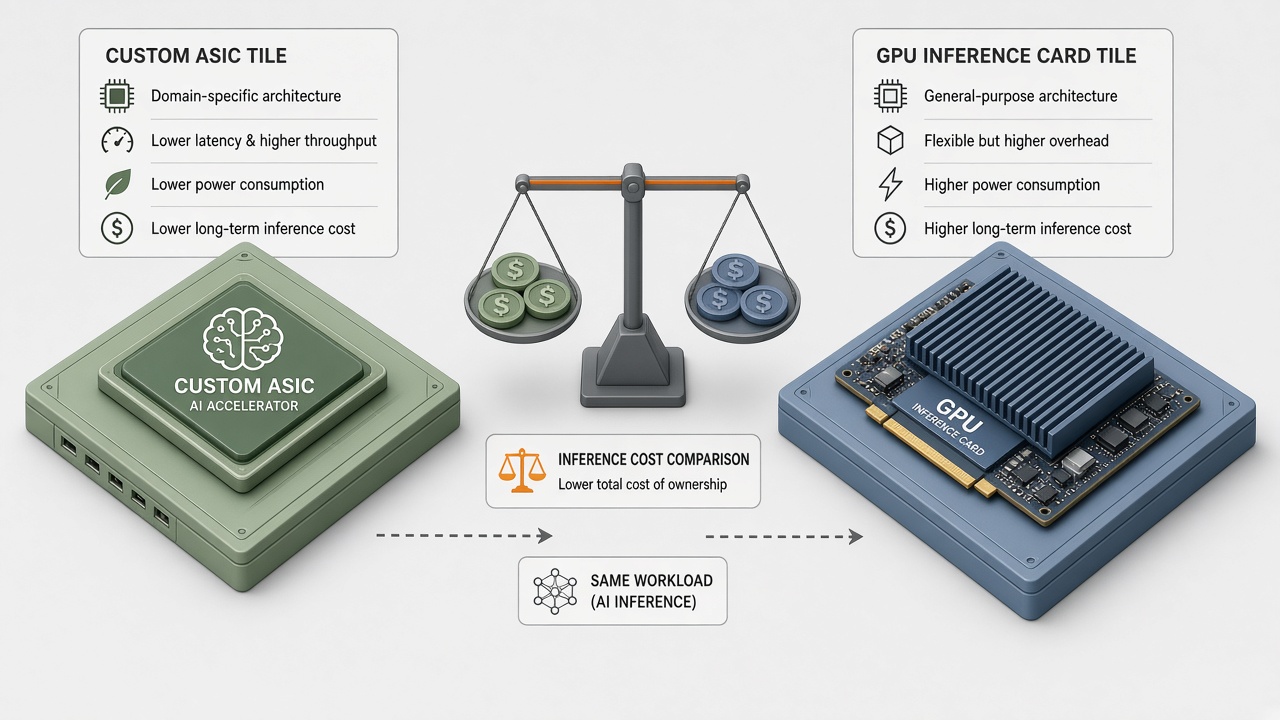
Meta reports MTIA 2i reduces total cost of ownership by 44% compared to GPUs on launched production models, using large SRAM plus LPDDR instead of costly HBM, while MTIA 400 and 500 target GenAI inference with rising bandwidth and MX low-precision formats. These figures come from Meta's own A/B tests in live traffic, not independent third-party Llama benchmarks against NVIDIA B200 clusters.
Key public claims and context:
- MTIA 2i: 44% TCO reduction vs GPUs on ranking and recommendation inference with competitive model quality
- MTIA 400: 400% higher FP8 FLOPS vs MTIA 300; 51% higher HBM bandwidth; rack of 72 devices as scale-up domain
- MTIA 500: 50% higher HBM bandwidth vs MTIA 450; up to 80% higher HBM capacity; 43% higher MX4 FLOPS
- Deployment scale: hundreds of thousands of MTIA chips for organic and ads inference per Meta infrastructure updates
- Co-design: models like DHEN and HSTU launched after MTIA 2i design freeze, proving flexibility beyond classic DLRM shapes
Meta simultaneously operates large NVIDIA GPU clusters for frontier training and signed AMD GPU capacity deals in February 2026. Custom silicon targets high-volume, predictable inference rather than replacing NVIDIA for all AI workloads.
Benchmark Methodology Notes
Public evidence compares Meta-internal production workloads on MTIA against GPU baselines with undisclosed utilization, while NVIDIA benchmarks measure tokens per dollar on rented H100, H200, and B200 instances running vLLM with GPT-OSS-20B. These are not apples-to-apples tests, so buyers outside Meta cannot replicate headline savings without matching software stack, model architecture, and traffic patterns.
| Benchmark source | Hardware compared | Workload | Limitation |
|---|---|---|---|
| Meta ISCA MTIA 2i paper | MTIA 2i vs undisclosed GPUs | Ranking and recommendation production | Meta-only workloads; GPU model unspecified |
| Meta MTIA blog (Mar 2026) | MTIA 400/500 vs commercial products (qualitative) | GenAI inference | No public token/$ for Llama 70B class |
| Third-party GPU benchmark (Mar 2026) | H100, H200, B200, MI300X | vLLM GPT-OSS-20B concurrency | Cloud rental pricing; no MTIA row |
| Industry analysis | Hyperscaler custom vs NVIDIA | Workload segmentation thesis | Calls for matched latency and power disclosure |
Tom's Hardware noted Meta builds MTIA on PyTorch, vLLM, and Triton, improving portability versus CUDA-locked stacks. Portability across chips matters because inference economics depend on scheduler efficiency and batching as much as raw FLOPS.
When Custom Silicon Beats General GPUs
MTIA wins when inference traffic is high-volume, shape-stable, and co-designed with Meta models, while NVIDIA GPUs win for diverse LLM serving, frontier training, and buyers who cannot replicate Meta's full software integration. Meta argues mainstream GPUs are built for large-scale pre-training then applied less cost-effectively to inference; MTIA 450 and 500 invert that priority.
Decision factors for operators evaluating similar economics (even without MTIA hardware):
- Utilization: custom chips need sustained load to amortize non-recurring engineering and fab commitments
- Model stability: fixed architectures (ads ranking, feed ranking, fixed Llama serving shapes) suit ASIC optimization
- Precision mix: MX4 and MX8 support on MTIA 400/500 targets efficient GenAI inference batching
- Memory hierarchy: SRAM plus LPDDR trades HBM cost for workloads with predictable memory footprints
- Latency SLOs: production A/B tests emphasized meeting SLOs at lower Perf/TCO, not peak benchmark FLOPS alone
AWS Trainium and Inferentia, Google TPU inference paths, and Microsoft Maia follow the same segmentation pattern: custom silicon for predictable inference, NVIDIA for training and heterogeneous research clusters.
Implications for Llama Hosting
Meta's MTIA investment lowers Meta's internal cost to serve Llama inference at scale but does not give external Llama hosts access to MTIA hardware, so self-hosters should compare NVIDIA, AMD, and cloud managed endpoints on their own traffic shapes. Meta's February 2026 AMD agreement adds GPU capacity alongside MTIA, signaling hybrid fleets for open-model serving through 2027.
Practical takeaways for teams hosting Llama or derivatives:
- Managed APIs (Meta, cloud partners) may pass through MTIA savings as price competition over time, but pricing is market-driven not cost-plus
- Self-hosted GPU buyers should benchmark tokens per dollar at their concurrency and context length, not Meta's ads ranking curves
- Quantization (FP8, MX formats) narrows gaps between custom and general silicon when models are optimized
- Training and fine-tuning still favor NVIDIA clusters; inference-only fleets can explore AMD MI300X or cloud custom instances
- Watch Meta PyTorch and vLLM contributions for scheduling tricks portable to commodity GPU fleets
Until independent labs publish matched MTIA versus B200 Llama 70B serving tests with power and utilization disclosed, treat Meta's 44% TCO figure as evidence of internal efficiency, not a universal MTIA beats NVIDIA claim.
Frequently Asked Questions
Does MTIA always deliver 44% lower inference cost than NVIDIA?
No. The 44% figure applies to specific Meta production ranking and recommendation workloads on MTIA 2i versus GPUs in Meta's A/B tests. GenAI LLM serving economics may differ, and no public matched Llama benchmark exists.
Can companies buy MTIA chips?
MTIA is Meta internal infrastructure co-developed with Broadcom. External buyers cannot procure MTIA like NVIDIA GPUs. Lessons apply to co-design strategy, not hardware SKU selection.
Does Meta still use NVIDIA for training?
Yes. Frontier training remains on large NVIDIA GPU clusters. MTIA 450 and 500 prioritize GenAI inference, with training as a secondary use case. Meta also expanded AMD GPU deployments in 2026.
Will MTIA lower Llama API prices for developers?
Lower internal costs may enable competitive pricing, but Meta sets API prices based on market positioning, not disclosed chip TCO. Monitor Llama hosting offers from Meta and cloud partners rather than inferring from silicon news.
What benchmark would settle the MTIA vs NVIDIA debate?
An independent test running the same model and workload on MTIA and current NVIDIA systems while disclosing latency, throughput, power, cluster utilization, and software overhead at equal SLOs. No such public test exists as of September 2026.