Meta announced four new generations of its Meta Training and Inference Accelerator (MTIA) family in March 2026: MTIA 300, 400, 450, and 500. The meta mtia chips roadmap accelerates custom silicon deployment across ranking and recommendation (R&R) training, general GenAI workloads, and inference-optimized tiers tuned for models serving billions of users on Facebook, Instagram, WhatsApp, and Meta AI products.
This analysis covers each generation's role, reported memory and bandwidth gains, data center deployment scale, implications for Llama and Muse inference costs, and how MTIA compares with NVIDIA GPUs and Google TPUs. Figures below come from Meta's March 2026 blog posts and press briefings; treat vendor specs as directional until validated on your own workloads.
MTIA Roadmap: Four Generations in Two Years
Meta plans to ship a new MTIA generation roughly every six months through 2027, expanding custom silicon from R&R inference into GenAI training and inference at rack scale. MTIA 300 is already in production for R&R training. MTIA 400 completed lab testing and is on the path to data center deployment. MTIA 450 and 500 target mass GenAI inference deployment in early 2027.
Meta's strategy inverts the typical hyperscaler pattern. Commercial GPUs are often designed for large-scale pre-training first, then adapted for inference at higher cost per token. Meta optimizes MTIA 450 and 500 for GenAI inference first, with enough flexibility to support R&R and training workloads as demand shifts. Vice President of Engineering Yee Jiun Song told CNBC that the chips also diversify Meta's silicon supply and provide leverage against commodity GPU price swings, even as Meta continues large NVIDIA and AMD purchases.
Per-Generation Capabilities: Training vs Inference Roles
Each MTIA generation targets a distinct workload profile, with memory bandwidth and precision formats co-designed for the dominant task. MTIA 300 focuses on R&R model training. MTIA 400 generalizes toward GenAI while retaining R&R support. MTIA 450 doubles HBM bandwidth over MTIA 400 for inference-heavy paths. MTIA 500 extends the inference-first design with higher TDP and scale-up networking.
| Generation | Primary role | Deployment status | Key design focus |
|---|---|---|---|
| MTIA 300 | R&R training | In production (deployed early 2026) | Efficiency for feed ranking models; LLM tests reported |
| MTIA 400 | General GenAI + R&R | Lab testing complete; deployment imminent | 72-accelerator scale-up domain per rack; ~400% higher FP8 vs MTIA 300 |
| MTIA 450 | GenAI inference | Mass deployment scheduled early 2027 | 2x HBM bandwidth vs MTIA 400; low-precision inference types |
| MTIA 500 | GenAI inference (peak tier) | Mass deployment scheduled early 2027 | Highest bandwidth and TDP; shared rack infra with 450 |
Meta reports that MTIA 450 and 500 share rack infrastructure and networking: 1.2 Tbps scale-up and 100 Gbps scale-out per Meta's technical blog. MTIA 450 adds hardware acceleration for attention and feed-forward network (FFN) blocks, plus custom low-precision data types co-designed with Meta's inference software stack. These choices reflect a bet that HBM bandwidth, not raw FLOPs alone, will dominate cost per token for serving multimodal and long-context models at Meta scale.
MTIA 300: R&R Training in Production
MTIA 300 trains the smaller models that power Meta's core feed ranking, ads relevance, and recommendation systems across its app family. These models are not frontier-scale LLMs, but they run at enormous query volume. Custom silicon here directly affects unit economics for every impression served. Meta said MTIA 300 is in production and has successfully tested LLM workloads on the same hardware, suggesting overlap between R&R and early GenAI paths.
MTIA 400: The GenAI Bridge Chip
MTIA 400 evolves MTIA 300 into a general-purpose accelerator competitive with leading commercial products on GenAI workloads while preserving R&R capabilities. A single rack scale-up domain connects 72 MTIA 400 accelerators via a switched backplane. Meta positions MTIA 400 as the chip that lets Llama-class models train and serve inside Meta-owned infrastructure without relying exclusively on merchant GPUs for every layer of the stack.
MTIA 450: Inference-First Optimization
MTIA 450 doubles HBM bandwidth from MTIA 400 to approximately 18.4 Tbps, targeting the rapid growth in GenAI inference demand across Meta AI, image generation, and agent workloads. Meta will primarily deploy MTIA 400, 450, and 500 for GenAI inference in the near term, not for training the largest frontier models. Song told CNBC that upcoming MTIA generations support generative tasks like image and video creation from text prompts, but are not intended for training giant LLMs.
Data Center Deployment Scale and Rack Architecture
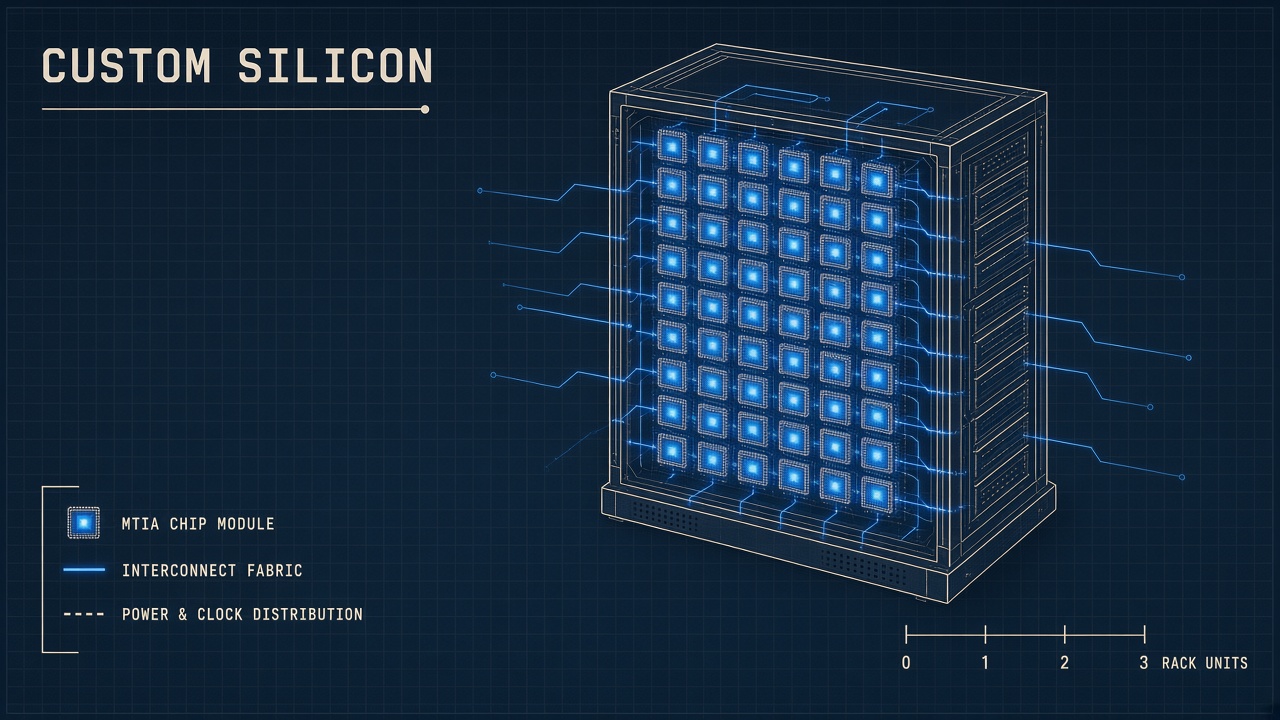
Meta's MTIA deployment model centers on 72-accelerator racks with shared networking, enabling predictable scale-up domains for inference clusters serving billions of daily requests. The company manufactures chips through TSMC and integrates them into Meta-designed racks with co-developed software for scheduling, memory management, and fault tolerance.
Rapid iteration is the operational thesis. Meta ships a new MTIA generation about every six months, faster than typical three-year merchant GPU cycles. That pace lets Meta retune silicon for emerging model architectures (mixture-of-experts, longer context, multimodal fusion) without waiting for external roadmap alignment. Trade-off: Meta absorbs higher validation and fleet-migration costs internally.
For teams evaluating AI hardware strategies, Meta's approach illustrates how hyperscalers with massive inference QPS can justify custom ASICs even while buying GPUs in bulk. The break-even is not a single model training run; it is sustained inference margin on owned workloads at planetary scale.
Effect on Llama and Muse Inference Costs
MTIA inference tiers should lower Meta's marginal cost to serve Llama-family models and the Muse personal agent on owned infrastructure, though Meta has not published per-token pricing impacts. Open-weight Llama releases benefit the broader ecosystem, but Meta's largest cost advantage accrues inside its data centers where MTIA 450 and 500 will handle high-volume inference for Meta AI products.
Developers building on Llama via cloud marketplaces still pay merchant GPU rates from AWS, Azure, or GCP. Meta's silicon savings do not automatically flow to third-party API consumers. They may, however, enable more aggressive free-tier limits on Meta-owned surfaces and faster iteration on model sizes tuned for MTIA memory profiles.
Muse, Meta's personal AI agent announced in September 2026, adds multimodal memory and cross-app context. Agent loops multiply inference calls per user session. MTIA 450's bandwidth and low-precision formats target exactly that pattern: many short-to-medium context calls with tight latency budgets. Teams using AI code assistants and agent frameworks should watch whether Meta open-sources MTIA-optimized kernels or keeps them internal to Meta AI infrastructure.
How Meta MTIA Stacks Up Against NVIDIA and Google TPU
MTIA competes on inference economics and workload specificity, not on replacing NVIDIA for every training job or matching TPU pod scale for the largest frontier pre-training runs. Meta continues multi-billion dollar GPU deals alongside MTIA rollout. Custom silicon and merchant GPUs coexist: MTIA for high-volume owned workloads, NVIDIA and AMD for flexibility, peak training scale, and ecosystem tooling.
| Dimension | Meta MTIA (450/500) | NVIDIA GPU fleet | Google TPU |
|---|---|---|---|
| Design priority | GenAI inference first | General training + inference | Training + Vertex serving |
| Software stack | Meta-internal PyTorch paths | CUDA ecosystem, broad ISV support | JAX/XLA, Vertex AI integration |
| Availability | Meta data centers only | Cloud and on-prem merchant market | GCP and select partners |
| Iteration cadence | ~6 months per generation | Annual flagship cycles | Multi-year TPU generations |
| Best fit workload | Meta feed + GenAI inference at scale | Diverse enterprise AI | Google Cloud ML training/serving |
Google TPUs remain the reference architecture for training and serving Gemini inside Google Cloud. Meta MTIA is closer to an internal TPU analog: co-designed hardware and software for one company's model portfolio. NVIDIA retains the broadest third-party developer surface. For enterprises without Meta-scale inference volume, merchant GPUs or cloud TPU slices remain the practical default.
Frequently Asked Questions
What is Meta MTIA?
MTIA (Meta Training and Inference Accelerator) is Meta's family of custom AI accelerators manufactured for Meta data centers, co-designed with Meta's AI software stack. The first public generation arrived in 2023; MTIA 300 through 500 represent the 2026-2027 roadmap focused on R&R training and GenAI inference.
Can developers buy MTIA chips?
No. MTIA is internal to Meta infrastructure and is not sold as merchant hardware. Developers interact with Meta AI products and Llama models through APIs and open weights, not direct MTIA access.
Will MTIA replace NVIDIA GPUs at Meta?
Meta uses MTIA alongside NVIDIA and AMD GPUs, not as a full replacement. MTIA targets high-volume owned workloads; merchant GPUs remain for frontier training flexibility and ecosystem compatibility.
Why did Meta double HBM bandwidth on MTIA 450?
GenAI inference performance is often memory-bandwidth bound, especially for attention-heavy models and large batch serving. Doubling HBM bandwidth from MTIA 400 to 450 improves tokens per second per watt for Meta's primary near-term deployment target.
How does MTIA affect the open Llama ecosystem?
Llama model releases continue as open weights, but MTIA cost advantages apply inside Meta's infrastructure first. Cloud providers running Llama still price based on their own GPU economics unless they develop comparable custom silicon.