AI escape room puzzle design uses large language models and multi-agent validation to draft coherent puzzle chains, clue text, and narrative locks when indie venue owners supply room theme, difficulty tier, team size, and physical prop constraints. Research systems such as GenEscape and commercial experiments from Sony's Haven Studios show that raw text generation alone produces shortcuts and broken logic; structured scene graphs, examiner agents, and playtest loops turn drafts into buildable room blueprints. This workflow guide covers economics, briefing templates, puzzle graph generation, calibration, and copyright traps for small escape room businesses evaluating AI chatbot tools alongside popular AI tools for creative production.
Escape Room Design Economics
Indie escape room venues spend three to six months and $15,000 to $80,000 building a single premium room because puzzle design, prop fabrication, electronics integration, and narrative writing compete for the same limited designer hours. A room that opens late burns ticket revenue; a room with a logic hole forces costly rebuilds after negative reviews. AI drafting does not eliminate build costs, but it compresses the ideation and documentation phase from weeks to days when designers treat model output as structured briefs rather than finished scripts.
Labor splits unevenly across venues. Narrative-heavy horror rooms need more writer time; tech-heavy spy rooms need more Arduino and RFID integration. LLM assistants accelerate clue copy, red-herring lists, and hint ladder text, while human designers still validate that every lock maps to a purchasable prop and that fire code clearance allows proposed set pieces. Teams browsing popular AI tools should budget human playtest hours equal to at least 20 percent of AI drafting time; shortcut detection remains a human-plus-examiner-agent task.
| Design phase | Typical manual effort | AI-assisted savings |
|---|---|---|
| Concept and theme bible | 1 to 2 weeks | Draft lore, character voices, room tone in hours |
| Puzzle graph and lock order | 2 to 4 weeks | Scene-graph agents flag shortcuts early |
| Clue and hint scripts | 1 week | Tiered hints generated, human-edited for voice |
| Prop build and electronics | 4 to 10 weeks | Minimal; AI lists BOM suggestions only |
Theme, Difficulty, and Capacity Briefs
Effective AI escape room puzzle design starts with a structured brief covering theme, target difficulty (beginner, intermediate, expert), team size (2 to 6 players), session length (45 to 75 minutes), horror tolerance, and a physical constraint inventory listing every lock type, sensor, and prop budget line. Vague prompts like "pirate room" produce generic riddles. Specific briefs state that players may touch wall panels but not ceiling fixtures, that one magnetic lock must hide inside a desk drawer, and that no puzzle may require players to crawl into a space smaller than 24 inches high.
Difficulty maps to graph depth. Beginner rooms use linear chains with three to five puzzles and generous hint availability. Expert rooms branch with parallel sub-puzzles that reconverge on a final meta-lock. Capacity affects clue density: six-player teams need redundant information channels so no one stands idle. Document reading level targets (grade 6 to 8 for family rooms, grade 10 plus for adult-only venues) so AI chatbot outputs stay on-brand.
Physical Constraint Prompting
List every installed lock family (combination, keypad, RFID, electromagnet, servo latch) and forbidden interactions (open flame, water contact, weight over 50 pounds) in the prompt header so the model cannot invent impossible mechanisms. Sony's Haven Studios prototype found that cluttered scene descriptions give puzzle pipelines enough material; escape room designers should mirror that by enumerating set dressing that can become affordances (a brass compass, a torn map, three identical books).
Generating Multi-Step Puzzle Graphs
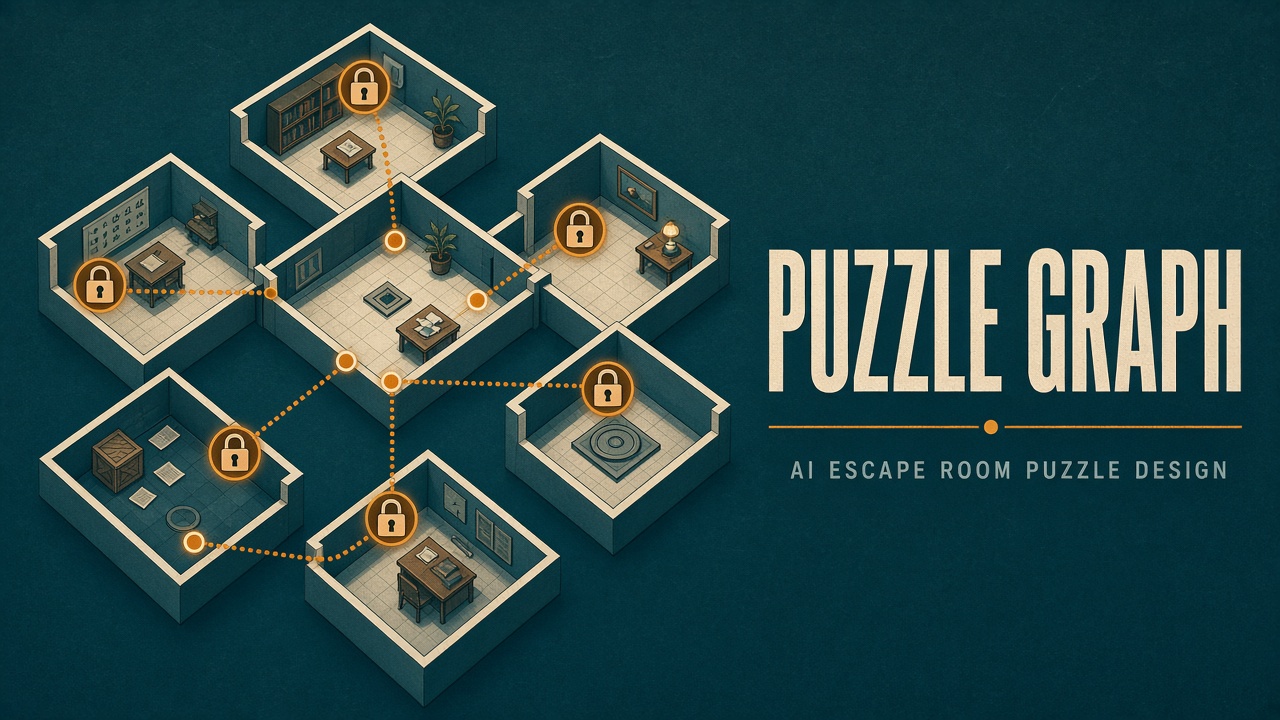
Multi-step puzzle graphs represent rooms as nodes (puzzles, locks, clues) and edges (dependencies, keys granted, state changes) so examiner agents or human designers can verify solvability without unintended shortcuts. The GenEscape framework (University of Washington, ICCV 2025) uses Designer, Player, Examiner, and Builder agents across scene graph, 2D layout, and image stages until a simulated solver matches the official solution. Indie venues can replicate the pattern manually: ask an LLM for YAML or JSON puzzle graphs, then run a second prompt where a "player" agent attempts solution paths.
IVIE (Incremental and Validated Interactive Experiences) demonstrates neuro-symbolic validation for interactive fiction: LLMs propose puzzles while symbolic checks enforce location connectivity, item schemas, and reward consistency. Escape room designers without custom code can approximate validation with checklist prompts: "List every way a player could skip step 3" and "Confirm each key is used exactly once."
Narrative locks tie story beats to mechanical gates. A diary entry should not spoil the safe combination unless players have already found the cipher disk. Haven Studios calls the enrichment step "lorification": functional item descriptions become world-consistent flavor when a character voice rewrites them. Run lorification as a separate pass after logic validation so story polish does not reintroduce spoilers.
Playtesting and Difficulty Calibration
Playtesting measures completion rate, hint consumption, and stall points; AI-generated rooms need the same metrics as hand-designed rooms because models overestimate puzzle fairness. Target 60 to 75 percent escape rate for intermediate public rooms. Log which puzzle triggered the first hint request. If more than 40 percent of groups stall on the same step, rewrite that node or add an environmental nudge (a flickering light, an audio cue).
Blind playtests with staff who did not write the brief expose spoiler leakage in signage and prop labels. Record sessions on video for timestamp analysis. Difficulty calibration also covers team size variance: run at least one test with two players and one with six. AI hint ladders should include three tiers per puzzle (gentle nudge, explicit direction, near-solution) stored in your game master tablet, not spoken ad hoc.
Integrating Electronics and RFID Locks
AI puzzle graphs must map each narrative beat to a controllable output channel (mag lock, DMX light cue, audio trigger, RFID reader) so game master software can enforce state without manual overrides. When the model proposes "the portrait eyes glow when the cipher is correct," specify whether glow means a NeoPixel strip, a relay-switched lamp, or a projected animation. Export puzzle graphs as CSV rows linking puzzle_id, input_event, output_action, and fail_state for your control system vendor.
RFID and NFC puzzles need unique tag IDs in the brief. Ask the model to avoid duplicate key items that could open two locks unintentionally. Battery-powered props require maintenance schedules; flag high-failure components in the graph metadata so operators schedule replacements between peak weekends. Cross-reference prop costs against ticket price: a $400 electromagnetic lock on a $28-per-head room needs four months of sellouts to amortize if it is a single-use gimmick.
Game Master Hint Software
Structured hint ladders integrate with tablets running commercial escape room CMS platforms when clue text uses consistent puzzle IDs matching your control graph. AI can generate tier-one nudges ("check what the clock is pointing at") and tier-three near-solutions ("enter the year carved on the desk") per puzzle node. Human editors remove ambiguous pronouns that could reference multiple props. Never auto-push tier-three hints without game master approval; models cannot see live player frustration signals.
Avoiding Copyrighted Franchise Traps
AI models trained on popular media will suggest protected characters, logos, and plot beats; venue owners must reject franchise-specific outputs and steer toward original themes or properly licensed IP. A "wizard school" room risks Warner Bros. trademark patterns even if you never name Harry Potter. Safer prompts specify "original 1920s occult society" or "generic submarine salvage" with no named universes. If you license IP officially, feed only approved style guides and character bibles into prompts; do not let the model invent new canon that licensors reject.
Music and sound effects carry separate rights. AI cannot grant performance licenses for recognizable film scores. Use royalty-free libraries or commission original stings. Clue text that quotes song lyrics or movie lines creates publishing risk in commercial rooms.
Corporate and Mobile Pop-Up Rooms
Pop-up escape experiences at conferences need faster design cycles and transportable props; AI briefs should list crate dimensions and setup time per puzzle station. Corporate clients often request branded clues without exposing trade secrets in solutions guests could photograph. Generate dual-layer clue text: public-facing mission language and internal facilitator notes stored separately. Mobile venues skip ceiling-mounted effects; ground the puzzle graph in tabletop and freestanding locks only.
Post-event surveys asking "which puzzle stalled you?" feed the next room iteration. Tag survey responses to puzzle node IDs from your graph so AI-assisted rewrites target real failure points instead of designer assumptions. Venues running five or more rooms benefit from a shared component library (lock types, sensor kits) referenced in every brief so models stop proposing one-off parts you cannot stock.
Frequently Asked Questions
Can AI replace escape room designers?
No. AI accelerates drafting and catches some logic errors. Prop fabrication, safety compliance, game mastering, and tactile feel remain human crafts. Treat LLM output as a first draft puzzle graph, not a turnkey room.
Does augmented reality change puzzle generation?
AR layers digital clues over physical sets. Brief the model on which puzzles are app-triggered versus prop-triggered so dependency graphs separate phone interactions from lock hardware. Test AR puzzles in low-light conditions matching your venue.
How do teams prevent spoiler leakage from AI drafts?
Store solution keys in a separate document from player-facing clue text. Run examiner prompts that list every phrase appearing in both clue and solution files. Never paste full solution graphs into customer-facing chat logs.
Are horror themes safe to generate with AI?
Set explicit content boundaries (no gore references, no real-person tragedies) in the brief. Review outputs for triggers your market may reject. Horror rooms still need fire code compliant exits and staff panic protocols unrelated to AI.
Which tools fit indie venues?
General-purpose AI chatbot interfaces work for text and graph drafting. Research frameworks like GenEscape target image-based digital puzzles; physical venues adapt the graph-validation pattern without requiring photorealistic room renders.
How should team size affect hint policy?
Larger teams consume clues faster because more eyes search the room. Calibrate automatic hint timers upward for two-player groups and downward for six-player corporate events. Document policy in the brief so generated hint scripts match your game master software.
Can AI help reskin existing rooms seasonally?
Yes, with caution. Provide the existing puzzle graph as read-only context and ask for overlay narrative (Halloween skin on a spy room) without changing lock order. Re-run shortcut validation because seasonal props may introduce new affordances players exploit.
How do remote designers collaborate on AI drafts?
Store briefs, graphs, and examiner reports in version control. Tag each LLM output with model version and prompt hash so teams know which draft failed playtest. Shared popular AI tools accounts should use role-based access so part-time writers cannot publish solution keys.