Long-context models promised to end the patchwork of chunking scripts and brittle retrieval pipelines. In practice, stuffing a million tokens into one prompt only helps when the model can reason across the full window without losing thread. Anthropic's September 2026 Mythos 5.1 release, available alongside Fable 5.1 under Project Glasswing for verified organizations, pushes that boundary for legal reviewers, research analysts, and engineers mapping entire repositories.
Claude Mythos 5.1 long context capabilities mirror Fable 5.1 specifications with different safeguard envelopes for trusted cyber and life sciences users. This guide explains context limits, legal and research workflows, when to pair native long context with RAG, and per-million-token cost tradeoffs. Compare against AI chatbot assistants and AI code tools before committing production traffic.
Mythos 5.1 Long-Context Capabilities
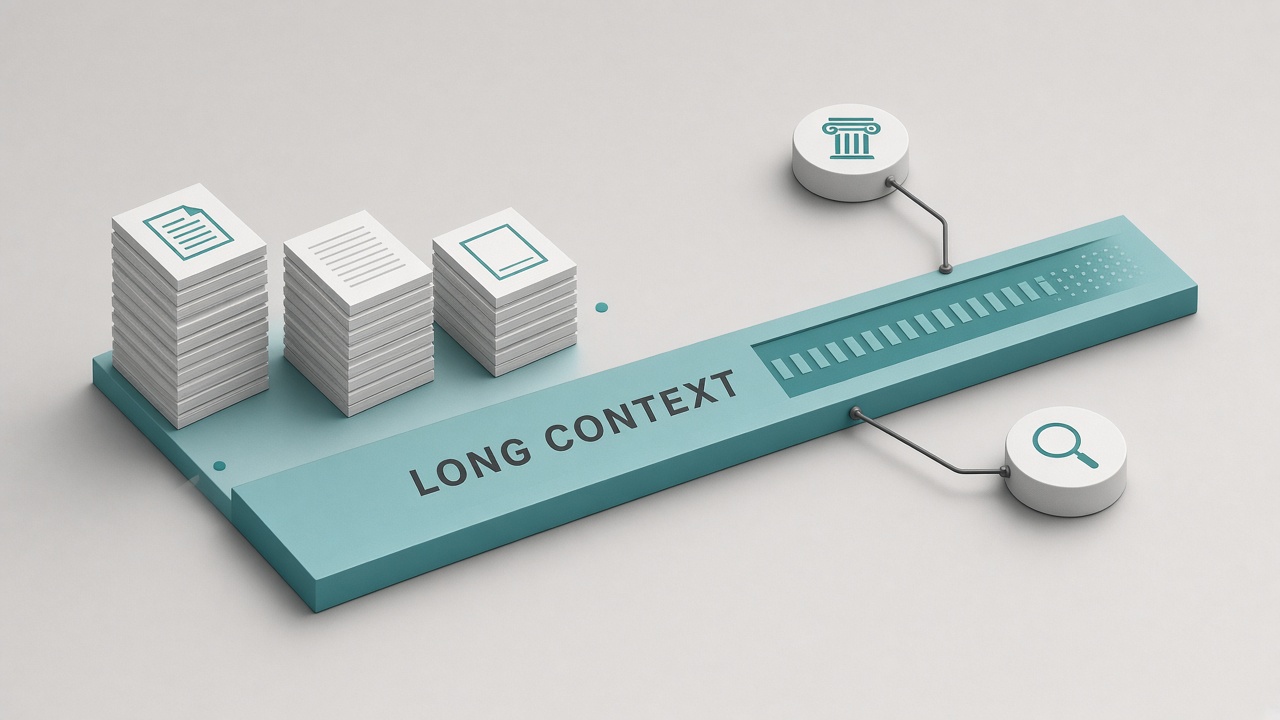
Claude Mythos 5.1 offers a 1 million token default and maximum context window, 128K maximum output
tokens, adaptive thinking always on, and API identifier claude-mythos-5-1 for Project Glasswing
participants. Mythos shares Fable 5.1 weights; differences are policy layers that relax refusals for
vetted defensive cyber and life sciences work. Knowledge cutoff is June 2026 with the same June 2026 training
data cutoff documented on the Claude platform.
| Specification | Mythos 5.1 / Fable 5.1 value |
|---|---|
| Context window | 1M tokens (standard pricing across window) |
| Max output | 128K tokens |
| Input pricing | $10 per million tokens |
| Output pricing | $50 per million tokens |
| Cache read pricing | $0.25 per million tokens (0.025x base input) |
| Access | Mythos: Glasswing only; Fable: general |
Reasoning Across the Full Window
Anthropic positions Fable and Mythos 5.1 for tasks that connect details across the entire context, including multistep research, long agentic coding sessions, and document suites that exceed smaller-model limits. Long context does not remove hallucination risk. Models may still invent citations unless outputs are grounded with retrieval or human verification.
Legal and Research Workflows on Full-Window Context
Legal teams use Mythos and Fable 5.1 to compare clause variants across contract corpora, summarize deposition transcripts, and map regulatory filings to internal policies within one thread when verified for their tenant. Research groups load literature bundles, lab notebooks, and supplementary datasets to synthesize hypotheses. Neither use case removes attorney or principal investigator sign-off; the model accelerates first-pass review.
Workflow pattern: ingest documents in stable order (table of contents prefix), ask scoped questions per section, then request cross-document matrices. For privilege-sensitive matters, run inside customer-controlled VPC deployments on Bedrock, Vertex, or Foundry with logging policies aligned to bar rules.
Life Sciences and Cyber Research Notes
Mythos 5.1 exists so verified life sciences and cyber defense teams can discuss sensitive topics blocked under standard Fable safeguards, not to bypass law. Organizations must enroll in Anthropic's Life Sciences Verification Program or Cyber Verification Program. General legal teams without verification should use Fable 5.1 and expect stricter refusals on dual-use prompts.
RAG Versus Native Long Context
Use native long context when you need holistic reasoning across most of a corpus in one pass; use RAG when the datastore exceeds one million tokens, updates frequently, or requires citation to specific chunk IDs. Hybrid patterns cache a stable briefing prefix (policies, style guides, core statutes) while RAG fetches fresh docket entries or nightly code commits.
| Approach | Best for | Watchouts |
|---|---|---|
| Native 1M context | M&A datarooms under token cap, repo-wide refactors | High cost, slower latency |
| RAG only | Live knowledge bases, ticketing systems | Chunk boundary errors |
| Hybrid | Legal research with static corpuses + fresh filings | Cache invalidation complexity |
Code Repository Analysis
Engineering teams load large monorepo slices into Fable or Mythos sessions for architecture reviews, dependency tracing, and migration planning, especially when combined with Claude Code long-running agents. Repository context competes with documentation and test files for tokens; prune generated artifacts and binaries before upload. Pair with static analysis tools rather than trusting the model for security guarantees.
Pricing Per Million Tokens and Cost Control
At list API prices, a single 1M input request costs about $10 before output tokens, making naive "dump everything" prompts expensive. Cache reads at $0.25 per million tokens reward stable prefixes: load statutes, policies, or repo READMEs once, then issue many queries against the cached prefix. Anthropic notes up to 38% cheaper typical Claude Code sessions versus prior Fable cache pricing.
Cost control tactics: segment corpora into phased prompts, lower effort for summarization subtasks, route simple lookups to Sonnet 5, and monitor token usage per matter or ticket in billing dashboards. Legal and research leads should approve per-matter spend caps before associates run full-corpus loads.
Tokenizer Changes and Forecasting
Fable and Mythos 5.1 use the tokenizer introduced with Claude Opus 4.7, producing roughly 30% more tokens than older Claude models for the same text. Renewal forecasts based on Opus 4 era usage will underbudget Mythos deployments unless finance reruns token counts on representative documents.
Frequently Asked Questions
Who can access Mythos 5.1?
Organizations approved through Anthropic's Cyber Verification Program or Life Sciences Verification Program receive Project Glasswing invitations for Mythos 5.1. All other customers should use generally available Fable 5.1 with standard safeguards.
Is 1M native context worth the cost for legal review?
It depends on corpus size and required reasoning depth. Matters under the token cap with heavy cross-reference needs benefit; high-velocity dockets with daily filings often need hybrid RAG instead.
Does Mythos improve accuracy over Fable on the same prompt?
Weights are identical; only safeguard policies differ. Accuracy gains come from fewer blocked benign research prompts in verified cyber and life sciences domains, not from a separate model checkpoint.
How long until Mythos 5.1 retires?
Anthropic commits to at least twelve months of support with earliest retirement not before September 1, 2027 for Fable 5.1, which shares the Mythos lifecycle. Plan migrations when Anthropic announces successors on the platform deprecations page.