Every department wants a different AI tool. Marketing trials copy generators. Engineering wires API keys into staging. Legal discovers both after customer data already left the firewall. Without a shared decision body, approvals either bottleneck in one overloaded security queue or never happen at all while shadow IT fills the gap.
A cross-functional AI steering committee aligns IT, legal, finance, and business leaders on which tools to approve, pilot, or ban. This guide covers membership, quorum, decision rights, intake from request form to agenda, leadership reporting, and fast paths for urgent needs. Teams evaluating AI automation platforms and AI research tools should stand up this committee before the approved-tool list becomes unmanageable.
Membership and Quorum: Who Sits at the Table
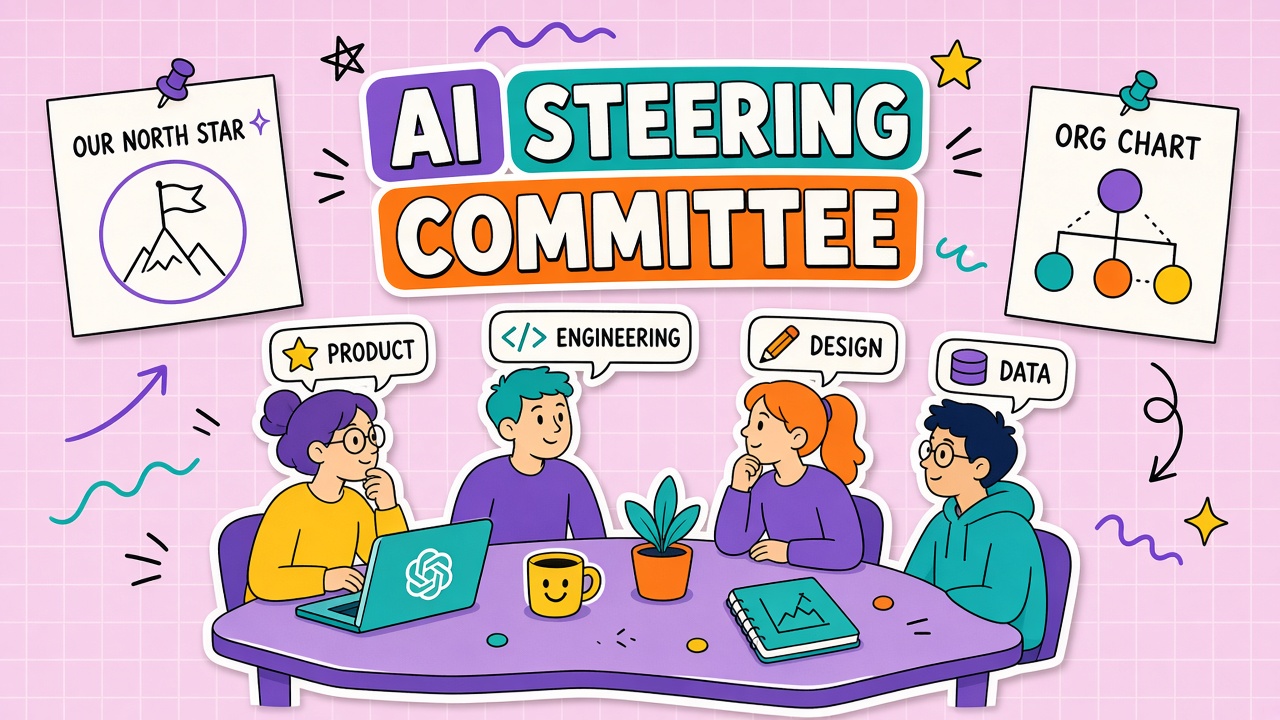
The committee should be small enough to meet monthly and large enough to represent every veto point in your organization. A practical core includes a business sponsor, IT or platform engineering, security, legal or privacy, finance or procurement, and one rotating workflow champion from operations.
Quorum requires at least the accountable executive sponsor plus security and legal delegates. Decisions without those roles present are provisional until the next full meeting. Document substitutes so vacations do not stall pilots for six weeks.
Rotating champions keep the committee grounded in daily workflow reality. A support lead in Q1 surfaces chatbot hallucination patterns procurement never sees. An engineering champion in Q2 explains why an API integration needs staging keys before finance approves seats. Rotation also spreads ownership so one department does not treat the committee as "IT's meeting."
Publish a roster with names, backup delegates, and term dates. Link each member to their intake review specialty: legal for DPAs, security for data tiers, procurement for renewal windows. New members receive a 30-minute onboarding packet covering the approved-tool list, last quarter's decisions, and open pilot inventory.
- Standing members: Sponsor (chair), program admin, security, legal, procurement
- Rotating members: One champion per quarter from sales, support, product, or engineering
- Optional observers: HR for employee monitoring tools, compliance for regulated industries
- Quorum rule: Sponsor plus two of security, legal, or procurement must attend for binding votes
Decision Rights: Approve, Pilot, or Ban
Clear decision rights prevent endless debate. The committee should publish three outcomes every request can receive: approved for production, approved for time-boxed pilot, or denied with documented rationale.
| Outcome | When to use | Typical conditions |
|---|---|---|
| Approve | Meets data tier, contract, and workflow fit | SSO, DPA signed, owner assigned, training scheduled |
| Pilot | Promising but unproven on your data or risk profile | Synthetic or low-sensitivity data only, 30 to 90 day cap, success metrics defined |
| Ban | Unacceptable risk, duplicate of approved tool, or policy violation | Written rationale shared with requester and leadership |
Pilots are not a soft yes. Each pilot needs an end date, evaluation owner, and explicit upgrade or sunset criteria. Without those fields on the intake form, pilots become permanent shadow production systems.
Denials need the same discipline as approvals. A written rationale reduces repeat requests for tools that fail the same control baseline. When a vendor is denied, note whether the door is closed permanently or open after contract changes. Teams evaluating alternatives in AI automation should compare against the denial reason, not just feature checklists.
Track pilot conversion rate as a committee health metric. If most pilots never graduate or sunset, your criteria may be too loose at intake or too vague at evaluation. Steering should review stuck pilots monthly and force a decision: promote, extend once with new metrics, or shut down.
Intake From Request Form to Agenda
Standardize intake so the committee reviews comparable packets. A single web form should capture tool name, vendor URL, business owner, data classification, use case, estimated seats, budget source, and alternatives considered.
- Submit: Requester completes the form; program admin acknowledges within two business days.
- Triage: Admin checks duplicates, assigns security and legal pre-reads, flags missing DPA or SSO gaps.
- Agenda placement: Complete packets go on the next meeting; incomplete packets roll with a due date.
- Decision: Committee votes; minutes record outcome, conditions, and follow-up owners.
- Communicate: Requester receives decision template within 24 hours of the meeting.
Urgent requests use a documented fast path (see FAQ) but still require security sign-off before production customer data. Automation tools that touch CRM or billing systems should never skip intake because a deadline is near.
Incomplete packets waste meeting time. Program admin should return requests missing budget owner, data classification, or alternatives considered within one business day. A pre-read deadline (for example 48 hours before the meeting) gives security and legal time to flag blockers early. Attach vendor security questionnaires and draft DPAs to the ticket so discussion focuses on decisions, not document hunts.
Maintain a public queue status page for requesters: submitted, triage, scheduled, decided. Transparency reduces Slack pings to committee members and sets realistic expectations on median intake-to-decision days.
Reporting to Leadership
Executives need signal, not every ticket detail. A quarterly steering report should summarize approved tools, active pilots, denied requests with themes, shadow IT incidents, spend against budget, and top risks on the horizon (model changes, subprocessors, regulatory updates).
Include one page of metrics: median intake-to-decision days, pilot conversion rate, and training completion by department. Tie outcomes to business goals where possible, such as hours saved in support after an approved research assistant rollout, without fabricating ROI figures.
Leadership reports should name risks plainly: subprocessors in non-approved regions, pilots past end date, or tools approved for internal tier only that marketing already wired to a landing page. Executives can tolerate measured experimentation; they cannot tolerate surprises on customer data.
Compare spend to budget by category: seats, API usage, and professional services. Flag tools with high seat count and low active usage for reclamation before renewal. Pair financial data with qualitative themes from denied requests to show where the organization is pushing against policy boundaries.
Charter Template and Meeting Cadence
Publish a one-page charter listing purpose, membership, quorum, decision types, escalation to executive leadership, and review date for the charter itself. Meet monthly for 60 to 90 minutes with a fixed agenda: minutes approval, intake queue, pilot status, policy updates, and one deep-dive topic (for example subprocessors or employee use policy).
Annual refresh covers membership rotation, decision SLA targets, and whether the committee should split into a fast tactical group plus a quarterly strategic review. Organizations under 200 employees can often combine AI steering with existing technology governance if AI-specific decision rights are spelled out explicitly.
Deep-dive topics rotate so the committee builds institutional knowledge: one month on subprocessors, next on employee acceptable use, then on API key hygiene. Record decisions as policy addenda, not oral tradition. New hires onboarding to AI champions should read charter plus last two months of minutes as part of role training.
Stakeholder Communication Between Meetings
Monthly meetings are not enough for fast-moving AI vendors. Between sessions, program admin sends a brief async update: decisions made by email for urgent items, pilot milestones hit or missed, and policy reminders tied to recent incidents. Keep updates under one screen; link to minutes for detail.
Requesters who were denied deserve a path forward. Include in the decision template: conditions that would change the outcome, alternate approved tools, and date when resubmission is welcome. Without that guidance, denied teams route around the committee entirely.
Champions should relay committee outcomes to their departments within a week of each meeting. A standard three-bullet summary (approved, piloting, sunset) in team standups beats a long forward of minutes nobody reads.
Integration With Existing IT Governance
Most enterprises already have change advisory boards, architecture review, and vendor risk processes. The AI steering committee should reference those bodies, not duplicate them. Map which decisions stay with AI steering (tool approval, data tier for prompts) versus which escalate to enterprise architecture (shared identity, network egress, logging standards).
When a tool passes AI steering, trigger downstream tickets automatically: SSO provisioning, DPA storage, training assignment, and escalation card creation. Manual handoffs between committees are where approved tools sit unused for weeks.
For research-heavy teams, coordinate with AI research tool evaluation criteria so lab environments and production approvals use consistent data tier language. Researchers should not discover at production gate that their preferred corpus was never legal for customer data.
Frequently Asked Questions
Is there an urgency path when a deadline looms?
Yes, but it is narrow. Security and legal must still review data tier and contract terms. Urgency shortens scheduling, not control requirements. Document the business deadline, interim mitigations (sandbox data, read-only integrations), and a date to return for full approval.
How do we handle shadow IT discoveries?
Treat discovery as intake, not punishment. Bring the tool into the queue, assess risk, and either approve with conditions, migrate users to an approved equivalent, or mandate shutdown with a migration plan. Repeated bypass after denial escalates to management with clear policy references.
How large should the committee be?
Six to nine voting members plus a rotating champion usually works. Larger groups defer decisions or meet too rarely. If every department needs a seat, use consulted roles instead of voting members.
What if vendors lobby executives directly?
Route executive interest back through the same intake form. Sponsors can champion a tool but cannot bypass security or legal review. The committee minutes become the single source of truth for what was approved and under which conditions.
Align Before You Scale
A cross-functional AI steering committee is governance light enough to keep pace with vendor releases and strict enough to stop unreviewed data flows. Define membership, quorum, and decision rights first, then wire intake to a predictable agenda and leadership reporting rhythm. Teams browsing AI automation and AI research categories should treat committee approval as part of the rollout plan, not an afterthought once licenses are already purchased.