Content calendars fill with keywords while writers receive vague one-line assignments. Pages ship without search intent alignment, miss SERP features, and duplicate what already ranks without adding entity depth.
An AI workflow for SEO content briefs maps keywords to intent, extracts SERP features and entities, and produces briefs with outlines, questions, and internal links for editors and SMEs. AI assists research and structure; humans own accuracy and publish decisions. Connect entity research to AI research tools and multimedia planning to AI video workflows when briefs include rich results targets.
Keyword and Intent Mapping
Assign each target keyword a primary intent label (informational, commercial, transactional, navigational) before any outline work begins. AI clusters keyword lists faster when you provide search volume, current rank, and business priority columns. SEO specialists reject clusters that mix incompatible intents in one brief.
- Import keywords from your tracking tool with URL mapping for existing content.
- Flag cannibalization: two URLs targeting the same intent need consolidation, not another brief.
- Document SERP volatility: news-heavy queries need different update cadence than evergreen guides.
- Align intent with funnel stage and CTA expectations in the brief header.
- Exclude branded navigational queries from net-new briefs unless a dedicated landing page is missing.
| Intent type | Brief emphasis | Typical CTA |
|---|---|---|
| Informational | Definitions, how-to depth, FAQ coverage | Newsletter or related guide |
| Commercial investigation | Comparisons, criteria, pros and cons | Product tour or demo |
| Transactional | Pricing clarity, trust signals, objections | Sign up or purchase |
| Navigational | Brand page optimization, not blog briefs | Direct conversion on brand URL |
Priority Scoring
Score brief candidates on business value, rank gap, and content gap before AI spends tokens on SERP extraction. Low-priority keywords with strong existing pages should get refresh briefs, not net-new URLs.
SERP Feature and Entity Extraction
Capture which SERP features appear for the target query (featured snippet, People Also Ask, video carousel, local pack) and which entities top pages mention consistently. AI summarizes competitor headings and entity lists from pasted outlines or research exports. SEO specialists verify against live SERPs; models lag recent layout changes.
- Record SERP screenshot date and locale for reproducibility.
- List PAA questions to cover in H2 or FAQ sections.
- Note snippet format winners: paragraph, list, or table.
- Extract named entities: tools, standards, regulations, people, locations.
- Identify content gaps competitors skip that match your expertise.
Research assistants help compile entity lists from authoritative sources. Every entity in the brief needs a planned citation or internal link, not model memory alone.
SERP Change Monitoring
Re-run SERP extraction when rank drops two positions or a new SERP feature appears for the cluster. Briefs older than 90 days on volatile topics need refresh notes before writers start drafts.
Brief: Outline, Questions, and Links
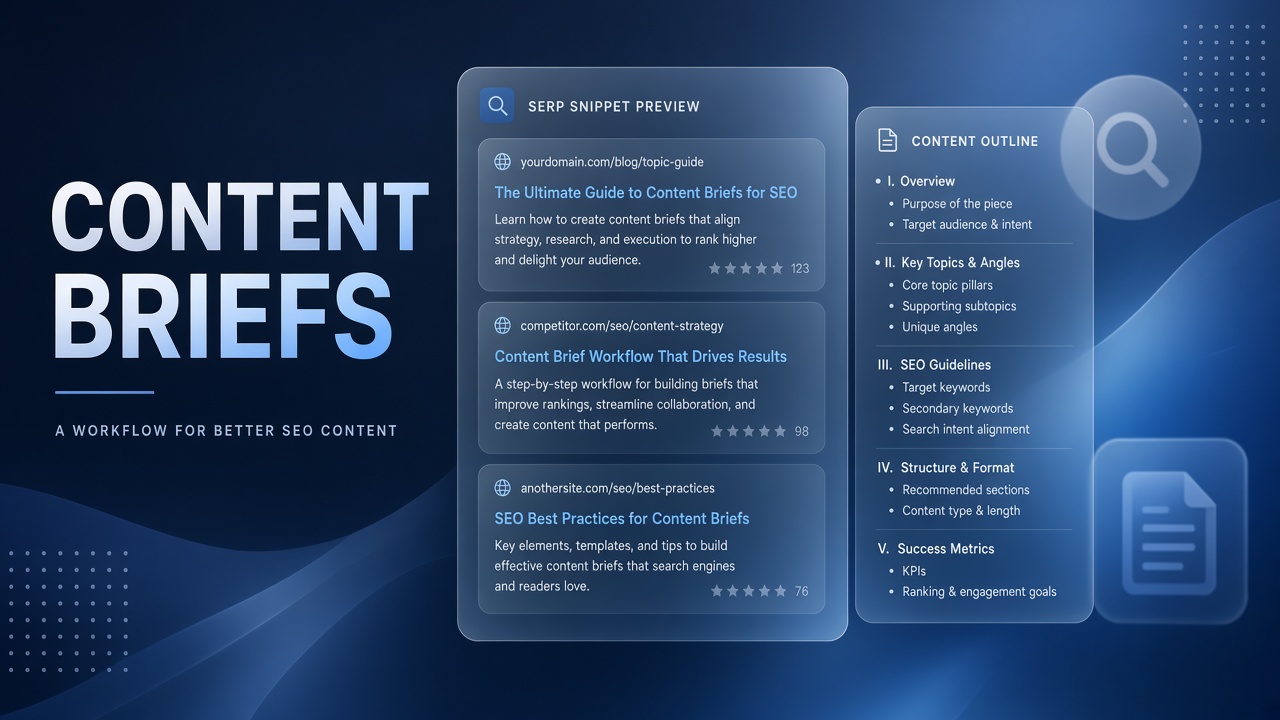
The brief deliverable includes a proposed H2 outline, reader questions to answer, word count target, tone notes, and required internal and external links. AI generates the first pass from intent map plus SERP extraction inputs. SEO specialists edit until a writer can draft without Slack clarifications.
| Brief section | AI assist | SEO must verify |
|---|---|---|
| Title and H1 | Variant suggestions | Primary keyword placement, brand rules |
| Outline | H2/H3 from SERP gaps | Logical flow, no duplicate H2 topics |
| Questions to answer | PAA and forum mining | Accuracy and YMYL sensitivity |
| Link plan | Internal URL suggestions | Live URL status and anchor diversity |
| Schema notes | FAQ or HowTo candidates | Eligibility and policy compliance |
Brief Template Versioning
Store brief templates in a shared workspace with version numbers so AI prompts reference the current schema. Writers reject briefs missing mandatory fields like meta description guidance or image alt requirements.
Editor and SME Assignment
Assign an editor and subject matter expert before the brief leaves SEO review; SMEs validate claims, editors enforce voice and structure. AI briefs accelerate handoff but do not replace SME fact-check on technical or regulated topics.
- SEO status: brief approved for assignment with intent and link plan locked.
- SME scope: which sections need expert quotes, data, or approval.
- Editor scope: readability, brand voice, and citation formatting.
- Timeline: draft, SME review, SEO pre-publish, and legal if YMYL.
- Reject path: brief returns to SEO if SME finds fundamental intent mismatch.
When briefs include video modules, loop in production early using video planning notes in the brief appendix. SERP carousels reward pages with aligned multimedia metadata.
Writer Kickoff
Optional 15-minute kickoff for complex briefs: SEO walks intent, SME clarifies boundaries, writer confirms outline. AI-generated briefs reduce kickoff time but do not eliminate it for YMYL or new product launches.
Brief Quality Bar
A publish-ready brief answers what success looks like in search and for the reader before drafting starts. Reject briefs that list keywords without questions, links without anchor guidance, or outlines without word count targets. SEO leads sample 10 percent of briefs monthly for calibration across specialists.
Refresh Versus Net-New Briefs
Refresh briefs document what to keep, cut, merge, and redirect rather than treating AI output as a blank page. Include current URL metrics and decaying sections. Net-new briefs require cannibalization check completion.
Competitive Gap Notes
Each brief includes a competitive gap paragraph: what top three URLs cover that you will match, and what unique proof or data you will add. AI lists competitor headings easily; SEO specialists judge whether gaps are real differentiation or vanity depth. Gap notes prevent writers from reproducing me-too outlines.
Internal Link Audit Before Assignment
Verify every planned internal link resolves with 200 status and matches anchor intent before the brief reaches writers. Broken links in briefs become broken links in drafts. AI-suggested URLs need manual confirmation against your sitemap export, not live crawl assumptions from model training data.
Post-Publish Feedback Loop
Thirty days after publish, SEO compares rank movement and engagement to brief hypotheses and updates the brief template if intent mapping was wrong. Brief quality improves when outcomes feed back into clustering rules and SERP extraction prompts. Failed briefs become training examples for junior SEO specialists.
Schema and Rich Results Planning
Briefs note eligible schema types and required fields so developers implement markup during build, not after launch. AI suggests FAQ schema when PAA questions appear in SERPs; SEO validates against Google guidelines. Rich result eligibility does not guarantee display; briefs should state that explicitly.
Frequently Asked Questions
How does YMYL change SEO briefs?
Your Money Your Life topics require named expert reviewers, primary source citations, and conservative claim language in the brief itself. Document E-E-A-T expectations: author bio requirements, medical or financial disclaimers, and update frequency. AI must not invent statistics or expert credentials. Legal review belongs in the brief timeline, not after publish.
Should we disclose AI use in content briefs or published articles?
Disclosure policy belongs to legal and brand; the brief should state whether AI drafting is allowed and how authors document AI assistance. Search engines penalize low-quality auto content, not disclosure alone. Briefs should require human rewrite thresholds and fact-check steps when AI drafts prose. Transparency to readers may be required in your jurisdiction or industry.
Can we auto-publish articles from AI briefs?
This workflow stops at the brief; auto-published articles skip SME and editor gates. Programmatic SEO needs the same entity verification and link QA as human-written pages. If you scale production, add automated checks for broken links and duplicate titles, not full auto-publish from raw model output.
How long should a content brief be?
Two to four pages for standard posts, longer for pillar content with multimedia and schema requirements. Brevity that omits questions and links forces writers to guess. AI expands research sections; SEO specialists trim to decision-grade detail.
Briefs That Writers Can Execute
SEO specialists scale quality when AI accelerates intent mapping and SERP extraction while humans lock outlines, links, and SME assignment before drafting. Briefs are the contract between search strategy and content production, not a substitute for editorial judgment.