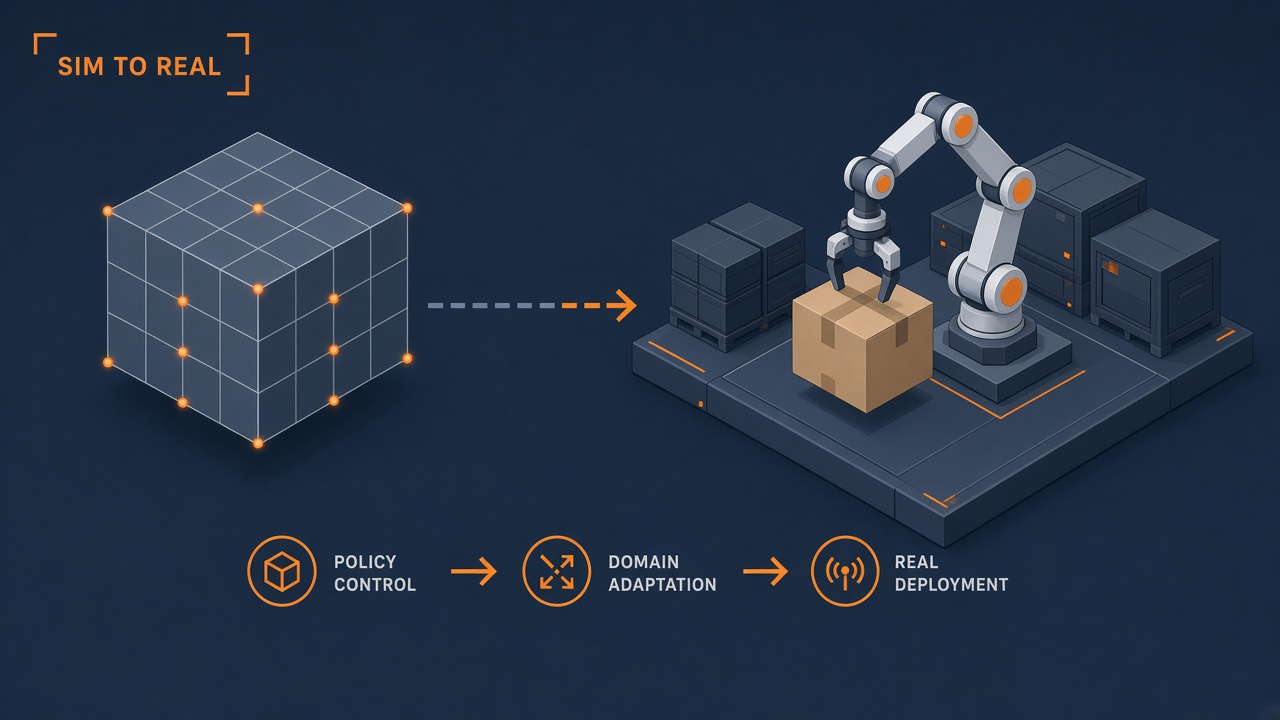
Sim-to-real robotic grasping trains pick-and-place policies entirely in simulation, then deploys them on physical arms with zero or minimal real-world fine-tuning when domain randomization, sensor modeling, and tactile feedback close the perception and physics gap. Recent research reports 95.7% average grasp success on 12 objects with zero-shot transfer using diffusion-based depth noise modeling (DiffuDepGrasp), 78.2% real-world success across six dexterous tasks with foundation-model-guided randomization (DexSim2Real), and the first zero-shot sim-to-real closed-loop dexterous grasping in cluttered scenes (ClutterDexGrasp). Warehouse teams evaluating AI research on manipulation or building AI research infrastructure for automated picking should understand why grasping fails where navigation succeeds, and which sim2real techniques actually transfer to novel SKUs.
Why Grasping Is Harder Than Navigation
Mobile robot navigation mostly needs coarse geometry and obstacle maps; grasping needs millimeter contact physics, friction coefficients, deformable packaging, and sensor artifacts that simulators approximate poorly. AMRs plan paths around pallets using lidar with centimeter resolution. Pick arms must align fingertips with box edges, infer grasp stability under acceleration, and recover when a glossy label creates a depth void. A policy that navigates flawlessly can still drop every SKU if contact dynamics differ between Isaac Gym and the warehouse floor.
Navigation errors are often recoverable: replan around a blocked aisle. Grasp errors damage inventory, jam conveyors, or trigger safety stops. Clutter compounds the problem. Occluded objects, overlapping cartons, and mixed orientations in bins require closed-loop re-planning, not open-loop trajectories from a single overhead snapshot.
Warehouse throughput adds latency constraints. Policies must decide grasp points within hundreds of milliseconds while the conveyor advances. Simulation can run millions of trials overnight; deployment must match real cycle times without cloud round trips. That pressure pushes teams toward end-to-end learned grasping rather than slow analytic grasp synthesis on every novel box.
SKU turnover breaks models trained on fixed object meshes. Retail and e-commerce facilities introduce new packaging weekly. Sim2real pipelines must generalize across shape, texture, mass distribution, and compliance, not memorize a closed set of CAD models.
Simulation Engines and Physics Approximations
Modern sim-to-real grasping relies on GPU-parallel physics engines (NVIDIA Isaac Gym, Isaac Sim, MuJoCo, PyBullet) that trade exact contact solving for millions of randomized training episodes. Isaac Gym-style environments batch thousands of parallel robot instances, each with independent object poses and friction draws. Reinforcement learning or imitation learning optimizes grasp policies against reward functions combining success, stability, and collision penalties.
Physics approximations remain the core limitation. Rigid-body contact solvers struggle with soft bags, shrink wrap, and partially empty cartons. Mesh collisions simplify cardboard creases. Simulators often use convex hulls that misrepresent handle cutouts or nested flaps. Teams compensate with domain randomization rather than perfecting every material model, accepting that some sim configurations are physically unrealistic if they improve robustness.
ClutterDexGrasp trains a teacher policy in simulation with clutter density curriculum learning and safety curricula, then distills into a student 3D diffusion policy operating on partial point clouds. The two-stage design separates exploration-rich teacher behavior from deployable student inference on real depth sensors.
DexSim2Real adds foundation-model-guided domain randomization: a vision-language model critiques rendered scenes for visual realism while CMA-ES optimizes simulation parameters. The approach reduced the sim-to-real performance gap to 8.3% across six contact-rich dexterous tasks compared with manual randomization baselines.
Randomization of textures and Lighting
Domain randomization varies textures, lighting, camera intrinsics, and background clutter during training so policies encounter real-world diversity without paired sim-real datasets. Tobin et al. established the foundational idea: randomize visual parameters until simulated scenes bracket real appearances, enabling zero-shot CNN grasping. Later work factorizes which randomization dimensions matter most for vision-language-action models, comparing episode-wise versus frame-wise perturbation schedules.
Texture randomization alone fails when depth sensors introduce holes, flying pixels, and edge bleeding absent in pristine sim depth. DiffuDepGrasp addresses this with a Diffusion Depth Generator that grafts learned sensor noise onto geometrically clean simulation depth, achieving 95.7% average success on 12 objects with zero-shot transfer using only raw depth at deployment.
Lighting randomization must cover warehouse realities: sodium vapor glare, LED stripes, reflective Mylar mailers, and partial shadows inside bins. HDR environment maps and randomized light positions cheaply expand visual diversity. Physical randomization on real robots (table height jitter, object pose noise) complements visual DR when policies still overfit to sim backgrounds.
| Randomization target | What breaks without it | Typical sim lever |
|---|---|---|
| RGB texture and lighting | Overfit to clean render backgrounds | HDR maps, albedo noise, random lights |
| Depth sensor noise | Policies rely on impossible perfect edges | Diffusion noise grafting, void injection |
| Friction and mass | Slip or crush on real objects | Per-episode physics parameter draws |
| Actuator latency | Timing mismatch on fast conveyors | Observation delay, action latency noise |
Tactile Sensing in the Loop
Tactile sensing closes the last millimeter of sim2real gap by detecting slip, contact force, and compliance that depth cameras miss. DexSim2Real's Tactile-Visual Cross-Attention Policy fuses vision and touch for zero-shot sim-to-real reinforcement learning on dexterous hands. GelSight-style sensors and capacitive fingertips provide high-resolution contact patches impossible to render cheaply at scale in sim, so teams randomize tactile noise models or use sim-to-real adaptation layers.
Warehouse parallel-jaw grippers with force-torque sensing benefit from simpler tactile signals: grasp force thresholds, slip detection during lifts, and vibration cues when cartons shift. Closed-loop force control compensates when sim friction coefficients underestimate real cardboard stiffness. Without tactile feedback, policies trained on rigid meshes crush soft goods or drop heavy items when COM differs from CAD assumptions.
SimToolReal demonstrates targeted randomization including observation delays, pose estimate noise, grasp-region box perturbations, and external force disturbances to encourage stable grasps on diverse tool shapes. The lesson generalizes to warehouse SKUs: randomize contact uncertainty, not only visuals.
Integration cost remains nontrivial. Tactile sensors add wiring, calibration, and cleaning cycles in dusty DC environments. Many production cells still rely on vision plus force limits until slip rates justify sensor upgrades.
Novel Object Generalization Limits
Sim2real grasping generalizes within shape and physics families but still fails on radically novel packaging, extreme compliance, or adversarial textures unless retrained or augmented with real demonstrations. Zero-shot claims typically cover tens of object categories with randomized meshes, not unlimited e-commerce SKUs. Transparent bottles, mesh bags, and cables remain failure modes because simulators lack accurate optics and deformation models.
Soft goods (apparel in poly bags, bubble mailers) deform under grip force. Policies trained on rigid boxes apply excessive squeeze or grasp empty air when bags shift. Food-adjacent fulfillment may need soft robotics grippers and separate sim material models, not standard parallel jaws with texture DR alone.
Mitigation strategies include procedural mesh libraries scaled to millions of objects, online failure logging with periodic sim fine-tuning, human teleoperation datasets for edge cases, and vision-language models that propose grasp affordances on unseen items. None eliminate the need for monitoring intervention rates after deployment.
Empirical studies on vision-language-action sim2real transfer emphasize disentangling randomization factors rather than monolithic DR. Teams should benchmark novel SKU holdout sets weekly, not assume laboratory success rates persist when suppliers change carton coatings.
Warehouse integration adds conveyor encoder sync, WMS pick confirmations, and exception divert lanes when grasp confidence falls below threshold. Simulation should model these IT interfaces, not only arm kinematics. A policy that grasps perfectly in isolation still fails if the WMS expects a scan before lift-off and the robot stack lacks barcode timing hooks.
Maintenance teams need sim traceability: which randomization seed family produced the deployed policy, which object mesh library version trained it, and which depth camera firmware the noise model assumed. Without version pins, a camera firmware OTA can silently widen the sim2real gap. Treat grasp models like any other production ML artifact with MLOps gates before line promotion.
Multi-SKU induction cells benefit from hierarchical policies: coarse region proposal over the bin, fine grasp refinement on selected patches, and tactile confirm before high-speed transfer. ClutterDexGrasp's teacher-student split mirrors this hierarchy for dexterous hands; parallel-jaw warehouse cells can adopt lighter two-stage depth networks with similar architecture discipline.
Pick accuracy SLAs in contracts should define measurement windows: per shift, per SKU family, and per lighting condition after HVAC or skylight changes. Simulation teams can replay logged failure frames through updated noise models before retraining, shortening root-cause cycles when a new supplier ships glossy mailers that create depth voids.
Frequently Asked Questions
Which gripper works best for sim2real warehouse picking?
Parallel-jaw and vacuum grippers dominate warehouse cells because sim contact models are simpler and cycle times faster than multi-finger dexterous hands. Dexterous sim2real research (ClutterDexGrasp, DexSim2Real) targets complex bins; most DC automation still uses two-finger tooling with force limits.
Can sim2real handle soft goods?
Rigid-object sim2real pipelines fail on deformable packaging without soft-body simulation or dedicated compliant grippers. Apparel and mailers need material-specific models or real-world fine-tuning datasets beyond standard Isaac Gym rigid assets.
How fast are learned grasp policies?
Inference must fit conveyor tact times, often under 500 ms including depth capture. DiffuDepGrasp emphasizes deploy-efficient depth-only inference without heavy foundation model overhead. Profile on-target GPU or edge accelerators before promising line rates.
Do I need real robot data?
Zero-shot sim2real aims to avoid collection, but production systems almost always log failures for periodic retraining. Hybrid approaches use sim for bulk training and small real datasets for SKU tail correction.
Isaac Gym vs Isaac Sim for grasping?
Isaac Gym excels at massively parallel RL with simplified rendering. Isaac Sim offers higher-fidelity RTX sensors and ROS integration for digital twin workflows. Choose based on whether throughput of training episodes or sensor realism is the bottleneck.
What success rate is realistic in production?
Published research reports 78-96% on controlled object sets. Production mixed-SKU lines should plan for lower initial rates, human exception stations, and continuous monitoring. Vendor claims require holdout testing on your actual inventory mix.
Where should I learn more about sim2real grasping?
Start with domain randomization baselines, depth noise modeling papers, and clutter grasping systems cited above. For broader robotics ML context, explore AI research tags and AI research search on manipulation topics.