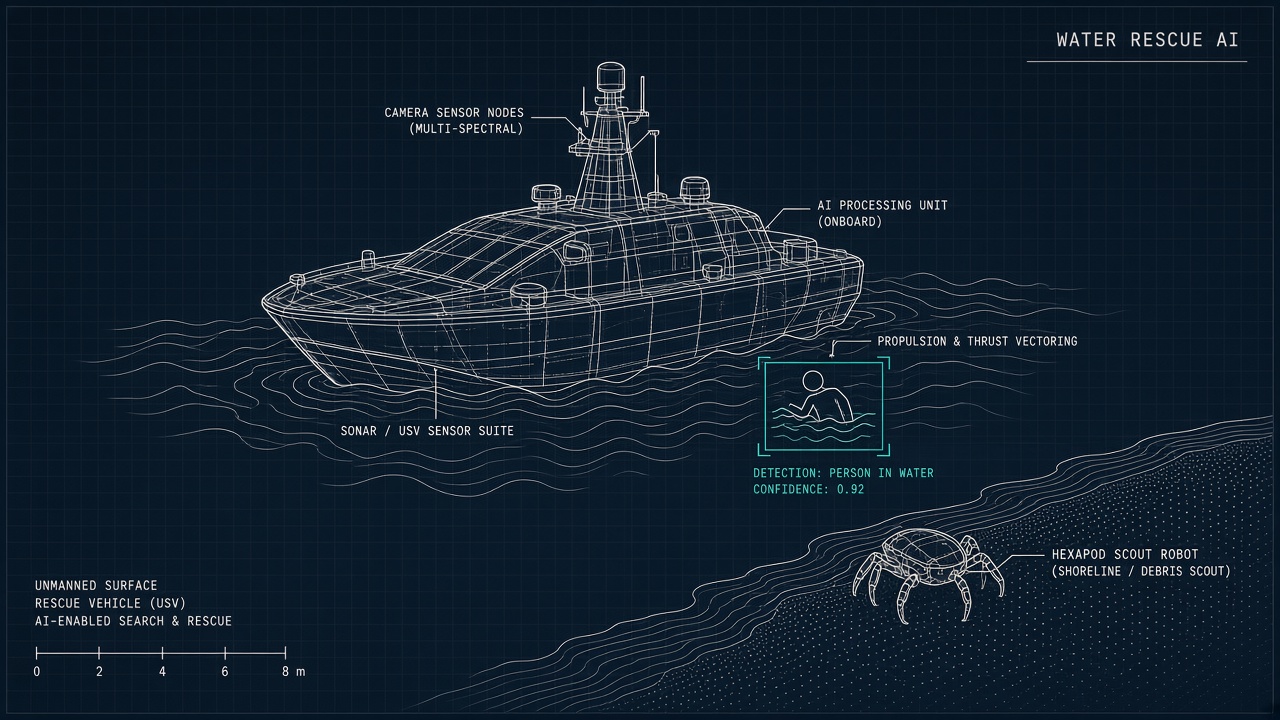
Floodwaters rise faster than rescue boats can deploy. Surf zones knock swimmers down before lifeguards reach them. Shorelines after hurricanes mix mud, debris, and standing water where wheeled robots stall and divers risk entanglement. Amphibious rescue robot AI addresses this gap by pairing platforms that move across water, sand, and shallow surf with perception stacks that detect drowning victims, classify terrain, and steer autonomous vehicles toward people in distress. Recent prototypes such as Robobuoy, QuadBoat, and adaptive vision platforms for cross-medium robots show that computer vision and lightweight navigation models can run on edge hardware in real pools and lakes, though full autonomous rescue in open ocean conditions remains experimental.
Emergency managers evaluating command-and-control software should remember that rescue robotics sits downstream of reliable detection and localization. Teams comparing AI chatbot tools for incident documentation need the same discipline when reviewing vendor claims about autonomous water rescue. For related robotics explainers, see the EliteAI.tools blog index.
What Amphibious Rescue Robot AI Means in Plain Language
Amphibious rescue robot AI is the combination of water-capable robotic platforms with machine learning perception and navigation so the system can find a person in distress, reach that person across aquatic and shoreline terrain, and assist retrieval without a human operator steering every motion. Amphibious in this context does not mean every robot walks on land and swims like a human. It means the platform tolerates transitions between dry ground, wet sand, shallow surf, and open water that stop conventional wheeled or tracked machines.
The AI layer typically handles object detection (is that a head above water?), environment classification (are we in foam, glare, or night conditions?), path planning toward a target, and coordination when multiple robots share a scene. Classical marine autonomy relied on GPS waypoints and radar; modern stacks add convolutional detectors such as YOLO variants, sensor fusion with lidar or sonar, and geometric heading controllers that convert bounding-box coordinates into motor commands on resource-constrained boards like Raspberry Pi or Jetson modules.
| Platform type | Terrain strength | Typical AI role |
|---|---|---|
| Autonomous surface vehicle (USV) | Pools, lakes, calm harbors | Drowning detection, visual homing |
| Quadruped or hexapod legged robot | Surf zone, wet sand, shallow water | Terrain classification, grasp planning |
| Hybrid buoy-boat (U-shaped gripper) | Urban flooding channels | Victim ID, obstacle avoidance |
| Multi-robot fleet | Large search areas with coordination | Task allocation, multimodal fusion |
How amphibious rescue differs from land-only robots
Land public-safety robots such as Boston Dynamics Spot excel at stairs, rubble, and indoor standoffs, but Spot is not an amphibious drowning rescue platform; water rescue requires buoyancy, corrosion resistance, and perception tuned for glare, spray, and partial submersion. Treating a terrestrial quadruped as interchangeable with a surf-zone hexapod overstates readiness. Amphibious research robots like Case Western Reserve University's MR. Crab use waterproof actuators and crab-inspired legs that both walk and manipulate objects underwater, a different design envelope than a warehouse AMR with a camera mast.
How the Underlying AI Pipeline Works
A typical amphibious rescue AI pipeline runs perception on edge hardware, fuses detections with navigation state, and outputs thrust or leg commands through a low-level controller that respects water dynamics and safety limits. Published systems break the stack into repeatable layers even when hardware differs.
Perception and victim detection
Robobuoy, described in Applied System Innovation (2025), pairs YOLO12m for drowning-person detection with YOLOv5m for tracking the unmanned surface vehicle itself, achieving [email protected] scores of 0.9284 and 0.9848 respectively on a combined open-source and custom dataset. A geometric navigation algorithm converts bottom-center coordinates of detections into heading commands. Pool trials reported successful target reaching in all nine runs with positioning error within 1 meter and traversal times between 11 and 23 seconds.
Adaptive visual perception research for amphibious rescue robots (2026) addresses a core engineering problem: a single detector trained for open water underperforms on wet shoreline rocks or glare-heavy foam. That platform uses YOLO-based environment discrimination to switch between specialized aquatic and terrestrial models, reporting 92.3% environment classification accuracy, 28.6 FPS average throughput, and a 7.2% detection accuracy gain in mixed scenes versus the best single model on an 8,000-image dataset plus 2,000-frame video sequences.
Navigation, control, and retrieval
QuadBoat, presented on arXiv, is a quadruped unmanned surface vehicle inspired by fisher-spider hunting behavior. It uses inverse kinematics plus cascaded model-predictive and PID control to track victims and lift objects from the water surface. Vision-guided pickup experiments indoors and outdoors validate that perception-to-grasp loops can close on moving targets, though published work emphasizes prototype validation rather than mass deployment.
On the legged side, MR. Crab demonstrates automatic gripping algorithms that position an 18-degree-of-freedom hexapod for cylindrical object retrieval in up to 3 meters of water, with Lake Erie field tests for surf-zone traversal. Hall-effect sensing on crab-like legs (Sebastian platform, Sensors 2024) classifies buried metal cylinders while walking, showing how tactile and magnetic cues complement vision when turbidity hides cameras.
| System | AI components | Reported validation |
|---|---|---|
| Robobuoy | YOLO12m + YOLOv5m, geometric heading | 9/9 pool trials, under 1 m error |
| Adaptive vision platform | YOLO env classifier + dual detectors | 92.3% env accuracy, 28.6 FPS |
| QuadBoat | Visual tracking, MPC-PID control | Lab and outdoor pickup demos |
| MR. Crab | Automatic gripping, teleop GUI | Lake Erie UXO retrieval tests |
| YOLOv8 + PSO fleet (2025) | Multimodal fusion, swarm allocation | Simulation and lab integration |
Typical workflow steps
- Deploy sensors (visible camera, optional sonar or lidar) with weather-rated enclosures.
- Run environment classification or manual mode selection for aquatic vs shoreline scenes.
- Execute victim detection with confidence thresholds and human-on-loop review when available.
- Plan approach path respecting currents, obstacles, and minimum standoff for safety.
- Engage retrieval mechanism (buoy grip, lift arms, or tow line) while logging video for after-action review.
- Hand off patient care to human medics; robots transport, they do not replace clinical assessment.
Real Deployments and Published Evidence
Most amphibious rescue robot AI evidence today comes from academic prototypes and defense-adjacent UXO programs rather than municipal lifeguard fleets replacing jet skis. That distinction matters for procurement officers: peer-reviewed pool and lake trials demonstrate feasibility, but continuous duty on a crowded public beach with legal liability frameworks is a separate milestone.
Robobuoy authors position the system as an affordable intervention for unguarded or underserved aquatic areas, explicitly noting the prototype is not affiliated with commercial products sharing similar names. Automated Rescue Boat research using YOLOv8n on Raspberry Pi reports obstacle detection near 95% and victim identification near 92% in controlled tests with 15-meter rescues averaging 30 seconds, figures that warrant replication across lighting and clothing variability before operational sign-off.
Defense environmental research (SERDP-ESTCP) funds crab-like legged robots for surf-zone munitions access, anticipating completion around 2027. While the mission is UXO rather than swimmer rescue, the locomotion and gripping data transfer directly to hazardous shoreline access where human divers face rip currents and visibility loss. Boston Dynamics Spot deployments in public safety (Massachusetts State Police standoff, 2024) prove legged robots in land emergencies but should not be cited as amphibious drowning solutions.
Multimodal perception and swarm coordination
A 2025 multimodal water rescue architecture fuses MAIXCam images, sonar, and lidar through a YOLOv8-AFPN-P345 detector, then allocates tasks across a robot group with particle swarm optimization. The design targets perception gaps in foam and rain where visible light alone fails. Swarm approaches matter when one USV cannot cover a river mouth during flash flooding; they also multiply communication and cybersecurity requirements.
International Maritime Organization guidance on search and rescue continues to center human command structures, which means robot fleets will likely enter service as augmentations to existing SAR patterns rather than standalone replacements. Integrators should map robot telemetry into the same incident command interfaces dispatchers already use, including GPS tracks, video feeds, and explicit human abort controls. Without that wiring, even accurate detectors stay sidelined in procurement because they do not fit operational doctrine.
Limits, Risks, and Ethical Guardrails
Amphibious rescue robot AI fails loudly when training data omits night scenes, dark skin tones in glare, nonstandard flotation devices, or debris that mimics human shapes; false positives waste critical minutes and false negatives cost lives. Models trained in pools rarely capture ocean swell, boat wake, or rescue litter without domain adaptation.
- Regulatory vacuum: Few jurisdictions certify autonomous life-saving buoys the way they certify AEDs; liability may fall on municipalities and vendors alike.
- Comms loss: Surf and flooding degrade radio links; edge autonomy must include safe stop behaviors, not silent drift away from victims.
- Physical limits: Small USVs cannot recover unconscious adults in heavy seas; retrieval forces and battery life cap mission profiles.
- Surveillance concerns: Always-on waterfront cameras raise privacy questions beyond beach season.
- Automation bias: Dispatchers might delay human teams if a robot is "en route" but stuck on a sandbar.
Ethical deployment should keep trained lifeguards and boat crews in the loop, publish detection thresholds and failure modes, and avoid marketing language that implies parity with Coast Guard response in Class III surf. Robots extend reach; they do not remove the duty to maintain staffed stations and community water-safety education.
Who Should Use This and Who Should Wait
University labs, coast guard research units, and OEMs building surf-capable legged platforms should invest now in adaptive perception and field datasets; public beach operators should pilot USV detectors only with parallel human coverage and clear escalation protocols. Insurance carriers and standards bodies should wait for repeatable third-party benchmarks before treating autonomous rescue as equivalent to manned craft.
| Audience | Recommendation | Caveat |
|---|---|---|
| Flood-prone city OEM | Pilot camera-guided USV in controlled canals | Require human medic handoff SOP |
| Defense UXO program | Adopt crab-leg platforms with multimodal sensing | Mission differs from swimmer rescue |
| Commercial beach operator | Wait for certified products and liability coverage | Academic mAP scores do not equal beach certification |
| Robotics startup | Collect cross-medium data early | Environment switching beats single mega-model |
Frequently Asked Questions
How accurate is amphibious rescue robot AI today?
Published prototypes report strong controlled-environment metrics (for example, Robobuoy near 0.93 mAP for drowning detection and adaptive platforms above 92% environment classification), but open-ocean accuracy varies with weather, clothing, and sensor fouling. Treat lab numbers as upper bounds until replicated in your deployment geography.
Are autonomous water rescue robots regulated?
Most countries lack a dedicated certification path analogous to medical devices; municipal adoption typically flows through procurement law, maritime safety codes, and vendor indemnity clauses rather than a single AI standard. Consult local maritime authorities before advertising autonomous life-saving capability to the public.
How much data do amphibious rescue models need?
Adaptive systems in recent papers train on thousands of labeled images plus long mixed-environment videos; transfer learning from general YOLO checkpoints reduces cold-start cost but still demands local fine-tuning for foam, night, and debris profiles. Budget for continuous collection each season.
Can Boston Dynamics Spot perform water rescue?
Spot is deployed for land-based public safety (standoffs, hazmat recon, rubble search) and is not marketed as an amphibious drowning rescue platform. Conflating Spot stories with surf-zone robots misstates capabilities.
Should humans remain in the loop?
Yes. Current evidence supports human supervision for launch authority, false-alarm review, and medical care after contact. Full unsupervised beach deployment is not supported by peer-reviewed field studies at scale.
When is sensor fusion required?
Visible-light-only stacks struggle in glare, night, and heavy rain; sonar, lidar, or thermal channels improve robustness when fused with careful calibration. Fusion adds cost and integration time but reduces single-modality blind spots documented in multimodal rescue papers.
What hardware runs these models on the water?
Edge boards such as Raspberry Pi, Jetson modules, and MAIXCam accelerators appear in published rescue prototypes, selected for wattage budgets on battery-powered USVs. Throughput targets near 30 FPS are common for real-time homing.
Conclusion
Amphibious rescue robot AI merges water-capable mechanics with detectors, environment classifiers, and navigation policies tuned for shoreline chaos. Robobuoy and adaptive YOLO scheduling show credible pool and lab results; QuadBoat and MR. Crab stretch retrieval into quadruped and hexapod form factors; swarm and multimodal papers point toward fleet coverage in flooding scenarios. Limits are real: regulation lags, surf exceeds small USV capacity, and land robots like Spot solve different problems. Teams should benchmark on local water conditions, keep humans accountable for life safety decisions, and treat robotics as force multiplication for responders, not a substitute for trained crews and prevention programs.