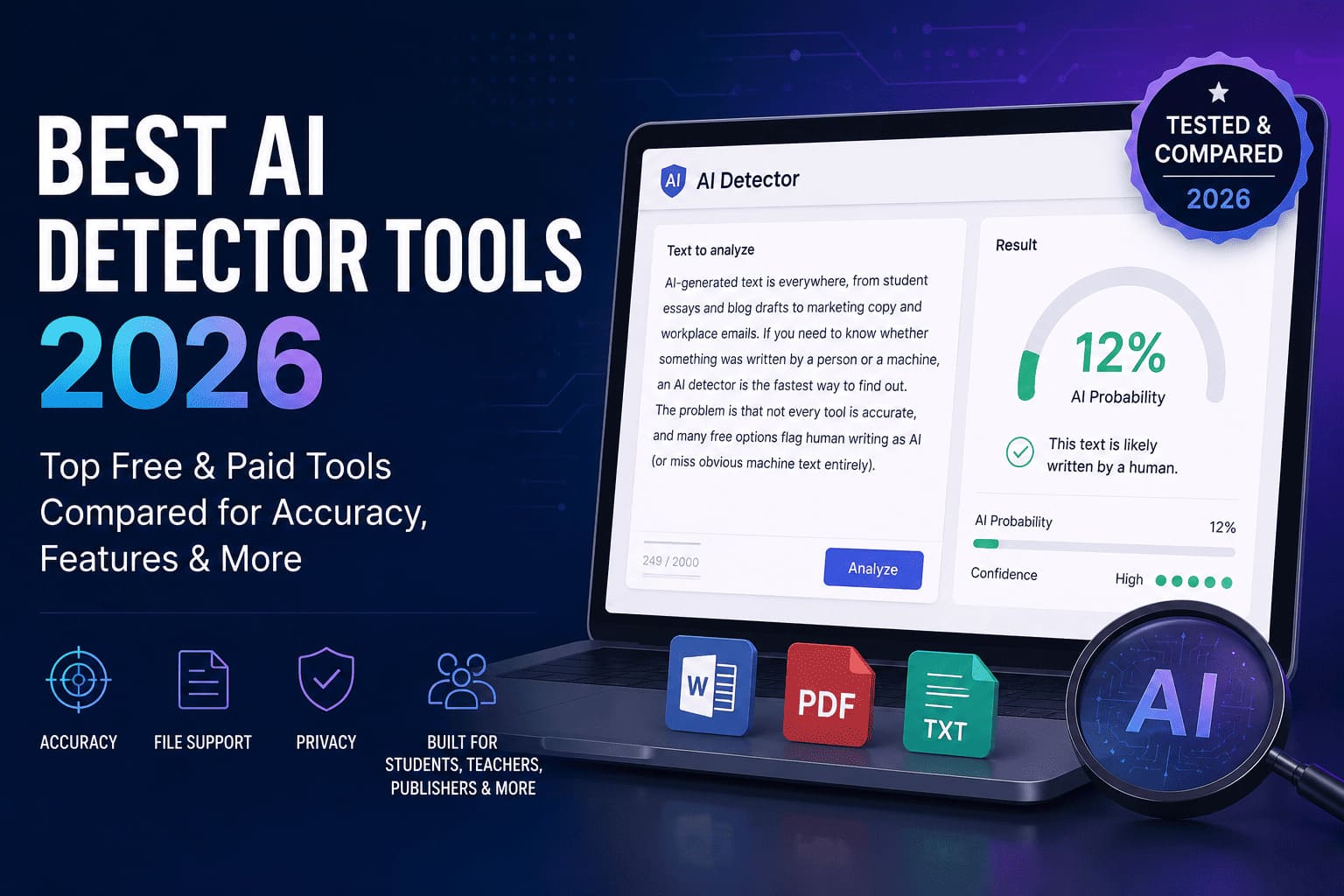
A free AI detector lets you paste text (or sometimes upload a file) and get a label such as "likely AI," "mixed," or "likely human" without paying for a subscription. In 2026 most people reach for one when a student essay feels too polished, a freelance article arrives overnight, or a workplace email reads like ChatGPT. Free tiers are useful for spot checks, but they are not courtroom evidence: character caps, missing file upload, and noisy scores on short passages are normal.
This guide explains what free AI checkers can and cannot catch, how free limits differ from paid plans, and which tools fit students, teachers, writers, and publishers. You will find a comparison table for eight widely used detectors, a plain-language section on reading percentage scores, and an FAQ for high-stakes questions. For a broader ranked list that includes paid enterprise options, start with our best AI detector tools in 2026 roundup, then browse the full AI detector category on EliteAI.tools when you need more names beyond this free-focused shortlist.
What free AI detectors and checkers actually do
Free AI detectors estimate whether text was written by a large language model by scoring statistical patterns: low surprise between words, uniform sentence length, and phrasing that matches common ChatGPT or Claude outputs. They do not "know" authorship the way a teacher who has read your prior papers would. They compare your passage to patterns seen in machine-generated training data and similar web text.
Most free checkers follow the same rough pipeline: tokenize the input, run a classifier or perplexity-style model, return an overall score plus optional sentence highlights. Paid tiers add batch uploads, LMS hooks, plagiarism bundles, and API access. Free tiers usually stop at paste-only workflows and daily word budgets.
What free AI detectors can catch (and what they miss)
Free checkers work best on long, lightly edited AI drafts in English: full paragraphs pasted straight from ChatGPT, Gemini, or Claude with minimal rewriting. They struggle when a human heavily edits AI output, when the text is very short, or when the writer is a skilled native speaker with a distinctive voice.
Usually surfaces
Clear machine patterns
- Long paste-from-chatbot essays with generic transitions ("In conclusion," "It is important to note")
- Uniform paragraph length and repetitive sentence openings
- English academic prose at high school or early college level
- Text that matches public GPT-style templates recruiters see daily
Often misses or mislabels
Edge cases and false alarms
- Heavily paraphrased or human-merged AI paragraphs
- Short emails, product blurbs, or social posts under about 150 words
- Technical human writing that is formal and predictable
- Non-English or mixed-language drafts on English-only free tools
- AI text passed through multiple rewrite tools in sequence
No free checker proves cheating by itself. Treat a high AI score as a reason to ask follow-up questions, compare against earlier writing samples, or run a second tool. Treat a low score as weak reassurance if other evidence (impossible citations, sudden style shifts) still looks suspicious.
Free vs paid AI detector limits in 2026
Free AI checker plans trade depth for accessibility. Expect character or word caps per day, no API, slower support, and marketing nudges toward premium. Paid plans buy higher volume, team dashboards, LMS integration, plagiarism plus AI bundles, and sometimes legal-friendly audit logs for publishers.
- Volume. Free tiers often allow one to several thousand words per day. Long theses require splitting text or paying.
- Uploads. PDF and DOCX upload may be premium-only on tools such as GPTZero or Winston AI, while paste boxes stay free.
- Batch and classroom. Turnitin and institutional Copyleaks seats are rarely free for individuals; they are licensed per school or company.
- Explainability. Sentence-level highlights and "origin" reports often sit behind paid education or business tiers.
- Privacy. Free web forms may retain submissions for model improvement unless you read the opt-out settings.
If you only check your own draft twice a week, free limits are usually enough. If you screen dozens of freelance articles per month, a paid seat or API plan typically costs less than the time lost to false positives and manual re-checks.
Free AI detector comparison table
The table below focuses on eight tools people search for when they want a free AI detector or a generous trial. Limits change; confirm on each official site before a deadline. "Free" means a usable tier without paying, not unlimited institutional screening.
| Tool | Free tier | Typical input | Highlights | Best free use |
|---|---|---|---|---|
| ZeroGPT | Yes, character limits | Paste | Basic sentence flags | Quick student sanity checks |
| GPTZero | Yes, daily word cap | Paste; files on paid | Strong education focus | Teachers testing one essay |
| QuillBot | Limited detector uses | Paste in suite | Bundled with paraphrase | Writers already in QuillBot |
| Originality.ai | Trial credits | Paste and scan | Publisher-oriented | Testing before a paid content plan |
| Copyleaks | Limited trial | Upload on paid | Enterprise AI + plagiarism | Evaluating LMS integration |
| Winston AI | Free trial words | Paste; files on paid | OCR on higher tiers | SEO teams sampling articles |
| Turnitin | Not free for individuals | LMS submission | Institutional AI report | Students only via school account |
| Pangram | Free checks with limits | Paste | Modern classifier UX | Second opinion after ZeroGPT |
When two tools disagree, assume the truth is uncertain. Run the longer passage again after removing quotes and references, which sometimes skew scores. For tool-by-tool depth beyond free tiers, the 2026 best AI detectors guide walks through accuracy caveats and classroom workflows in more detail.
Best free AI detector picks for students
Students usually need a fast paste box, no credit card, and enough words to cover a five-page draft split into two scans. Accuracy matters, but so does learning whether your own rewriting still looks machine-smooth before Turnitin day.
ZeroGPT for budget spot checks
ZeroGPT remains a common first stop because the interface is simple and the free tier handles typical homework length if you paste in sections. Use it after you merge AI brainstorming into your own sentences. If every paragraph still scores high, add personal examples, vary sentence length, and cite sources you actually opened.
GPTZero when your school talks about AI policy
GPTZero is widely named in academic integrity discussions. The free daily cap is enough for self-checks before submission. Paid classroom features are for instructors, but students benefit from reading GPTZero's highlighted sentences to see which phrases look templated.
QuillBot only if you already use the writing suite
QuillBot is not a dedicated forensic tool, but the bundled AI checker is convenient when you paraphrase in the same tab. Do not paraphrase solely to evade detection; instructors increasingly run multiple tools. Use QuillBot to improve clarity, then verify with ZeroGPT or Pangram.
Best free AI detector picks for teachers
Teachers need explainable flags, consistent policy language, and caution about accusing students based on one percentage. Free tiers are fine for triage on a single suspicious paper; whole-class screening usually needs a licensed product.
GPTZero for sentence highlights on one submission
Run GPTZero on the free tier when you want highlighted sentences to discuss with a student rather than a single red banner. Pair results with in-class writing samples or an oral follow-up. One high score is a conversation starter, not automatic guilt.
Turnitin when your district already pays
Turnitin is not a personal free tool, but many teachers only have AI detection inside the LMS they already use. If your institution licenses Turnitin, treat that report as primary and use free checkers as informal second opinions only.
Copyleaks trials for pilot programs
Department heads evaluating AI policy sometimes start a Copyleaks trial to test LMS hooks and combined plagiarism plus AI views. The free window is short; use it to compare workflow friction against GPTZero dashboards before buying seats.
Best free AI detector picks for writers and freelancers
Writers use free checkers to prove originality to clients, to scan guest posts before publication, and to see whether an outline-heavy draft still reads robotic after editing.
Pangram and ZeroGPT work well as a two-tool habit: if both flag the same paragraph, rewrite that section with concrete detail. QuillBot helps polish grammar, but run a dedicated detector afterward because polished human text can still trip classifiers when it is too uniform.
Save PDF exports from clients and run paid trials on Winston AI when you need file upload and a paper trail for agency billing. The free trial word pool is small but enough to test whether Winston fits your content volume before subscribing.
Best free AI detector picks for publishers and site owners
Publishers care about scale, API access, and false positives that would reject legitimate human journalists. Truly free unlimited scanning is rare; expect trial credits or per-word pricing.
Originality.ai targets content sites and agencies. Use the trial credits to scan a representative batch of articles, note false positive rate on your house style, then decide if per-scan pricing beats manual editing time. Copyleaks fits newsrooms that already use it for duplicate detection and want AI layered into the same pipeline. Winston AI appeals when marketing teams also want image or OCR paths on higher plans.
For a wider publisher-focused comparison, cross-read the best AI detector tools in 2026 article and keep the AI detector tag bookmarked when new scanners launch mid-year.
How to read AI detector results without overreacting
Most tools return a percentage or label describing likelihood, not certainty. Read the output in context: text length, language, genre, and whether quotes or bullet lists dominate the passage.
- Check word count first. Scores on 80-word blurbs swing wildly. Aim for at least a few hundred words of body text for stable signals.
- Strip boilerplate. Remove titles, references, and block quotes, then rescan. Bibliographies sometimes inflate machine-like uniformity.
- Read highlighted sentences. If only two sentences flag AI, rewrite those instead of tossing the whole draft.
- Compare voice to prior work. Sudden jumps from casual forum posts to formal encyclopedic tone matter more than a single percentage.
- Run a second free tool. Disagreement between ZeroGPT and Pangram usually means "investigate," not "case closed."
- Document policy. Teachers and editors should save screenshots and dates if a dispute escalates, especially when free tiers change models without notice.
Treat "human" scores as weak proof too. A skilled user can prompt models for messy, idiomatic prose. Detection is one signal in a bundle that includes sourcing, interviews, revision history, and platform metadata.
A simple free AI checker workflow
Use this sequence when you want consistent results without paying yet:
- Paste the full draft into ZeroGPT or GPTZero within free limits.
- Note overall score and any highlighted sentences.
- Revise flagged sections with specific facts, first-person experience, or cited sources.
- Rescan the revised version in Pangram as a second opinion.
- If stakes are high (expulsion, contract termination), escalate to institutional Turnitin or a paid Originality.ai plan rather than relying on free tabs alone.
Common mistakes with free AI detectors
- Scanning too little text. A tweet-length paragraph is not enough for reliable scores.
- Assuming one tool is ground truth. Models update quarterly; last month's calibration may not match today's ChatGPT tone.
- Ignoring mixed labels. "Mixed" often means human and machine patterns both appear, which matches real hybrid workflows.
- Using paraphrasers to "beat" detectors. Ethical and policy risk aside, stacked rewriting sometimes increases false positives.
- Pasting confidential data. Free web forms may store text; redact client names and student IDs.
- Skipping the paid guide when buying seats. Before budget meetings, read best AI detector tools in 2026 so you know which paid features you actually need.
Frequently asked questions
What is the best free AI detector in 2026?
There is no single winner for every user. ZeroGPT and GPTZero cover most student and teacher spot checks on a budget. Pangram is a strong second opinion. Publishers usually outgrow free tiers quickly and move toward Originality.ai or Winston AI.
Are free AI detectors accurate enough for schools?
Free tools are accurate enough for informal triage and student self-checks, not for automatic punishment. Schools should pair any score with human review, clear policy, and an appeals path. Institutional Turnitin or licensed Copyleaks fits bulk screening better than anonymous free websites.
Can a free AI checker detect ChatGPT 4 or Claude?
Detectors target statistical fingerprints common across many models, not one brand name. Fresh model updates can temporarily lower accuracy until vendors retrain. Run two free tools and focus on highlighted sentences rather than the headline percentage.
Does QuillBot's free AI detector count as reliable?
QuillBot is reliable as a convenience check inside a writing workflow, but dedicated detectors such as GPTZero or Pangram should confirm anything serious. QuillBot's core product is paraphrasing, which can itself change detector scores.
Why did my human essay score as AI on a free tool?
Formal tone, perfect grammar, short length, and template-heavy prompts (five-paragraph structure) mimic machine patterns. Add personal anecdotes, uneven sentence rhythm, and specific citations, then rescan a longer excerpt. If the score stays high, ask an instructor to compare with your previous assignments.
When should I stop using free detectors and pay?
Pay when you need batch uploads, API integration, team dashboards, or audit logs. Content agencies scanning hundreds of posts per month, newsrooms, and universities almost always need Originality.ai, Copyleaks, or Winston AI rather than daily paste limits. Our best AI detector tools in 2026 guide compares paid tiers in more depth.
The takeaway
Free AI detector and checker tools are excellent for quick, low-stakes signals: students polishing drafts, teachers opening one suspicious essay, writers double-checking a client piece. They are weak as final judges. Start with ZeroGPT, GPTZero, or Pangram on the free tier, add QuillBot only when you already write there, and plan paid trials with Originality.ai, Winston AI, or institutional Turnitin when volume and accountability rise. Explore more options anytime in the AI detector category and keep the 2026 best detectors roundup nearby when you outgrow free limits.