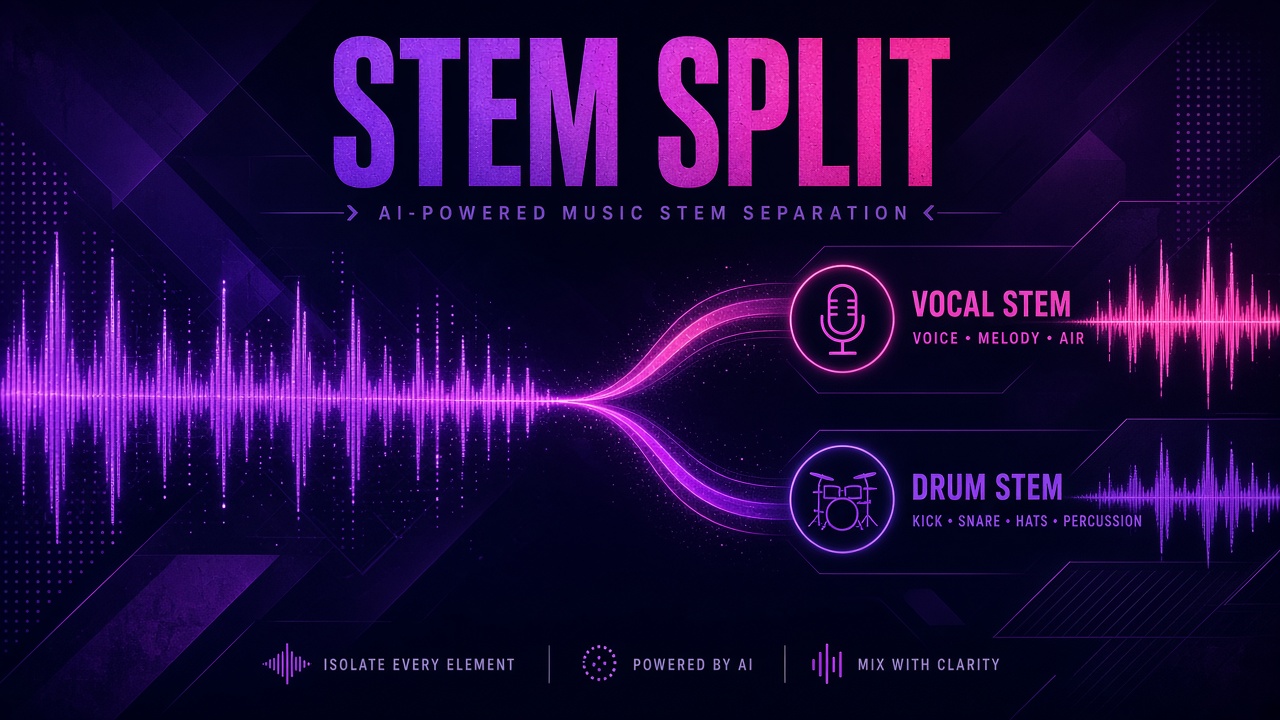
Stem separation uses machine learning to unmix a finished stereo track into vocals, drums, bass, and other instrument groups. Producers use isolated vocals for remixes, karaoke beds, sample chops, and reference analysis. Tools like Demucs, LALAL.AI, and Moises made separation accessible from a browser or plugin, but output quality depends on genre, mix density, and mastering. Teams browsing AI music tools or AI audio processors need a workflow that handles artifacts, documents legal risk, and integrates cleanly with a digital audio workstation (DAW).
How Stem Separation Works
Modern separators train neural networks on large multitrack datasets to predict source masks applied in the frequency domain or waveform domain, then reconstruct per-stem audio. Meta's Demucs family (v3 and v4) popularized hybrid time-frequency architectures with strong open-source adoption. Commercial services LALAL.AI and Moises add proprietary models, cloud rendering, and mobile apps tuned for consumer vocal removal. None of these systems recover the original studio multitrack; they estimate plausible stem approximations that always carry bleed and phase artifacts.
| Tool | Deployment | Typical stems | Best for |
|---|---|---|---|
| Demucs (open source) | Local CLI, Python, some DAW bridges | 4-stem and 6-stem variants | Technical users, batch offline jobs |
| LALAL.AI | Web, API, desktop | Vocal, instrumental, drums, bass, piano, etc. | Fast vocal/instrumental splits |
| Moises | Mobile, web, some DAW plugins | Vocals, drums, bass, other | Practice, live jam, quick edits |
| iZotope RX (Music Rebalance) | Desktop plugin | Adjustable stem weights | Post-production fine control |
Model Versions and Reproducibility
Stem separation quality shifts when vendors retrain models; archive model version strings with each export for client revisions. Demucs releases name checkpoints (htdemucs, htdemucs_ft); LALAL.AI updates engines without always announcing changelog detail. If a remix approved in January sounds different in June, version drift may be the cause. For contest or sync licensing, reproducibility matters as much as subjective quality.
Quality by Genre
Vocal isolation works best on sparse pop and hip-hop mixes with dry lead vocals; dense metal, orchestral, and heavily reverbed indie rock produce metallic halos and drum bleed into vocal stems. EDM with sidechain pumping confuses bass and kick separation. Acoustic jazz with bleeding room mics rarely yields clean stems suitable for commercial release without manual repair. Always A/B the separated vocal against the full mix on headphones and monitors before committing to a remix contract.
Run multiple models when budget allows: Demucs locally for batch experiments, LALAL.AI or Moises for quick client previews. Document which model produced deliverables so you can reproduce results. Higher sample rates (44.1 kHz or 48 kHz lossless input) beat low-bitrate MP3 uploads every time.
Remix Workflow From Reference to Release
Producers often start with a reference mix, isolate vocals for timing and key analysis, rebuild drums and bass, then replace or layer new elements. Use the vocal stem to map phrase boundaries and breath points in your DAW markers. Build scratch instrumental beds from royalty-free loops while waiting on clearance; swap in final separated instrumental only after legal review. This sequencing prevents wasted mix hours on uncleared material.
Karaoke and practice workflows differ from commercial remix: personal use rehearsal with Moises on a phone rarely triggers the same licensing scrutiny as a Spotify release, but public performance of unlicensed backing tracks still carries venue liability. Treat separation as a creative tool with legal guardrails, not a loophole.
Copyright and Sampling Law Basics
Separating stems from a commercial recording does not grant rights to sample, distribute, or sync that material. The underlying composition and sound recording remain protected. Fair use in the United States is a case-by-case doctrine; nonprofit education, commentary, and transformative remix may qualify in some circumstances, but commercial release of recognizable vocal chops from major label tracks carries infringement risk unless licensed. Platforms like Spotify and YouTube Content ID flag uncleared samples regardless of whether stems were AI-isolated.
Practical rules for producers: use separation on your own multitrack exports when possible; license acapellas officially; get clearance for sync in ads and film; treat AI isolation of copyrighted masters as a production technique, not a license substitute. When working with unsigned artists, get written permission covering remixes and stem manipulation. Consult an entertainment lawyer for revenue-bearing releases.
DAW Integration Workflow
A repeatable production workflow: import reference mix, separate stems offline, align stems to session tempo, process artifacts, then rebuild arrangement with new instrumentation. Export separated files as 24-bit WAV to avoid compounding lossy compression. In Ableton Live, Logic Pro, or FL Studio, place vocal stem on dedicated bus with de-bleed EQ notch on drum frequencies. Use phase inversion tests against the instrumental stem to check cancellation artifacts.
- Archive original mix and separation settings (model version, date).
- Separate at project sample rate; avoid unnecessary sample-rate conversion.
- Time-align stems if the model introduced latency (null test with mix).
- Apply spectral repair (RX, ERA, manual EQ) before heavy compression.
- Produce remix against instrumental; keep unprocessed vocal stem safety copy.
- Master with integrated loudness targets for destination platform.
Some AI music DAW assistants generate MIDI or replacement parts from chord estimates; treat those as creative layers separate from legal stem use. Combine generative instrumentation with legally cleared vocal stems only.
Choosing Between Local and Cloud Separation
Local Demucs runs on consumer GPUs with predictable per-track cost but require DevOps comfort; cloud APIs bill per minute and simplify mobile workflows at scale. A mastering house processing catalog backups may invest in a dedicated GPU workstation running batch Demucs overnight. A touring DJ needing a quick acapella preview on a phone reaches for Moises. API integrations (LALAL.AI enterprise) suit SaaS products that offer stem splits as a feature; read terms on commercial redistribution of separated audio.
Latency matters for live remix sets: offline separation completes before the show; real-time stem separation plugins remain experimental for club-ready quality. Producers doing sound-alike references for arrangement sketching can tolerate lower fidelity than those releasing on streaming platforms.
Artifact Handling
Common artifacts include metallic treble on vocals, ghost cymbals in instrumental beds, and pumping background noise when the model misclassifies reverb tail as voice. Mitigate with narrow EQ cuts, multiband expansion, manual gating on phrase gaps, and spectral editing. For client-facing work, disclose that AI separation was used when bleed is audible; some remixes need re-recording a guide vocal instead of forcing a dirty isolation.
Batch processing overnight on GPU hardware suits album-length catalog work. Cloud APIs charge per minute; local Demucs runs cost electricity and setup time but scale for libraries. Track GPU model hashes when reproducibility matters for legal discovery or version control.
Stem Count and Instrument-Specific Models
Four-stem splits (vocals, drums, bass, other) are fast; six-stem and instrument-specific models trade compute for cleaner isolation on piano, guitar, or wind parts. LALAL.AI markets dedicated engines per stem type; run piano and vocal passes separately when a ballad vocal bleeds into piano reverb. Drum separation quality affects remix groove reconstruction: sloppy kick-snare bleed forces manual drum replacement rather than sample-layering on top of AI drums.
Delivery and Client Communication
When delivering remixes or stems to labels, document separation method and disclose bleed limitations in delivery notes. A&R teams may request dry vocals; if AI isolation cannot meet broadcast standards, propose re-tracking sessions instead of delivering unusable assets. Include null-test screenshots or spectral captures in internal QA, not necessarily client-facing, to defend creative decisions when artifacts are audible but musically acceptable in context.
Frequently Asked Questions
Is vocal isolation legal for YouTube covers?
A cover may still need a mechanical license for the composition, and using the original master vocal stem is not the same as performing your own cover vocal. Many creators use AI instrumentals plus their own voice; using isolated original vocals without permission risks takedowns.
Which model is best in 2026?
No single winner across all genres. Demucs 4-class models excel in research benchmarks; LALAL.AI and Moises trade convenience and stem-type presets. Test on your specific material.
Can I sell remixes from AI stems?
Only with rights to the underlying recording and composition. AI separation does not transfer ownership or clearance.
Why do vocals sound metallic?
Frequency masking errors and phase mismatch between estimated masks create comb-filtering. Try another model, lower separation aggressiveness if available, or use spectral repair tools.
Does separation work on live recordings?
Live audience noise and room bleed reduce quality sharply. Expect cleanup work or consider multitrack capture instead for future shows.
How does this fit broader AI audio tooling?
Stem separation pairs with AI audio mastering, noise reduction, and generative accompaniment. Keep separation outputs as intermediate assets with documented provenance before downstream AI processing.
Should I separate before or after mastering?
Separate the final released mix when working from commercial masters; separating premaster multitracks is unnecessary if you already own stems. Heavy limiting and clipping on mastered tracks worsen separation artifacts, so ask rights holders for instrumental versions when available.
Are free Demucs stems commercially usable?
Demucs software licensing does not grant copyright in the underlying song. Commercial usability depends on your rights to the recording you separated, not on the open-source tool license alone.
What file format should I export?
Use 24-bit WAV at the session sample rate for production; MP3 stems introduce artifacts that compound through mixing and mastering. Archive lossless exports even when delivering MP3 previews to clients.