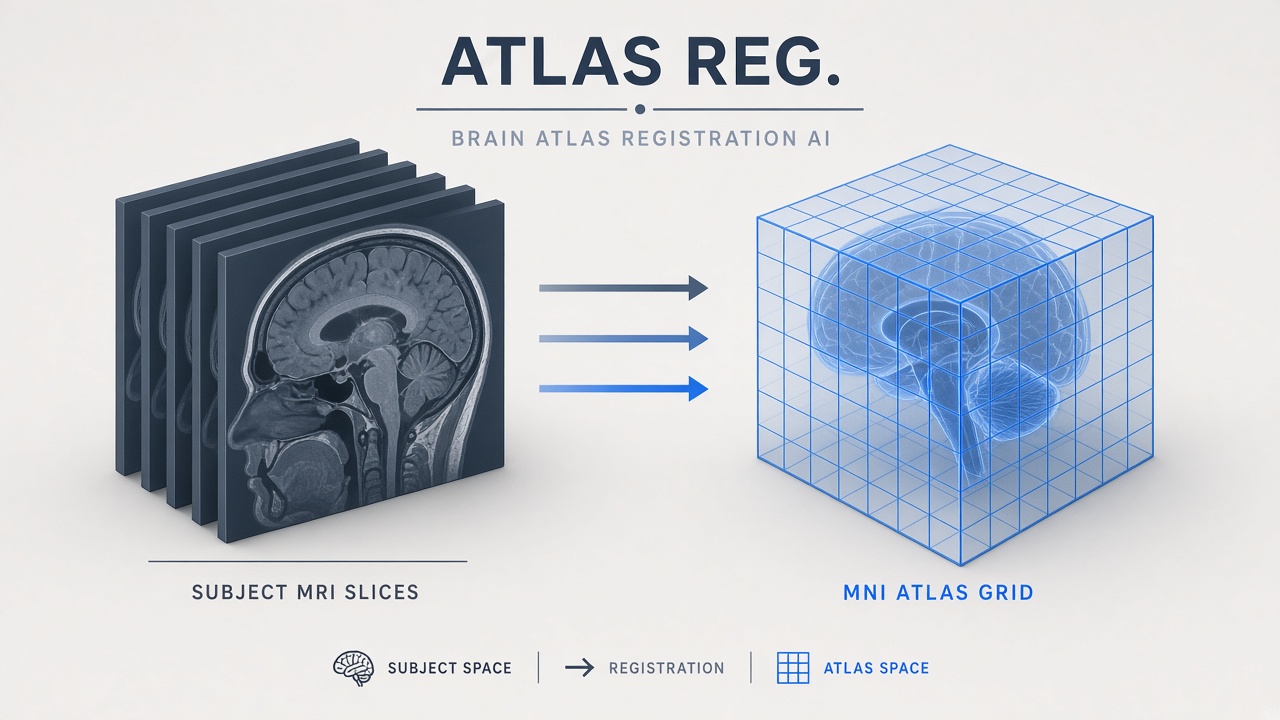
A neurologist compares two patients' MRI scans side by side, but the brains sit at different angles, skull shapes differ, and cortical folds do not line up. Before any group analysis, voxel statistics, or automated segmentation can run, each scan must be warped into a shared coordinate space. That process is brain atlas registration, and modern pipelines increasingly rely on machine learning to do it in seconds instead of hours. Brain atlas registration AI combines classical optimization methods like ANTs SyN with deep learning models such as VoxelMorph, SynthMorph, and EasyReg that predict deformation fields directly from image pairs.
Neuroimaging labs, clinical trial sites, and brain-computer interface teams all depend on consistent spatial alignment. A misregistered hippocampus can flip a biomarker signal from significant to noise. Teams evaluating AI chatbot products for clinical documentation should understand that registration quality upstream determines every downstream AI claim about brain structure. For broader context on how research teams publish technical explainers, browse the EliteAI.tools blog index.
What Brain Atlas Registration AI Means in Plain Language
Brain atlas registration AI is the use of machine learning models to align one brain MRI volume to a reference template or atlas so that the same anatomical location in every subject maps to the same voxel coordinates. A brain atlas is a standardized 3D map with labeled regions (cortex, subcortex, white matter tracts). Registration computes a spatial transform: rigid (translation and rotation), affine (scaling and shear), or nonlinear (local warping that follows sulci and gyri).
Classical registration optimizes a similarity metric (mutual information, cross-correlation) over millions of voxel displacements. Each new scan pair requires a fresh optimization that can take minutes on a workstation. Deep learning registration trains a neural network on thousands of aligned pairs so that at inference time the model predicts the deformation field in one forward pass, often in under a second on a GPU.
| Registration type | What it corrects | Typical use case |
|---|---|---|
| Rigid | Head position in scanner | Quick motion correction |
| Affine | Global scale and orientation | Cross-subject template alignment (first pass) |
| Nonlinear (deformable) | Local shape differences between brains | Group studies, atlas-based segmentation |
Common reference atlases
MNI152 is the most widely used nonlinear average template in human neuroimaging; FreeSurfer's Desikan-Killiany and Destrieux parcellations label cortical regions after registration to its surface space. Pediatric and neonatal studies use age-matched templates because adult atlases misalign developing brains. Disease-specific atlases exist for populations with atrophy or lesions, but most clinical pipelines still default to MNI space for interoperability across published studies.
How the Underlying AI Pipeline Works
Deep learning registration models learn a function that maps a fixed image and a moving image to a dense deformation field, trained with unsupervised similarity losses plus regularization that keeps transforms smooth and invertible. VoxelMorph, introduced by Balakrishnan and colleagues, uses a U-Net encoder decoder to predict velocity fields integrated via scaling-and-squaring to produce diffeomorphic transforms. The network is trained on large MRI datasets so inference requires no per-pair optimization.
Classical tools: ANTs and FreeSurfer
ANTs (Advanced Normalization Tools) SyN remains a gold-standard nonlinear registration method in neuroimaging benchmarks, solving a variational optimization that can take several minutes per pair but handles large deformations with strong topology preservation. FreeSurfer, maintained at Massachusetts General Hospital, is a full neuroimaging suite whose recon-all pipeline includes surface-based registration and subcortical segmentation. FreeSurfer now integrates learning-based tools: EasyReg for symmetric multimodal registration and SynthMorph for joint affine and deformable alignment without preprocessing.
Deep learning tools in the ecosystem
SynthMorph, developed at the Martinos Center, trains on synthetic images with randomized anatomy and acquisition parameters so the model generalizes across MRI contrasts, resolutions, and intensity scales. EasyReg, published in Scientific Reports (2023), combines domain randomization with a command-line interface that needs no GPU or deep learning expertise, and ships inside FreeSurfer. BrainMorph (2024) extends keypoint-based registration to groupwise settings and diseased brains, trained on over 100,000 volumes from nearly 16,000 subjects.
| Tool | Approach | Speed (typical) | Availability |
|---|---|---|---|
| ANTs SyN | Optimization-based diffeomorphic | Minutes per pair | Open source (ANTs) |
| VoxelMorph | U-Net velocity field prediction | Sub-second on GPU | Open source (VoxelMorph repo) |
| SynthMorph | Synthetic training, anatomy-aware | Seconds | FreeSurfer, standalone CLI |
| EasyReg | Symmetric, multimodal, domain randomization | Seconds | FreeSurfer command line |
| BrainMorph | Keypoint foundation model, groupwise | Fast pairwise and group | GitHub (alanqrwang/brainmorph) |
Typical workflow steps
- Acquire T1-weighted (and optionally T2 or FLAIR) MRI volumes.
- Skull-strip or use a method that handles skull-intact data (BrainMorph supports both).
- Run affine registration to a template (MNI152 or study-specific).
- Apply nonlinear registration (ANTs SyN, SynthMorph, or VoxelMorph).
- Transfer atlas labels or run surface reconstruction (FreeSurfer recon-all).
- Validate with visual QC overlays and Jacobian determinant maps for folding artifacts.
Real Deployments and Published Evidence
Learning-based registration has moved from research papers into production neuroimaging pipelines bundled with FreeSurfer, the most cited structural MRI analysis suite in academic literature. EasyReg authors report accuracy comparable to classical methods on 1 mm isotropic within-modality pairs, with larger gains when registering across modalities (T1 to T2) and resolutions. SynthMorph papers demonstrate robust performance on images straight from the scanner without bias-field correction or resampling preprocessing.
Comparative studies continue to benchmark deep learning against ANTs SyN. A 2024 pediatric registration study in MELBA journal compared SyN ANTs with VoxelMorph and other learning methods, highlighting that initialization quality affects both classical and deep pipelines. ISMRM proceedings note that fair comparisons require matching smoothness constraints and evaluating beyond Dice scores alone (Hausdorff distance, intensity consistency).
Large-scale consortia (UK Biobank, ADNI, HCP) precompute registrations for shared templates so downstream researchers download already-aligned data. Clinical trial imaging cores increasingly offer cloud pipelines where GPU-accelerated EasyReg or SynthMorph reduces turnaround from overnight batch jobs to near-real-time QC during scanning sessions.
Where registration sits in BCI and clinical AI
Brain-computer interface research uses registration to map electrode locations or functional MRI activations to standard regions before training decoders. Stroke and tumor studies warp pre- and post-treatment scans to quantify lesion growth. Any vendor claiming AI-based brain biomarkers should document which registration tool and atlas version produced the features, because swapping SyN for a fast deep model can shift effect sizes in small cohorts.
Limits, Risks, and Ethical Guardrails
Registration AI can fail silently: smooth deformation fields may hide anatomically implausible warping that still improves similarity metrics, especially near lesions, resection cavities, or extreme atrophy. Deep models trained predominantly on healthy adult brains underperform on pediatric, geriatric, or pathological populations unless retrained or validated on those domains.
- Topology violations: Non-diffeomorphic transforms can fold tissue, mapping unrelated regions together. Check Jacobian determinants.
- Modality shift: Models trained on 1 mm T1 scans may fail on low-field or thick-slice clinical scanners.
- Interpretability: Fast inference trades away the explicit energy landscape classical methods optimize, making failure diagnosis harder.
- Regulatory context: FDA-cleared neuroimaging software often locks registration parameters; swapping in experimental DL models invalidates clearance.
Ethical guardrails include population-representative training data, transparent reporting of atlas version and registration tool in publications, and avoiding deterministic brain charts that imply normative judgment from template deviation alone. Registration enables group comparison; it does not by itself diagnose disease.
Who Should Use This and Who Should Wait
Research labs processing hundreds of scans, multicenter trials needing fast QC, and developers building reproducible neuroimaging pipelines should adopt validated learning-based registration (EasyReg, SynthMorph) now, with classical SyN as a reference check on a subset. Single-scan clinical reads where a neuroradiologist inspects native space anatomy may not need nonlinear atlas registration at all.
| Audience | Recommendation | Caveat |
|---|---|---|
| Academic neuroimaging lab | Adopt FreeSurfer EasyReg or SynthMorph for throughput | Benchmark against SyN on your cohort |
| Clinical trial imaging core | Lock pipeline version, document SOPs | Regulatory validation required for changes |
| BCI startup | Use fast DL registration in training loops | Validate on impaired anatomy subsets |
| Individual clinician | Wait unless using cleared commercial software | Do not rely on research scripts for diagnosis |
Teams without GPU infrastructure can still run EasyReg on CPU within FreeSurfer. Groups needing guaranteed diffeomorphisms for theoretical guarantees may retain ANTs SyN for final analysis while using deep models for screening and QC. Hybrid pipelines are common and scientifically defensible when documented.
Frequently Asked Questions
How accurate is brain atlas registration AI compared to ANTs SyN?
On standard adult T1-to-template tasks, published results show learning methods match or approach SyN Dice overlap scores while running orders of magnitude faster; accuracy varies by modality, pathology, and initialization. No single model wins every benchmark. Validate on your data before replacing a validated classical pipeline.
What is the difference between VoxelMorph and SynthMorph?
VoxelMorph is a general deep learning registration framework requiring training or pretrained weights suited to your contrast; SynthMorph is a FreeSurfer-integrated tool trained on synthetic data for robust cross-contrast alignment without preprocessing. SynthMorph targets turnkey brain MRI workflows; VoxelMorph offers more flexibility for researchers who train custom models.
Does FreeSurfer include AI registration tools?
Yes. FreeSurfer distributes EasyReg and SynthMorph as command-line tools alongside its classical surface registration pipeline. Check the FreeSurfer version in your environment because learning-based modules arrived in recent releases and differ from legacy mri_robust_register workflows.
Is AI brain registration FDA cleared?
Some commercial neuroimaging products include registration in FDA-cleared workflows, but open-source EasyReg, VoxelMorph, and SynthMorph are research tools unless wrapped by a vendor with regulatory submission. Clinical use requires the cleared software version, not ad hoc substitution of algorithms.
How much training data do deep registration models need?
Foundation models like BrainMorph train on tens of thousands of volumes; smaller labs typically use pretrained weights from FreeSurfer or published checkpoints rather than training from scratch. Custom training helps when your cohort differs strongly from public datasets (infants, rare diseases, exotic contrasts).
Can registration AI handle brain tumors or lesions?
Lesions violate the assumption that anatomy differs only by smooth deformation; registration around resection cavities often requires lesion masking, cost-function masking, or specialized templates. BrainMorph reports training on diseased subjects, but any clinical measurement near lesions demands manual QC.
Do I need a GPU for brain atlas registration AI?
GPU acceleration helps VoxelMorph and BrainMorph inference; EasyReg and SynthMorph run on CPU within FreeSurfer at acceptable speeds for many batch pipelines. Cloud GPU instances suit large retrospective studies; CPU clusters remain viable for EasyReg deployments.
Conclusion
Brain atlas registration AI accelerates a foundational neuroimaging step by predicting deformation fields with neural networks trained on large MRI corpora. ANTs SyN remains the classical reference; VoxelMorph pioneered fast diffeomorphic learning; FreeSurfer now ships EasyReg and SynthMorph for production use; BrainMorph pushes toward foundation-model scale for groupwise and pathological brains. Success depends on validation, transparent atlas versioning, and QC that catches impossible warps before they contaminate biomarkers. Teams building on these tools should benchmark on their own cohorts, document pipeline versions for reproducibility, and treat registration as necessary infrastructure rather than a black-box preprocessing step.