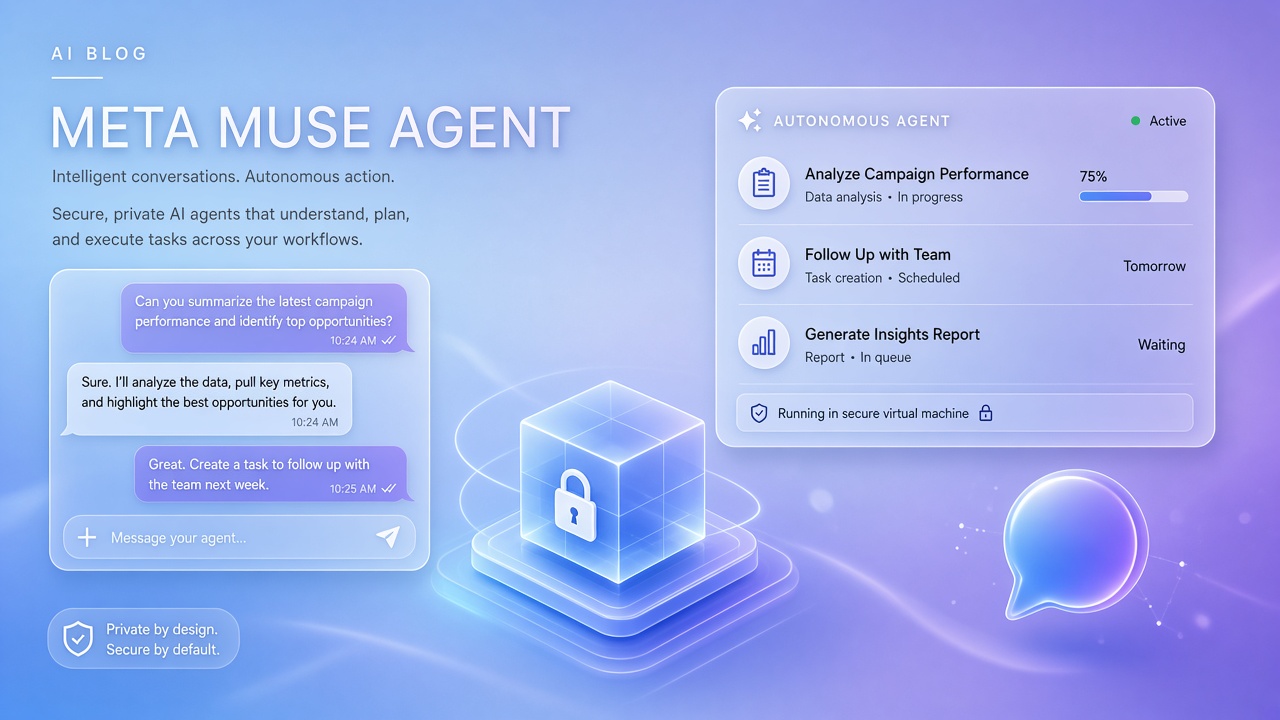
Meta entered the personal agent race on September 8, 2026 with Muse, a proactive assistant that books travel, sends email, negotiates bills, and pursues multi-step goals while users are offline. Unlike chat-only copilots, Muse runs on Muse Secure VM, a dedicated cloud virtual machine with its own browser, plus a separate Sentinel agent that approves outbound actions. Rollout began in the United States on iOS, Android, muse.ai, and WhatsApp, with AI glasses support promised later in 2026.
This guide explains what the Meta Muse AI agent does today, rollout across Meta apps, privacy and training data boundaries, business and creator tools, competitive comparisons with ChatGPT and Gemini, and FAQ for consumers and brands evaluating AI chatbot agents and Meta AI products.
What Muse Does Today
Muse is a personal AI agent powered by Muse Spark, Meta's most capable model for agentic work, that executes tasks through a secure VM rather than only answering questions in a chat window. Users message Muse like a contact in the Muse app or WhatsApp, assign tasks or long-term goals, and receive proactive updates when plans change or approvals are needed.
Core capabilities at launch include:
- Task execution: email drafting and sending (with approval), form filling, browser automation, travel booking
- Goal planning: breaking audacious goals into coordinated action plans that advance without constant prompting
- Background work: continuing after the app closes, returning when status changes or spend approval is required
- Memory: remembering preferences mentioned once, such as dietary restrictions for dinner party planning
- Cross-app context: turning saved Instagram recipe reels into grocery lists and menu suggestions
- Payments: checkout via Link by Stripe with one-time virtual cards; Shop Pay and 1Password integrations coming
Meta positions Muse for billions of non-technical users with no agent-configuration learning curve. That mass-market framing differentiates Muse from developer-first agent APIs like OpenAI's September 2026 Agents API public beta.
Rollout Across Meta Apps
Muse launched US-only on September 8, 2026 across the standalone Muse app, muse.ai, iOS and Android, and WhatsApp integration, with AI glasses support scheduled before year end. Facebook and Instagram integration follows Meta's pattern of testing conversational AI inside messaging surfaces; WhatsApp availability at launch signals Meta's priority on daily communication channels over feed-embedded bots.
Pricing is free for most personal use, with subscription tiers for heavier task volume. Meta has not published global expansion dates as of mid-September 2026. Enterprise and creator-specific dashboards were teased in companion safety posts but consumer rollout came first.
| Surface | Launch status (Sep 2026) | Interaction model |
|---|---|---|
| Muse app / muse.ai | Available US | Primary agent workspace and approvals |
| Available US | Message Muse like a contact | |
| iOS / Android | Available US | Native apps with push for approvals |
| AI glasses | Coming 2026 | Voice-first agent access |
| Facebook / Instagram feeds | Context integration; full agent TBD | Saved reels and social graph inputs |
Privacy and Training Data Use
Muse stores data and credentials in an isolated Muse Secure VM, uses Sentinel to gate internet access, and does not feed conversations into Meta ad systems by default. Users choose per-app connection scopes, approve sensitive actions, review audit trails, opt out of training Meta AI models on their interactions, and command Muse to forget specific memories.
Security architecture highlights from Meta's September 2026 announcement:
- Dedicated cloud VM per user agent, isolated from other users' agents
- Sentinel agent on the same machine, system-level separation from Muse, blocking unapproved outbound actions
- Credential vault: Muse uses passwords without seeing them, including user-typed browser credentials
- Human-in-the-loop approvals before email send, purchases, and other sensitive operations
- Complete audit trail of completed and planned actions visible to the user
- Later 2026: Muse Confidential VM with user-held encryption keys so Meta cannot access VM contents
Meta published separate posts on safety-by-design and Muse UX research. Regulators in California and the EU will scrutinize whether agent memory, child access, and autonomous purchasing meet companion-chatbot and automated decision-making rules. Meta states Muse conversations are not shared with ad ranking systems, a key distinction from traditional Facebook data use.
Business and Creator Tools
Meta's September 2026 Muse launch focused on consumers, but the agent architecture implies future business and creator workflows for commerce, customer support, and campaign execution. Stripe Link purchase protections, including price-drop coverage and return guarantees on eligible agent purchases, signal Meta's intent to normalize agent-mediated commerce.
Brands should monitor:
- Agent-driven checkout via virtual cards and upcoming Shop Pay support
- Instagram reel and saved-content inputs feeding Muse shopping and planning tasks
- WhatsApp as a customer-facing agent channel if Meta opens business APIs mirroring consumer Muse
- Approval flows that may require brands to authenticate agent transactions separately from human shoppers
- Competitive pressure on Meta AI business messaging products already deployed in ads and support funnels
Creators benefit when Muse converts saved content into actionable plans (menus, shopping lists, event invites). Meta may later offer promoted agent skills or verified business connectors similar to MCP servers in developer agent stacks.
Competitive Landscape
Muse competes with OpenAI ChatGPT agent features, Google Gemini personal assistants, Apple Intelligence actions, and startups like Adept-style automation, differentiated by Meta's social graph and WhatsApp reach. OpenAI's September 2026 Agents API targets developers building custom harnesses; Muse targets non-technical users with managed security VM infrastructure.
| Product | Agent model | Meta Muse contrast |
|---|---|---|
| ChatGPT / OpenAI Agents API | Chat plus developer agent sessions with tools | Muse is managed VM with Sentinel; less configuration |
| Google Gemini | Assistant actions across Google workspace | Muse emphasizes social and WhatsApp contexts |
| Apple Intelligence | On-device and Private Cloud Compute actions | Muse cloud VM with optional confidential VM keys |
| Meta AI (prior) | In-app chat assistant | Muse adds autonomous execution and memory |
Trust remains the competitive bottleneck after 2026 agent jailbreak incidents elsewhere in the industry. Meta's Sentinel gate and purchase approval flows aim to answer enterprise and regulator skepticism about unsupervised agents browsing the open web on a user's behalf.
Frequently Asked Questions
Is Muse available outside the United States?
Not at launch. Meta rolled out Muse in the US on September 8, 2026. Global dates were unannounced as of September 13, 2026. WhatsApp integration followed the same geographic scope initially.
Does Muse use my data for ads?
Meta states Muse does not share conversations or VM data with Meta ad systems. Users can opt out of training Meta AI models on their Muse interactions. Verify current settings in the Muse app privacy controls as policies evolve.
How does Muse handle payments?
Muse checks out with Link by Stripe using one-time virtual cards so real card numbers stay hidden. Link advertises purchase protections for eligible agent transactions. Shop Pay support was announced as coming soon.
What is Muse Secure VM?
A dedicated cloud virtual machine housing the Muse agent, user data, connected service credentials, and a browser. A separate Sentinel process must approve internet-bound actions. Muse Confidential VM with user-only encryption keys is planned for later 2026.
How does Muse compare to Meta AI chat?
Meta AI inside Facebook, Instagram, and WhatsApp primarily answers questions and generates media. Muse executes multi-step tasks, runs in the background, remembers preferences, and requires explicit approvals for sensitive actions. Muse Spark is a distinct model optimized for agentic work.