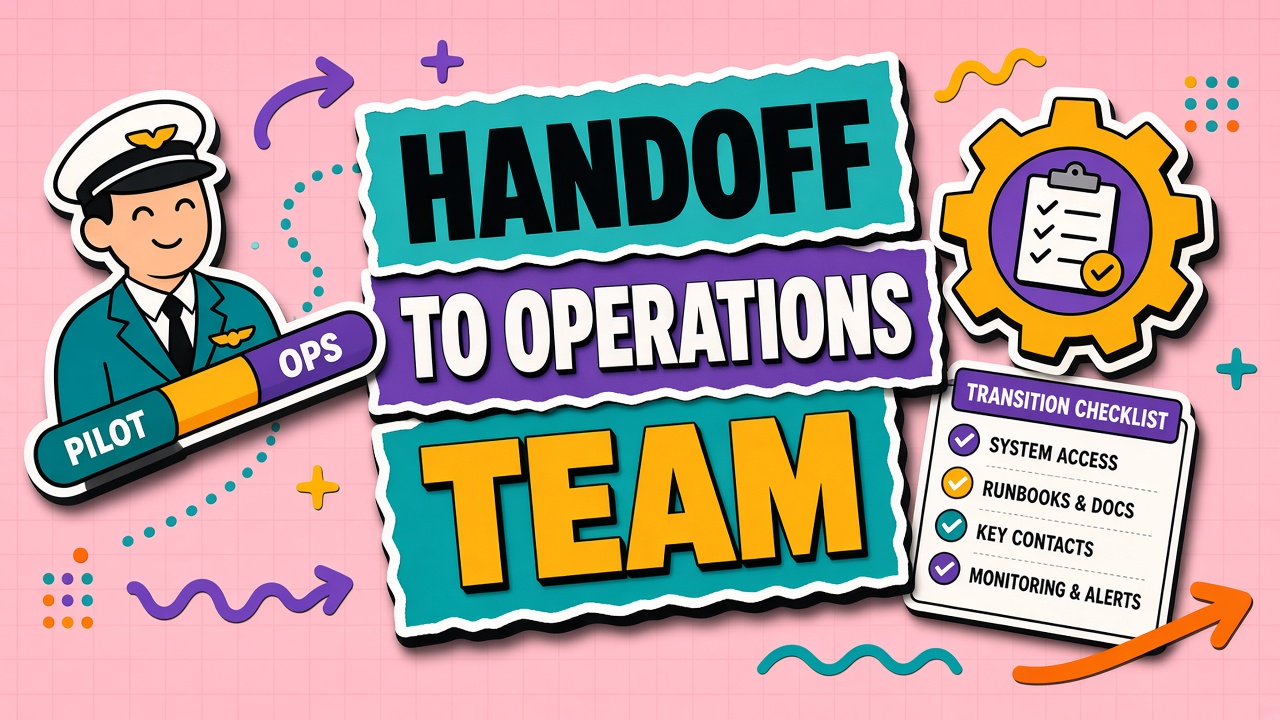
Pilot teams celebrate a demo. Operations inherits a login, a vague Slack thread, and pager duty without context. Within weeks the workflow degrades: prompts drift, alerts fire with no runbook, and vendor tickets reopen because nobody knows the account owner. A structured AI pilot to operations handoff transfers artifacts, support tiers, monitoring thresholds, and a hypercare window so production stability outlasts the champions who built the pilot.
This checklist targets ops leads taking over AI automation flows and AI customer service tools after a successful pilot. Engineering may build the integration; operations keeps it running.
Handoff Artifacts: Runbooks, Dashboards, and Contacts
Ops cannot support what is not written down. Minimum artifact pack before signature on the handoff document:
- Runbook: Step-by-step for restart, pause, fail over, and vendor status page checks
- Architecture diagram: Data flows, PII boundaries, and integration endpoints
- Dashboard links: Usage, error rate, latency, cost per day, queue depth
- Contact roster: Vendor TAM, internal engineering on-call, business owner, security liaison
- Credential map: Where API keys live, rotation schedule, break-glass procedure
- Prompt and config versions: Production tag or commit hash, not "latest in someone's doc"
Store artifacts in the same system ops uses for other production services. A Notion page only the pilot team reads is not a handoff. Link runbooks from alert messages so 3 a.m. pages open the right doc.
Support Tiering: L1 Internal vs Vendor
Define who answers which failure mode before go-live, not when customers complain.
| Tier | Handles | Escalates when |
|---|---|---|
| L1 internal ops | Known errors in runbook, user access, queue backlog | Novel errors, data mismatch, security suspicion |
| L2 engineering | Integration bugs, parser changes, deployment rollback | Vendor platform defect confirmed |
| Vendor support | Outages, model regressions, billing on vendor side | SLA breach requiring account executive |
| Business owner | Workflow policy, customer communication tone | Regulatory or contractual exposure |
L1 for customer service AI should include trained agents who know when to disable auto-draft features without waiting for engineering. Document those toggles in the runbook with customer-visible impact notes.
Monitoring and Alert Thresholds
Alerts should mean action, not noise. Pilot teams tolerate flaky metrics; ops will mute channels that cry wolf. Set initial thresholds from pilot p95 values plus headroom.
- Error rate: Page when five-minute error share exceeds 2x pilot baseline for fifteen minutes
- Latency: Warn when p95 exceeds customer SLA; page when SLA missed for three consecutive intervals
- Cost: Daily spend anomaly versus seven-day rolling average
- Quality proxy: Human override rate or thumbs-down rate spike (if instrumented)
- Queue depth: Backlog age for async jobs used in automation chains
Pair each alert with runbook section ID and owner role. Review thresholds thirty days after handoff when real traffic patterns replace pilot samples.
Hypercare Period After Handoff
Hypercare is a two to four week window where pilot champions stay on-call for ops questions without owning every ticket. Ops leads the pager; pilots join bridgelines for unknown failures.
Hypercare calendar:
- Week 1: Daily fifteen-minute sync: incidents, near misses, doc gaps
- Week 2: Sync three times; pilot edits runbook from ops feedback
- Week 3: Ops handles all incidents solo; pilots observe unless paged
- Week 4: Formal sign-off or extension with written reasons
Exit criteria: ops resolved ninety percent of incidents using runbook only, dashboards trusted, vendor ticket templates used without rewrite. If criteria fail, extend hypercare rather than pretending handoff completed on schedule.
Acceptance Criteria for Handoff Sign-Off
Ops should sign handoff only when acceptance criteria are binary pass or fail. Example criteria: runbook covers top five historical incident types; on-call engineer completes dry-run rollback in under thirty minutes; dashboards show seven days of stable baseline data; vendor ticket template copied into ops knowledge base; business owner confirms customer communication templates for known failure modes.
Partial handoffs ("we will finish the runbook next sprint") recreate pilot purgatory. If criteria fail, extend pilot with explicit date or reduce production scope until ops can accept. Scope reduction is a valid outcome: hand off one workflow completely instead of three workflows partially.
Knowledge Transfer Sessions
Record two knowledge transfer sessions before hypercare ends. Session one walks happy path execution with live traffic read-only. Session two walks last major incident from pilot phase including blind alleys. Recordings age better than slide decks because ops hears the questions pilots actually answered.
Index recordings by runbook section timestamps. Future hires and vendors onboarding to your stack find answers faster when video chapters map to alert names they see at 2 a.m.
Operational Ownership After Hypercare
Name a single operational owner per workflow with job description language, not volunteer spirit. Owner duties include runbook freshness, prompt version approvals with workflow steward, monthly dashboard review, and vendor relationship for tier-one tickets. Capacity plan for owner time: typically two to four hours weekly for mature workflows, more during first quarter post-handoff.
Backup owner required for PTO coverage. Pilots may fade; ops owners remain until workflow retires.
Service Level Objectives for AI Workflows
Define SLOs before handoff so ops knows what "healthy" means. Examples: ninety-five percent of async jobs complete within fifteen minutes; chat assist suggestions available ninety-nine point five percent of business hours; error rate below one percent on validated payloads; cost per day within twenty percent of seven-day baseline unless campaign ticket linked. SLOs belong in handoff packet with measurement query or dashboard panel ID.
Error budget policy: when SLO burns fast, freeze non-emergency prompt changes and open incident. Pilot teams often optimize for demo success; ops needs sustainable SLOs tied to real traffic mix, not best-case demos.
Financial Operations Handoff
Ops owns runtime; finance still owns invoice surprises. Transfer knowledge of billing cadence, credit burn rate, seasonal spikes, and which cost center tags each API key. Include vendor portal access for ops read-only billing view. First month after handoff, ops compares dashboard spend to invoice weekly and files discrepancies using vendor template from runbook.
Handoff Implementation Sequence
Phase A artifact collection: pilot exports runbooks, diagrams, dashboards, contacts, credential map, prompt versions, eval summaries, and incident history into ops-approved repository. Phase B walkthrough: ops executes each runbook section in staging while pilot narrates; gaps become tickets with due dates before handoff sign-off. Phase C acceptance: ops lead signs binary checklist; failures extend pilot or reduce scope.
Phase D hypercare: daily then thrice weekly then solo ops with pilot tertiary on-call. Phase E steady state: ops owner named in org chart capacity, backup owner assigned, drill schedule calendarized, vendor billing view verified. Skipping Phase B produces runbooks that read well but fail at step three under pager stress.
Common Handoff Failures to Avoid
Failure one: runbook describes happy path only. Add top five incident playbooks from pilot history. Failure two: dashboards exist but alerts route to empty Slack channel. Test paging before sign-off. Failure three: business owner disappears after demo; name deputy for policy questions. Failure four: hypercare ends on calendar date despite open runbook gaps. Extend hypercare with written criteria, not optimism.
Measuring Handoff Success
Success metrics ninety days post-handoff: mean time to resolve incidents using runbook without pilot assist, percentage of alerts actionable without runbook edit, customer-visible incidents attributable to AI workflow, cost variance within ten percent of pilot baseline, and business owner satisfaction score from short survey. Missing metrics means you cannot tell handoff from prolonged pilot with different badge.
If pilot assist rate stays above twenty percent after day sixty, reopen hypercare or rewrite runbook sections cited in assist tickets. Handoff is not a ceremony; it is sustained ops competence.
Operational Readiness Review Before Go-Live
Conduct readiness review one week before handoff signature. Attendees: ops lead, pilot lead, business owner, security liaison. Agenda item one: demonstrate runbook execution on staging incident inject. Item two: page on-call engineer unannounced with simulated alert; measure time to correct runbook section. Item three: verify credential rotation drill completed in last quarter. Item four: confirm customer communication templates approved for top three failure modes.
Readiness review fails if any attendee cannot locate dashboard, runbook, or escalation contact within two minutes from cold start. Failed review reschedules handoff; it does not proceed with "we will fix runbook later" notes that become permanent debt.
Documentation Living After Handoff
Runbooks rot when nobody owns updates. Ops owner reviews runbook monthly against last three incidents: if any step was wrong, patch within five days. Prompt version changes trigger runbook appendix update same release. Dashboard links validated quarterly for broken URLs. Vendor contact roster verified when account manager email bounces.
Pilot team transitions to advisory role after hypercare: available for consult, not default owner. Advisory boundary prevents ops from silently routing every ticket back to champions who already moved to next project.
Living documentation is the difference between handoff that sticks and handoff that reverts to hero culture within one quarter.
Frequently Asked Questions
Do we need 24/7 coverage on day one?
Match coverage to customer impact. Batch automation jobs may need business-hours ops only. Live customer chat integrations need follow-the-sun or vendor SLA-backed support.
Who goes on call for AI-specific failures?
Primary: ops engineer or platform on-call. Secondary: integration engineer. Pilot champion is tertiary during hypercare only, then off rotation.
What if the pilot team disbands after handoff?
Knowledge must live in artifacts, not people. If champions leave, freeze prompt changes until new owners certify on runbook walkthrough recorded on video.
Can one handoff cover multiple AI workflows?
One handoff packet per production workflow or tightly coupled bundle. Do not merge unrelated tools into a single runbook ops cannot navigate under stress.
The Bottom Line
Transfer AI tools to operations with complete runbooks, tiered support, tuned alerts, and a bounded hypercare period. Pilots prove value; ops sustains it. Handoff is production work, not a meeting slide.