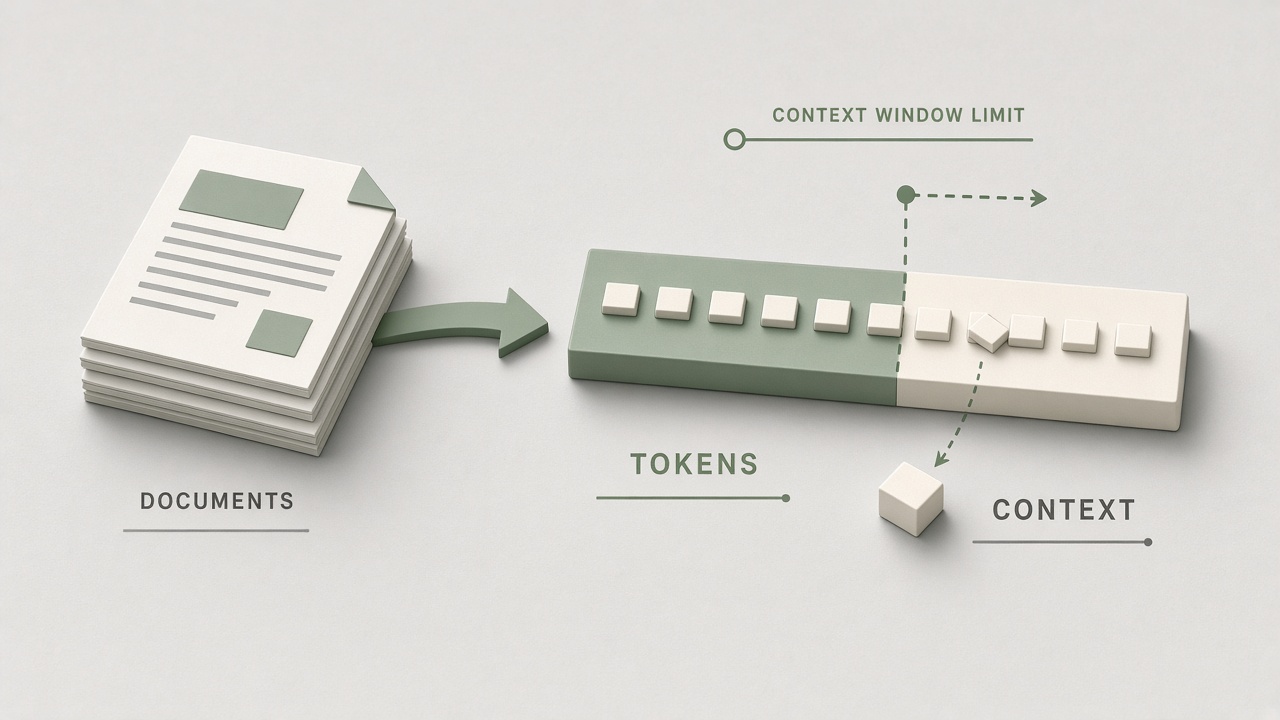
You paste a sixty-page contract into a chat assistant and ask, "Summarize indemnification clauses only." The model answers confidently but omits section 14 because that text never reached the model: it was truncated silently or pushed out by earlier messages. AI context window explained in one sentence: the context window is the maximum number of tokens (text pieces) a model can read and write in a single request, including system instructions, conversation history, tool definitions, and attached files. Context limits shape every AI code review workflow and long-form AI voice transcript analysis pipeline that feeds minutes of speech into one prompt.
Tokens vs Words and Characters
Tokens are the subword units models tokenize text into; English averages roughly three quarters of a word per token, but code, JSON, and non-Latin scripts tokenize differently and often consume more tokens per visible character. Providers bill and limit by tokens, not pages. A 10k-word document might be 13k tokens in English prose or 20k tokens in dense JSON. Always measure with the same tokenizer your model API uses.
| Content type | Rough tokens per unit | Planning note |
|---|---|---|
| English prose | ~1.3 tokens per word | Use API tokenizer counts |
| Source code | Higher due to symbols | Count files individually |
| JSON / logs | Often 2x prose rate | Minify or filter fields |
| CJK languages | Variable by character | Never assume English ratios |
Counting tokens before send
Client SDKs and server-side middleware should estimate input tokens before calling the model. Reject or reroute oversized payloads to chunking pipelines early. Surprise truncation mid-deploy causes silent quality regressions users attribute to "the model got dumber" when the context budget changed.
Advertised vs Usable Context
Marketing context sizes (128k, 200k, 1M tokens) describe theoretical input capacity; usable context is lower after reserving space for system prompts, tool schemas, safety prefixes, model output budget, and provider overhead. A 128k window might leave 100k for user documents once agent tools and long system policies load. Output tokens also count toward limits on many APIs: a 4k max completion reduces effective input headroom in the same request.
Long-context models still exhibit "lost in the middle" behavior: facts buried in the center of huge prompts are recalled less reliably than content at the start or end. Usable context therefore includes quality considerations, not just token arithmetic. RAG often beats stuffing entire corpora into one prompt.
Input and output budget split
Plan total window equals input plus maximum completion tokens. Streaming long answers consumes output tokens that cannot be reclaimed for additional input in the same call. Multi-turn chats accumulate prior assistant messages in history, compounding usage across turns even when users ask short follow-ups.
Truncation Strategies When Input Exceeds Limits
When input exceeds the window, systems truncate (drop oldest chat turns, head or tail of documents), summarize compressively, or reject the request with actionable errors. Silent truncation is the worst UX: users believe the model saw the full file. Explicit errors ("attachment exceeds 90k token budget, split into parts 1 to 3") preserve trust.
| Strategy | Best for | Risk |
|---|---|---|
| Drop oldest chat turns | Long support threads | Loses early constraints |
| Head + tail keep | Logs with recent errors at end | Misses middle events |
| Rolling summary memory | Multi-day copilot sessions | Summary drift and omissions |
| Hard reject with guidance | Compliance doc review | User friction unless alternatives offered |
Priority ordering
Rank context components: system safety rules highest, authenticated user intent next, retrieved evidence next, decorative examples lowest. When trimming, drop low-priority sections first and log what was removed for support debugging. Never truncate security instructions to fit marketing copy examples.
Chunking and Map-Reduce for Long Documents
Chunking splits large inputs into overlapping segments processed separately; map-reduce runs partial analysis per chunk then aggregates results in a final synthesis call. Map-reduce fits contract clause extraction, repo-wide refactors, and podcast transcript review. Overlap (50 to 200 tokens) reduces boundary artifacts where sentences split mid-thought.
- Split document on structure (headings, pages) when possible, not arbitrary byte cuts.
- Map: ask each chunk a focused question with shared instructions.
- Reduce: merge chunk outputs, deduplicate entities, resolve conflicts explicitly.
- Optional refine pass on disputed sections only.
Hierarchical summarization
Summarize sections, then summarize summaries for executive views. Each level consumes tokens but stays within windows. Preserve pointers to original chunk IDs so users can drill down. Hierarchical approaches power many legal and research products advertising "unlimited document" features without a single million-token call.
Cost Implications of Context Size
Larger contexts cost more per request because input token pricing scales linearly or worse; long prompts also increase latency and cache miss rates. Financial models should include average tokens per session, not list price per 1k tokens alone. A cheap model with 200k stuffed context can exceed a premium model with RAG retrieving 8k relevant tokens.
| Approach | Token cost profile | Quality tradeoff |
|---|---|---|
| Full doc in one prompt | Highest input tokens every query | Lost-in-the-middle on huge docs |
| RAG top-k chunks | Moderate, scales with k | Misses if retrieval fails |
| Map-reduce multi-call | Several calls, sum of chunks | Strong for exhaustive review |
| Cached system + tools | Lower repeat cost on prefix | Requires provider cache support |
FinOps guardrails
Set per-user and per-org daily token budgets. Alert when sessions exceed p95 token usage. Offer cheaper models for summarization map steps and premium models only for reduce synthesis. Instrument which features drive token spikes: attachments, agent loops, or verbose tool JSON.
Frequently Asked Questions
Does prompt caching change context math?
Prompt caching (where supported) bills repeated long prefixes at reduced rates and speeds latency, but cached segments still occupy context window space. Cache hits help FinOps on stable system prompts and tool definitions; they do not expand maximum window size. Invalidate cache when tool schemas change.
How should file attachments respect limits?
Pre-flight token count attachments server-side; offer automatic chunking, selective page ranges, or retrieval indexing instead of raw full-file injection. Show users how many tokens their upload consumed and what was truncated. PDFs with images may require separate OCR pipelines with their own limits.
Why do multi-turn chats "forget" early details?
Chat history accumulates tokens; apps drop oldest messages or summarize when approaching limits, which looks like forgetting even though the model has no persistent memory unless stored externally. Persist critical facts in a session store or database and reinject compact state each turn rather than relying on full verbatim history forever.
Is 1M context always better than RAG?
Ultra-long windows simplify architecture for some workflows but increase cost, latency, and attention failures; RAG plus moderate windows often wins on accuracy per dollar for enterprise corpora. Choose based on evaluation metrics on your documents, not brochure token counts alone.
How do voice transcripts fit context windows?
Speech-to-text output grows quickly on hour-long meetings; chunk by speaker segment or time window, then map-reduce action items and decisions. Pair transcript pipelines with diarization metadata so chunk summaries preserve who said what. Voice-heavy products should surface token estimates before "analyze full recording" actions.
Designing Long Document UX
Products should communicate context status: tokens used, sections included, sections omitted, and recommended next actions (index for search, split PDF, narrow page range). Hidden limits breed distrust when answers miss obvious sections users see on screen. Progress indicators during map-reduce multi-call jobs reduce abandonment on large jobs.
Developer API patterns
Expose `max_context_tokens`, `input_tokens`, and `truncated: true` flags in API responses. Document how tool definitions consume budget. Provide SDK helpers that pack messages greedily by priority rather than naive concatenation. Version context policies in changelogs when defaults shift.
Evaluating Context Strategies Before Launch
Benchmark long-document tasks with golden questions whose answers live in the beginning, middle, and end of test files. Compare full-context, RAG, and map-reduce on accuracy, cost, and latency. Publish internally which strategy your product uses per feature so support teams explain behavior consistently.
- Pick three document lengths: medium, large, extreme for your user base.
- Place target facts at start, middle, and end positions.
- Measure recall rate and token cost per successful answer.
- Stress-test multi-turn sessions with 20 plus follow-up messages.
- Re-run after model upgrades; context behavior shifts between versions.
Provider and Model Differences
Context window sizes, tokenizer behavior, caching rules, and truncation defaults differ across providers and model families even when marketing numbers look similar. A workflow tuned on one API may silently break when switching vendors because tool JSON tokenizes differently or because the new model applies aggressive middle-context attention decay. Re-benchmark after every model swap.
Some APIs expose separate limits for vision tokens when images attach to prompts. OCR text from scanned PDFs can dwarf visible page count. Audio pipelines that transcribe then summarize consume transcript tokens plus system overhead; budget both stages in AI voice features before promising "analyze entire call recordings" on fixed pricing tiers.
Agent loops and context creep
Autonomous agents append tool outputs to context each iteration. A ten-step browse-and-search loop can exhaust a large window even when individual pages looked small. Cap iteration count, summarize tool observations compressively, or reset context with a structured state object stored outside the prompt. Agent frameworks without context accounting are a common source of production bill shocks and mysterious "forgetting."
External Memory vs In-Context Memory
Persistent memory stores (vector DB session summaries, CRM notes, user preference tables) extend effective recall beyond one request without stuffing entire histories into every call. Reinject compact memory bullets each turn: user role, open ticket IDs, last agreed decisions. Full verbatim chat logs belong in storage, not repeated raw in prompts unless the immediate task requires exact quotes.
Code assistants indexing repositories externally and retrieving relevant files per query mirror this pattern. Developers asking "refactor the auth module" benefit from retrieval of related files rather than loading every file in the monorepo into one context blob. The same architecture protects AI code budgets and answer quality simultaneously.
Parallel vs Serial Document Processing
Map steps can run in parallel across chunks for latency; reduce steps must run serially to merge conflicting findings and produce one coherent answer. Parallel map with ten concurrent API calls finishes faster than one giant prompt for hundred-page PDFs but requires deduplication logic when chunks mention the same entity with slightly different wording. Track chunk IDs in reduce prompts so the model resolves conflicts explicitly rather than averaging contradictions.
Serial processing (chunk one, feed summary into chunk two) preserves narrative order for timelines and contract section dependencies but accumulates summary drift. Pick parallel map-reduce for independent fact extraction; pick serial summarization for storyline coherence in incident reports or earnings call narratives.
Sliding window overlap for extraction tasks
Extraction tasks (clause identification, PII scanning, log anomaly detection) benefit from sliding windows with 10 to 15 percent overlap so entities split across chunk boundaries appear whole in at least one window. Deduplicate extracted entities in a post-processing step using stable IDs or fuzzy matching on span text. Overlap increases token spend but reduces missed findings that pure head-tail truncation causes on structured documents.
Document default truncation behavior in runbooks: which features drop oldest turns versus head-tail keep, which reject uploads, and which auto-chunk silently. Support engineers answering "the bot ignored page 40" need instant visibility into token counts and truncation flags without reading application code under incident pressure.
Conclusion
AI context window explained for builders combines token counting, honest usable budget planning, explicit truncation or chunking, map-reduce for exhaustive work, and cost-aware architecture choices. Advertised window size is not usable window size. Long inputs demand product UX that shows what the model actually read. Pair window tactics with retrieval when corpora exceed reliable attention limits. Whether you ship AI code analysis or AI voice meeting summaries, measure with the provider tokenizer, test middle-of-document recall, and prefer transparent limits over silent cuts.