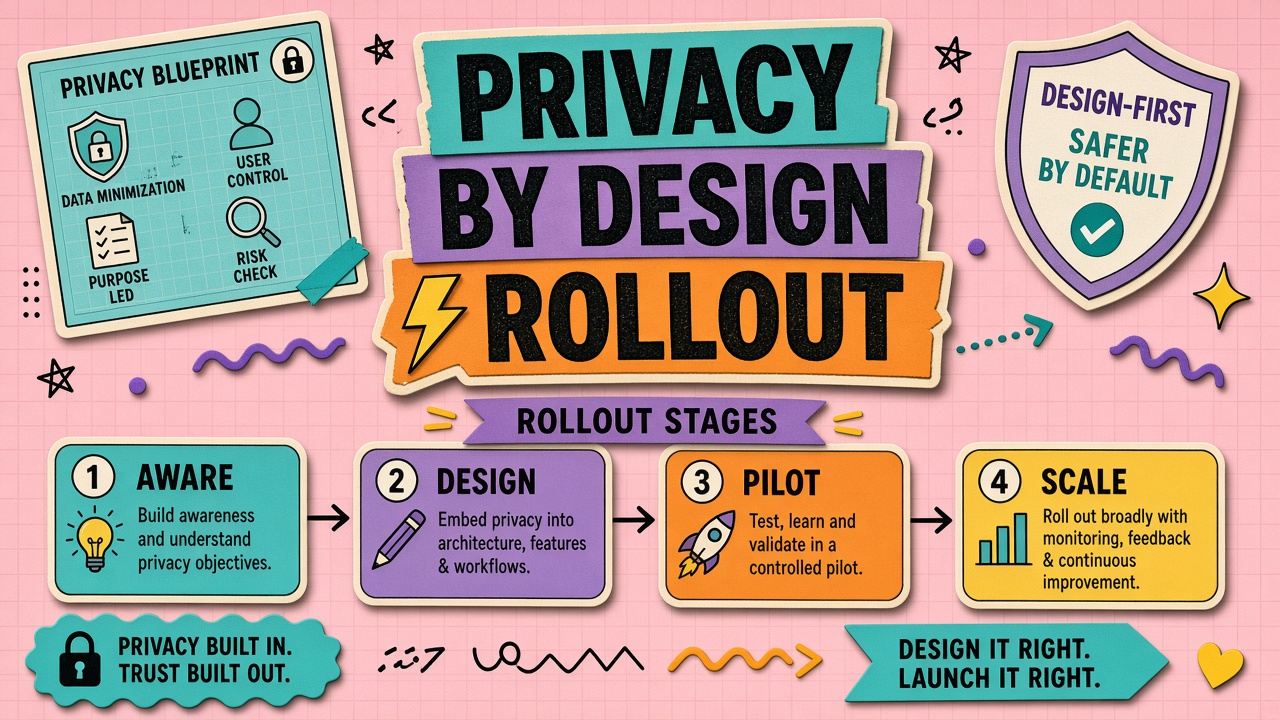
Procurement approves a new AI writing assistant on Friday. Legal review starts Monday. By Wednesday, marketing has already connected the tool to a live CRM export. That sequence is the opposite of privacy by design for AI tools, where privacy gates sit inside the adoption workflow from the first intake form.
Privacy by design means defaults, architecture, and process choices minimize personal data exposure before anyone pastes customer records into a prompt. Teams rolling out Private AI Chatbot alongside AI Automation should treat privacy as a lifecycle discipline spanning intake, pilot, production, and decommission.
Principles: Minimization, Purpose Binding, and Transparency
Data minimization limits what enters prompts, attachments, and fine-tuning sets. Purpose binding ties each integration to a documented business goal so feature creep does not expand data collection silently. Transparency ensures employees and customers know when AI processes their information.
Apply these principles at decision points: vendor selection, integration design, role provisioning, and incident response. A checklist on the wall is useless if the intake form never asks what data categories the pilot will touch.
Privacy Gates in Intake and Pilot
Gate one: intake. Require data classification, regions served, and retention expectations before security spends cycles on demos. Reject pilots that cannot articulate lawful basis for processing where personal data is involved.
Gate two: architecture review. Map data flows from source systems through the model to logs and downstream automations. Identify subprocessors and cross-border hops before credentials are issued.
Gate three: pilot exit. Define measurable privacy criteria alongside accuracy metrics. A pilot that wins on speed but logs prompts indefinitely should not graduate without remediation.
Default Settings That Reduce Exposure
Disable training on customer data by default when the vendor offers an enterprise control. Turn off public sharing links, shorten session retention, and require SSO instead of shared passwords. Pre-fill role templates with least-privilege scopes for API keys.
Citizen developers often enable plugins that broaden data access. Lock plugin installation behind an allowlist. Default new workspaces to internal-only visibility until an admin publishes a reviewed template.
Decommission and Data Return
AI rollout privacy obligations do not end at cancellation. Runbooks should cover API key revocation, export of remaining artifacts, vendor deletion tickets, and verification that backups aged out. Document proof of deletion for regulated customers.
Migrate workflows off the tool before cutover date so teams do not re-create shadow accounts. Archive policy decisions and DPIA summaries for audit even after the vendor relationship ends.
Embedding Privacy in Ongoing Governance
Assign a privacy owner paired with the AI champion. Quarterly reviews should cover new features, subprocessors, and incident trends. When the vendor ships a model update that changes logging behavior, treat it as a change requiring notice assessment.
Governance rhythms should mirror software release cadence. If product ships weekly, privacy review cannot be annual. Maintain a lightweight change log of integrations, new data fields sent to models, and policy exceptions granted. Publish a monthly summary for leadership that counts open risks, not only completed checklists.
Privacy Impact Assessments for AI Features
A DPIA or PIA should trigger when AI processes personal data at scale, profiles individuals, or uses sensitive categories. The assessment documents necessity, proportionality, risks, and mitigations. For AI, mitigations often include minimization pipelines, human review gates, regional deployment, and contractual training opt-outs.
Reuse a template tailored to LLM workflows: list prompt sources, retention of prompts and embeddings, automated decision impact, and fallback when the model refuses or hallucinates. Store completed assessments with the vendor record so renewals reference prior decisions instead of restarting from zero.
Privacy by design rollout checklist
- Intake captures data categories, regions, and lawful basis
- Architecture diagram reviewed before API keys issued
- Enterprise defaults: no training on customer data, SSO required
- Pilot exit criteria include retention and deletion tests
- Decommission runbook tested in staging at least once
- Quarterly governance reviews scheduled with privacy owner
Measuring Privacy Outcomes, Not Only Compliance
Track metrics that predict incidents: count of policy exceptions, volume of regulated-tier data in AI logs, time to revoke access after role change, and percentage of integrations using approved templates versus ad hoc Zapier flows. Compliance checkmarks matter less if exceptions climb every quarter.
Celebrate teams that redesign workflows to need less data, not only teams that ship fastest. Privacy by design is a competitive advantage when customers ask how you handle their information compared to rivals who bolted on AI without controls.
Role-Based Privacy Templates for Teams
Marketing, engineering, and support teams paste different data types into AI tools. Publish role-specific templates that list approved tools, forbidden fields, and example prompts that minimize exposure. A support template might allow ticket summaries with customer IDs redacted; an engineering template might allow stack traces but never production secrets.
Templates reduce one-off exceptions because employees start from a reviewed pattern instead of improvising. Update templates when vendors change defaults or when incidents reveal a gap in the prior version.
Vendor Contract Clauses That Enable Privacy by Design
Negotiate contractual rights to configure retention, opt out of training, receive subprocessor notice, and obtain deletion certificates. Contracts should also define what happens when the vendor ships a feature that increases logging: notice period and your right to disable the feature without penalty.
Pair legal clauses with technical verification. A deletion SLA in contract means little if your team never tests the deletion API before renewal. Schedule an annual deletion drill for at least one high-volume integration.
Privacy in Citizen Developer and Low-Code AI Platforms
Low-code AI builders let non-engineers connect CRMs to models in minutes. Privacy by design requires pre-approved connectors, field-level allowlists, and sandbox tenants that cannot reach production data. Citizen developers should inherit templates, not raw API keys with org-wide scope.
Review every published automation quarterly. Orphaned flows continue sending customer data long after the pilot owner left the company. Automate discovery of integrations that call external AI endpoints and flag those without an intake record.
Aligning Rollout Privacy With Customer Notices
When AI features face end users, privacy by design includes updating customer-facing notices before launch. Internal minimization fails if the product still collects fields the notice does not disclose. Sync product, legal, and engineering on a single data map referenced by both DPIA and public privacy policy.
Staging and Production Privacy Parity
Teams often relax privacy controls in staging. Production-like data in staging tenants violates minimization if those tenants lack the same retention, access, and region settings as production. Use synthetic fixtures or tokenized copies. Ban production database restores into staging AI integrations without privacy sign-off.
Penetration tests and red teams should exercise privacy controls, not only authentication. Verify that disabled logging flags cannot be toggled by compromised admin accounts without alerting security operations.
Training and Awareness During Rollout
Privacy by design fails if employees do not know the defaults you configured. Launch training that shows which data is off-limits, how to request exceptions, and where to report suspected misuse. Champions in each department reinforce behavior better than a single all-hands slide.
Documenting Privacy Decisions for Audit
Store intake forms, DPIA summaries, configuration screenshots, and exception approvals in a single repository legal can search during customer audits. Version-control policy documents alongside product releases so investigators can see what controls applied on any given date.
Frequently Asked Questions
How do citizen developers fit privacy by design?
Provide approved templates with pre-reviewed data scopes. Self-service should not mean self-approved integrations with production CRMs.
Do API integrations need the same gates as UI tools?
Yes. APIs often move more data with less human visibility. Require schema review, rate limits, and logging parity with interactive use.
Won't privacy gates slow AI adoption?
Front-loaded gates reduce rework and incident cost. A two-day architecture review beats a two-month breach investigation.
How do we apply privacy by design to legacy AI integrations?
Inventory legacy flows, classify data handled, and prioritize remediation by risk. Short-term mitigations include redaction proxies and read-only data sources. Long-term, migrate to approved patterns or retire integrations that cannot meet tier requirements.
What should boards see about AI privacy?
Report open high-risk findings, incident trends, and progress on deletion and minimization initiatives. Avoid vanity metrics like total prompts processed unless paired with control effectiveness evidence.
How do we maintain privacy by design across many AI vendors?
Use a standard intake and configuration baseline applied to every vendor. Centralize DPAs and subprocessors in one register. Reuse architecture patterns so each new tool does not invent privacy controls from scratch.
The Bottom Line
Privacy by design for AI rollouts weaves minimization, purpose binding, and transparency into intake, pilot, and decommission. Start with private AI chatbot evaluations and automation workflows that include privacy owners from day one.