A search-and-rescue team needs twenty drones to sweep a canyon, but one ground station cannot micromanage every altitude change. A defense contractor wants coordinated overwatch without a fragile central link. An ag operator wants three heavy spray drones to cover a field while one pilot supervises. Each scenario depends on drone swarm coordination algorithms: the math and software that let many unmanned aerial vehicles (UAVs) agree on goals, share local state, and stay separated in three-dimensional space. Modern drone swarm coordination AI combines multi-agent reinforcement learning (MARL), distributed model predictive control, consensus protocols, and increasingly language-model-assisted task decomposition.
Swarm coordination sits at the intersection of robotics, wireless networking, and safety regulation. Teams evaluating AI chatbot interfaces for mission planning should understand that natural-language task descriptions still must compile into verified control policies with collision guarantees. For broader context on how EliteAI.tools publishes technical explainers, browse the EliteAI.tools blog index.
What Drone Swarm Coordination Means in Plain Language
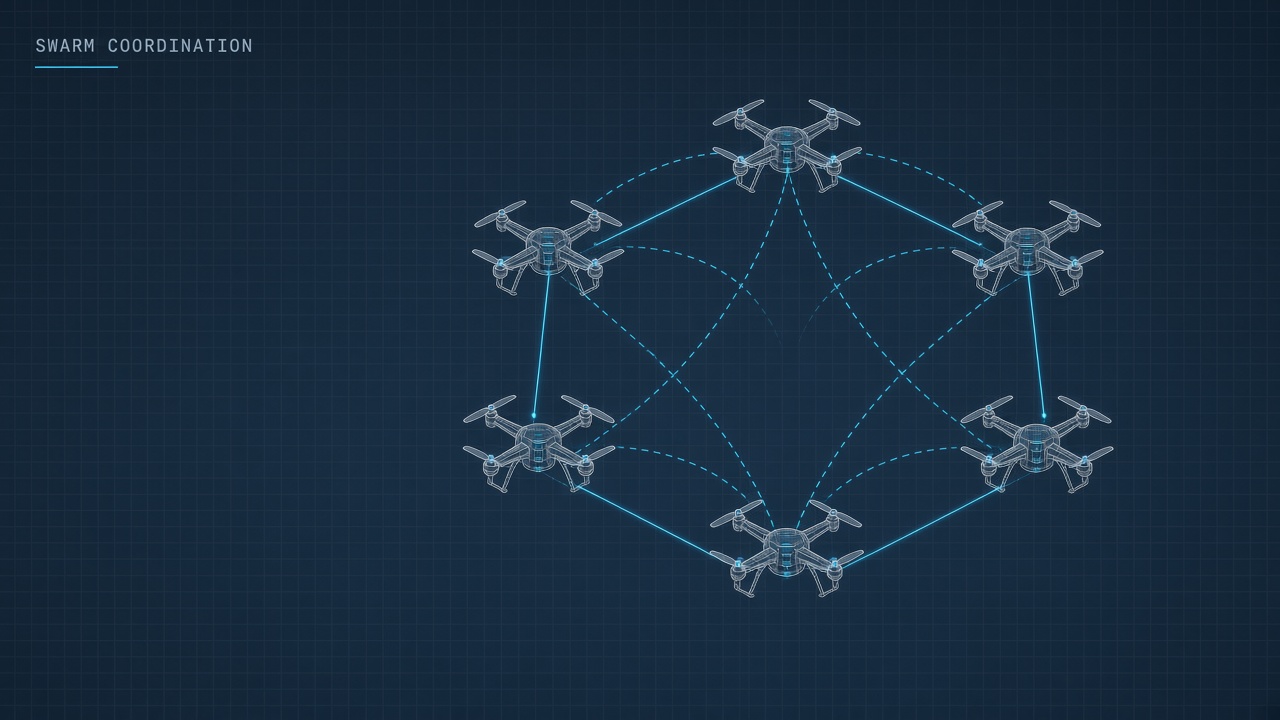
Drone swarm coordination is the set of algorithms and communication rules that let multiple UAVs operate as a coordinated group: assigning tasks, sharing position estimates, avoiding collisions, and recovering when links or sensors fail. A swarm is not merely many drones flying nearby. Each aircraft runs local control software while periodically exchanging messages with neighbors or a mesh network. Coordination can be centralized (one planner assigns trajectories), decentralized (each drone optimizes locally with shared constraints), or hybrid (global goals with distributed execution).
Classical bio-inspired methods such as Reynolds flocking (separation, alignment, cohesion) still appear in simple demos, but complex dynamic missions increasingly rely on learning-based and optimization-based controllers. Patent and research trends from 2024 onward show MARL (MADDPG, MAPPO, QMIX-style value decomposition) as the default architecture for adversarial search, persistent tracking, and time-sensitive target scenarios where hand-tuned rules break down.
| Architecture | Who decides | Strength | Weakness |
|---|---|---|---|
| Centralized planner | Ground station or cloud | Global optimality, easier debugging | Single point of failure, bandwidth limits |
| Decentralized MARL | Each UAV policy | Scales to large swarms, tolerates link loss | Hard to certify, sim-to-real gap |
| Distributed MPC | Local optimization with coupled constraints | Provable collision avoidance under stated assumptions | Compute and communication overhead |
| Consensus protocols | Voting among peers | Robust state agreement (GNSS-denied ops) | Latency, partial compromise scenarios |
Coordination versus low-level flight control
Swarm coordination sits above attitude and motor control: it outputs waypoints, velocity commands, or formation offsets that each drone's onboard autopilot tracks. Pixhawk-class stacks handle stabilization; coordination layers run at 1 to 10 Hz over mesh WiFi, LTE, or dedicated radios. Mixing these layers incorrectly (for example, sending conflicting goals faster than the autopilot can reject them) is a common integration failure in field tests.
How the Underlying AI Pipeline Works
A typical learning-based swarm pipeline simulates thousands of multi-agent episodes, trains decentralized policies with shared reward signals, compresses networks for edge deployment, then validates in hardware-in-the-loop tests before limited outdoor flights. The pipeline has four stages: mission specification, policy generation, communication fabric, and safety verification.
Multi-agent reinforcement learning
MARL treats each drone as an agent observing local state (position, velocity, neighbor ranges) and emitting actions (thrust, yaw rate, goal offsets). Value-decomposition methods like QMIX learn a team value function while preserving decentralized execution at inference. Training runs in simulators such as AirSim, Gazebo, or custom UE4 environments where collision penalties and mission rewards shape emergent flocking, encirclement, or coverage behaviors. Recent patent filings describe hierarchical MARL that couples task allocation with path planning in a single training loop.
Language-model-assisted policy generation
GenSwarm, published in npj Robotics (2025), uses large language models to generate executable multi-robot control code from natural-language task descriptions. For flocking and aggregation tasks, GenSwarm produces purely distributed policies that use only local sensing. For shaping or encirclement tasks, it may combine one-time centralized goal assignment with distributed execution. The system selects control structure based on task semantics, then deploys generated policies on physical robot teams. Benchmarks show competitive performance against hand-tuned Boids and ORCA controllers on several tasks, though expert-tuned baselines still win on average in published comparisons.
Distributed MPC and consensus layers
DMPC-Swarm (Autonomous Robots, 2025) integrates distributed model predictive control with event-triggered wireless messaging so nano-quadcopter swarms avoid collisions even when packets drop. Ground-based compute nodes solve coupled optimization problems while aircraft carry lightweight radios. Separately, SwarmRaft adapts the Raft consensus algorithm for UAV localization when GNSS is degraded or spoofed: drones fuse inertial data with inter-drone ranging and vote on position state updates. These approaches prioritize verifiable safety properties over open-ended learning.
- Define mission goals, airspace constraints, and failure modes (link loss, GNSS denial, single-drone crash).
- Train or synthesize policies in simulation with domain randomization (wind, latency, sensor noise).
- Deploy compressed models on edge hardware; reserve CPU for safety monitors independent of the learned policy.
- Establish mesh or star communication with heartbeat and geofence enforcement.
- Run staged field tests: single drone, pair, small swarm, then scale with independent safety observers.
- Log trajectories, message traces, and near-miss events for post-flight audit.
Real Deployments and Published Evidence
Hardware demonstrations now span nano-quadcopter swarms with distributed MPC, agricultural spray fleets under FAA exemptions, and military research programs that coordinate hundreds of assets under human supervision. DMPC-Swarm authors report the first distributed-hardware implementation of their MPC variant on up to 16 nano-quadcopters connected by a real wireless mesh. GenSwarm reports real-world multi-robot deployments of LLM-generated policies for flocking, aggregation, and formation tasks.
Agricultural swarm operations in the United States
In 2024 the FAA granted Hylio an exemption allowing one operator to control up to three agricultural drones above 55 pounds without a separate visual observer per aircraft, including night operations over controlled private land. Rantizo received similar approval for swarming and BVLOS spray missions. These exemptions are precedent-setting but narrow: operations stay low altitude, geofenced, and supervised. They demonstrate commercial demand for multi-drone coordination under existing Part 107 and Part 137 frameworks, not a general waiver for urban BVLOS swarms.
Defense and research programs
DARPA's OFFSET program explored human-swarm teaming with more than 250 unmanned assets in complex urban environments, emphasizing operator interfaces and rapid mission retasking rather than fully autonomous strategic decision-making. Academic labs routinely publish outdoor flocking demos, but transition to certified commercial BVLOS swarms awaits broader FAA rulemaking (including proposed Part 108 frameworks for detect-and-avoid and UTM integration). The July 2024 FAA authorization for multiple BVLOS delivery operators in the Dallas-Fort Worth area uses UTM-style deconfliction, which is coordinated airspace management rather than autonomous swarm flocking in shared corridors.
Limits, Risks, and Ethical Guardrails
Swarm coordination AI fails loudly in simulation and quietly in the field when communication latency, GPS spoofing, or sim-to-real gaps violate the assumptions baked into training. Learned policies can produce emergent collisions under distribution shift. Consensus protocols may tolerate crash faults but not Byzantine adversaries without heavier cryptography. Regulatory frameworks lag hardware capability, creating temptation to fly first and seek forgiveness later.
- Communication fragility: Mesh networks degrade near metal structures, foliage, and jamming. Algorithms must prove safety under message loss (DMPC-Swarm addresses this explicitly).
- Dual-use concerns: Coordination research applies equally to search-and-rescue and offensive massing. Export controls and institutional review boards apply to many deployments.
- Accountability: When twenty drones collide with manned aircraft, assigning liability among operator, manufacturer, and software vendor remains unsettled law.
- Environmental impact: Agricultural swarms reduce soil compaction versus tractors but increase low-altitude noise and chemical drift risk if wind models fail.
- Over-trust in AI: LLM-generated policies require the same verification as hand-written controllers; natural language is not a substitute for collision proofs.
Ethical guardrails include human-on-the-loop kill switches, geofencing, independent range finders for separation, transparent logging, and refusal to deploy offensive swarms without national legal authorization. Civilian operators should treat FAA exemptions as time-bounded privileges with strict operational limits, not blanket permission for urban swarming.
Who Should Use This and Who Should Wait
Defense research labs, agricultural service providers with existing FAA certifications, and robotics companies with mature sim-to-real pipelines should invest in validated coordination stacks now, starting with small swarms and independent safety monitors. Hobbyists, urban delivery startups without BVLOS authorization, and teams lacking RF engineering expertise should wait until regulations and UTM infrastructure catch up.
| Audience | Recommendation | Caveat |
|---|---|---|
| Ag spray operator | Pursue exemption-aligned 3-drone workflows with redundant sensors | Exemptions expire; monitor FAA rule updates |
| University robotics lab | Benchmark MARL against DMPC baselines in shared simulators | Outdoor flights need COA or waiver |
| Defense contractor | Hybrid centralized tasking plus distributed control | ITAR and export controls apply |
| Urban logistics startup | Wait for Part 108 / UTM maturity | Multi-operator BVLOS is not swarm autonomy |
Communication architecture and latency budgets
Swarm coordination quality depends as much on the radio fabric as on the algorithm. Mesh WiFi works in lab volumes but degrades in agricultural fields with line-of-sight blockers. LTE backhaul adds latency that can destabilize tight formation control if policies assume zero-delay neighbor updates. Production teams therefore publish latency budgets: maximum acceptable message age, fallback behavior when heartbeats expire, and geofence triggers that force loiter or land-in-place. DMPC-Swarm's event-triggered messaging is one response to bandwidth limits; consensus protocols like SwarmRaft trade compute for agreement under packet loss. Without documented link-loss behavior, a swarm demo that works in an empty hangar may scatter unpredictably at a crowded airshow.
Defense research and supervised autonomy
Military research programs coordinate large numbers of small unmanned aircraft under human-on-the-loop supervision rather than fully autonomous kill chains. DARPA OFFSET and related efforts explored heterogeneous swarms with centralized mission planning and decentralized execution for reconnaissance and mapping. These programs emphasize audit logs, operator override, and airworthiness reviews that commercial startups sometimes skip in marketing materials. The lesson for civilian teams is structural: separate mission authorization from low-level coordination, and never conflate impressive simulation videos with cleared operational procedures. Export controls (ITAR) and spectrum licensing add months to deployment timelines for cross-border demos.
Frequently Asked Questions
How reliable are drone swarm coordination algorithms in practice?
Reliability depends on environment, swarm size, and algorithm class: distributed MPC methods publish collision guarantees under stated communication models, while MARL policies require extensive field validation because guarantees are empirical, not formal. Published hardware demos succeed in controlled conditions; reliability in GPS-denied urban canyons or contested spectrum remains an active research area.
Are drone swarms legal for commercial use in the United States?
There is no general FAA rule authorizing unrestricted commercial swarms; operators need Part 107 certification plus waivers or exemptions for multi-drone control, BVLOS, or aircraft over 55 pounds. Agricultural exemptions for three-drone teams exist through 2026 for specific vendors and operational envelopes. Broader rulemaking is in progress via FAA reauthorization mandates.
Should teams choose MARL or classical flocking algorithms?
Classical Boids-style rules suffice for demonstrations and benign environments; MARL fits dynamic adversarial missions where rewards and obstacles change faster than hand tuning allows. Many production systems hybridize: classical separation constraints wrapped around learned high-level policies.
What data is needed to train swarm coordination AI?
Simulation-first training dominates: millions of episodes with randomized physics, sensor noise, and communication delay, optionally fine-tuned on small real flight logs. Federated learning across fleets is an emerging direction to reduce central data bottlenecks while preserving privacy, but deployment maturity varies.
Can large language models safely control drone swarms?
LLMs can generate and structure control code (as in GenSwarm), but safety-critical execution still requires compilation, simulation testing, and independent monitors before hardware deployment. Treat LLM output as a draft policy, not a certified flight plan.
How do swarms operate without GPS?
Approaches include visual-inertial odometry, UWB ranging, LiDAR SLAM, and consensus protocols like SwarmRaft that fuse peer measurements when GNSS fails. Accuracy degrades with swarm size and environment geometry; military and indoor systems invest heavily in redundant sensing.
Conclusion
Drone swarm coordination algorithms translate mission intent into safe multi-aircraft motion through MARL, distributed optimization, consensus, and increasingly automated code generation. DMPC-Swarm and related work prove collision-aware coordination on physical nano-swarm hardware; GenSwarm shows LLMs can draft multi-robot policies; agricultural exemptions prove regulated commercial demand for small supervised swarms. Success requires matching algorithm class to mission risk, investing in communication and sensing redundancy, and treating regulatory authorization as a hard constraint rather than an afterthought. Teams should start small, log everything, and never confuse simulation performance with airspace safety.