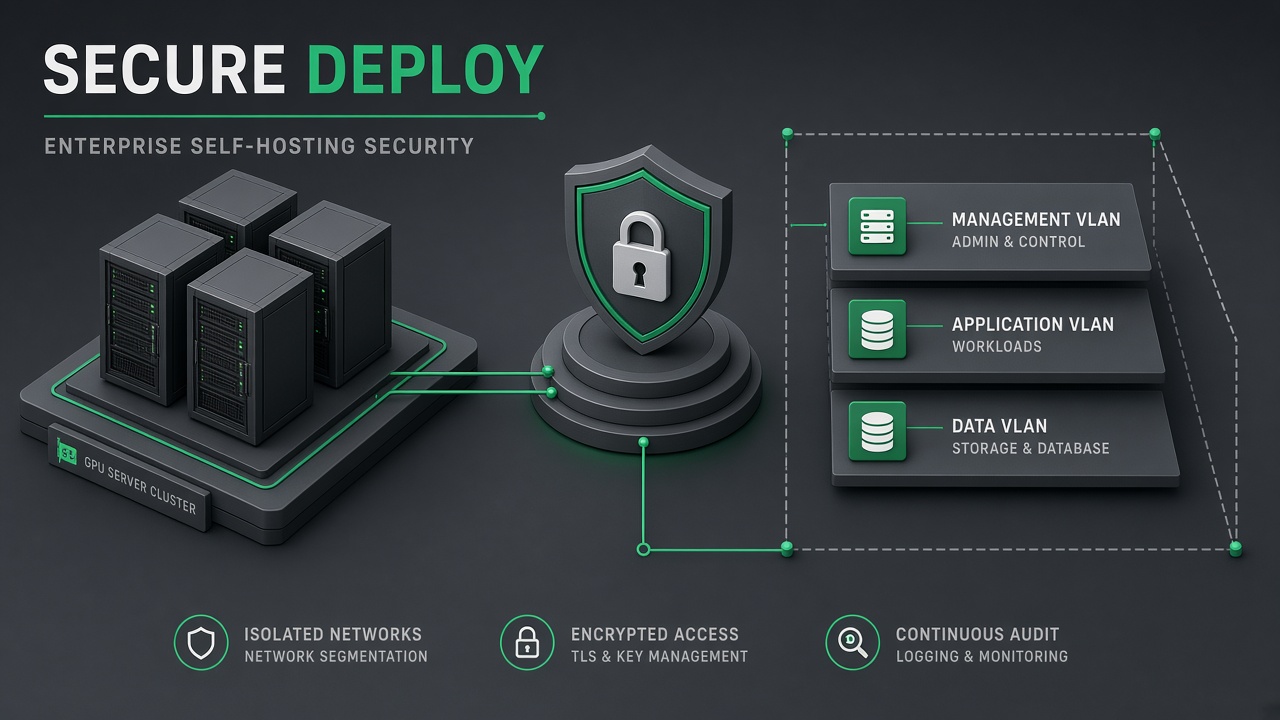
DeepSeek-R1, DeepSeek-V3, and DeepSeek-V4 open-weight releases let enterprises run frontier-class inference on private GPU clusters without routing prompts through vendor APIs. That architecture removes cloud data residency concerns for static weights but shifts every security control to your team: network boundaries, identity management, model integrity, output filtering, and patch velocity when new CVEs hit serving frameworks. Security reviews that stop at benchmark scores miss the operational risks that determine whether self-hosting actually reduces enterprise exposure.
This DeepSeek self hosting security checklist covers architecture choices, threat models, logging, and update policies for on-prem open models. Use it before approving production traffic to any DeepSeek deployment, and compare tooling in AI code platforms with open source AI resources when selecting serving stacks.
Self-Hosting Architecture Options for DeepSeek
Production DeepSeek deployments typically use vLLM or SGLang with OpenAI-compatible endpoints, while development teams sometimes start with Ollama before migrating to hardened serving layers. Model size dictates hardware: distilled variants run on multi-GPU workstations, DeepSeek-R1 and V3 need tensor or expert parallelism across eight or more datacenter GPUs, and DeepSeek-V4-Flash requires roughly 170 to 175 GB VRAM while V4-Pro needs cluster-scale capacity near 862 GB.
Common architecture patterns include:
- Single-tenant inference cluster: Dedicated GPU nodes behind an internal load balancer with API gateway authentication.
- Air-gapped research enclave: Weights loaded from verified offline media with no outbound internet from inference nodes.
- Hybrid cloud burst: Primary self-hosted capacity with cloud overflow only for non-sensitive workloads.
- Disaggregated serving: Experimental prefill and decode separation for high-load MoE models on GB200-class hardware.
| Model tier | Typical hardware | Serving notes |
|---|---|---|
| Distilled R1 (8B to 14B) | 1 to 2 consumer or pro GPUs | Suitable for dev; enforce localhost binding |
| DeepSeek-R1 / V3 full | 8x H200 FP8 or 4x B200 FP4 | Tensor or expert parallel via vLLM |
| DeepSeek-V4-Flash | 2x H200 or 2x RTX Pro 6000 | Verify vLLM 0.22+ with MoE support |
| DeepSeek-V4-Pro | Multi-node GPU cluster | Plan expert parallelism and KV cache at 1M context |
Ollama defaults bind to all interfaces on port 11434, exposing inference APIs broadly. Set OLLAMA_HOST to localhost or an internal VLAN before any pilot. Production stacks should terminate TLS at a reverse proxy, enforce API keys or mutual TLS on vLLM, and run containers as non-root with read-only root filesystems where feasible.
Threat Model for Open-Weight Deployments
Open weights eliminate vendor-side prompt logging but introduce supply chain, insider, and application-layer risks that cloud APIs partially absorb through provider security programs. Threat modeling should cover model files, serving infrastructure, and downstream applications separately.
Priority threats include:
- Tampered weights: Malicious safetensors from unofficial mirrors. Mitigate with SHA-256 verification against Hugging Face published checksums and internal registry controls.
- Network exfiltration: Compromised inference nodes calling external endpoints. Block outbound traffic except approved registries.
- Prompt injection and tool abuse: Agent frameworks executing unsafe tool calls. Layer output filtering and human approval for high-risk actions.
- Unauthorized API access: Missing authentication on internal endpoints. Require API keys, mTLS, and network segmentation.
- Dependency CVEs: PyTorch, CUDA, nginx, and vLLM vulnerabilities. Tie patch cadence to SBOM monitoring.
Regulated industries often choose air-gapped nodes for sensitive workloads even when general employee chat runs on shared clusters. Document data classification per route so security reviews can reject one-size-fits-all deployments.
Logging and Access Control Requirements
Self-hosted DeepSeek needs the same identity, audit, and retention policies as any production API, with additional care to avoid logging full prompts that contain regulated data unless redaction pipelines exist.
Minimum controls:
- Role-based access to model admin consoles and weight storage.
- Authentication on every inference endpoint, not just the public gateway.
- Structured audit logs: caller identity, model version, token counts, latency, policy decisions.
- Prompt and completion redaction or hashing for sensitive tiers.
- Rate limits and abuse detection aligned with internal acceptable use policies.
- Separate API keys per application with revocation playbooks.
Output filtering layers should strip model-specific tags or tool directives before responses reach business applications. Llama Guard or custom validation pipelines help when DeepSeek reasoning traces include chain-of-thought segments not meant for end users. Log retention must match GDPR, HIPAA, or sector rules even when data never left your data center.
Update and Patch Cadence
Open-weight deployments require continuous updates to serving frameworks, CUDA stacks, and model checkpoints, not a one-time security sign-off at launch. DeepSeek releases new variants and vLLM adds compatibility fixes frequently; pinned versions reduce surprise behavior changes but increase CVE exposure.
Recommended patch policy:
- Subscribe to CVE feeds for vLLM, PyTorch, CUDA, and base container images.
- Maintain staging clusters that mirror production parallelism settings.
- Test new DeepSeek checkpoints against regression suites before promotion.
- Document rollback procedures for bad releases affecting reasoning quality or safety filters.
- Align model deprecation with hosted API timelines when hybrid architectures exist.
DeepSeek hosted API aliases for legacy model names were scheduled to retire in mid-2026 in favor of deepseek-v4-flash and deepseek-v4-pro naming. Self-hosted teams should track upstream release notes independently because open weights do not auto-update. Version tags in API responses help client applications detect silent model swaps during rolling upgrades.
Security Review Checklist Summary
Use this table as a gate before production approval for any DeepSeek self-hosting program.
| Control area | Review question |
|---|---|
| Model integrity | Are weights verified and sourced from official repositories only? |
| Network | Are inference nodes isolated with egress blocked by default? |
| Authentication | Do all endpoints require API keys or mTLS behind TLS termination? |
| Logging | Are audit logs redacted appropriately and retained per policy? |
| Output safety | Is filtering applied before responses reach applications? |
| Patching | Is there a tested cadence for framework and model updates? |
Frequently Asked Questions
Is self-hosted DeepSeek more secure than the cloud API?
Self-hosting can improve data residency when weights run on isolated infrastructure you control. Security outcomes depend on implementation quality. Poorly configured open endpoints or missing patches can be worse than a mature cloud API with enterprise contracts.
Which serving framework should enterprises use?
vLLM is the common production choice for DeepSeek MoE models with OpenAI-compatible APIs. SGLang offers strong alternatives with day-zero support for new releases. Reserve Ollama for development with strict network binding.
Do open weights phone home after download?
Static safetensors files do not initiate outbound connections by themselves. Risk shifts to serving software, containers, and compromised nodes that could exfiltrate prompts if networks are not restricted.
How much GPU capacity do we need for DeepSeek-V4?
V4-Flash targets roughly 170 to 175 GB total VRAM including KV cache overhead. V4-Pro requires cluster-scale resources near 862 GB. Capacity planning must include concurrent users and context length, not weights alone.
Where can teams compare self-hosting tools?
Evaluate serving frameworks, monitoring, and guardrail products through AI code tooling directories and open source AI guides before finalizing architecture decisions.