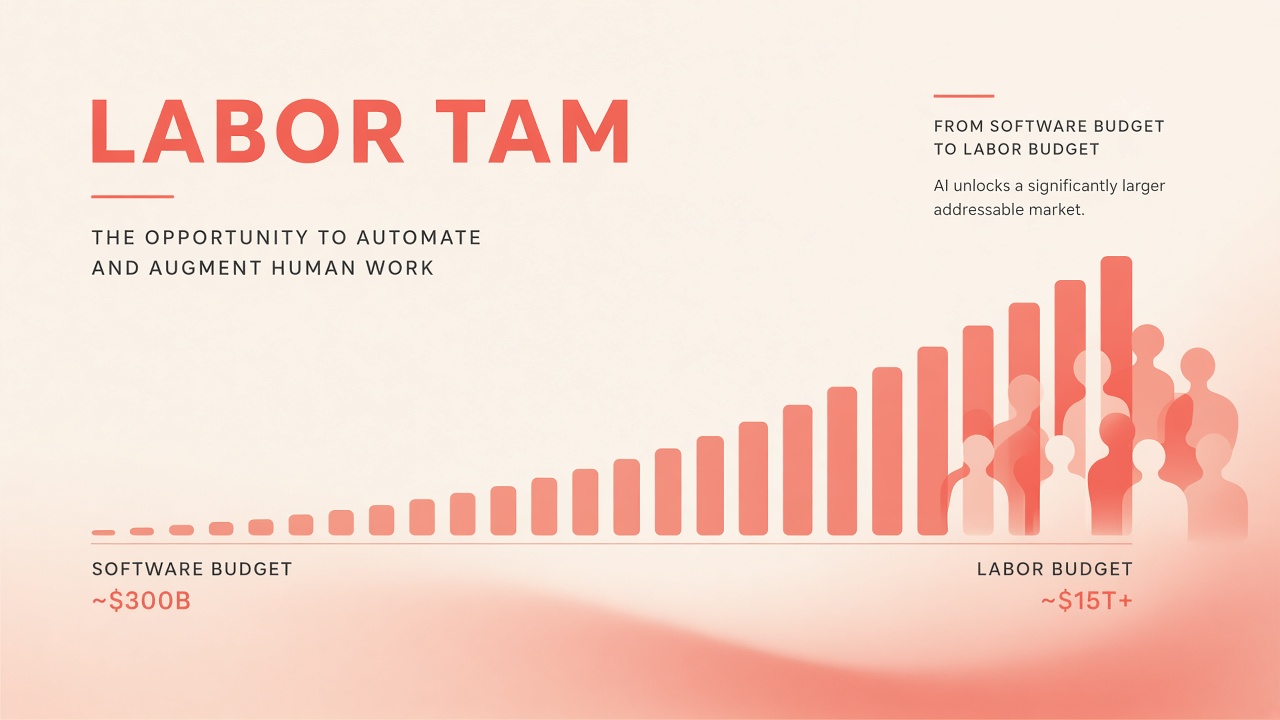
Pitch decks size vertical AI markets by historical software spend. That method makes fragmented industries look tiny. Sapphire Ventures argues the real opportunity sits in labor and services budgets ten to thirty times larger than software line items. A property manager spending thirty thousand dollars on leasing software may spend three hundred thousand on leasing staff. When AI performs the work instead of assisting it, addressable spend jumps from the software wedge to the labor pool. This guide explains the software TAM trap, a labor-based sizing method, why messy workflows create moats, and where commoditization risk remains. Connect the framing to AI automation strategy and AI productivity investments across your organization.
The Software TAM Trap
Sizing vertical AI by software spend understates opportunity because fragmented, operationally messy industries allocate most budget to people performing work, not tools recording it. Analysts applying horizontal SaaS multiples to niche categories conclude markets are too small for venture scale or lab interest. Founders then avoid categories that look modest on a spreadsheet but harbor enormous labor spend.
Menlo Ventures notes a parallel pattern in healthcare administration: hundreds of billions flow to administrative services against a much smaller IT budget. Universities expanded administrator headcount faster than software investment. Law firms bill associate and paralegal time as core product. Insurance adjusters still handle claims manually at scale. These industries did not underinvest in software because they were unsophisticated; prior software generations could not operate with the judgment and context the work demanded.
The trap has strategic consequences. Markets that look obviously large from day one attract frontier labs and well-funded horizontal players. Markets disguised by modest software surfaces stay quiet long enough for vertical systems to compound integrations, proprietary context, and outcome liability. Sapphire calls this the Goldilocks TAM: large enough for venture outcomes, overlooked because software spend alone looks small.
Labor TAM Sizing Method
Size vertical AI markets by asking what the industry spends on the work itself: wages, outsourced services, agencies, and contractor overflow, then estimate what share AI can absorb with human oversight. Start with a workflow map, not a software category report.
- Identify the job-to-be-done: leasing tours, draw review, medical chronology, freight dispatch, claims triage, not "property tech" labels.
- Quantify labor and services spend: FTE cost, BPO invoices, agency fees tied to that workflow.
- Map software spend separately: Treat as entry wedge, not ceiling.
- Estimate automation ceiling: Percent of tasks with clear rules vs judgment-heavy exceptions.
- Model expansion paths: Adjacent workflows the same system can own after initial wedge.
| Sizing lens | Typical finding | Strategic implication |
|---|---|---|
| Software TAM only | Niche, crowded by point solutions | Underserves labor displacement story |
| Labor TAM | 10x to 30x larger per account | Justifies outcome pricing and services |
| Operating budget | Full workflow ownership potential | System-of-record plus system-of-action |
Sapphire's property management example illustrates expansion: same customer, same company, thirty-fold increase in addressable spend when the product performs leasing work instead of logging it. Grow Therapy, Legora, and CollegeVine (cited by Menlo) measure ROI against headcount and throughput, not software budgets alone.
Messy Workflow Moat
Operational mess creates defensibility: complex integrations, offline steps, regulated liability, and fragmented buyers repel fast-following labs and horizontal SaaS vendors. Sapphire's "gritty work" lens emphasizes that moats come from owning workflow, integrations, and outcome liability, not from picking a vertical label.
Fragmented markets amplify the effect. Eighty-six percent of CPA firms have fewer than ten employees; construction lending teams vary policies by region; freight carriers run detention rules per customer contract. Horizontal vendors prefer concentrated buyers to justify enterprise sales motion. Vertical AI companies willing to encode edge cases compound context competitors cannot replicate by buying the same foundation model.
Every handled exception becomes training signal and policy code. Fund due diligence workflows, construction draw waiver gaps, and medical chronology OCR failures encode into proprietary systems. Demg.ai's agentic operations framing adds that closed outcome loops on first-party data compound faster than stateless copilots.
Commoditization Risk for Clean Tasks
Workflows that are clean, text-only, and lightly integrated commoditize quickly as labs and horizontal tools absorb them; durable vertical AI concentrates on gritty, liability-bearing, system-integrated work. Drafting a generic email or summarizing a clean PDF faces relentless price pressure. Approving a construction draw, dispatching freight under customer-specific detention clauses, or producing a HIPAA-aligned medical chronology for litigation does not.
Founders should honestly segment their roadmap. Tasks with clear inputs, no write-back to operational systems, and low consequence of error become features, not companies. Tasks requiring audit trails, regulatory alignment, and multi-system state changes support standalone platforms. Investors applying Sapphire's framework ask whether the wedge expands into labor budget or stalls as a thin copilot layer.
Commoditization also arrives via buyer build-vs-buy calculus. When a workflow is clean enough for internal IT to wire a foundation model in a quarter, vendor differentiation must shift to data loops, compliance packaging, and implementation speed on messy integrations.
Investor Logic and Founder Implications
Investors backing vertical AI under labor TAM thesis seek Goldilocks markets, gritty workflow depth, fragmented buyers, and credible expansion from software wedge to operating budget. Aditya Reddy and Cathy Gao at Sapphire highlight three dynamics: venture-scale outcome disguised by modest software surface, workflows requiring integrations and liability absorption, and fragmented customer bases underserved by horizontal GTM.
Founders should pitch labor displacement with humility: human oversight remains on exceptions, regulated decisions, and client relationships. The economic story is throughput and cost per outcome, not full unattended replacement on day one. Pricing should migrate toward hybrid and outcome models as measurement proves attribution, per Deloitte and demg.ai outcome pricing analysis.
Buyers evaluating vendors can invert the lens. Ask whether a tool assists an employee or removes steps from the workflow entirely. Assist-only tools compete on seats; workflow owners compete on labor lines your CFO already tracks.
Case Patterns Across Verticals
Labor TAM reframing appears consistently across property management, healthcare administration, legal services, insurance claims, construction finance, and freight operations, each with modest software spend and large services budgets. Menlo Ventures cites Grow Therapy absorbing intake and credentialing so clinicians see more patients without added staff. Legora targets legal research and drafting that would bill by the hour. CollegeVine deploys campus agents for enrollment and transcript processing. The pattern is identical: wedge on software budget, expand into labor line, become system of action.
Fragmentation as Feature, Not Bug
Fragmented buyer bases with low internal technical DNA slow horizontal vendors but reward vertical founders willing to implement per-customer policy variants. Sapphire notes that eighty-six percent of CPA firms have fewer than ten employees; similar fragmentation appears in regional lenders, boutique law firms, and owner-operator trucking fleets. Vertical AI companies that embrace high-touch onboarding turn fragmentation into moat because each implementation encodes local rules competitors cannot copy from a single enterprise template.
Operating System Thesis
Winning vertical AI companies may resemble operating systems for an industry function, collapsing point tools into workflow ownership with outcome liability. Commentators on Sapphire's framework note that winners will not look like classic vertical SaaS with feature checklists; they will own decisions, data exhaust, and compliance artifacts for a process end to end. Financial architecture must keep pace: revenue recognition, AI liability documentation, and compliance cost allocation become diligence topics when labor budgets enter the contract value.
Practical Sizing Exercise
Teams evaluating a vertical AI bet can run a one-hour workshop: list FTE roles touching the workflow, attach loaded annual cost, estimate percent automatable in three years, and compare to incumbent software spend. The gap between software and labor numbers usually surprises executives more than another market report. Document assumptions about exception rates and regulatory gates so projections stay honest.
Corporate development teams applying the lens to acquisitions should ask target companies which budget line grew last year: seats, usage, or outcome fees tied to labor displacement. Revenue quality improves when expansion comes from workflow depth, not discounting alone. Strategics buying point tools without labor expansion path may overpay for features labs will commoditize.
Services Wrapper Risk
Labor TAM stories sometimes hide heavy professional services margins required to encode messy workflows; investors should separate software gross margin from implementation hours. A vertical AI company that wins on grit but cannot productize edge cases becomes a consultancy with a chatbot front end. Product roadmaps should show declining services intensity per customer cohort as playbooks mature.
Frequently Asked Questions
Why is software TAM wrong for vertical AI?
Software TAM ignores that the largest cost in fragmented industries is labor performing the work, not software licensing it. Vertical AI that executes work accesses budgets an order of magnitude larger than historical SaaS categories.
What is a Goldilocks TAM?
A Goldilocks TAM is large enough for venture returns but disguised by modest software spend and operational mess, delaying attention from labs and horizontal incumbents. Sapphire Ventures popularized the term for vertical AI market selection.
How does ACV expand from software to labor?
Products expand ACV by performing more workflow steps autonomously, capturing value previously paid to staff and agencies rather than adding seats. Same customer relationship, different budget line.
What signals commoditization risk?
Clean text tasks, no system write-back, low error consequence, and easy lab replication signal commoditization. Gritty integrations, audit requirements, and outcome liability signal durability.
Will foundation labs erase vertical AI?
Labs threaten thin application layers; they are less positioned to absorb operational mess, regulatory liability, and fragmented buyer GTM in niche industries. Depth in workflow ownership remains the defense.
How should founders pitch labor TAM responsibly?
Quantify labor spend, show phased automation with human gates, and tie pricing to measurable outcomes rather than promising full replacement overnight. Credibility beats inflated displacement claims.
What is Menlo's healthcare admin example?
Menlo contrasts roughly seven hundred forty billion dollars in annual healthcare administrative services spend against a much smaller IT budget, illustrating labor-heavy markets where vertical AI closes judgment gaps prior software could not. The ratio varies by sub-sector but the pattern repeats.
What should enterprise buyers ask vendors?
Ask which budget line the product targets today and which labor workflows it can own in eighteen months, with references proving expansion beyond the initial wedge. Vague "AI transformation" slides without budget mapping signal assist-only positioning.
Conclusion
Vertical AI's real TAM hides in labor markets, not software budgets. Sizing by historical SaaS spend makes fragmented industries look small and steers founders toward crowded clean tasks. Labor-based sizing, messy workflow moats, and honest commoditization analysis produce better companies and sharper buyer decisions. Pair the framework with AI automation roadmaps and AI productivity metrics tied to headcount and throughput. The opportunity is not hidden because it is small; it is hidden because spreadsheets measure the wrong denominator.