A frontier language model might advertise hundreds of billions of parameters, yet your API bill does not scale as if every weight fired on every request. Behind models like Mixtral, Grok, and parts of the GPT family sits a design pattern called Mixture of Experts (MoE). Instead of one monolithic feed-forward block processing every token, MoE stacks multiple parallel expert networks and a router that picks which experts to run. Most parameters exist in storage; only a fraction participate in each forward pass.
Mixture of Experts (MoE) is a sparse neural network architecture where a gating router selects a small subset of expert sub-networks to process each token or input segment. The result is a model with very high total parameter count but lower active compute per inference step. This guide explains how MoE routing works, why the pattern reduces training and inference cost relative to dense models of similar capacity, the tradeoffs around load balancing and expert collapse, and what buyers of AI code and AI image generator tools should ask vendors about latency, quality, and routing transparency.
MoE in One Paragraph
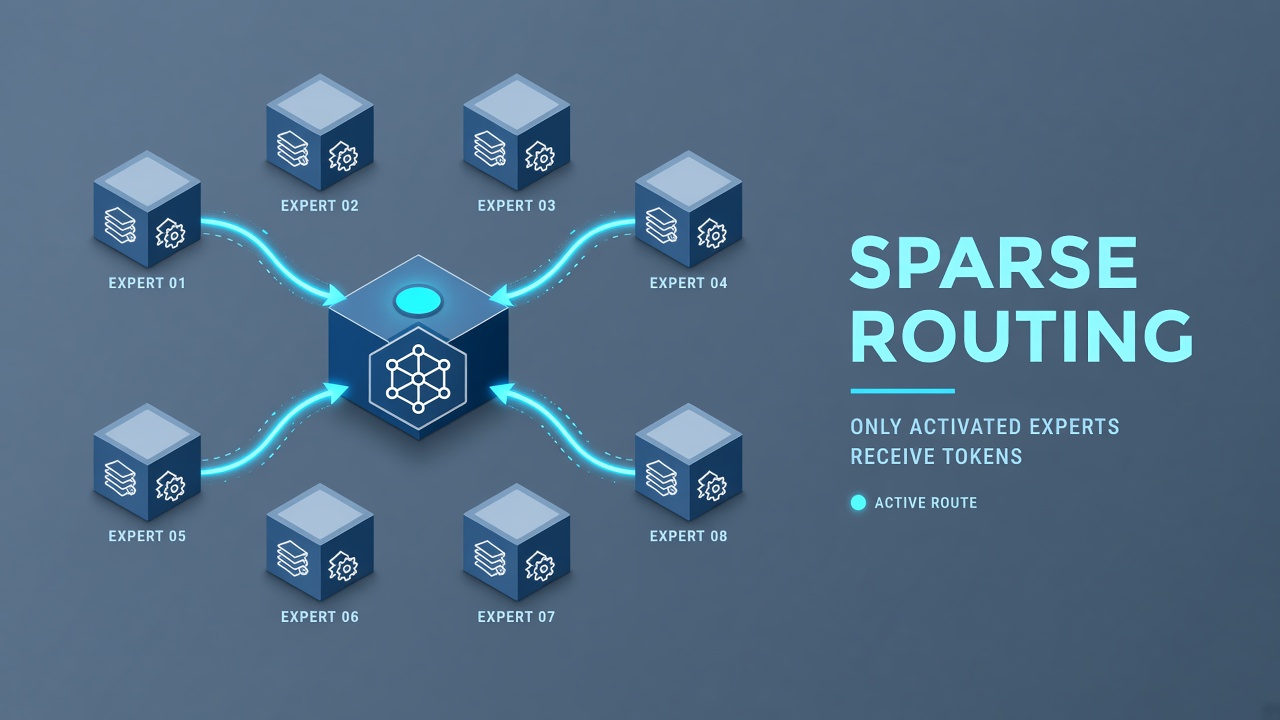
A Mixture of Experts layer replaces a single large feed-forward network with N smaller expert networks plus a router that outputs a probability distribution over those experts for each token. During inference, only the top-k experts (often k=2) receive the token and contribute weighted outputs. The remaining experts stay idle. Total model capacity grows with the number of experts, but FLOPs per token scale with k, not N. Google Switch Transformer, Mistral Mixtral 8x7B, and DeepSeek-MoE popularized the pattern for large language models. Vision and multimodal systems apply similar routing to image patches or modality-specific blocks.
How the Router Picks Experts Per Token
The router is typically a learned linear projection from the hidden state to a score vector with one entry per expert; softmax or top-k selection determines which experts activate. Each transformer layer may include its own MoE block. The router sees the current token representation after self-attention and decides which feed-forward experts should transform it. Selected experts run in parallel; their outputs are combined using router weights as coefficients.
| Component | Role | Typical design choice |
|---|---|---|
| Router (gating network) | Scores experts per token | Linear layer + softmax, top-2 selection |
| Expert FFN blocks | Specialized feed-forward transforms | Smaller than equivalent dense FFN |
| Shared attention | Context mixing before routing | Dense multi-head self-attention |
| Load-balancing loss | Prevents router ignoring experts | Auxiliary loss encouraging uniform usage |
Routing is token-level in most LLM MoE designs. That means adjacent tokens in the same sentence may activate different expert subsets. Over long contexts, cumulative routing decisions shape how specialized each expert becomes during training. Some experts gravitate toward syntax, others toward factual recall or code tokens, though specialization is emergent rather than manually assigned.
Why MoE Reduces Compute Cost
MoE reduces active FLOPs per token because only k of N experts run, while total parameter count can still scale into hundreds of billions. Parameter count influences memory footprint and knowledge capacity; active FLOPs influence latency and energy per request. A dense 70B model activates all 70B parameters in its feed-forward paths each step. An 8x7B MoE model may list 47B total parameters but activate roughly 13B per token when two 7B-class experts fire per layer. Training also benefits when combined with techniques like expert parallelism across GPUs.
Cloud API pricing often correlates with active compute rather than headline parameter counts, though vendors rarely publish routing details. For self-hosted deployments, MoE models demand enough GPU memory to hold all experts even though only subsets compute per batch item. Memory bandwidth and expert parallelism strategy matter as much as raw parameter marketing.
Tradeoffs: Load Balancing, Expert Collapse, and Latency
MoE introduces operational risks that dense models avoid: uneven expert utilization, routing collapse, and batching complexity that can add tail latency. Without load-balancing auxiliary losses, routers may send most tokens to a few favorite experts while others atrophy. That expert collapse wastes capacity and can degrade quality on under-trained specialists. Training teams monitor per-expert utilization histograms and adjust loss weights accordingly.
| Risk | Symptom | Mitigation |
|---|---|---|
| Expert collapse | Few experts handle most tokens | Load-balancing auxiliary loss, capacity factors |
| Routing instability | Quality swings on paraphrased prompts | Router noise during training, ensemble evals |
| Serving latency | Variable expert activation per batch | Expert parallelism, fused kernels, batch padding |
| Memory overhead | All experts loaded despite sparse activation | Multi-GPU sharding, quantization, offloading |
Latency is not automatically lower than a smaller dense model. MoE saves FLOPs relative to a dense model of the same total parameters, but a well-optimized dense 8B model may still respond faster than a poorly served 8x7B MoE stack. Inference frameworks like vLLM, TensorRT-LLM, and vendor-specific serving layers implement MoE-aware kernels; maturity varies by model family.
What MoE Means for AI Tool Buyers
Buyers should treat headline parameter counts skeptically and ask vendors about active parameters per token, serving architecture, and quality benchmarks on their workloads. A coding assistant built on an MoE foundation model may excel at boilerplate generation while struggling on rare library APIs if routing under-trains relevant experts. Image and multimodal pipelines that advertise MoE speedups should clarify whether routing happens in the text encoder, diffusion U-Net, or both.
Questions worth adding to vendor security and procurement questionnaires:
- What is the active parameter count per inference step, not total stored parameters?
- Is the model dense or MoE, and which expert top-k value is used at serving time?
- How does latency scale with context length compared to dense alternatives you also offer?
- Are quality evaluations reported on tasks matching your use case, not only aggregate benchmarks?
Teams comparing AI code tools should run identical repositories through candidates and measure pass rates, not just tokens per second. Teams evaluating AI image generators should note whether speed claims reference MoE text encoders, distilled diffusion steps, or unrelated caching.
Notable MoE Models in Production
Several widely deployed language models use MoE layers, though vendors do not always advertise the architecture in consumer-facing marketing. Mistral AI's Mixtral 8x7B and Mixtral 8x22B pair sparse experts with strong benchmark performance relative to active compute. Google's Switch Transformer demonstrated trillion-parameter scale with MoE training techniques. DeepSeek-MoE and Grok models from xAI reference sparse expert designs in technical reports. OpenAI has not fully disclosed GPT-4 architecture details, but industry analysis often speculates MoE or hybrid sparse components in frontier stacks.
When evaluating an API, search for model cards, technical reports, or Hugging Face config files that list
num_local_experts, num_experts_per_tok, or similar fields. Those values tell you more about
serving behavior than a press release headline about total parameters.
Training MoE at Scale
Training MoE models requires expert parallelism: different GPUs hold different experts, and the router dispatches tokens across devices during each forward pass. Data parallelism alone is insufficient when expert count exceeds single-device memory. Training frameworks like Megatron-DeepSpeed, Fairscale, and vendor-internal stacks implement all-to-all communication patterns that shuffle activations to the GPUs hosting selected experts. Poor communication topology can erase the FLOP savings MoE promises.
Load-balancing auxiliary losses penalize routers that ignore experts. Without them, training collapses toward a few dominant experts and wastes the rest. Teams monitor entropy of router distributions per layer and per batch. Healthy training shows diverse expert usage that stabilizes over time without forcing perfectly uniform splits, since some specialization is desirable.
MoE in Multimodal and Code Models
MoE is not limited to text-only transformers; vision-language and code models apply sparse routing in feed-forward blocks or modality-specific towers. A coding assistant backed by an MoE model may route syntax-heavy tokens differently from natural language comments. Image generation pipelines sometimes use MoE in text encoders while keeping diffusion UNets dense. Buyers comparing image generators should ask whether speed claims reference MoE text stacks, fewer diffusion steps, or unrelated caching layers.
MoE vs Dense Models: Quick Comparison
| Dimension | Dense model | MoE model |
|---|---|---|
| Parameters active per token | Nearly all feed-forward weights | Subset via router (top-k experts) |
| Memory at rest | Proportional to parameter count | All experts stored; higher for same capacity |
| Training complexity | Standard data parallelism | Expert parallelism, load-balancing tuning |
| Quality predictability | Consistent per architecture size | Depends on routing health and expert balance |
Frequently Asked Questions
Is MoE always better than dense models?
No. MoE trades training and serving complexity for conditional compute savings at large scale. Small dense models remain simpler to deploy on edge hardware and often win on latency for narrow tasks. MoE shines when you need very large capacity without paying full dense FLOPs per token.
How many parameters are active in Mixtral 8x7B?
Mixtral 8x7B stores roughly 47 billion parameters but activates about 13 billion per token when two experts run per MoE layer. Exact active counts vary by implementation details and which layers use MoE versus dense blocks. Treat published figures as approximations and verify on your serving stack.
Does MoE reduce hallucinations?
MoE is an efficiency architecture, not an alignment technique; hallucination rates depend on training data, fine-tuning, and retrieval layers, not routing alone. Some MoE models score well on benchmarks, but routing does not inherently ground outputs in facts.
Is self-hosting MoE harder than dense models?
Yes, typically. You must shard experts across devices, implement or rely on MoE-aware inference kernels, and monitor load balance in production. Managed APIs hide this complexity; on-prem teams should budget engineering time beyond standard dense model deployments.
Do image models use MoE?
Some diffusion and multimodal architectures experiment with MoE in transformer blocks, but consumer-facing image tools more often cite step distillation or faster samplers for speed gains. Ask vendors which layer MoE applies to when speed claims reference sparse experts.
Can you fine-tune MoE models?
Yes, but fine-tuning MoE models requires frameworks that update router and expert weights correctly without destabilizing load balance. Parameter-efficient methods like LoRA can target expert layers selectively. Confirm your fine-tuning provider supports the specific MoE architecture before committing labeled data.
Does quantization work with MoE?
Quantization (INT8, INT4, GPTQ, AWQ) applies to MoE models but must account for all stored experts even when only subsets activate per token. Memory savings come from weight compression, not from skipping inactive experts on disk. Serving frameworks continue to optimize MoE-aware quantized kernels.
Future of Sparse Models
Research continues on dynamic expert counts, learned routing sparsity, and mixing MoE with state-space models for long-context efficiency. Hardware vendors optimize for sparse patterns with specialized kernels and interconnect topologies. As context windows grow, routing decisions accumulate across thousands of tokens, making stable expert utilization even more important for predictable latency. Buyers should expect MoE to remain a default architecture choice for large language models even as dense small models dominate edge deployment.
Conclusion
Mixture of Experts AI explained in practical terms: a router sends each token through a few specialist networks instead of one giant feed-forward block. That sparse activation pattern is why models can advertise massive parameter counts while keeping per-request compute manageable. The tradeoffs are real: load balancing, expert collapse, serving complexity, and memory overhead. Buyers evaluating AI tools should look past parameter marketing, test on their own workloads, and ask vendors how many experts actually fire when a user submits a prompt.