Enterprise AI deployments depend on chains of vendors most security teams never fully inventory. A single customer-facing application may route through an orchestration layer, call a foundation model API, store embeddings in a vector database hosted by a cloud provider, and rely on a SaaS platform that quietly added generative features last quarter. When any link fails, changes terms, or exposes training data, your organization absorbs the blast radius.
AI supply chain risk is the exposure created when model providers, infrastructure hosts, fine-tuning partners, data labeling vendors, and fourth-party subprocessors can affect system behavior, data confidentiality, or regulatory compliance without your direct control. This guide helps procurement, security, and platform teams governing AI API integrations and AI automation workflows build defensible supply chain programs aligned with NIST AI RMF, EU AI Act transparency expectations, and enterprise TPRM practice.
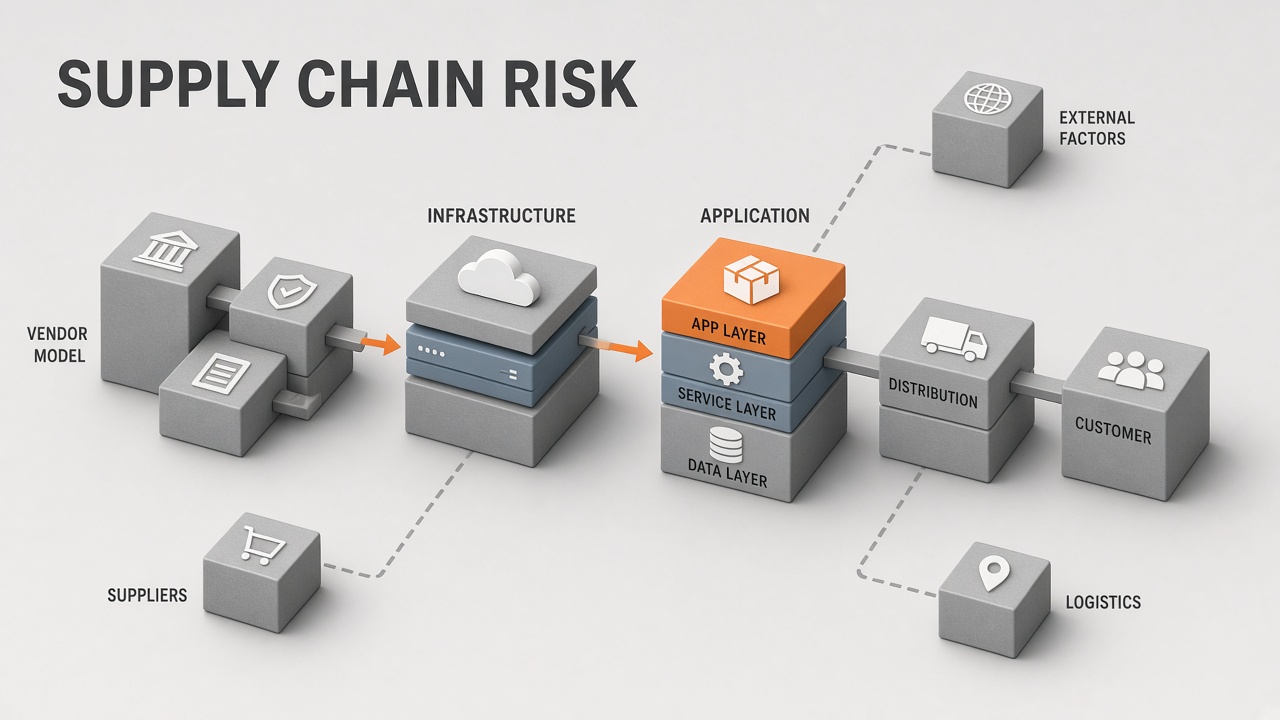
Supply Chain Layers: Model, Infra, Integration, SaaS Embed
Map AI supply chain risk across four layers: foundation model providers, infrastructure and hosting, integration middleware, and embedded AI features inside SaaS products you already purchased. Each layer carries distinct failure modes, contractual levers, and monitoring requirements. Treating AI risk as only an API key problem misses the majority of enterprise exposure.
| Layer | Risk type | Owner | Primary control |
|---|---|---|---|
| Model | Version drift, licensing, bias, capability change | ML platform / AI engineering | Model registry, version pins, eval gates |
| Infrastructure | Region residency, outage, data residency breach | Cloud / platform engineering | Regional deployment policy, private endpoints |
| Integration | Prompt injection, key sprawl, shadow routing | Application security | LLM gateway, allowlists, DLP inspection |
| SaaS embed | Undisclosed AI, subprocessor chains, opt-out defaults | Procurement / vendor management | DPA clauses, subprocessor audits, inventory |
Model Layer Detail
Foundation model providers can change weights, deprecate endpoints, alter data retention defaults, or route requests through undisclosed subprocessors without your engineering team noticing. Pin model versions in production configuration. Require vendor notification of material behavioral change within contractually defined windows, typically fifteen to thirty days for enterprise agreements.
Integration Layer Detail
Middleware such as LangChain, LlamaIndex, or custom orchestration code introduces dependencies that inherit vulnerabilities from upstream packages and may route data to unapproved endpoints. Maintain software bills of materials alongside AI bills of materials. Scan integration code in CI for hardcoded API keys and unauthorized provider URLs.
Provenance and Lineage Documentation
Model provenance documentation must trace base model identity, version checksums, fine-tuning datasets, adapter layers, evaluation benchmarks, and deployment artifacts in machine-readable AI Bill of Materials format. CycloneDX 1.6 and SPDX 3.0 AI profiles provide standards regulators and enterprise customers increasingly expect. Static PDF model cards alone are insufficient for supply chain assurance.
- Base model name, version, source repository, and SHA-256 checksum.
- Fine-tuning method (full fine-tune, LoRA, QLoRA) and training dataset references.
- Evaluation results on held-out benchmarks relevant to your use case.
- Known limitations, bias disclosures, and safety mitigations from model cards.
- Deployment configuration: quantization, context length, temperature defaults.
- Third-party datasets and their commercial use licenses.
AIBOM Operationalization
Generate AIBOM artifacts at procurement signing and on every model update, storing them in your GRC repository with cryptographic hashes for integrity verification. For internally trained models, integrate AIBOM generation into training pipelines. For third-party models, verify published checksums against production deployments quarterly.
Lineage for RAG Systems
Retrieval-augmented generation systems require lineage for embedding models, vector store contents, chunking policies, and source document corpora in addition to the generation model. A compromised or poisoned corpus creates supply chain risk independent of foundation model security. Document corpus provenance and refresh schedules in your AIBOM extensions.
Subprocessor Change Notification Requirements
Contractual subprocessor clauses must require advance notification of new AI subprocessors, hosting region changes, and material model updates, with your right to object or terminate within defined periods. Standard SaaS DPAs often list subprocessors generically. AI-specific addenda should name model providers, labeling vendors, and inference infrastructure explicitly.
| Change type | Minimum notice | Required action |
|---|---|---|
| New subprocessor | 30 days | Privacy review, inventory update, objection right |
| Model version change | 15 days | Re-evaluation, regression testing, AIBOM refresh |
| Hosting region shift | 30 days | Residency compliance check, DPA amendment |
| Data policy change | Immediate for material changes | Risk assessment, potential service suspension |
Monitoring Subprocessor Registers
Subscribe to vendor subprocessor register updates and reconcile quarterly against your AI inventory register entries. Automated diff alerts when vendors add new inference providers or training data partners prevent silent supply chain expansion. Map each subprocessor to data classes it may process.
Concentration Risk and Exit Planning
Concentration risk arises when a single model provider, cloud region, or orchestration vendor supports critical workflows without documented fallback paths. NIST AI RMF and enterprise TPRM frameworks recommend explicit exit strategies before dependency becomes strategic lock-in. Define fallback for every tier-one AI service in your catalog.
- Identify single-provider dependencies across production workloads.
- Document alternative models with comparable capability for each critical use case.
- Maintain portable prompt templates and evaluation suites that run against multiple providers.
- Test failover quarterly, not only during incidents.
- Negotiate data export and model artifact portability clauses in enterprise contracts.
Open-Weight Exit Options
Open-weight models on Apache 2.0 or MIT licenses provide exit options when API providers change pricing or deprecate models, but introduce hosting, security patching, and operational burden. Evaluate self-hosting costs against concentration risk tolerance. Pin open-weight versions explicitly and scan for known vulnerabilities before production deployment.
Multi-Vendor Routing
LLM gateways that support deterministic routing, waterfall failover, and circuit breaking reduce outage impact while centralizing policy enforcement across AI API providers. Routing architecture itself becomes a supply chain node requiring uptime SLAs and security review.
Fourth-Party AI in Tools You Already Use
Fourth-party AI risk appears when your existing SaaS vendors embed generative features powered by subprocessors you never assessed, often with default opt-in to training on customer data. CRM platforms, ticketing systems, and productivity suites added AI assistants throughout 2024 and 2025 without triggering your standard new-vendor procurement workflow.
Run a fourth-party discovery sprint across your SaaS inventory. For each product, answer: Does it call external model APIs? Which subprocessors? What data classes flow to them? Can features be disabled tenant-wide? Does the vendor offer zero-retention or no-training enterprise tiers? Update your AI inventory register with embedded features treated as distinct systems.
Contractual Controls for Embedded AI
Amend existing SaaS agreements with AI addenda covering subprocessor disclosure, feature disablement, data minimization, and incident notification for AI-specific failures. Procurement teams accustomed to three-year renewals must treat AI feature launches as material contract events warranting re-assessment.
Continuous Behavioral Monitoring
Static vendor assessments at signing miss model updates that shift behavior; continuous evaluation of output quality, latency, and policy adherence detects supply chain drift in production. Integrate automated eval pipelines that run against production-sampled outputs weekly. Alert when behavioral metrics deviate beyond thresholds tied to your risk tolerance.
Frequently Asked Questions
How do we assess supply chain risk for open-source models?
Vet open-source model licenses for commercial use restrictions, pin exact versions with checksums, scan weights for malware, and document hosting responsibility when you self-deploy. Open-source removes API vendor concentration but shifts operational and security burden to your team. Maintain SBOM and AIBOM for all dependencies in the inference stack.
Does regional hosting eliminate supply chain risk?
Regional hosting addresses data residency requirements but does not eliminate model provenance, subprocessor, or capability change risks within the chosen region. Contract for EU-only inference where GDPR requires it, then continue monitoring model versions, subprocessors, and behavioral drift in that region.
What SLAs should we require from AI vendors?
Require uptime SLAs, incident notification windows, model change notice periods, subprocessor update rights, and data deletion timelines in enterprise AI agreements. Standard SaaS SLAs rarely cover model deprecation or behavioral regression. Negotiate AI-specific schedules and remedies for material model changes that break your integrations.
We use only one AI provider. Is supply chain risk management overkill?
Single-provider dependency increases concentration risk; supply chain documentation and exit planning become more important, not less. Enterprise customers and regulators ask about vendor resilience regardless of your internal vendor count. Document your provider's subprocessors and your fallback plan.
Vendor Due Diligence Questionnaire
Extend standard security questionnaires with AI-specific sections covering model provenance, training data licensing, subprocessor chains, fine-tuning policies, incident history, and behavioral change notification practices. SIG Lite and CAIQ templates rarely include AI supply chain fields. Add supplemental questions mapped to your AIBOM schema so vendor responses populate your inventory register automatically during procurement.
NIST AI RMF MAP Alignment
NIST AI RMF MAP function category 4.1 calls for contextualizing AI risks including third-party components; your supply chain program provides the operational evidence for MAP compliance. Document how each vendor dependency maps to identified risks in your AI risk register. Update mappings when subprocessors change or model versions shift capabilities relevant to your use case.
Incident Response for Supply Chain Events
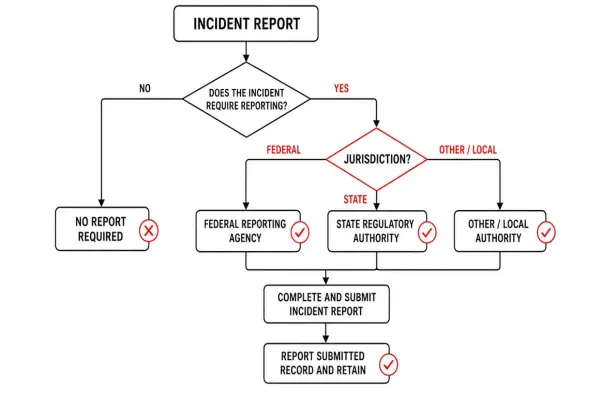
Define incident playbooks for supply chain events: model deprecation notices, subprocessor breaches, unexpected capability changes, and provider outages affecting production workflows. Playbooks should specify communication owners, customer notification thresholds, failover activation steps, and evidence preservation for regulatory reporting. Test playbooks annually with tabletop exercises simulating provider failure scenarios.
Implementation Roadmap
Week one: inventory all AI dependencies across four layers; weeks two through four: build AIBOM templates and subprocessor maps; month two: negotiate contract addenda and exit plans; ongoing: quarterly supply chain attestation and behavioral monitoring. AI supply chain risk management succeeds when layers are mapped with owners and controls, provenance is machine-readable, subprocessor changes trigger review, concentration has documented fallbacks, and fourth-party embedded AI is discovered before auditors or incidents expose the gap.
Supply Chain Visibility as Competitive Advantage
Organizations with documented AI supply chain programs respond faster to vendor changes, win enterprise deals requiring transparency, and reduce incident impact through tested failover paths. Supply chain risk management is not procurement overhead. It is the infrastructure that makes responsible AI deployment scalable across AI automation and API-dependent products your teams ship every quarter. Begin with your highest-criticality dependencies and expand coverage each quarter until every production AI workflow has documented provenance, subprocessor maps, and tested exit paths.