Your team already uses a familiar AI chatbot for drafts and research. Someone asks whether client data is safe in that product. You check the privacy page, see reassuring language, and assume the free or personal plan matches what enterprise customers get. That assumption is where most workplace AI privacy mistakes start. Consumer vs enterprise AI privacy is not a marketing label. It is a different contract for how prompts, uploads, and outputs are stored, trained on, shared, and deleted.
This guide compares what typically changes when you move from consumer to enterprise tiers: training opt-out, zero data retention options, admin controls, data isolation, and formal protections like DPAs, BAAs, and SOC 2 reports. Use it before anyone on your team pastes HR records, source code, or customer contracts into an AI chatbot. If privacy is your primary filter, browse private AI chatbot and research tools with your compliance checklist in hand.
What Typically Changes at Enterprise Tier
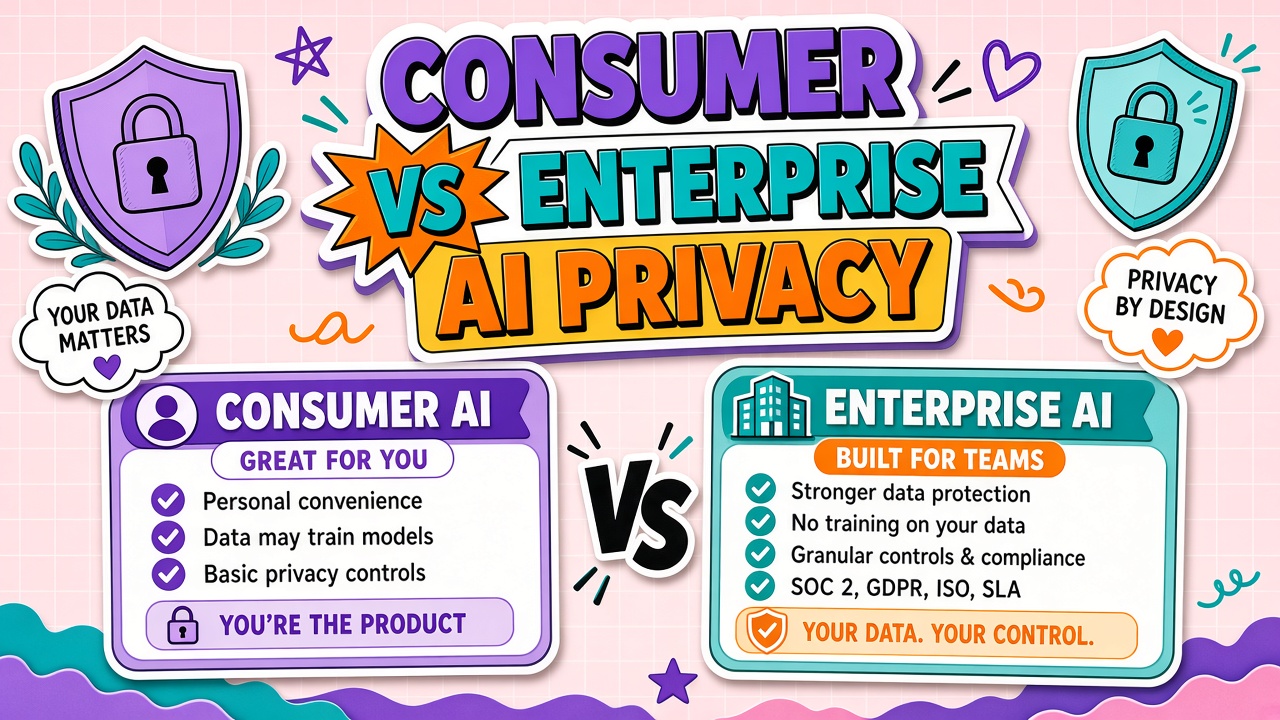
Enterprise tiers usually change data handling defaults, not just feature limits. Consumer plans optimize for growth: generous free access, persistent chat history, and terms that allow model improvement from user content unless you opt out. Enterprise plans optimize for procurement: shorter retention, training disabled by default, admin consoles, audit trails, and documents your legal team can sign.
| Privacy dimension | Typical consumer tier | Typical enterprise tier |
|---|---|---|
| Model training on your content | May be allowed by default; opt-out varies by vendor and region | Usually disabled by default on business accounts |
| Data retention | Long chat history; unclear deletion timelines | Configurable retention; documented deletion SLAs |
| Admin and access control | Individual account only | SSO, SCIM, roles, domain capture, usage logs |
| Legal agreements | Click-wrap terms of service | DPA, custom terms, sometimes BAA for healthcare |
| Support for security reviews | Public FAQ and community forums | Sub-processor lists, SOC 2, security questionnaires |
The logo stays the same. The obligations do not. Document the exact plan SKU, region, and verification date for every tool in your stack.
Training Opt-Out and Zero Data Retention Availability
Training opt-out means your prompts and outputs are not used to improve foundation models. On many consumer paths, you must find a settings toggle or accept terms that permit improvement. Enterprise paths often disable training organization-wide without per-user action.
Zero data retention (ZDR) or "no storage" modes go further: prompts and completions are processed for the request and not retained after the session, subject to abuse monitoring exceptions vendors document. ZDR is rarely available on free consumer tiers. It appears on API enterprise agreements and some business chat plans with explicit configuration.
- Verify scope: Training opt-out may cover chat but not file uploads, plugins, or API calls.
- Check defaults: New team members on consumer accounts may re-enable training-friendly settings.
- Separate products: A vendor's consumer app and enterprise API may have different retention policies.
- Log proof: Screenshot admin settings and link the policy version you relied on.
Admin Controls and Data Isolation
Enterprise admin controls exist so organizations can enforce policy, not just trust individual users. Common controls include single sign-on, role-based permissions, workspace boundaries, export restrictions, and centralized billing that prevents shadow IT on personal cards.
Data isolation varies by architecture. Some vendors offer dedicated instances, private endpoints, or region-locked processing for regulated industries. Others offer logical separation on shared infrastructure with contractual guarantees. Ask where prompts are processed, which subprocessors touch them, and whether your tenant is co-mingled with consumer traffic in caches or support tooling.
Contractual Protections: DPA, BAA, and SOC 2
Formal agreements turn marketing privacy claims into enforceable processor obligations. A Data Processing Agreement (DPA) defines roles under GDPR-style law: what the vendor may do with personal data, subprocessors, breach notification, and deletion. A Business Associate Agreement (BAA) is required when US covered entities share protected health information with the vendor. SOC 2 Type II reports describe controls auditors tested over time, not a guarantee of zero incidents.
Consumer click-wrap terms rarely give your legal team negotiation leverage or clear remedies. Enterprise procurement exists precisely because regulated and B2B buyers need signed documents, not FAQ paragraphs. If a vendor refuses a DPA on your tier, treat the product as suitable for public data only until the contract path is clear.
When Consumer Tier Is Never Acceptable
Consumer tiers are unacceptable when law, contract, or insurer requirements demand processor agreements and auditable controls. Examples include employee health data, unreleased financial filings, trade secrets under NDA, children’s data, and client materials where your MSA makes you liable for subprocessors.
- Regulated industries with mandatory BAAs or regional data residency
- Client contracts that prohibit consumer SaaS without enterprise DPAs
- Security policies requiring SSO, MFA enforcement, and centralized offboarding
- Incidents where consumer account compromise would expose entire chat history
- Workflows needing ZDR or documented deletion within fixed windows
"We will upgrade later" is not a mitigation if sensitive content already entered a consumer account. Pilot on the correct tier from day one or use synthetic data until procurement completes.
Enterprise AI privacy vs consumer: documentation checklist
Procurement should collect four artifacts before approval: current privacy policy URL with capture date, plan-specific data handling addendum, sub-processor list with regions, and available SOC 2 or ISO reports. For healthcare workflows, confirm BAA availability on the exact SKU. For EU data, confirm Standard Contractual Clauses or adequacy path. Consumer FAQ answers are not substitutes for these documents when auditors ask about enterprise AI privacy vs consumer posture.
AI business tier data training defaults should appear in writing, not inference from brand reputation. Some vendors disable training only for workspace content while still improving from consumer free tier traffic. AI team plan privacy features like domain capture and retention policies matter when employees mix personal and work accounts on the same email domain.
Frequently Asked Questions
Can we upgrade mid-project without losing privacy posture?
Upgrading to enterprise often improves forward-looking controls, but content already submitted under consumer terms may remain under older retention rules until deleted. Before migration, export what you need, delete consumer workspace history where policy allows, and confirm with the vendor whether historical data was used for training. Re-run your checklist on the business admin console after cutover.
What should we export before switching tiers or vendors?
Export prompts, outputs, uploaded files, custom instructions, and integration configs. Document which projects contained sensitive data so legal can assess prior exposure. Keep a dated archive of the consumer terms that governed that period. Do not assume enterprise retroactively covers past uploads.
Does business chat privacy apply to the same vendor's API?
Not automatically. Chat apps, plugins, fine-tuning products, and APIs often have separate policies and toggles. Map each integration point to its own tier and DPA scope. Developers frequently expose more data through API automation than chat users intend.
Is a paid "team" plan the same as enterprise for privacy?
Team plans add seats and shared workspaces but may still use consumer-grade terms without DPAs or ZDR. Read the enterprise SKU requirements on the pricing page. "Team" is billing structure; "enterprise" is usually contractual and compliance structure.
The Bottom Line
Consumer and enterprise AI privacy tiers from the same brand are different contracts. Enterprise typically adds training opt-out, shorter retention, admin controls, and signed DPAs or BAAs plus SOC 2 evidence. Consumer tiers are poor fits for regulated, client-bound, or secret workflows. Verify tier, region, and policy version before the first real upload; export and delete consumer history before switching; and never assume team billing equals enterprise compliance.
Compare vetted AI chatbot options and private AI research tools on EliteAI.tools with your procurement checklist before rollout.