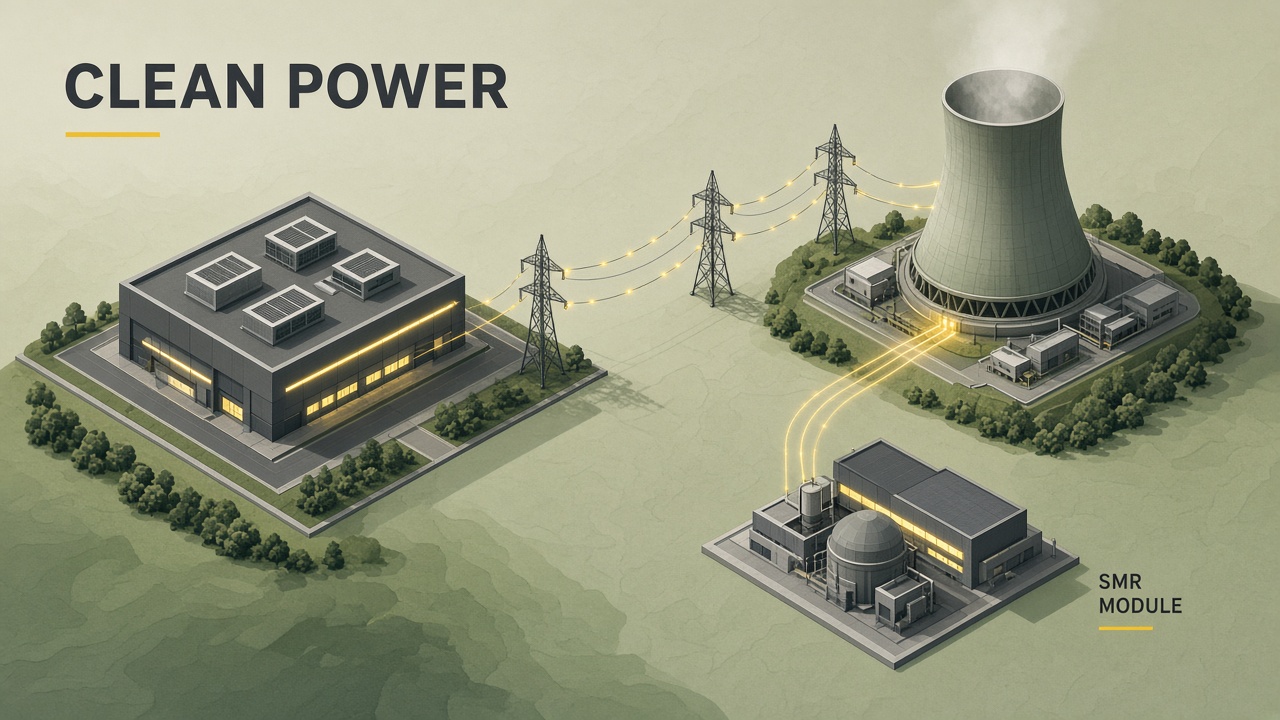
AI data center expansion outpaced grid capacity in 2026, pushing Microsoft, Google, Amazon, and Meta toward long-term nuclear power purchase agreements and small modular reactor partnerships. The nuclear power ai data centers trend reflects demand for firm, carbon-free baseload electricity that solar and wind alone cannot guarantee for 24/7 GPU clusters.
This analysis surveys major disclosed deals, compares SMR development timelines against traditional plant restarts, tracks regulatory approval status, and explains ESG reporting implications for teams monitoring AI code infrastructure and AI infrastructure sustainability commitments.
Major Nuclear-AI Deals Disclosed in 2026
Thirteen publicly tracked hyperscaler nuclear agreements totaled approximately 9.8 GW of committed or potential capacity by May 2026, with Meta leading by cumulative volume and Amazon holding the only deal where nuclear power actively flows to AI infrastructure today. Deal structures range from 20-year PPAs on restarted reactors to equity investments in SMR vendors still years from commercial operation.
| Buyer | Supplier / project | Capacity | First power target |
|---|---|---|---|
| Microsoft | Constellation Crane Clean Energy Center (TMI Unit 1 restart) | 835 MW | H2 2027 |
| Amazon | Talen Energy Susquehanna (front-of-meter PPA) | Up to 1.92 GW | Active (2025 agreement) |
| Amazon | X-energy Xe-100 at Cascade facility, Washington | Up to 960 MW (phased) | Early 2030s |
| Kairos Power SMR master agreement | 500 MW total (50 MW initial) | 2030 first reactor | |
| Fortum Finland nuclear PPA (Sep 2026) | Up to 50% of one plant output | 22-year contract | |
| Meta | TerraPower, Oklo, Vistra, Constellation portfolio | Up to ~6.6 GW cumulative | 2030 to 2035 delivery window |
Microsoft's 20-year PPA with Constellation, announced September 2024, targets restart of Three Mile Island Unit 1 as the Crane Clean Energy Center. The deal adds roughly 835 MW of carbon-free capacity and requires NRC licensing review plus state permits. Google invested at least 13 billion euros in Finnish AI infrastructure in September 2026 alongside a Fortum nuclear supply agreement, illustrating how European expansion pairs data center build-outs with existing reactor output.
SMR vs Traditional Plant Restarts
Traditional reactor restarts and long-term PPAs on operating plants deliver power years before first-of-a-kind SMR deployments, but SMR deals let hyperscalers shape next-generation designs and site reactors near planned data center campuses. The trade-off is timeline certainty versus strategic control.
Restart projects like Crane (TMI Unit 1) leverage existing licensed infrastructure with known grid interconnection. Regulatory paths are established but politically sensitive given Three Mile Island's history. SMR projects from Kairos Power, X-energy, TerraPower, and Oklo promise modular factory-built units but face first-of-a-kind licensing, fuel supply chain, and construction risk stretching into the 2030s.
- Restarts and extensions: Faster to grid, lower technology risk, limited site options
- Existing plant PPAs: Immediate or near-term power (Amazon-Talen), subject to FERC grid rules
- SMR development agreements: Long lead times, potential co-location with data centers, unproven at scale
- Fusion contingent deals: Microsoft-Helion (50 MW stated for 2028) remain speculative
Carnegie Endowment analysis notes hyperscaler commitments could provide roughly 6.9 GW by the early 2030s, but many SMR timelines depend on vendors achieving first commercial operation. Enterprises reporting net-zero progress should distinguish contracted PPAs on operating plants from aspirational SMR capacity in investor disclosures.
Regulatory Approval Status by Project
Nuclear-AI deals cross federal nuclear licensing (NRC), state public utility commissions, and FERC transmission rules when interconnecting data centers directly to generation assets. Amazon's initial behind-the-meter Talen proposal was declined by FERC in November 2024; the 2025 front-of-meter arrangement avoids that approval path while preserving up to 1.92 GW through 2042.
Microsoft's Crane restart requires NRC safety and environmental review plus Pennsylvania state permits. FERC approved a transmission waiver for Crane in June 2026, removing one interconnection hurdle. Google-Kairos Hermes demonstration reactors need NRC construction and operating licenses; TVA collaboration targets first Generation IV electricity sales to a US utility grid. Meta's multi-vendor SMR portfolio spans Wyoming Natrium licensing, Oklo Aurora applications, and Vistra site studies across Texas.
International deals follow different regimes. Google's Finland Fortum PPA operates under EU energy market rules without US NRC jurisdiction. China and other markets pursue separate embodied AI and nuclear standards that US hyperscaler deals do not directly affect but may influence global supply chain competition for reactor components and fuel.
ESG Disclosure Effects for Hyperscalers
Nuclear PPAs change how hyperscalers report Scope 2 emissions, renewable energy credits, and grid-matched clean power claims for AI data centers. SEC climate disclosure rules and voluntary frameworks increasingly ask whether contracted nuclear counts toward 24/7 carbon-free energy goals or requires separate labeling from intermittent renewables.
Sustainability teams should track three reporting dimensions. First, whether nuclear PPAs qualify as clean energy under each framework (most count nuclear as zero-carbon but some ESG screens exclude nuclear by policy). Second, whether power is physically delivered to data center sites or financially settled across grid regions. Third, whether SMR development investments appear as capital expenditures, R&D partnerships, or off-balance-sheet commitments in annual reports.
Community opposition near restart sites and SMR host communities may create reputational risk independent of carbon accounting. Microsoft and Constellation emphasized job creation and tax revenue in Pennsylvania restart messaging. Google framed Finnish nuclear supply as enabling cold-climate data center efficiency. Investors weighing AI infrastructure stocks should read 10-K risk factors on power availability alongside nuclear-specific licensing delays.
Frequently Asked Questions
How much nuclear capacity have hyperscalers committed for AI?
Public trackers cite approximately 9.8 GW across thirteen disclosed projects as of mid-2026, with Meta holding the largest cumulative potential volume and Amazon operating the only deal with power actively flowing to AI data center infrastructure today.
Is Microsoft's Three Mile Island restart confirmed?
Microsoft signed a 20-year PPA with Constellation in September 2024. Restart requires NRC approval and state permits. Constellation targets first power in H2 2027 with operations extended to at least 2054 if licensed.
What is an SMR in the AI data center context?
A small modular reactor is a factory-built nuclear unit typically under 300 MW per module. Hyperscalers partner with SMR vendors to secure long-term clean power near planned data center campuses, though commercial deployment timelines often extend past 2030.
Why did FERC reject Amazon's behind-the-meter nuclear deal?
FERC declined the initial Talen behind-the-meter interconnection in November 2024, citing inadequate protections against cost shifts to other ratepayers. Amazon restructured the agreement as a front-of-meter PPA in 2025.
How does nuclear power affect AI sustainability reporting?
Nuclear PPAs generally count as zero-carbon Scope 2 sources but may be disclosed separately from wind and solar in corporate sustainability reports. SMR development investments require clear categorization between operational energy contracts and venture-style technology bets.