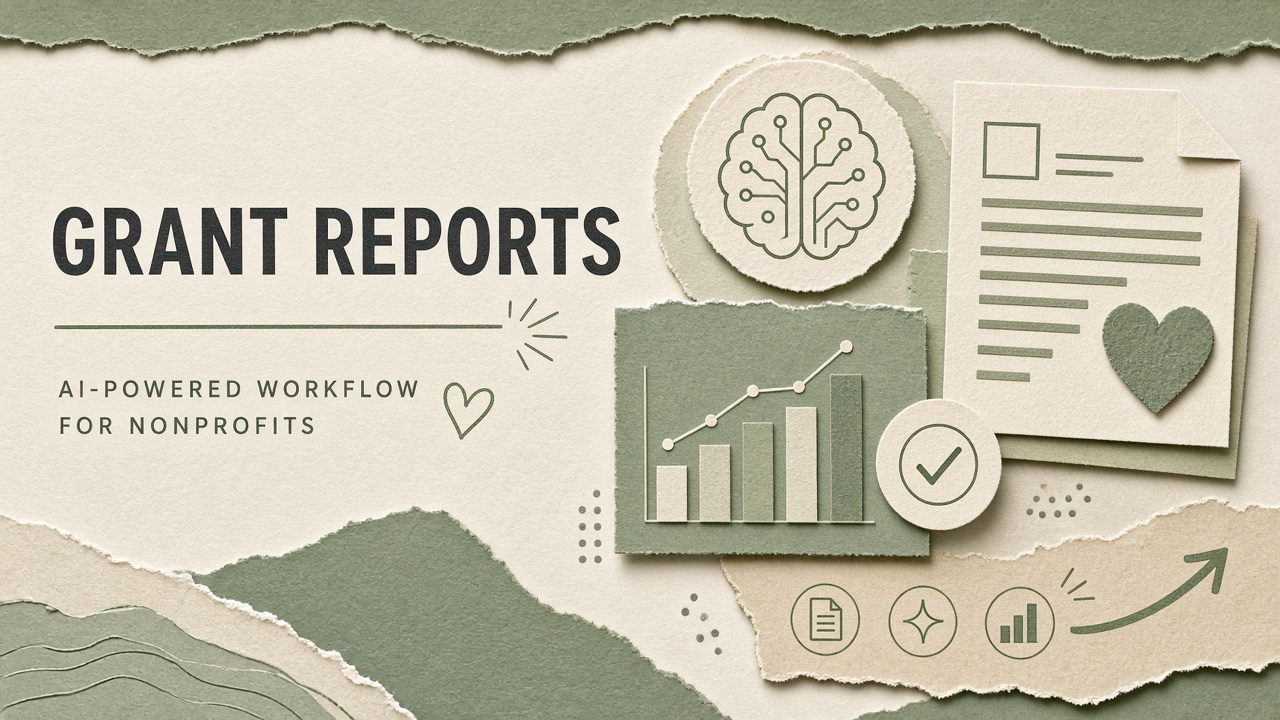
Nonprofit grant reporting cycles compress program outcomes, financial accountability, and funder-specific formatting into deadlines that strain small teams. Program staff hold the stories and service data; finance holds the ledger; development holds the funder relationship. Narrative sections often get written last from scattered spreadsheets and anecdotal notes while numbers in tables may not align with the prose funders read first.
An ai workflow nonprofit grant reporting routine maps funder templates to internal data sources, drafts narrative sections from verified metrics and approved anecdotes, keeps financial tables in a finance-owned track, routes program director review, and archives submission acknowledgments. AI accelerates drafting and consistency checks; humans own accuracy, restricted fund rules, and impact claims. Teams often pair reporting with AI chatbot tools for internal Q&A on past reports and AI video tools for beneficiary story capture with consent workflows before anecdotes enter narratives.
Map Funder Template to Internal Data
Grant reporting starts by mapping each funder template section to authoritative internal data sources and owners before any narrative generation runs. AI cannot reconcile mismatched field definitions between CRM exports, case management systems, and finance GL codes without an explicit mapping layer program and finance staff maintain per grant.
Typical mappings link outcome indicators to program databases, participant counts to enrollment exports, demographic breakdowns to de-identified aggregates, and budget lines to restricted fund accounts in the accounting system. Narrative-only sections such as challenges and lessons learned map to interview notes and leadership memos with clear provenance tags.
- Inventory funder PDF or portal fields for the reporting period.
- Assign each field a source system, refresh cadence, and responsible role.
- Document restricted fund IDs tied to the grant award.
- Flag fields requiring auditor or finance sign-off before narrative reference.
- Version the mapping when funders change templates mid-award.
| Funder section | Internal source | Owner |
|---|---|---|
| Activities and outputs | Program MIS, service logs | Program manager |
| Outcome indicators | Evaluation exports, surveys | M&E lead |
| Financial summary | GL restricted funds | Finance |
| Stories and case examples | Consent-approved story bank | Communications |
Deadline and Milestone Tracking
Reporting calendars should list narrative draft dates, finance table freeze dates, and program director review slots backward from funder submission deadlines. AI drafting slots open only after metric extracts for the period are locked or marked provisional with explicit caveats.
Narrative Draft From Metrics and Anecdotes
AI drafts grant narrative sections by combining locked metric tables and consent-approved anecdotes into funder-aligned prose, with every quantitative claim tied to a cited internal export. Drafts should read in the funder's preferred tone while avoiding superlatives or unaudited impact language. Program staff edit for accuracy and voice; AI does not invent participants, outcomes, or community quotes.
Effective narrative drafts open each section with outcomes tied to indicators, follow with activity descriptions that explain how services produced those numbers, and close with challenges and adaptations supported by staff notes. Anecdotes appear as illustrative examples labeled with consent scope, not as statistical proof.
- Insert footnote-style references to metric export IDs inside working drafts for reviewer traceability.
- Separate provisional metrics from final when finance has not closed the period.
- Flag adjectives that imply causation when data shows correlation only.
- Use funder outcome language verbatim where scoring rubrics require specific terms.
- Keep beneficiary identifiers out of drafts unless explicit named consent exists.
Story Bank Governance
Only anecdotes with recorded consent forms matching the funder's publicity restrictions may feed AI narrative prompts. Communications maintains the story bank with expiration dates and usage limits per grant. Video or audio captures follow the same consent metadata before video AI tools produce transcripts for draft inclusion.
Separate Financial Tables Verified by Finance
Financial tables live in a finance-owned workflow with GL reconciliation and restricted fund checks before narratives reference any dollar figures. AI should not generate budget versus actual tables from memory or partial exports. Program narratives may describe spending themes only after finance publishes approved figures in the shared reporting workspace.
| Financial exhibit | Verification step | Sign-off |
|---|---|---|
| Budget vs actual | GL tie-out to restricted fund | Controller or designee |
| Functional expense split | Allocation methodology review | Finance director |
| Match or in-kind | Documentation file check | Grants accountant |
| Variance explanations | Program and finance joint note | Both functions |
When narrative drafts precede finance close, use placeholder language approved by finance rather than estimated numbers. Cross-check tools can flag when prose mentions a dollar amount absent from signed financial exhibits.
Program Director Review
Program directors review complete draft packages for outcome accuracy, mission alignment, funder relationship tone, and consistency between narrative and exhibits before executive or board submission. Review is not a copy edit alone. Directors confirm activities described match field reality and that challenges sections do not create unmanaged reputational risk with the funder.
- Verify each outcome claim against locked metric exports attached to the draft.
- Confirm anecdotes match consent records and funder publicity rules.
- Align challenge narratives with corrective actions already underway.
- Resolve cross-section contradictions between program and financial variance notes.
- Approve version for development relations final formatting and portal upload.
Board and Executive Visibility
Material grants may require executive or board committee awareness before submission when reports disclose significant variances or programmatic pivots. AI summaries for internal leadership should use the same verified exhibits, not alternate drafts.
Internal Collaboration Tools
Grant teams benefit from internal knowledge bases where staff query past report language and funder preferences without pasting current drafts into unsecured tools. An internal chatbot trained on approved archives accelerates onboarding when new program managers inherit awards mid-cycle. Answers should cite archived report IDs so users verify context before reuse.
Communications may produce short video summaries for board briefings after written reports submit, using the same verified metrics as on-screen graphics. Video is supplementary outreach, not a substitute for signed PDF exhibits funders require.
Submission and Acknowledgment Archive
Final submissions upload to funder portals or secure email with a complete archive of PDF exports, portal confirmation screenshots, and timestamped acknowledgment receipts stored in the grants file. Development staff record submission actor, report version ID, and any funder follow-up questions. Archives support renewal conversations and auditor requests years later.
Post-submission, funders sometimes request clarifications on narrative claims. The archive should link each submitted sentence to source metrics so staff respond consistently without improvising new numbers. Amendment submissions receive their own version IDs rather than silent overwrites of the original file.
- Store portal confirmation IDs and email read receipts when available.
- Index archives by grant ID, period, and funder for search.
- Retain working drafts with reviewer comments per records retention policy.
- Log funder feedback themes for the next reporting cycle mapping updates.
- Restrict archive access to roles with legitimate grant oversight needs.
Frequently Asked Questions
How do restricted funds affect narrative drafting?
Narratives may describe activities funded by restricted grants only when expenses posted to the correct restricted fund accounts and finance verified the mapping. AI prompts should include fund IDs so drafts do not blend unrestricted program results into restricted grant reports. Commingled costs require finance allocation notes before prose references them.
What impact claims are safe in funder narratives?
Impact claims should match evaluation designs funders approved: outputs reported as outputs, outcomes reported only with measured evidence and stated limitations. Avoid causal language when programs lack comparison groups or external evaluation. Program directors downgrade or remove AI-suggested superlatives during review.
Can grant reports include photos of participants?
Photos require consent forms that explicitly cover grant reporting and funder publicity channels, not only general website use. Communications verifies consent before images attach to drafts. De-identified or aggregate visuals are preferable when consent is narrow or expired.
How do we handle one program with multiple funders?
Maintain separate template mappings and metric slices per funder award even when programs overlap operationally. AI drafts should run per grant with fund-specific outcome sets to prevent double-counting participants across reports. Shared stories need consent scopes covering each funder named in the report.
Reports Funders Can Trust
Nonprofit grant reporting improves when funder templates map to authoritative data, AI drafts narratives from verified metrics and approved stories, finance owns financial tables, program directors review holistically, and submissions archive with acknowledgments. The workflow succeeds when funders renew with confidence in your numbers and prose, not when the narrative merely reads persuasively.