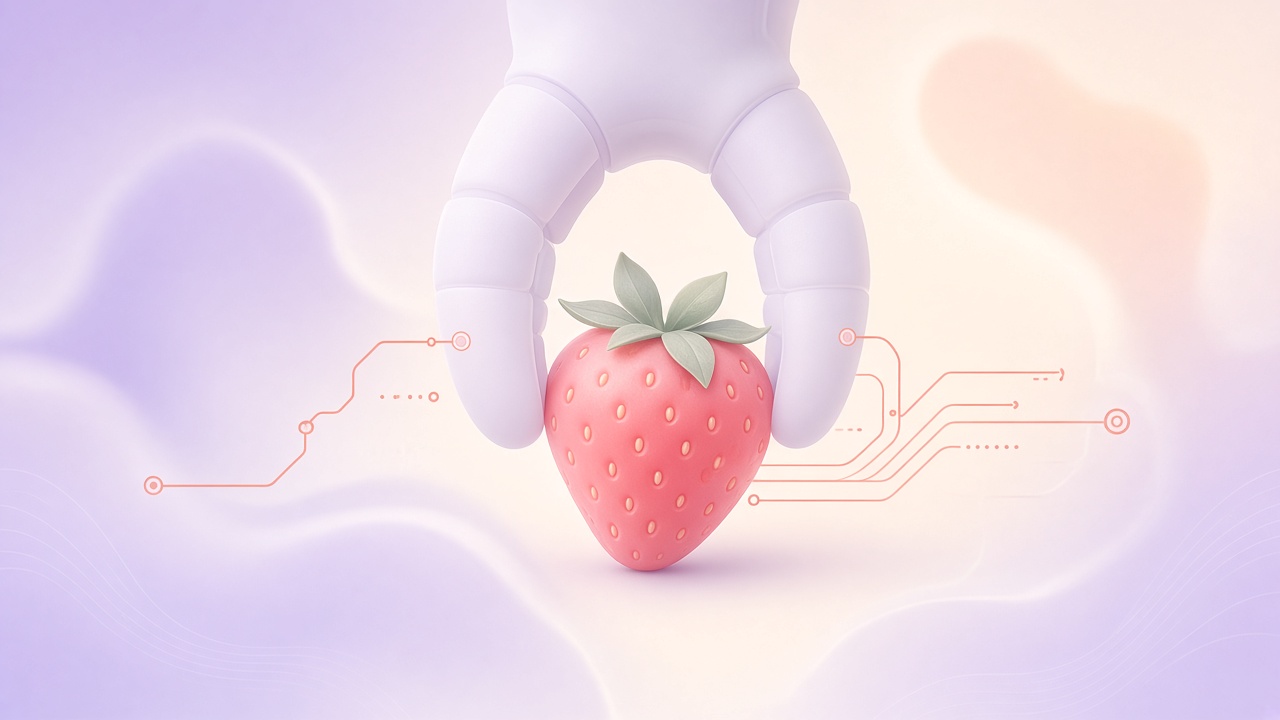
Soft robotics AI control combines compliant grippers and continuum manipulators with machine learning controllers that adapt grasp force, shape, and motion to fragile, deformable objects humans handle easily but rigid industrial arms crush. Recent systems report 95.83% grasp success with 4.17% damage on multi-object fruit trials using FMDS-YOLOv8 vision plus variable-structure soft actuators, vision-tactile FruitTouch grippers for slip and softness prediction, and Nature Communications multimodal five-finger harvesters with 100% shape classification accuracy on test fruits. Engineers exploring AI research on embodied manipulation or AI research infrastructure for food automation should understand why soft materials change both the control problem and the data required to learn safe grasps.
Rigid vs Soft End Effectors
Rigid parallel-jaw and vacuum grippers excel on boxed warehouse SKUs with known geometry; soft end effectors excel when object shape, stiffness, and surface fragility vary item to item. Steel fingertips with position control assume the object does not deform. A 5 N squeeze on a rigid carton is fine; the same command bruises a strawberry or cracks an egg. Soft fingers distribute contact pressure across compliant silicone or fabric chambers, increasing conformal contact area and reducing peak stress.
Tradeoffs include slower actuation, lower payload, and shorter material life. Pneumatic soft actuators inflate and deflate over hundreds of milliseconds; high-speed pick-and-place lines favor rigid tooling. Agricultural and food processing lines accept 6-8 second grasp cycles when damage reduction saves more value than raw throughput.
Hybrid designs mount soft pads on rigid fingers, capturing partial compliance without full continuum robots. Food industry reviews note that balancing high throughput and low damage rates pushes vendors toward vision-guided force control even on semi-rigid tooling.
Selection criteria: if SKU geometry is fixed and packaging rigid, rigid arms with force limits win on cost and speed. If products are biological, deformable, or variable size, soft robotics plus AI control becomes economically rational despite complexity.
Labor shortages in orchard and greenhouse work accelerate ROI calculations for soft robotic harvesters even at 6-second cycle times. When bruised fruit discounts exceed automation capex within two seasons, growers tolerate slower throughput than rigid carton pickers demand.
Modeling Deformable Contact
Learning controllers for soft robots requires models of hyperelastic materials, pneumatic pressure-to-curvature mappings, and contact forces that change as the finger wraps around irregular produce. Finite element models (FEM) capture finger bending up to 240 degrees in published five-finger grippers, matching experimental curvature within reported tolerances. FEM is too slow for real-time MPC on every grasp, so teams use learned surrogates or simplified analytical models calibrated offline.
Deformable object manipulation multiplies state dimensionality: the object mesh deforms, not just its pose. Simulators with soft-body physics (SOFA, MuJoCo soft constraints, Isaac Flex) enable policy training but suffer sim2real gaps on friction and damping. Data-driven models map air pressure and tendon tension directly to fingertip pose without explicit material PDEs.
LAFNet (Learning Adaptive Force Network) predicts grasp force from tactile and air-pressure modalities inspired by human pinching behavior, achieving damage-less fragile fruit grasping with pneumatic soft fingers. The network fuses sequential tactile patterns and global pressure states, replacing hand-tuned force schedules.
Contact sensing closes the loop. Stretchable optical fiber tactile sensors measure curvature and pressure along soft fingers; embedded cameras in gel fingertips produce high-resolution tactile images for slip detection. Without sensing, open-loop inflation profiles fail when fruit size or ripeness shifts compliance.
Learning Controllers on Soft Robots
AI control stacks for soft robots combine perception (RGB, depth, YOLO segmentation), grasp planning (analytic or learned), and closed-loop force or pressure regulation trained from simulation, human demonstration, or multimodal logs. The FMDS-YOLOv8 agricultural manipulator detects fruit type and pose, extracts contours in MATLAB, and adjusts three independently rotatable soft actuators for center or parallel grasp modes. Objects up to 140 mm diameter fit center grasp configurations; parallel mode handles up to 105 mm.
Reinforcement learning in soft-body sim can discover wrapping grasps, but sample efficiency is poor. Imitation learning from human harvesters or teleoperation accelerates deployment. FruitTouch open-sources hardware and simulation environments for vision-based tactile slip and softness prediction, lowering the barrier to experiment with learned controllers on real berries.
Control frequencies split across layers: vision at 10-30 Hz, pressure regulation at 100+ Hz, and supervisory task planning slower still. Edge GPUs run compact YOLO variants; microcontrollers handle valve PWM for pneumatic fingers. Latency budgets matter when fruit hangs on stems and wind moves targets.
| Control approach | Strength | Limitation |
|---|---|---|
| Hand-tuned pressure profiles | Simple, interpretable | Fails across ripeness and size variance |
| Learned force from tactile (LAFNet) | Adapts per fruit instance | Needs labeled multimodal data |
| Vision-language grasp planning | Generalizes object categories | Latency and sim2real on soft contact |
| RL in soft-body sim | Discovers complex wrap grasps | Expensive training; physics gap |
Agricultural and Food Handling Wins
Greenhouse strawberry harvesting, postharvest sorting, and fragile food pick-and-place are the clearest 2026 wins for soft robotics plus AI because damage directly destroys product value. The Nature Communications five-finger gripper integrates vision, tactile, and curvature sensing across 13 onboard sensors, actuating in two seconds at 80 kPa with up to 6 N pull force and 1 kg lift capacity (16x gripper weight). Hue-based HSV color detection supports ripeness assessment; tactile channels distinguish soft from firm fruit.
Field demonstrations include greenhouse strawberry harvest with minimal damage and handling of mangoes, apples, and pawpaws in lab conditions. Workspace expansion from 200 mm² to 14,000 mm² enables one gripper family across size-varying crops, reducing tooling changeovers versus rigid jaw sets per SKU.
Postharvest sorting lines benefit when robots must grade and pack stone fruit, berries, and tomatoes on the same line. Vision detects defects; soft grippers prevent secondary bruising during transfer. Reviews of high-speed fragile food handling emphasize millisecond vision paired with force sensors and deep learning for grasp method selection as the path to commercial throughput.
Challenges remain: outdoor dust on sensors, sanitation requirements, gripper wear from acids and sugars, and seasonal labor integration. Soft robotics is not yet universal on industrial chicken or tofu lines where hygiene and speed constraints dominate.
Medical Catheter and Rehab Robots
Medical soft robots use continuum structures and compliant actuation for catheter steering, endoscopy, and rehabilitation exosuits where rigid links cannot safely contact human tissue. AI control learns safe workspace limits, patient-specific impedance, and gesture intent from EMG or force feedback. Unlike agriculture, medical devices face regulatory clearance (FDA, CE) requiring traceable validation datasets and fail-safe behaviors when models drift.
Continuum robots with tendon routing or pneumatic backbone bending navigate tortuous anatomy. Learning-based controllers map camera or EMG inputs to curvature commands while respecting maximum strain on silicone walls. Sim2real gaps are life-critical; clinicians often demand hybrid control with analytic safety envelopes around learned policies.
Rehabilitation soft exosuits assist stroke patients with compliant assistance tuned to gait phase. Machine learning personalizes torque profiles from wearable sensors. The same compliance principles as fruit grippers apply: distribute force, avoid stiff impact, adapt to variable human biomechanics.
Data privacy and clinical trial costs slow medical adoption relative to greenhouse pilots. Agricultural wins fund adjacent research on tactile sensing and deformable modeling that later transfers to surgical soft instruments.
Sim2real for soft robots lags rigid grasping because hyperelastic parameters vary with temperature, humidity, and material aging. Greenhouse operators often collect season-long datasets across ripeness stages rather than trusting sim alone. When sim is used, co-training on both FEM rollouts and real teleop logs stabilizes policies before field deployment.
Food safety regulations (FDA FSMA, EU hygiene rules) require washable or replaceable gripper surfaces and documented cleaning cycles. AI controllers must degrade gracefully when sensors fog after sanitizing sprays. Design reviews should schedule sensor occlusion tests alongside grasp success benchmarks.
Continuum catheter robots share control math with agricultural soft fingers: both map low-dimensional actuator commands to high-dimensional shape spaces. Cross-pollination between fields accelerates when open hardware (FruitTouch, academic soft gripper kits) lowers prototyping cost for startups entering either market.
Blackberries and clustered berries stress multi-finger coordination: the Nature Communications gripper's rotational harvesting module shows how AI planners sequence finger closure order to avoid stem tangles. Learning those sequences from human picker video reduces manual scripting of pneumatic timing tables for each cultivar.
Industrial bakery lines handling unfilled pastries illustrate mid-compliance needs: too rigid crushes layers; fully soft fingers may be slower than needed. Tunable stiffness via granular jamming or variable pressure chambers lets one AI controller sweep the compliance envelope within a single production day.
Frequently Asked Questions
How durable are soft grippers?
Silicone and fabric actuators fatigue from cyclic inflation, UV exposure, and chemical washdown. Agricultural deployments plan regular membrane replacement. Medical devices document lifecycle limits in IFUs. Durability lags steel tooling but improves as materials science advances.
Can soft robots match conveyor speed?
Not for high-speed rigid SKU lines. Soft grasp cycles of 2-8 seconds suit harvest and gentle transfer, not 120 picks per minute parcel sort. Hybrid lines use rigid transport with soft robotics only at delicate transfer points.
Does soft robotics need sim2real?
Yes, when policies train in simulation, but many agricultural systems lean on real greenhouse data because soft-body sim remains imperfect. Tactile-rich teleoperation datasets often outperform pure sim for initial deployment.
What sensors are essential?
At minimum: vision for pose, pressure or tactile for contact, and often curvature or proprioceptive bending feedback on continuum fingers. FruitTouch-style optical tactile sensors add slip detection critical for gentle lifts.
Are medical soft robots commercially available?
Some continuum catheter and endoscopy platforms exist under regulatory clearance; many AI-controlled rehab suits remain research or limited release. Expect stricter validation than agricultural pilots.
Is a rigid arm with soft pad enough?
Often yes for moderately fragile items. Full soft continuum manipulators matter when wrap grasps and large shape variation dominate. Match compliance level to bruising sensitivity and throughput targets.
Where should I follow soft robotics research?
Track agricultural robotics venues, Nature Communications and IEEE RA-L hardware papers, and open projects like FruitTouch. Broader context lives under AI research and AI research search.