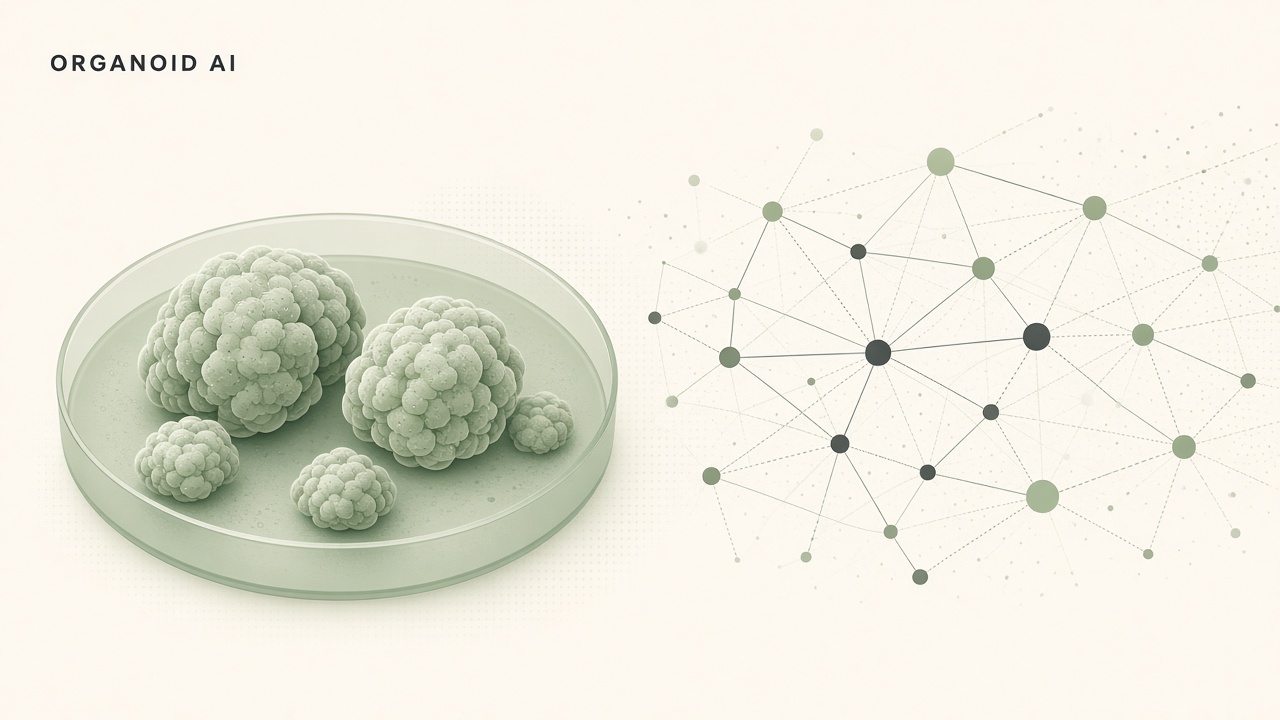
A lab grows a three-dimensional blob of human neural tissue from stem cells, then asks a question that microscopy alone cannot answer: how closely does this organoid match a twelve-week fetal cortex? AI brain organoids neurodevelopment work answers that by training models on single-cell transcriptomes, imaging features, and reference atlases of the developing human brain. The result is not a digital twin of a patient mind. It is a quantitative layer that scores maturation, flags batch effects, and predicts how perturbations shift cell states. Neuroscience teams, rare-disease foundations, and computational biologists browsing EliteAI.tools blog coverage use these pipelines to decide which protocols to trust before expensive animal work or clinical hypotheses harden.
What AI Brain Organoid Modeling Means
AI brain organoid modeling means applying machine learning to organoid data (usually single-cell RNA sequencing, sometimes brightfield or calcium imaging) to estimate developmental stage, regional identity, cell-type composition, and disease-relevant shifts against in vivo reference atlases. Brain organoids are stem-cell-derived three-dimensional cultures that self-organize into neural tissue with layered or regional structure depending on protocol. They are models, not miniature brains: they lack full vascularization, immune context, and the long-range wiring of an intact nervous system. AI does not replace biologists peering through microscopes. It harmonizes noisy, high-dimensional measurements so teams can compare organoids across labs, time points, and genetic backgrounds on a shared coordinate system.
The conceptual shift is from anecdotal morphology ("this looks like a rosette") to measurable fidelity. A 2024 Nature integrated human neural organoid cell atlas (HNOCA) combined more than 1.7 million cells from 36 single-cell datasets spanning 26 protocols, then mapped them to developing human brain references. That atlas lets researchers ask which primary cell types appear in vitro, which remain missing, and whether metabolic stress signatures distinguish cultured neurons from fetal counterparts without erasing core identity labels. AI models trained on such atlases become reusable scorers: upload a new organoid batch, receive a developmental age estimate, a regional specificity readout, and flags for under-represented populations.
Buyers comparing this field to consumer AI chatbot products should expect different deliverables. Organoid AI ships as Python notebooks, pretrained checkpoints, and cloud pipelines tied to sequencing vendors, not conversational interfaces. The value is reproducible QC and hypothesis generation for experiments that still require wet-lab validation.
The AI Pipeline for Organoid Neurodevelopment
A typical AI pipeline ingests raw organoid measurements, normalizes batch effects, embeds cells in a shared latent space aligned to fetal brain references, and outputs sample-level predictions such as developmental age, disease status, or perturbation response. Pipelines differ by modality, but transcriptomic workflows dominate published benchmarks because single-cell RNA sequencing captures cell-type identity and state at scale.
Data Ingestion and Harmonization
Organoid datasets arrive siloed by protocol, donor line, and sequencing chemistry; integration methods (scVI, Harmony, or atlas projection) align them before any classifier trains. HNOCA demonstrates atlas-scale integration: new studies project onto the existing embedding rather than retraining from scratch each time. Batch correction is not cosmetic. Without it, models learn plate IDs instead of biology. Teams should document which reference atlas version a scorer was trained on, because reannotation of fetal brain cell types can shift apparent fidelity scores when references update.
Developmental Age and Fidelity Models
Developmental age predictors treat each cell or sample as a point on a maturation axis learned from fetal brain time courses, then test whether organoid cultures track that axis monotonically. A 2025 preprint on cell type-agnostic transcriptomic signatures trained regularized regression on more than 2.8 million developing human brain cells and reported roughly 2.6 weeks error on held-out fetal data. When applied to cortical and midbrain organoids from independent studies, predicted ages correlated with in vitro culture age (reported Pearson correlations around 0.89 to 0.91 in those benchmarks). CELLECTION, another deep learning framework published in 2025, models each biological sample as an unordered set of cells and predicts continuous phenotypes such as developmental age; authors reported strong rank correlation on validation splits within organoid and fetal atlases. These numbers are encouraging for protocol QC but should not be quoted as clinical gestational age for individual patients.
Trajectory and Composition Tools
Trajectory models such as TRACE (Trajectory Representation and Composition Estimator) use transformer-style architectures fine-tuned on organoid time courses to estimate pseudotime and cell-type composition, including zero-shot inference on unseen batches via in-context anchor cells. TRACE targets a practical pain point: regionalized cell types emerge at transitional profiles that standard integration blurs. Composition-first tools like CELLECTION excel when phenotype depends on coordinated multi-cell-type signatures rather than any single marker gene. Imaging-side models (for example morphology quantification tools discussed in organoid literature) complement transcriptomics by scoring rosette formation and laminar structure when sequencing is too destructive or too expensive for daily QC.
| Approach | Input modality | Primary output | Best suited for |
|---|---|---|---|
| Atlas projection (HNOCA-style) | scRNA-seq | Cell-type fidelity, missing populations | Cross-protocol benchmarking |
| Developmental age regression | scRNA-seq | Maturation clock vs fetal weeks | Time-course QC |
| CELLECTION-style set models | scRNA-seq sample sets | Emergent phenotype prediction | Disease case-control, donor effects |
| TRACE-style trajectories | scRNA-seq time courses | Pseudotime, composition | Regional emergence timing |
| Morphology CNNs | Brightfield / fluorescence | Structural QC scores | High-throughput plate screens |
Real Deployments and Evidence
Published deployments cluster in academic core facilities, pharmaceutical early-discovery groups, and rare-disease consortia that need scalable organoid QC before compound or genetic screens, not in hospital diagnostics. Evidence is strongest where ground truth exists: fetal brain atlases with gestational age labels, morphogen screens with known regional outcomes, and disease organoids with matched patient genotypes.
HNOCA authors mapped neural disease modeling datasets onto the integrated atlas for automated cell-type annotation and differential expression, streamlining comparisons across ten modeled conditions. That workflow is already how many labs annotate new organoid runs: project cells, read off label transfer confidence, investigate low-confidence clusters manually. CELLECTION demonstrations include aligning organoid and fetal samples when naive integration fails, using ordinal developmental models to identify which cell programs drive stage predictions in both systems. For therapeutic timing questions (when to apply a drug during a critical window), that alignment is more actionable than a single aggregate "similarity score."
TRACE version 1.0, released on GitHub with documentation tied to a 2025 neuroepithelial organoid time-course study, targets labs running longitudinal scRNA-seq who need pseudotime without destroying transitional states. Inference can run CPU-only for smaller gene panels, lowering the bar for groups without dedicated GPU clusters. Cell type-agnostic maturation models have been applied to transplanted organoids, where authors reported accelerated maturation signatures relative to non-transplanted controls in at least one published dataset analysis. Again, those findings support experimental design; they do not by themselves justify clinical transplantation strategies.
Industry adoption remains cautious. Organoid screens for neurodevelopmental disorders and microcephaly risk genes appear in peer-reviewed literature, but regulatory paths for organoid-derived predictions touching patients are immature. AI scorers function as R&D instrumentation: prioritize which lines to expand, which time point to treat, which protocol variant to retire.
Limits, Risks, and Ethics
Models trained on atlas data inherit atlas gaps: under-sampled brain regions, donor demographics, and protocol biases become blind spots that look like high confidence when test organoids resemble training junk. Organoids universally show stress and metabolic signatures that distinguish them from primary fetal neurons even when core cell identities match. AI can quantify that gap but cannot wish it away. Overinterpreting a high fidelity score as "this organoid is a fetal brain at week X" misstates what transcriptomic clocks measure: molecular similarity under a specific feature set, not functional equivalence.
Reproducibility risks mirror broader ML in biology. Checkpoints depend on random seeds, reference genome builds, and gene panel choices (TRACE documentation notes performance differences between 512-gene and 2k-gene feature sets). A model that achieves strong correlation within one consortium may degrade on a new sequencing chemistry unless revalidated. Teams should treat published metrics as ceilings under ideal labeling, not guarantees on their first upload.
Ethics intersect organoid science and AI in ways chatbot policy debates rarely touch. Organoids can be derived from patient iPSCs, raising consent and identifiability questions when models link genomic background to disease predictions. Capacities for neural activity and sensory-like responses in advanced organoids prompt ongoing discussion about moral status, even though current cultures are far from sentience. AI that accelerates organoid maturation or disease modeling amplifies those debates by making experiments cheaper and faster. Governance frameworks (stem-cell oversight boards, data-sharing agreements) should precede fleet-scale automated scoring in clinically linked biobanks.
Dual-use concerns are lower than for generative biological sequence design, but disease models could inform harmful perturbation knowledge if paired with open chemical libraries. Access controls on patient-derived embeddings matter as much as on raw genomes.
Who Should Use Organoid AI Now vs Wait
Stem-cell core facilities, neurodevelopment labs with recurring scRNA-seq organoid panels, and pharma groups running genetic perturbation screens should adopt atlas projection and developmental clocks now; clinical diagnostic teams and educators should wait. If you already pay for single-cell sequencing on every batch, adding a HNOCA projection or maturation model is marginal cost relative to re-running failed differentiation months later. Bioinformaticians comfortable with AnnData objects and conda environments can integrate open tools within weeks.
Wait if your organoid program is still pre-QC at the wet-lab level (high contamination, inconsistent size, no pilot time course). AI magnifies structured data; it does not fix broken differentiation. Wait if you need FDA-ready claims about patient stratification; current evidence is research-grade. Educators may reference atlases pedagogically but should avoid implying organoids replicate conscious experience because a clock correlates with culture day.
Hybrid teams benefit most: biologists who can spot absurd predictions (a midbrain label on a cortical protocol) paired with ML engineers who tune thresholds and track reference updates. Solo AI chatbot integrators without sequencing literacy should partner with a core facility rather than piping FASTQ files through opaque SaaS dashboards.
Frequently Asked Questions
Are brain organoids mini-brains?
No. Organoids are simplified, avascular tissue models that recapitulate aspects of early neurodevelopment; they lack the connectivity, scale, and body context of an intact brain. AI fidelity scores describe molecular similarity to reference atlases, not consciousness or cognitive function.
What data do I need to run organoid AI?
Most published pipelines expect single-cell or single-nucleus RNA sequencing with metadata for culture day, protocol, and donor line; imaging-only tools need curated microscopy panels. Check each model's gene panel requirements before sequencing.
Should I use HNOCA or train a custom model?
Start with atlas projection for annotation and QC; train custom models when you have dozens of in-house batches with a phenotype labels unique to your screen. Custom training needs enough samples to avoid memorizing batch IDs.
Can AI replace morphology review?
Not entirely. Transcriptomic and imaging models catch systematic drift faster than manual review but miss contamination and equipment failures that experts spot immediately. Use AI as a triage layer, not the sole gate.
How is organoid AI used in drug discovery?
Teams score whether a compound shifts organoids toward or away from healthy developmental trajectories before moving to animal models. Predictions require orthogonal assays; regulators have not standardized organoid AI endpoints.
Do organoid AI tools need GPUs?
Atlas projection and lightweight regression often run on CPUs; fine-tuning transformer models like TRACE benefits from GPUs documented in each repository. Cloud notebook environments from sequencing vendors may bundle compute.
What ethical issues apply to patient-derived organoid AI?
Patient-derived iPSC lines require clear consent for genomic inference, sharing embeddings, and international collaboration. IRB and stem-cell governance boards should review pipelines that link predictions back to identifiable donors.
How often should models be revalidated?
Revalidate when you change sequencing chemistry, reference atlas versions, or culture protocols; at minimum annually for production screens. Keep a frozen benchmark set of historical batches to detect scorer drift.
Conclusion
AI turns brain organoids from qualitative curiosities into measurable neurodevelopmental assays. Integrated atlases such as HNOCA, set-based predictors like CELLECTION, maturation clocks with reported correlations near 0.9 on selected organoid datasets, and trajectory tools including TRACE give labs a shared language for fidelity and timing. AI brain organoids neurodevelopment modeling does not close the gap between a dish and a living brain; it quantifies where that gap remains so the next experiment targets real biology instead of batch noise. Use these systems in research workflows with open eyes about ethics, reference bias, and the limits of transcriptomic clocks. For broader context on how machine learning intersects biology and product design, continue with more articles on EliteAI.tools.