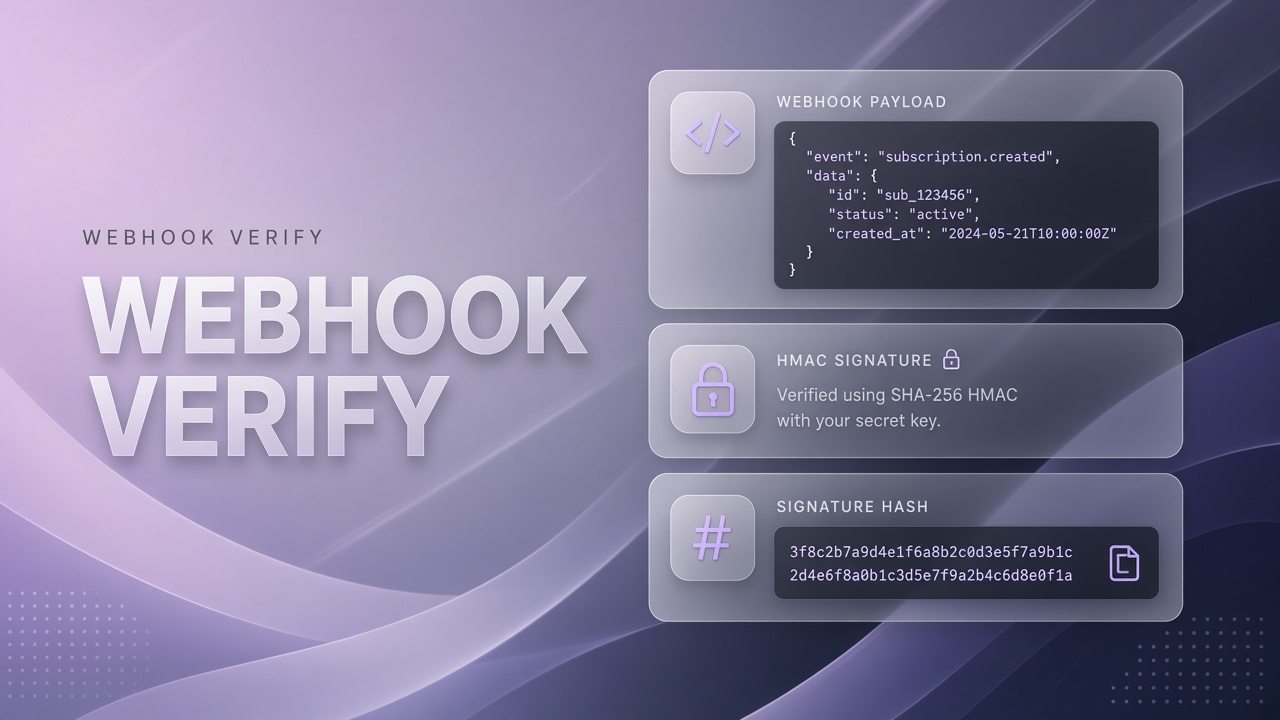
Webhooks arrive with 401 or 403 from your endpoint. Logs show "invalid signature" while the vendor dashboard marks deliveries failed. Automations never fire for completed fine-tunes, async jobs, or billing events. An AI webhook signature failure blocks the glue between AI platforms and your CRM, data warehouse, or internal orchestrator. The secret is usually correct; the bytes being hashed are not.
This guide covers raw body versus parsed JSON signing, clock skew, secret rotation, and replay prevention. Teams shipping AI design pipelines and AI writing workflows with async completion hooks use the same verification patterns across OpenAI, Anthropic, Stripe-style billing webhooks, and custom agent platforms.
Raw Body vs Parsed JSON Signing
Signature verification must hash the exact raw request body bytes received, before JSON parsing or whitespace normalization. Re-serializing parsed JSON changes key order, spacing, and Unicode escapes. HMAC over pretty-printed JSON never matches vendor signature over compact original body.
| Mistake | Symptom | Fix |
|---|---|---|
| Parse then stringify | 100% signature failure | Read raw body stream once; verify before parse |
| Framework auto-parses body | Empty raw body on second read | Use middleware that preserves raw payload |
| Charset conversion | Intermittent failure on non-ASCII | Verify UTF-8 bytes unchanged |
| Wrong header name | Missing signature header | Match vendor docs exactly (case-sensitive) |
Framework patterns: Express express.raw({ type: 'application/json' }) on webhook route only; Laravel middleware storing
$request->getContent() before Request JSON conversion; Python Flask reading request.get_data(). Verify signature
in dedicated route excluded from global JSON body parser.
For fix ai webhook signature debugging, log length and sha256 of raw body (not content) alongside signature header value. Compare one failing delivery captured at edge reverse proxy with application-received body. If hashes differ, proxy or WAF modified body. If hashes match but verification fails, secret or algorithm mismatch is next check.
Vendors differ on scheme: prefix like sha256=, multiple signatures v1/v2 during rotation, signing payload that concatenates
timestamp dot body. Read current docs for your provider; do not copy Stack Overflow snippet from different vendor.
Clock Skew Tolerance
Many webhook schemes include timestamp in signed material and reject events too far from server time. Signature valid cryptographically but rejected as stale means clock skew, not wrong secret. NTP drift on VM, wrong timezone on container, and manual clock adjustment cause sudden mass verification failure.
Implement tolerance window per vendor guidance (often five minutes). Compare webhook timestamp to UTC now; reject if outside window to limit replay window. Log rejected events with delta seconds for ops to diagnose NTP. Sync time on all webhook receiver nodes with reliable NTP; serverless cold starts still depend on platform clock.
- Confirm receiver system clock accurate (chrony, systemd-timesyncd).
- Parse timestamp header as integer seconds or ISO per spec.
- Reject if
abs(now - ts) > tolerancebefore or after HMAC check per vendor order. - Alert if skew rejections spike across all events (infra issue not attack).
For webhook_hmac ai api integrations spanning regions, all verification happens in UTC epoch seconds. Do not convert timestamp to local time before comparison. Document tolerance value in runbook so security reviews understand replay window size.
Secret Rotation Without Downtime
Rotate webhook signing secrets using dual-secret verification during overlap period. Vendor admin generates new secret; old secret remains valid until expiry. Your verifier tries HMAC with secret B if secret A fails, or validates v1 and v2 signature headers simultaneously during migration week.
Store secrets in secrets manager, not git. Environment variable swap alone causes instant failure if vendor still sends with old secret for hours. Rotation checklist: generate new secret in vendor UI, add new secret to app config as secondary, deploy verifier accepting both, update vendor to primary new secret, monitor success rate, remove old secret after zero traffic signed with old key for 24 hours.
Separate secrets per environment. Staging webhook URL with production secret causes confusing failures that look random. Label secrets
whsec_staging and whsec_prod in vault paths. CI tests should use fixture secret distinct from production.
Replay Attack Prevention
Timestamp tolerance plus idempotent event processing stops replayed valid signatures from causing duplicate side effects. Attacker capturing valid webhook could replay within tolerance window if your handler creates invoice or sends email on every POST.
Defenses: store processed event IDs in Redis or database with TTL exceeding tolerance window; return 200 on duplicate ID without re-running side effects; use idempotency keys on downstream API calls; reject events with timestamp older than five minutes even if signature valid when vendor allows stricter policy internally.
| Control | Protects against |
|---|---|
| Timestamp window | Old captured events |
| Event ID deduplication | Duplicate delivery and replay |
| HTTPS only endpoints | MITM capture on wire |
| IP allowlist (optional) | Random internet POST noise |
Return 401 quickly on bad signature; return 200 after enqueueing async work on good signature so vendor stops retry storm. Slow handlers cause vendor retries that look like duplicates; idempotency handles retries safely.
Algorithm and Encoding Pitfalls
HMAC algorithm name and encoding format must match vendor spec exactly.
SHA-256 versus SHA-1, hex versus base64 output, and signing string that prepends v1, timestamp, or event ID each differ by
provider. Copying Stripe verification code for OpenAI webhooks fails even with correct secret because signed payload construction differs.
Use constant-time comparison (hash_equals in PHP, crypto.timingSafeEqual in Node) to prevent timing side channels.
Never compare signatures with == on raw strings. Strip version prefix from header before compare when docs specify
v1=signature format.
UTF-8 normalization (NFC versus NFD) in JSON bodies affects byte sequence. Rare with English payloads; common with international customer names in webhook metadata. If failure correlates with non-ASCII fields, capture hex dump of affected byte range and ask vendor whether normalization occurs before signing on their side.
Testing Signature Verification
Maintain fixture tests with captured raw body file, headers, and expected pass/fail. Rotate fixtures when vendor changes scheme. CI job runs verifier against golden files on every deploy. Include negative cases: tampered body, expired timestamp, wrong secret, missing header.
Local development often disables verification for speed; ensure production config never inherits that flag via shared default. Feature flag
WEBHOOK_VERIFY=true mandatory in staging to catch middleware regressions before prod. Request bin tools help manual tests but
store redacted fixtures for automated suite instead of live replay alone.
Verification Debug Workflow
- Capture raw body, all signature-related headers, and request URL at application entry.
- Confirm body byte length matches Content-Length.
- Recompute HMAC locally with documented algorithm and test secret in isolated script.
- Compare constant-time to header value after stripping prefix.
- If local recompute matches header but app fails, inspect middleware order.
- If local recompute fails, secret or signed payload construction wrong.
- Test with vendor CLI "send test webhook" using same endpoint URL as production.
For ai event verification error escalations, provide vendor support with event ID, timestamp header, first 8 chars of signature, body sha256, and whether issue started after deploy or secret rotation. Avoid sending full body if contains PII.
Frequently Asked Questions
Why do signatures fail only on serverless functions?
API Gateway or Lambda proxy may parse JSON body and pass object to handler, losing raw bytes. Configure Lambda to receive base64 raw body or use Function URL with custom middleware that reads stream before JSON parser. API Gateway v2 HTTP API differs from REST API body handling; verify against AWS docs for your integration type.
Can load balancers break webhook signatures?
Generally no if pass-through. WAF rules that modify JSON (strip fields, escape HTML) break signatures. Request buffering that de-chunks incorrectly is rare but log body hash at edge and app to isolate. Some platforms inject headers without touching body; those are fine.
We have three webhook URLs for dev, staging, prod. One fails.
Each URL often has distinct signing secret in vendor dashboard. Dev secret in staging env causes failure only on that environment. Match URL registered with vendor to secret loaded in that deployment. Rotating prod secret does not update dev unless you copy intentionally.
Do design and writing tool webhooks use the same scheme?
Not guaranteed. Image job completion from design platforms and long-form generation from writing tools may use different header names or HMAC algorithms. Abstract verifier interface per vendor; do not assume one helper verifies all AI SaaS products.
Vendor retries after 401 amplify failures. What should we return?
Return 401 only when signature is definitively invalid. Return 500 for transient internal errors so vendor retries may succeed. Document idempotent handler so retries after successful 200 do not duplicate work. Rate-limit noisy invalid sources at WAF if attack traffic spikes without valid signatures.
The Bottom Line
Webhook signature verification failures trace to raw body handling, clock skew, secret mismatch, or framework middleware order, not mysterious crypto bugs. Verify exact bytes, tolerate bounded skew, rotate secrets with dual validation, and dedupe event IDs. Async AI workflows in design and writing products depend on reliable webhooks; treat verification as critical path code with tests using captured fixtures.
Review verifier implementation after every framework upgrade and load balancer change. Signature bugs are silent until automation stops, then every downstream job backs up at once. A one-hour investment in fixture tests and runbook clarity pays back the first time rotation or deploy would otherwise take production webhooks offline.