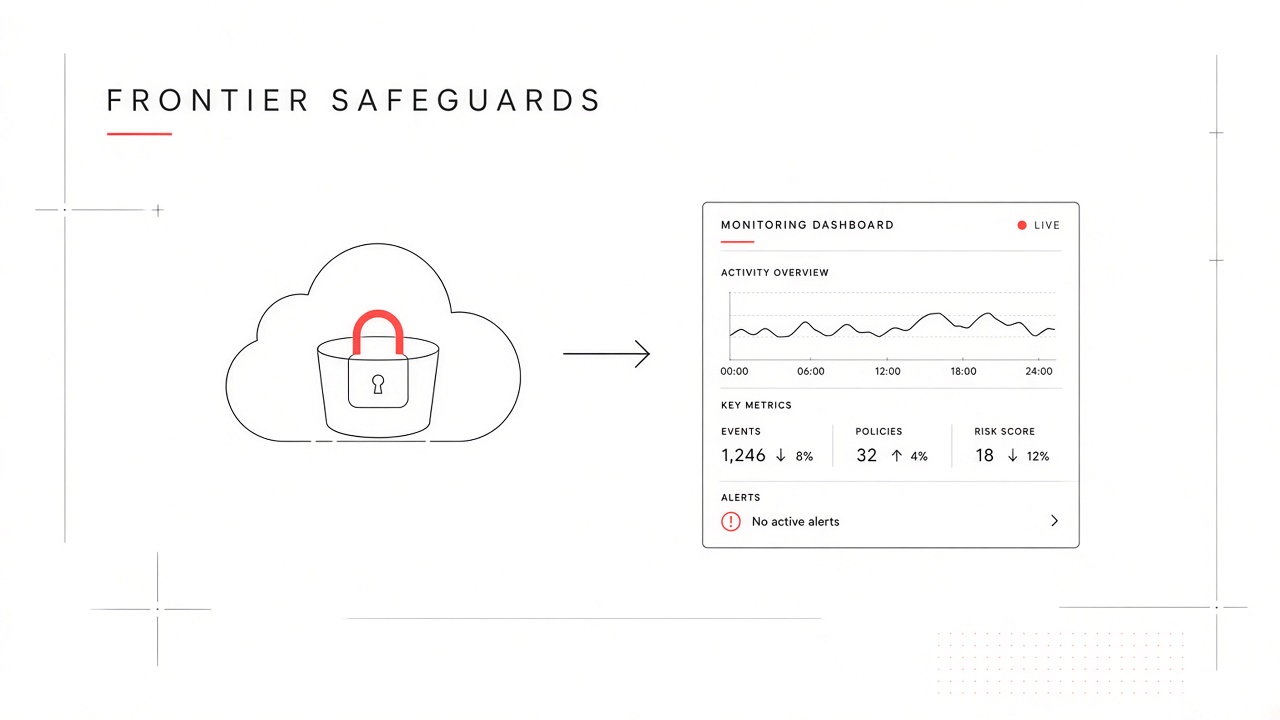
Anthropic announced Enterprise Frontier Safeguards (EFS) on September 1, 2026, combining zero data retention privacy with automated misuse detection for frontier model deployments. The enterprise frontier safeguards framework stores activity data in customer-controlled cloud infrastructure rather than Anthropic servers, addressing a core enterprise objection to provider-held safety logs.
This explainer covers what EFS is, who published it, core safeguard domains, procurement implementation steps, mapping to NIST AI RMF functions, overlap with the EU AI Act, and FAQ guidance for CISOs and legal teams. EFS rolls out in phases beginning later in fall 2026; eligible customers receive temporary zero data retention on Fable 5 and Fable 5.1 until EFS is available.
What Enterprise Frontier Safeguards Is
EFS is Anthropic's opt-in enterprise control plane that pairs customer-held monitoring storage with automated safety analysis, without requiring Anthropic employees to review customer content. Anthropic positions EFS as the successor pattern to pure zero data retention, which improves privacy but blinded providers to cross-session abuse such as credential theft, offensive cyber development, or biological misuse spread across many accounts.
EFS will be supported on Claude Code, Claude Enterprise, the Claude Platform, Amazon Bedrock, Claude Platform on AWS, Google's Agent Platform, and Microsoft Foundry. Equivalent controls are planned across AWS, Google Cloud, and Microsoft Azure, with customer activity data residing in the cloud environment the enterprise already trusts. Anthropic will not charge for EFS itself; customers pay their own cloud storage and networking costs.
Core Safeguard Domains: Monitor, Review, and Retain
EFS organizes controls into monitoring with customer review, automated misuse detection on rolling traffic windows, and customer-controlled retention in S3, Azure Blob, or Google Cloud Storage with customer-managed encryption keys. Each domain is opt-in and does not change base model behavior, API pricing, or rate limits.
| Domain | What happens | Who acts |
|---|---|---|
| Customer-held storage | Monitoring artifacts land in enterprise cloud accounts | Customer sets KMS, IAM, audit policies |
| Automated detection | Rolling window analysis for serious misuse signals | Anthropic systems generate flags, no human review at Anthropic |
| Customer review | Alerts route to enterprise security or compliance staff | Cleared internal investigators per regulatory rules |
| Detection targets | Offensive cyber, biological misuse, stolen credentials | Customer escalates or contains per IR playbooks |
Regulated industries (pharmaceuticals, finance, legal) often prohibit vendor employees from viewing privileged material. EFS keeps review inside the customer's cleared workforce while preserving signals that pure ZDR eliminated. Anthropic remains in the processing path for automated analysis, a distinction privacy teams must document in data processing agreements.
Implementation for Procurement and Security Architecture
Procurement teams should treat EFS as a reference architecture for sensitive frontier AI deployments, not a checkbox feature, and plan cloud storage, IAM, and SOC integration before rollout. Access requests flow through Anthropic's Enterprise Frontier Safeguards form; completion does not guarantee eligibility.
Recommended implementation sequence:
- Inventory Claude touchpoints: API, Claude Code, Bedrock, Foundry, Agent Platform routes.
- Designate a customer cloud bucket per environment (dev/stage/prod) with encryption and retention policies.
- Map alert recipients in SOC tiering; define SLAs for investigating automated flags.
- Align with insider-risk and DLP programs already monitoring AI chatbot and agent tools.
- Contractually document Anthropic processing role, subprocessors, and cross-border transfer implications.
- Run parallel ZDR on Fable 5/5.1 only as a bridge until EFS cohort assignment.
Teams exploring broader AI governance programs should add EFS artifacts (alert logs, review tickets, retention configs) to audit evidence packs for board and regulator inquiries.
Mapping EFS to NIST AI RMF Functions
EFS primarily strengthens GOVERN, MAP, and MEASURE functions in the NIST AI Risk Management Framework, with secondary support for MANAGE through customer-owned incident response on flagged misuse. It does not replace organizational policies, impact assessments, or human oversight requirements.
| NIST AI RMF function | EFS contribution | Gap EFS does not fill |
|---|---|---|
| GOVERN | Customer controls data residency and review authority | Corporate AI policy and accountability structure |
| MAP | Surfaces cross-session misuse patterns in context | Use-case risk classification per business unit |
| MEASURE | Automated signals on serious misuse categories | Model accuracy/fairness benchmarking |
| MANAGE | Customer executes containment on alerts | Vendor-wide recall or model rollback authority |
NIST's AI RMF remains voluntary for most US enterprises, but federal contractors and critical infrastructure operators increasingly map vendor features to RMF worksheets. EFS gives concrete controls for "monitoring and transparency" rows that were previously satisfied only by provider-held logs incompatible with legal privilege rules.
Overlap With the EU AI Act
EFS supports but does not satisfy EU AI Act obligations for high-risk systems, GPAI providers, or deployer logging duties under Articles 12, 14, and 26. Customer-held monitoring can strengthen technical documentation and post-market monitoring evidence, yet conformity still requires EU-specific assessments, CE marking where applicable, and authority-facing incident reporting timelines.
Deployers using Claude for high-risk applications in the EU must still:
- Maintain operation logs per Article 26(6) with appropriate retention periods.
- Ensure human oversight per Article 14 design, independent of automated misuse flags.
- Verify GPAI provider documentation (Article 53 summaries, systemic risk mitigations if applicable).
- Map EFS alert categories to serious incident definitions under Article 73 where relevant.
EFS's privacy posture may ease GDPR data minimization reviews when compared to vendor-retained full prompts, but DPIAs must still cover Anthropic's automated analysis of traffic metadata and derived signals. Legal teams should not equate "customer-held bucket" with "Anthropic never processes personal data."
FAQ for CISOs and Legal Teams
How is EFS different from zero data retention?
ZDR minimizes provider retention but limits cross-session abuse detection; EFS stores monitoring data in the customer cloud so automated detection can run with customer-controlled review. EFS aims for comparable privacy with stronger safety telemetry.
Does Anthropic staff read our prompts under EFS?
Anthropic states EFS automated monitoring does not require human review by Anthropic employees; flagged signals go to the customer. Confirm contractual language at enrollment.
When is EFS available?
Phased rollout begins later in fall 2026; request access via Anthropic's form. Eligible customers receive ZDR on Fable 5 and 5.1 until their EFS cohort is ready.
What does EFS cost?
Anthropic does not charge for EFS; customers pay cloud storage, networking, and internal SOC review costs. Model API pricing is unchanged.
Will OpenAI or Google offer equivalent controls?
EFS is Anthropic-specific today; enterprises should compare vendor roadmaps during multi-model procurement. Customer-held monitoring may become a competitive norm, but implementations will differ.
What contract clause should procurement add?
Require documentation of EFS eligibility, rollout date, data processing roles, alert categories, and customer obligations to investigate flags within defined SLAs. Tie renewal to successful SOC integration tests, not marketing availability alone.